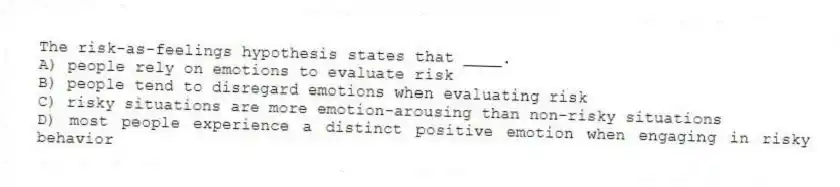
The risk-as-feelings hypothesis states that ____.
A) people rely on emotions to evaluate risk
B) people tend to disregard emotions when evaluating risk
C) risky situations are more emotion-arousing than non-risky situations
D) most people experience a distinct positive emotion when engaging in risky behavior
Correct Answer:

Verified
Q111: Even though Amanda just met Diego two
Q112: What is most accurate about the emotion
Q113: When asked to predict their emotional reaction
Q114: Bechara et al. (1997) conducted a study
Q115: The emotion of disgust is most likely
Q117: What theme is supported by the fact
Q119: According to the text, emotions do all
Q120: Suppose that you get a creepy feeling
Q121: Cross-cultural studies of people's internal emotional lives
Q125: The risk-as-feelings hypothesis suggests that _.
A)when evaluating
Unlock this Answer For Free Now!
View this answer and more for free by performing one of the following actions

Install the app to get 2 free unlocks

Unlock quizzes for free by uploading documents