





 Chat with AI


Introductory Econometrics: A Modern Approach 6th Edition by Jeffrey M Wooldridge
Edition 6ISBN: 130527010XIntroductory Econometrics: A Modern Approach 6th Edition by Jeffrey M Wooldridge
Edition 6ISBN: 130527010XUse the data set in ALCOHOL.RAW, obtained from Terza (2002), to answer this question. The data, on 9,822 men, includes labor market information, whether the man abuses alcohol, and demographic and background variables. In this question you will study the effects of alcohol abuse on employ, which is a binary variable equal to one if the man has a job. If employ = 0 the man is either unemployed or not in the workforce.
(i) What fraction of the sample is employed at the time of the interview? What fraction of the sample has abused alcohol?
(ii) Run the simple regression of employ on abuse and report the results in the usual form, obtaining the heteroskedasticity-robust standard errors. Interpret the estimated equation. Is the relationship as you expected? Is it statistically significant?
(iii) Run a probit of employ on abuse. Do you get the same sign and statistical significance as in part (ii)? How does the average partial effect for the probit compare with that for the linear probability model?
(iv) Obtain the fitted values for the LPM estimated in part (ii) and report what they are when abuse = 0 and when abuse = 1. How do these compare to the probit fitted values, and why?
(v) To the LPM in part (ii) add the variables age, agesq, educ, educsq, married, famsize, white, northeast, midwest, south, centcity, outercity, qrt1, qrt2, and qrt3. What happens to the coefficient on abuse and its statistical significance?
(vi) Estimate a probit model using the variables in part (v). Find the APE of abuse and its t statistic. Is the estimated effect now identical to that for the linear model? Is it “close”?
(vii) Variables indicating the overall health of each man are also included in the data set. Is it obvious that such variables should be included as controls? Explain.
(viii) Why might abuse be properly thought of as endogenous in the employ equation? Do you think the variables mothalc and fathalc, indicating whether a man’s mother or father were alcoholics, are sensible instrumental variables for abuse?
(ix) Estimate the LPM underlying part (v) by 2SLS, where mothalc and fathalc act as IVs for abuse. Is the difference between the 2SLS and OLS coefficients practically large?
(x) Use the test described in Section 15.5 to test whether abuse is endogenous in the LPM.
 Verified
Step 1 of 12
(i)
The calculation of fraction of the sample employed at the time of interview is calculated in Excel as follows:
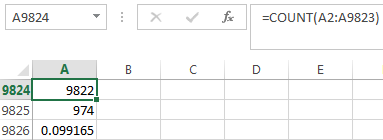
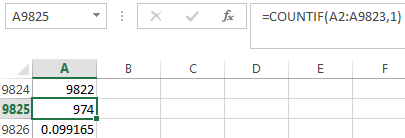
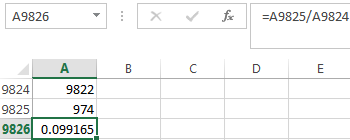
Therefore, the fraction of the sample employed at the time of interview is .
.
Step 2 of 12
Step 3 of 12
Step 4 of 12
Step 5 of 12
Step 6 of 12
Step 7 of 12
Step 8 of 12
Step 9 of 12
Step 10 of 12
Step 11 of 12
Step 12 of 12


Why don’t you like this exercise?
Other






