





 Chat with AI


Introductory Econometrics: A Modern Approach 6th Edition by Jeffrey M Wooldridge
Edition 6ISBN: 130527010XIntroductory Econometrics: A Modern Approach 6th Edition by Jeffrey M Wooldridge
Edition 6ISBN: 130527010XUse the data in HAPPINESS.RAW for this question. See also Computer Exercise C15 in Chapter 13.
(i) Estimate a probit probability model relating vhappy to occattend and regattend, and include a full set of year dummies. Find the average partial effects for occattend and regattend. How do these compare with those from estimating a linear probability model?
(ii) Define a variable, highinc, equal to one if family income is above $25,000. Include highinc, unem10, educ, and teens to the probit estimation in part (ii). Is the APE of regattend affected much? What about its statistical significance?
(iii) Discuss the APEs and statistical significance of the four new variables in part (ii). Do the estimates make sense?
(iv) Controlling for the factors in part (ii), do there appear to be differences in happiness by gender or race? Justify your answer.
 Verified
Step 1 of 14
(i)
Estimate the probit probability model (without intercept) relating  to
to  and including the full set of year dummies to get the result as:
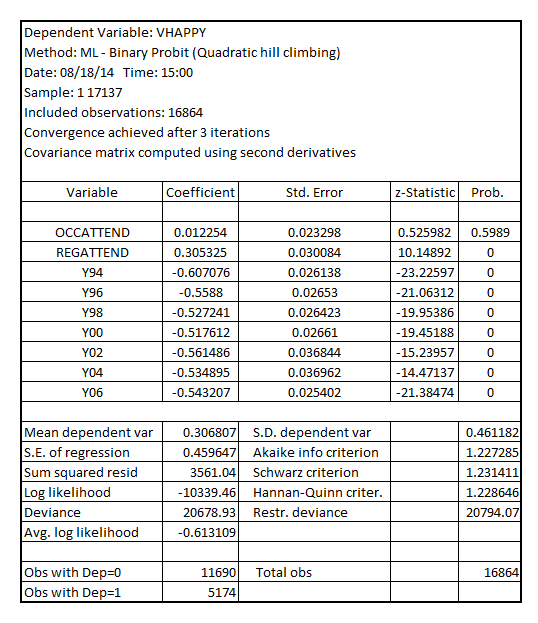
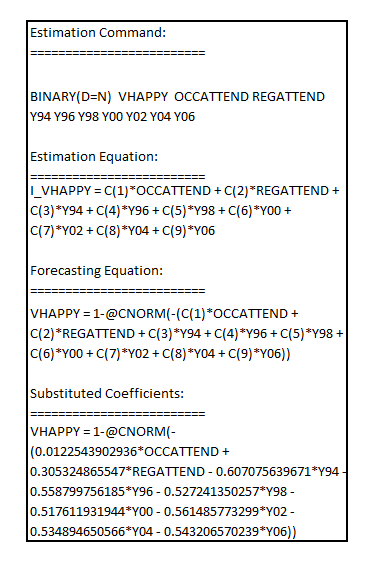
When full-set of year dummies is to be included, it would be appropriate to represent the model without intercept, in order to avoid the problem of dummy trap.
In order to compute the APE (Average Partial Effect) of  from the probit model, it is necessary to follow the following steps:
1. Compute for each observation in the sample dataset:

2. Take the average of the ScaleFactor_Probit over all the observations and multiply it with the coefficient of  from the probit model. The result will be APE (Average Partial Effect) of
  from the probit model
Step 2 of 14
Step 3 of 14
Step 4 of 14
Step 5 of 14
Step 6 of 14
Step 7 of 14
Step 8 of 14
Step 9 of 14
Step 10 of 14
Step 11 of 14
Step 12 of 14
Step 13 of 14
Step 14 of 14


Why don’t you like this exercise?
Other






