


expand icon
book Introductory Econometrics: A Modern Approach 6th Edition by Jeffrey M Wooldridge cover

Introductory Econometrics: A Modern Approach 6th Edition by Jeffrey M Wooldridge

Edition 6ISBN: 130527010X
book Introductory Econometrics: A Modern Approach 6th Edition by Jeffrey M Wooldridge cover

Introductory Econometrics: A Modern Approach 6th Edition by Jeffrey M Wooldridge

Edition 6ISBN: 130527010X
Exercise 9

Refer to Table in Chapter 13. There, we used the data in FERTIL1.RAW to estimate a linear model for kids, the number of children ever born to a woman.

(i) Estimate a Poisson regression model for kids, using the same variables in Table 13.1. Interpret the coefficient on y82.

(ii) What is the estimated percentage difference in fertility between a black woman and a nonblack woman, holding other factors fixed?

(iii) Obtain u. Is there evidence of over- or underdispersion?

(iv) Compute the fitted values from the Poisson regression and obtain the R-squared as the squared correlation between kidsi and  Refer to Table in Chapter 13. There, we used the data in FERTIL1.RAW to estimate a linear model for kids, the number of children ever born to a woman. <blockquote> (i) Estimate a Poisson regression model for kids, using the same variables in Table 13.1. Interpret the coefficient on y82. (ii) What is the estimated percentage difference in fertility between a black woman and a nonblack woman, holding other factors fixed? (iii) Obtain u. Is there evidence of over- or underdispersion? (iv) Compute the fitted values from the Poisson regression and obtain the R-squared as the squared correlation between kidsi and   Compare this with the R-squared for the linear regression model. </blockquote> Determinants of Women’s Fertility   Compare this with the R-squared for the linear regression model.

Determinants of Women’s Fertility
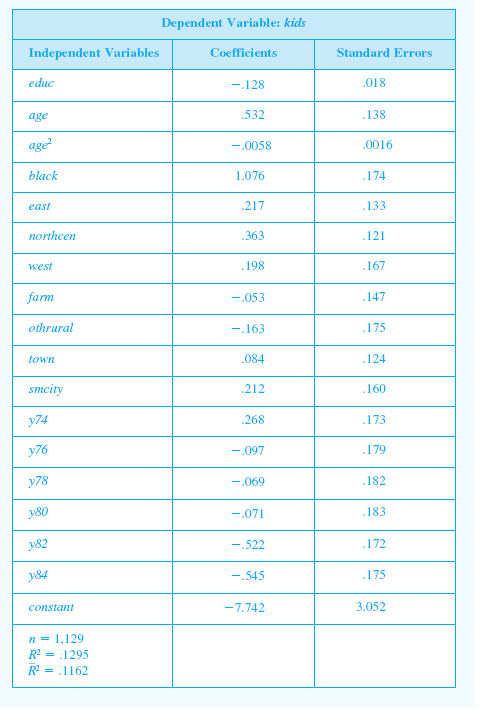
 Refer to Table in Chapter 13. There, we used the data in FERTIL1.RAW to estimate a linear model for kids, the number of children ever born to a woman. <blockquote> (i) Estimate a Poisson regression model for kids, using the same variables in Table 13.1. Interpret the coefficient on y82. (ii) What is the estimated percentage difference in fertility between a black woman and a nonblack woman, holding other factors fixed? (iii) Obtain u. Is there evidence of over- or underdispersion? (iv) Compute the fitted values from the Poisson regression and obtain the R-squared as the squared correlation between kidsi and   Compare this with the R-squared for the linear regression model. </blockquote> Determinants of Women’s Fertility

Step-by-step solution
Verified
like image
like image

Step 1 of 5

(i)

Estimate the Poisson regression model with     <div class=answer> (i) Estimate the Poisson regression model with   as the dependent variable on   The result is:     The coefficient of   is -0.192608 and it is significant at 5% level of significance as its p-value is 0.0043 which is less than critical p-value of 0.05 at 5% level of significance. This coefficient is interpreted as a decline in the fertility rate by 19.26% in the year 1982 vis-à-vis the year 1972. as the dependent variable on    <div class=answer> (i) Estimate the Poisson regression model with   as the dependent variable on   The result is:     The coefficient of   is -0.192608 and it is significant at 5% level of significance as its p-value is 0.0043 which is less than critical p-value of 0.05 at 5% level of significance. This coefficient is interpreted as a decline in the fertility rate by 19.26% in the year 1982 vis-à-vis the year 1972.
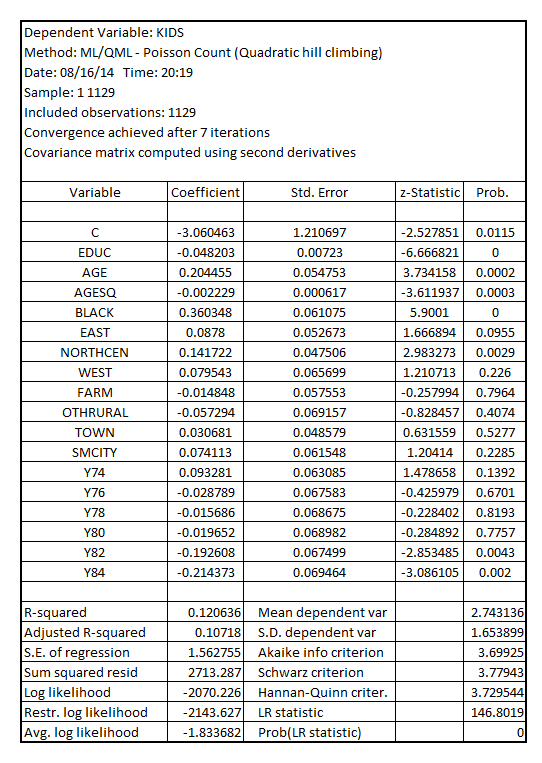
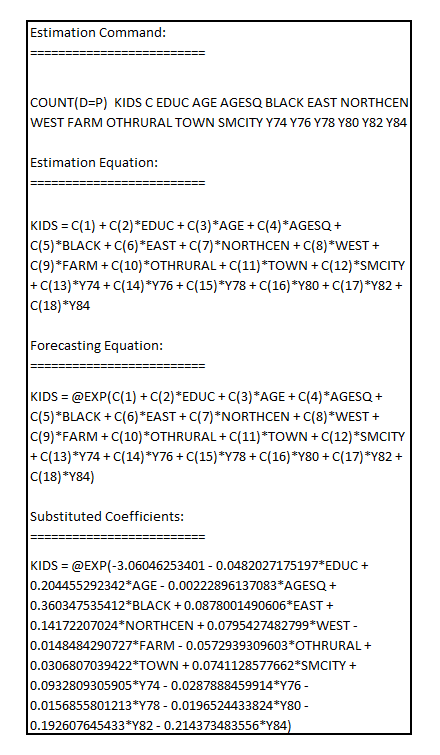
The result is:

    <div class=answer> (i) Estimate the Poisson regression model with   as the dependent variable on   The result is:     The coefficient of   is -0.192608 and it is significant at 5% level of significance as its p-value is 0.0043 which is less than critical p-value of 0.05 at 5% level of significance. This coefficient is interpreted as a decline in the fertility rate by 19.26% in the year 1982 vis-à-vis the year 1972.

    <div class=answer> (i) Estimate the Poisson regression model with   as the dependent variable on   The result is:     The coefficient of   is -0.192608 and it is significant at 5% level of significance as its p-value is 0.0043 which is less than critical p-value of 0.05 at 5% level of significance. This coefficient is interpreted as a decline in the fertility rate by 19.26% in the year 1982 vis-à-vis the year 1972.

The coefficient of     <div class=answer> (i) Estimate the Poisson regression model with   as the dependent variable on   The result is:     The coefficient of   is -0.192608 and it is significant at 5% level of significance as its p-value is 0.0043 which is less than critical p-value of 0.05 at 5% level of significance. This coefficient is interpreted as a decline in the fertility rate by 19.26% in the year 1982 vis-à-vis the year 1972. is -0.192608 and it is significant at 5% level of significance as its p-value is 0.0043 which is less than critical p-value of 0.05 at 5% level of significance.

This coefficient is interpreted as a decline in the fertility rate by 19.26% in the year 1982 vis-à-vis the year 1972.


Step 2 of 5


Step 3 of 5


Step 4 of 5


Step 5 of 5

close menu
Introductory Econometrics: A Modern Approach 6th Edition by Jeffrey M Wooldridge
cross icon




