


expand icon
book Introductory Econometrics: A Modern Approach 6th Edition by Jeffrey M Wooldridge cover

Introductory Econometrics: A Modern Approach 6th Edition by Jeffrey M Wooldridge

Edition 6ISBN: 130527010X
book Introductory Econometrics: A Modern Approach 6th Edition by Jeffrey M Wooldridge cover

Introductory Econometrics: A Modern Approach 6th Edition by Jeffrey M Wooldridge

Edition 6ISBN: 130527010X
Exercise 18

Use the entire panel data set in AIRFARE.RAW for this exercise. The demand equation in a simultaneous equations unobserved effects model is

log(passenit) = ?t1 + ?log(fareit.) + ai1 + uit1,

where we absorb the distance variables into ai1.

(i) Estimate the demand function using fixed effects, being sure to include year dummies to account for the different intercepts. What is the estimated elasticity?

(ii) Use fixed effects to estimate the reduced form

log(fareit) = ?t2 + ?21concenit + ai2 + vta2.

Perform the appropriate test to ensure that concenit can be used as an IV for log(fareit).

(iii) Now estimate the demand function using the fixed effects transformation along with IV, as in equation. Now what is the estimated elasticity? Is it statistically significant?

Equation  Use the entire panel data set in AIRFARE.RAW for this exercise. The demand equation in a simultaneous equations unobserved effects model is log(passenit) = ?t1 + ?log(fareit.) + ai1 + uit1, where we absorb the distance variables into ai1. <blockquote> (i) Estimate the demand function using fixed effects, being sure to include year dummies to account for the different intercepts. What is the estimated elasticity? (ii) Use fixed effects to estimate the reduced form log(fareit) = ?t2 + ?21concenit + ai2 + vta2. Perform the appropriate test to ensure that concenit can be used as an IV for log(fareit). (iii) Now estimate the demand function using the fixed effects transformation along with IV, as in equation. Now what is the estimated elasticity? Is it statistically significant? Equation   </blockquote>

Step-by-step solution
Verified
like image
like image

Step 1 of 4

The demand equation in a simultaneous equations unobserved effects model is given by:

    <div class=answer> The demand equation in a simultaneous equations unobserved effects model is given by:   (i) Estimating the demand function using fixed effects including the year dummies to account for the different intercepts and individual fixed effects, the result is:   The estimated elasticity is given by the coefficient of   which is -1.155039

(i)

Estimating the demand function using fixed effects including the year dummies to account for the different intercepts and individual fixed effects, the result is:
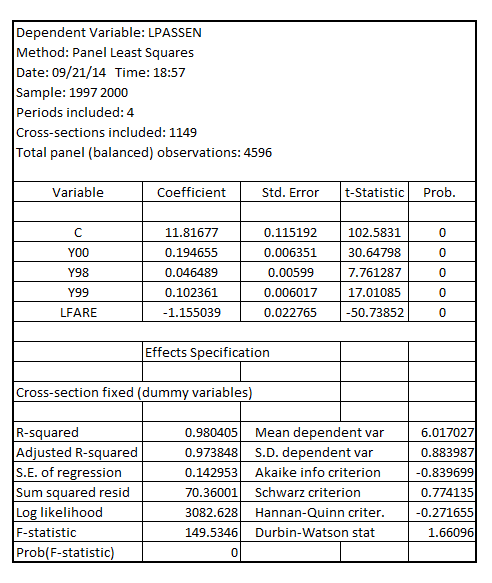
    <div class=answer> The demand equation in a simultaneous equations unobserved effects model is given by:   (i) Estimating the demand function using fixed effects including the year dummies to account for the different intercepts and individual fixed effects, the result is:   The estimated elasticity is given by the coefficient of   which is -1.155039

The estimated elasticity is given by the coefficient of     <div class=answer> The demand equation in a simultaneous equations unobserved effects model is given by:   (i) Estimating the demand function using fixed effects including the year dummies to account for the different intercepts and individual fixed effects, the result is:   The estimated elasticity is given by the coefficient of   which is -1.155039 which is -1.155039


Step 2 of 4


Step 3 of 4


Step 4 of 4

close menu
Introductory Econometrics: A Modern Approach 6th Edition by Jeffrey M Wooldridge
cross icon



