





 Chat with AI


Introductory Econometrics: A Modern Approach 6th Edition by Jeffrey M Wooldridge
Edition 6ISBN: 130527010XIntroductory Econometrics: A Modern Approach 6th Edition by Jeffrey M Wooldridge
Edition 6ISBN: 130527010XUse the data in MURDER.RAW for this exercise. The variable mrdrte is the murder rate, that is, the number of murders per 100,000 people. The variable exec is the total number of prisoners executed for the current and prior two years; unem is the state unemployment rate.
(i) How many states executed at least one prisoner in 1991, 1992, or 1993? Which state had the most executions?
(ii) Using the two years 1990 and 1993, do a pooled regression of mrdrte on d93, exec, and unem. What do you make of the coefficient on exec?
(iii) Using the changes from 1990 to 1993 only (for a total of 51 observations), estimate the equation
?mrdrte = ?0 + ?1?exec + ?2Aunem + ?u by OLS and report the results in the usual form. Now, does capital punishment appear to have a deterrent effect?
(iv) The change in executions may be at least partly related to changes in the expected murder rate, so that ?exec is correlated with ?u in part (iii). It might be reasonable to assume that ?exec-1 is uncorrelated with ?u. (After all, ?exec-1 depends on executions that occurred three or more years ago.) Regress ?exec on ?exec-1 to see if they are sufficiently correlated; interpret the coefficient on ?exec-1.
(v) Reestimate the equation from part (iii), using ?exec-1 as an IV for ?exec. Assume that ?unem is exogenous. How do your conclusions change from part (iii)?
 Verified
Step 1 of 9
(i)
There are in total 16 States which executed at least one prisoner in 1991, 1992 or 1993. These 16 States are as follows:
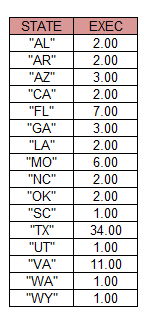
The State “TX” had the most executions. It had a total of 34 executions in 1991, 1992 or 1993
Step 2 of 9
Step 3 of 9
Step 4 of 9
Step 5 of 9
Step 6 of 9
Step 7 of 9
Step 8 of 9
Step 9 of 9


Why don’t you like this exercise?
Other






