expand icon
book Introductory Econometrics: A Modern Approach 6th Edition by Jeffrey M Wooldridge cover

Introductory Econometrics: A Modern Approach 6th Edition by Jeffrey M Wooldridge

Edition 6ISBN: 130527010X
book Introductory Econometrics: A Modern Approach 6th Edition by Jeffrey M Wooldridge cover

Introductory Econometrics: A Modern Approach 6th Edition by Jeffrey M Wooldridge

Edition 6ISBN: 130527010X
Exercise 9

Use the data in CARD.RAW for this exercise.

(i) In Table 15.1, the difference between the IV and OLS estimates of the return to education is economically important. Obtain the reduced form residuals,  Use the data in CARD.RAW for this exercise. <blockquote> (i) In Table 15.1, the difference between the IV and OLS estimates of the return to education is economically important. Obtain the reduced form residuals,   , from   . (See Table 15.1 for the other variables to include in the regression.) Use these to test whether educ is exogenous; that is, determine if the difference between OLS and IV is s a is ically significant. (ii) Estimate the equation by 2SLS, adding nearc2 as an instrument. Does the coefficient on educ change much? (iii) Test the single overidentifying restriction from part (ii). </blockquote>   , from  Use the data in CARD.RAW for this exercise. <blockquote> (i) In Table 15.1, the difference between the IV and OLS estimates of the return to education is economically important. Obtain the reduced form residuals,   , from   . (See Table 15.1 for the other variables to include in the regression.) Use these to test whether educ is exogenous; that is, determine if the difference between OLS and IV is s a is ically significant. (ii) Estimate the equation by 2SLS, adding nearc2 as an instrument. Does the coefficient on educ change much? (iii) Test the single overidentifying restriction from part (ii). </blockquote>   . (See Table 15.1 for the other variables to include in the regression.) Use these to test whether educ is exogenous; that is, determine if the difference between OLS and IV is s a is ically significant.

(ii) Estimate the equation by 2SLS, adding nearc2 as an instrument. Does the coefficient on educ change much?

(iii) Test the single overidentifying restriction from part (ii).

Step-by-step solution
Verified
like image
like image

Step 1 of 4

(i)

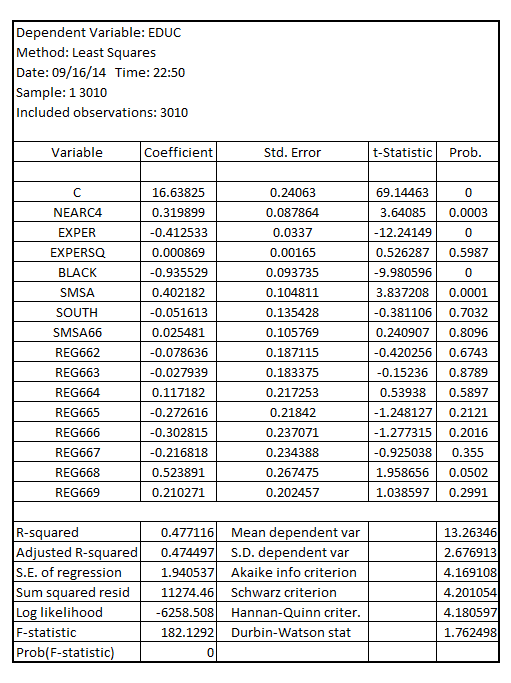
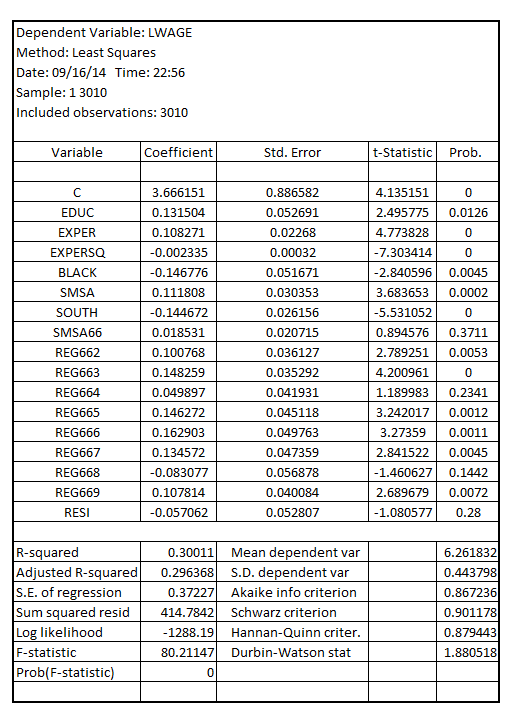
Estimating the reduced form equation relating     <div class=answer> (i) Estimating the reduced form equation relating   to   The result is:   Estimating the residuals   from the difference of actual   and estimated   and use it as an explanatory variable in the original equation that relates   to   The result is:   The coefficient of   is 0.057 with the p-value 0.28 which is greater than the critical p-value of 0.05 at 5% level of significance, indicating that   is not statistically significant at 5% level of significance. This also indicates that the difference between OLS and IV is not statistically significant. to     <div class=answer> (i) Estimating the reduced form equation relating   to   The result is:   Estimating the residuals   from the difference of actual   and estimated   and use it as an explanatory variable in the original equation that relates   to   The result is:   The coefficient of   is 0.057 with the p-value 0.28 which is greater than the critical p-value of 0.05 at 5% level of significance, indicating that   is not statistically significant at 5% level of significance. This also indicates that the difference between OLS and IV is not statistically significant.

The result is:

    <div class=answer> (i) Estimating the reduced form equation relating   to   The result is:   Estimating the residuals   from the difference of actual   and estimated   and use it as an explanatory variable in the original equation that relates   to   The result is:   The coefficient of   is 0.057 with the p-value 0.28 which is greater than the critical p-value of 0.05 at 5% level of significance, indicating that   is not statistically significant at 5% level of significance. This also indicates that the difference between OLS and IV is not statistically significant.

Estimating the residuals     <div class=answer> (i) Estimating the reduced form equation relating   to   The result is:   Estimating the residuals   from the difference of actual   and estimated   and use it as an explanatory variable in the original equation that relates   to   The result is:   The coefficient of   is 0.057 with the p-value 0.28 which is greater than the critical p-value of 0.05 at 5% level of significance, indicating that   is not statistically significant at 5% level of significance. This also indicates that the difference between OLS and IV is not statistically significant. from the difference of actual     <div class=answer> (i) Estimating the reduced form equation relating   to   The result is:   Estimating the residuals   from the difference of actual   and estimated   and use it as an explanatory variable in the original equation that relates   to   The result is:   The coefficient of   is 0.057 with the p-value 0.28 which is greater than the critical p-value of 0.05 at 5% level of significance, indicating that   is not statistically significant at 5% level of significance. This also indicates that the difference between OLS and IV is not statistically significant. and estimated     <div class=answer> (i) Estimating the reduced form equation relating   to   The result is:   Estimating the residuals   from the difference of actual   and estimated   and use it as an explanatory variable in the original equation that relates   to   The result is:   The coefficient of   is 0.057 with the p-value 0.28 which is greater than the critical p-value of 0.05 at 5% level of significance, indicating that   is not statistically significant at 5% level of significance. This also indicates that the difference between OLS and IV is not statistically significant. and use it as an explanatory variable in the original equation that relates     <div class=answer> (i) Estimating the reduced form equation relating   to   The result is:   Estimating the residuals   from the difference of actual   and estimated   and use it as an explanatory variable in the original equation that relates   to   The result is:   The coefficient of   is 0.057 with the p-value 0.28 which is greater than the critical p-value of 0.05 at 5% level of significance, indicating that   is not statistically significant at 5% level of significance. This also indicates that the difference between OLS and IV is not statistically significant. to

    <div class=answer> (i) Estimating the reduced form equation relating   to   The result is:   Estimating the residuals   from the difference of actual   and estimated   and use it as an explanatory variable in the original equation that relates   to   The result is:   The coefficient of   is 0.057 with the p-value 0.28 which is greater than the critical p-value of 0.05 at 5% level of significance, indicating that   is not statistically significant at 5% level of significance. This also indicates that the difference between OLS and IV is not statistically significant.

The result is:

    <div class=answer> (i) Estimating the reduced form equation relating   to   The result is:   Estimating the residuals   from the difference of actual   and estimated   and use it as an explanatory variable in the original equation that relates   to   The result is:   The coefficient of   is 0.057 with the p-value 0.28 which is greater than the critical p-value of 0.05 at 5% level of significance, indicating that   is not statistically significant at 5% level of significance. This also indicates that the difference between OLS and IV is not statistically significant.

The coefficient of     <div class=answer> (i) Estimating the reduced form equation relating   to   The result is:   Estimating the residuals   from the difference of actual   and estimated   and use it as an explanatory variable in the original equation that relates   to   The result is:   The coefficient of   is 0.057 with the p-value 0.28 which is greater than the critical p-value of 0.05 at 5% level of significance, indicating that   is not statistically significant at 5% level of significance. This also indicates that the difference between OLS and IV is not statistically significant. is 0.057 with the p-value 0.28 which is greater than the critical p-value of 0.05 at 5% level of significance, indicating that     <div class=answer> (i) Estimating the reduced form equation relating   to   The result is:   Estimating the residuals   from the difference of actual   and estimated   and use it as an explanatory variable in the original equation that relates   to   The result is:   The coefficient of   is 0.057 with the p-value 0.28 which is greater than the critical p-value of 0.05 at 5% level of significance, indicating that   is not statistically significant at 5% level of significance. This also indicates that the difference between OLS and IV is not statistically significant. is not statistically significant at 5% level of significance. This also indicates that the difference between OLS and IV is not statistically significant.


Step 2 of 4


Step 3 of 4


Step 4 of 4

close menu
Introductory Econometrics: A Modern Approach 6th Edition by Jeffrey M Wooldridge
cross icon