





 Chat with AI


Introductory Econometrics: A Modern Approach 6th Edition by Jeffrey M Wooldridge
Edition 6ISBN: 130527010XIntroductory Econometrics: A Modern Approach 6th Edition by Jeffrey M Wooldridge
Edition 6ISBN: 130527010XThe data in FERTIL2.RAW includes, for women in Botswana during 1988, information on number of children, years of education, age, and religious and economic status variables.
(i) Estimate the model children = ?0 + ?1educ + ?2age + ?3age2 + u by OLS, and interpret the estimates. In particular, holding age fixed, what is the estimated effect of another year of education on fertility? If 100 women receive another year of education, how many fewer children are they expected to have?
(ii) The variable frsthalf is a dummy variable equal to one if the woman was born during the first six months of the year. Assuming that frsthalf is uncorrelated with the error term from part (i), show that frsthalf is a reasonable IV candidate for educ. (Hint: You need to do a regression.)
(iii) Estimate the model from part (i) by using frsthalf as an IV for educ. Compare the estimated effect of education with the OLS estimate from part (i).
(iv) Add the binary variables electric, tv, and bicycle to the model and assume these are exogenous. Estimate the equation by OLS and 2SLS and compare the estimated coefficients on educ. Interpret the coefficient on tv and explain why television ownership has a negative effect on fertility.
 Verified
Step 1 of 6
(i)
Estimating the model  using OLS, the result is:
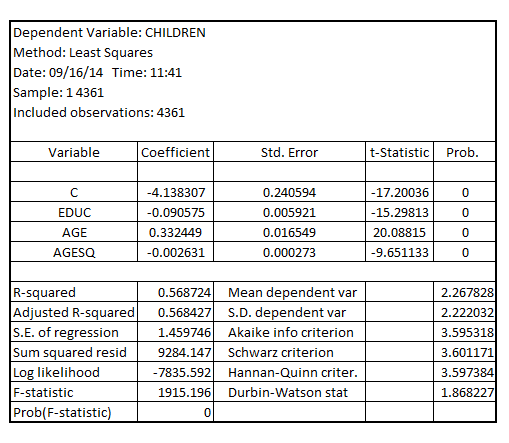
The coefficient of  is -0.090575 indicating that an additional one year of education , holding the age fixed would reduce the number of living children by 0.090575
If 100 women receive an another year of education, they are expected to 9.0575 fewer children
Step 2 of 6
Step 3 of 6
Step 4 of 6
Step 5 of 6
Step 6 of 6


Why don’t you like this exercise?
Other






