


expand icon
book Introductory Econometrics: A Modern Approach 6th Edition by Jeffrey M Wooldridge cover

Introductory Econometrics: A Modern Approach 6th Edition by Jeffrey M Wooldridge

Edition 6ISBN: 130527010X
book Introductory Econometrics: A Modern Approach 6th Edition by Jeffrey M Wooldridge cover

Introductory Econometrics: A Modern Approach 6th Edition by Jeffrey M Wooldridge

Edition 6ISBN: 130527010X
Exercise 18

This question assumes that you have access to a statistical package the computes standard errors robust to arbitrary serial correlation and heteroskedasticity for panel data methods.

(i) For the pooled OLS estimates in Table, obtain the standard errors that allow for arbitrary serial correlation (in the composite errors, vit = ai + uit) and het-eroskedasticity. How do the robust standard errors for educ, married, and union compare with the nonrobust ones?

(ii) Now obtain the robust standard errors for the fixed effects estimates that allow arbitrary serial correlation and heteroskedasticity in the idiosyncratic errors, uit. How do these compare with the nonrobust FE standard errors?

(iii) For which method, pooled OLS or FE, is adjusting the standard errors for serial correlation more important? Why?

Table Fixed Effects Estimation of Scrap Rate Equation
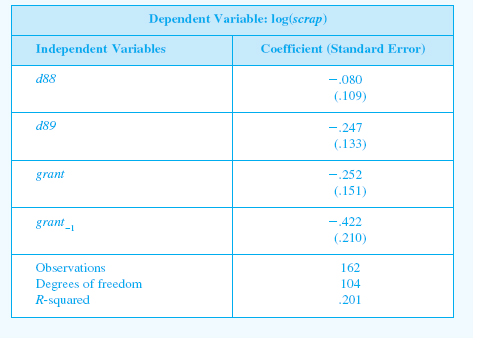
 This question assumes that you have access to a statistical package the computes standard errors robust to arbitrary serial correlation and heteroskedasticity for panel data methods. <blockquote> (i) For the pooled OLS estimates in Table, obtain the standard errors that allow for arbitrary serial correlation (in the composite errors, vit = ai + uit) and het-eroskedasticity. How do the robust standard errors for educ, married, and union compare with the nonrobust ones? (ii) Now obtain the robust standard errors for the fixed effects estimates that allow arbitrary serial correlation and heteroskedasticity in the idiosyncratic errors, uit. How do these compare with the nonrobust FE standard errors? (iii) For which method, pooled OLS or FE, is adjusting the standard errors for serial correlation more important? Why? </blockquote> Table Fixed Effects Estimation of Scrap Rate Equation

Step-by-step solution
Verified
like image
like image

Step 1 of 5

(i)

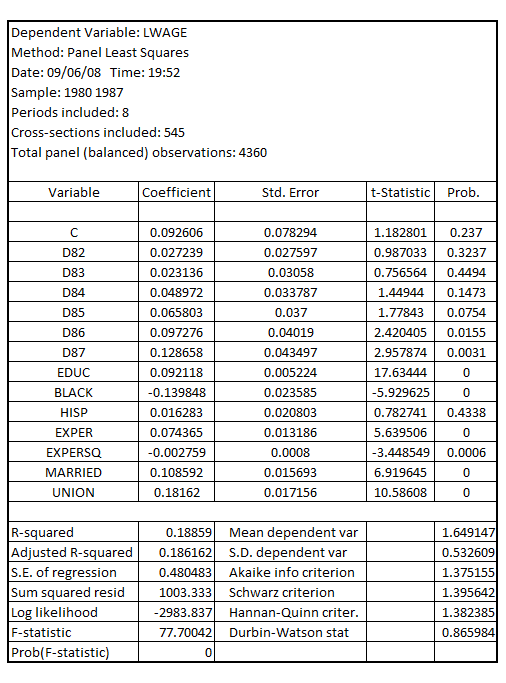
Estimating the wage equation in which    <div class=answer> (i) Estimating the wage equation in which   is the dependent variable and   , the year dummy variables as the explanatory variables along with   as the other explanatory variables, assuming the standard error for the coefficients of the explanatory variables that allow for the arbitrary serial correlation and heteroscedasticity and assuming   as the base dummy year, the result is:   Estimating the wage equation in which   is the dependent variable and   , the year dummy variables as the explanatory variables along with   as the other explanatory variables, assuming usual OLS standard error and assuming   as the base dummy year, the result is:   On comparing the robust standard errors for   with the non-robust errors, the result is: is the dependent variable and    <div class=answer> (i) Estimating the wage equation in which   is the dependent variable and   , the year dummy variables as the explanatory variables along with   as the other explanatory variables, assuming the standard error for the coefficients of the explanatory variables that allow for the arbitrary serial correlation and heteroscedasticity and assuming   as the base dummy year, the result is:   Estimating the wage equation in which   is the dependent variable and   , the year dummy variables as the explanatory variables along with   as the other explanatory variables, assuming usual OLS standard error and assuming   as the base dummy year, the result is:   On comparing the robust standard errors for   with the non-robust errors, the result is: , the year dummy variables as the explanatory variables along with     <div class=answer> (i) Estimating the wage equation in which   is the dependent variable and   , the year dummy variables as the explanatory variables along with   as the other explanatory variables, assuming the standard error for the coefficients of the explanatory variables that allow for the arbitrary serial correlation and heteroscedasticity and assuming   as the base dummy year, the result is:   Estimating the wage equation in which   is the dependent variable and   , the year dummy variables as the explanatory variables along with   as the other explanatory variables, assuming usual OLS standard error and assuming   as the base dummy year, the result is:   On comparing the robust standard errors for   with the non-robust errors, the result is: as the other explanatory variables, assuming the standard error for the coefficients of the explanatory variables that allow for the arbitrary serial correlation and heteroscedasticity and assuming     <div class=answer> (i) Estimating the wage equation in which   is the dependent variable and   , the year dummy variables as the explanatory variables along with   as the other explanatory variables, assuming the standard error for the coefficients of the explanatory variables that allow for the arbitrary serial correlation and heteroscedasticity and assuming   as the base dummy year, the result is:   Estimating the wage equation in which   is the dependent variable and   , the year dummy variables as the explanatory variables along with   as the other explanatory variables, assuming usual OLS standard error and assuming   as the base dummy year, the result is:   On comparing the robust standard errors for   with the non-robust errors, the result is: as the base dummy year, the result is:

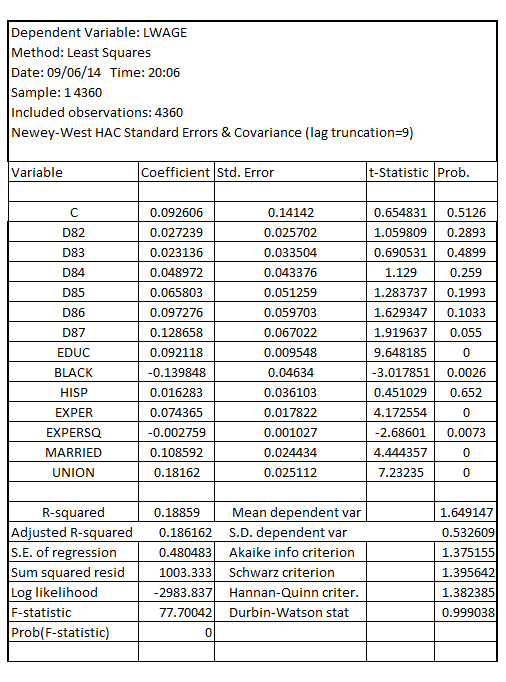


    <div class=answer> (i) Estimating the wage equation in which   is the dependent variable and   , the year dummy variables as the explanatory variables along with   as the other explanatory variables, assuming the standard error for the coefficients of the explanatory variables that allow for the arbitrary serial correlation and heteroscedasticity and assuming   as the base dummy year, the result is:   Estimating the wage equation in which   is the dependent variable and   , the year dummy variables as the explanatory variables along with   as the other explanatory variables, assuming usual OLS standard error and assuming   as the base dummy year, the result is:   On comparing the robust standard errors for   with the non-robust errors, the result is:

Estimating the wage equation in which    <div class=answer> (i) Estimating the wage equation in which   is the dependent variable and   , the year dummy variables as the explanatory variables along with   as the other explanatory variables, assuming the standard error for the coefficients of the explanatory variables that allow for the arbitrary serial correlation and heteroscedasticity and assuming   as the base dummy year, the result is:   Estimating the wage equation in which   is the dependent variable and   , the year dummy variables as the explanatory variables along with   as the other explanatory variables, assuming usual OLS standard error and assuming   as the base dummy year, the result is:   On comparing the robust standard errors for   with the non-robust errors, the result is: is the dependent variable and    <div class=answer> (i) Estimating the wage equation in which   is the dependent variable and   , the year dummy variables as the explanatory variables along with   as the other explanatory variables, assuming the standard error for the coefficients of the explanatory variables that allow for the arbitrary serial correlation and heteroscedasticity and assuming   as the base dummy year, the result is:   Estimating the wage equation in which   is the dependent variable and   , the year dummy variables as the explanatory variables along with   as the other explanatory variables, assuming usual OLS standard error and assuming   as the base dummy year, the result is:   On comparing the robust standard errors for   with the non-robust errors, the result is: , the year dummy variables as the explanatory variables along with     <div class=answer> (i) Estimating the wage equation in which   is the dependent variable and   , the year dummy variables as the explanatory variables along with   as the other explanatory variables, assuming the standard error for the coefficients of the explanatory variables that allow for the arbitrary serial correlation and heteroscedasticity and assuming   as the base dummy year, the result is:   Estimating the wage equation in which   is the dependent variable and   , the year dummy variables as the explanatory variables along with   as the other explanatory variables, assuming usual OLS standard error and assuming   as the base dummy year, the result is:   On comparing the robust standard errors for   with the non-robust errors, the result is: as the other explanatory variables, assuming usual OLS standard error and assuming     <div class=answer> (i) Estimating the wage equation in which   is the dependent variable and   , the year dummy variables as the explanatory variables along with   as the other explanatory variables, assuming the standard error for the coefficients of the explanatory variables that allow for the arbitrary serial correlation and heteroscedasticity and assuming   as the base dummy year, the result is:   Estimating the wage equation in which   is the dependent variable and   , the year dummy variables as the explanatory variables along with   as the other explanatory variables, assuming usual OLS standard error and assuming   as the base dummy year, the result is:   On comparing the robust standard errors for   with the non-robust errors, the result is: as the base dummy year, the result is:

    <div class=answer> (i) Estimating the wage equation in which   is the dependent variable and   , the year dummy variables as the explanatory variables along with   as the other explanatory variables, assuming the standard error for the coefficients of the explanatory variables that allow for the arbitrary serial correlation and heteroscedasticity and assuming   as the base dummy year, the result is:   Estimating the wage equation in which   is the dependent variable and   , the year dummy variables as the explanatory variables along with   as the other explanatory variables, assuming usual OLS standard error and assuming   as the base dummy year, the result is:   On comparing the robust standard errors for   with the non-robust errors, the result is:

On comparing the robust standard errors for     <div class=answer> (i) Estimating the wage equation in which   is the dependent variable and   , the year dummy variables as the explanatory variables along with   as the other explanatory variables, assuming the standard error for the coefficients of the explanatory variables that allow for the arbitrary serial correlation and heteroscedasticity and assuming   as the base dummy year, the result is:   Estimating the wage equation in which   is the dependent variable and   , the year dummy variables as the explanatory variables along with   as the other explanatory variables, assuming usual OLS standard error and assuming   as the base dummy year, the result is:   On comparing the robust standard errors for   with the non-robust errors, the result is: with the non-robust errors, the result is:


Step 2 of 5


Step 3 of 5


Step 4 of 5


Step 5 of 5

close menu
Introductory Econometrics: A Modern Approach 6th Edition by Jeffrey M Wooldridge
cross icon





