





 Chat with AI


Introductory Econometrics: A Modern Approach 6th Edition by Jeffrey M Wooldridge
Edition 6ISBN: 130527010XIntroductory Econometrics: A Modern Approach 6th Edition by Jeffrey M Wooldridge
Edition 6ISBN: 130527010XUse the data in AIRFARE.RAW for this exercise. We are interested in estimating the model
![Use the data in AIRFARE.RAW for this exercise. We are interested in estimating the model where 0t means that we allow for different year intercepts. <blockquote> (i) Estimate the above equation by pooled OLS, being sure to include year dummies. If ?concen = .10, what is the estimated percentage increase in fare? (ii) What is the usual OLS 95% confidence interval for ?1? Why is it probably not reliable? If you have access to a statistical package that computes fully robust standard errors, find the fully robust 95% CI for ?1. Compare it to the usual CI and comment. (iii) Describe what is happening with the quadratic in log(dist). In particular, for what value of dist does the relationship between log(fare) and dist become positive? [Hint: First figure out the turning point value for log(dist), and then exponentiate.] Is the turning point outside the range of the data? (iv) Now estimate the equation using random effects. How does the estimate of ?1 change? (v) Now estimate the equation using fixed effects. What is the FE estimate of ?1? Why is it fairly similar to the RE estimate? (Hint: What is for RE estimation?) (vi) Name two characteristics of a route (other than distance between stops) that are captured by ai. Might these be correlated with concenit? (vii) Are you convinced that higher concentration on a route increases airfares? What is your best estimate? </blockquote>](https://d2lvgg3v3hfg70.cloudfront.net/SMCC2709/313fc471_a53c_4e0c_90cd_1e03a2a788a3_SMCC2709_11.jpg)
where 0t means that we allow for different year intercepts.
(i) Estimate the above equation by pooled OLS, being sure to include year dummies. If ?concen = .10, what is the estimated percentage increase in fare?
(ii) What is the usual OLS 95% confidence interval for ?1? Why is it probably not reliable? If you have access to a statistical package that computes fully robust standard errors, find the fully robust 95% CI for ?1. Compare it to the usual CI and comment.
(iii) Describe what is happening with the quadratic in log(dist). In particular, for what value of dist does the relationship between log(fare) and dist become positive? [Hint: First figure out the turning point value for log(dist), and then exponentiate.] Is the turning point outside the range of the data?
(iv) Now estimate the equation using random effects. How does the estimate of ?1 change?
(v) Now estimate the equation using fixed effects. What is the FE estimate of ?1? Why is it fairly similar to the RE estimate? (Hint: What is
for RE estimation?)
(vi) Name two characteristics of a route (other than distance between stops) that are captured by ai. Might these be correlated with concenit?
(vii) Are you convinced that higher concentration on a route increases airfares? What is your best estimate?
 Verified
Step 1 of 9
(i)
Estimating the regression model by pooled OLS with inclusion of year dummies, the result is:

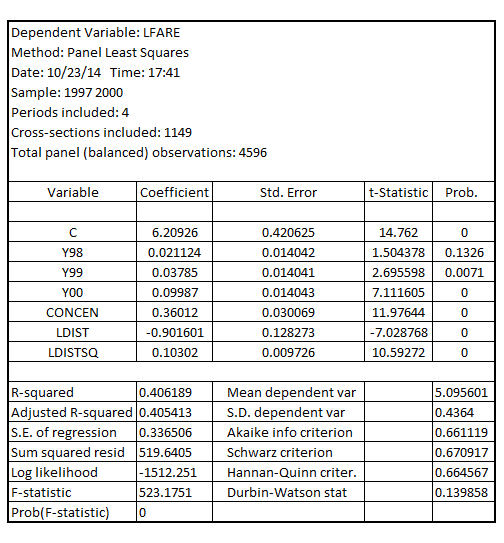
If , given that the coefficient of
  is 0.36012, the estimated percentage increase in
  is given by:

Step 2 of 9
Step 3 of 9
Step 4 of 9
Step 5 of 9
Step 6 of 9
Step 7 of 9
Step 8 of 9
Step 9 of 9


Why don’t you like this exercise?
Other






