


expand icon
book Introductory Econometrics: A Modern Approach 6th Edition by Jeffrey M Wooldridge cover

Introductory Econometrics: A Modern Approach 6th Edition by Jeffrey M Wooldridge

Edition 6ISBN: 130527010X
book Introductory Econometrics: A Modern Approach 6th Edition by Jeffrey M Wooldridge cover

Introductory Econometrics: A Modern Approach 6th Edition by Jeffrey M Wooldridge

Edition 6ISBN: 130527010X
Exercise 3

Use CRIME4.RAW for this exercise.

(

i) Reestimate the unobserved effects model for crime in Example 13.9 but use fixed effects rather than differencing. Are there any notable sign or magnitude changes in the coefficients? What about statistical significance?

(ii) Add the logs of each wage variable in the data set and estimate the model by fixed effects. How does including these variables affect the coefficients on the criminal justice variables in part (i)?

(iii) Do the wage variables in part (ii) all have the expected sign? Explain. Are they jointly significant?

Step-by-step solution
Verified
like image
like image

Step 1 of 5

(i)

Estimating the unobserved effects model for crime using the fixed effects rather than differencing, such that     <div class=answer> (i) Estimating the unobserved effects model for crime using the fixed effects rather than differencing, such that   is the dependent variable and   are the year dummy variables and   are the other explanatory variables, the result is:     On comparing the result of the unobserved effects model for crime using the fixed effects that   is the dependent variable and   are the year dummy variables and   are the other explanatory variables, with the results of the differenced model( with 1982 as the Base year), the overall result is: is the dependent variable and     <div class=answer> (i) Estimating the unobserved effects model for crime using the fixed effects rather than differencing, such that   is the dependent variable and   are the year dummy variables and   are the other explanatory variables, the result is:     On comparing the result of the unobserved effects model for crime using the fixed effects that   is the dependent variable and   are the year dummy variables and   are the other explanatory variables, with the results of the differenced model( with 1982 as the Base year), the overall result is: are the year dummy variables and     <div class=answer> (i) Estimating the unobserved effects model for crime using the fixed effects rather than differencing, such that   is the dependent variable and   are the year dummy variables and   are the other explanatory variables, the result is:     On comparing the result of the unobserved effects model for crime using the fixed effects that   is the dependent variable and   are the year dummy variables and   are the other explanatory variables, with the results of the differenced model( with 1982 as the Base year), the overall result is: are the other explanatory variables, the result is:
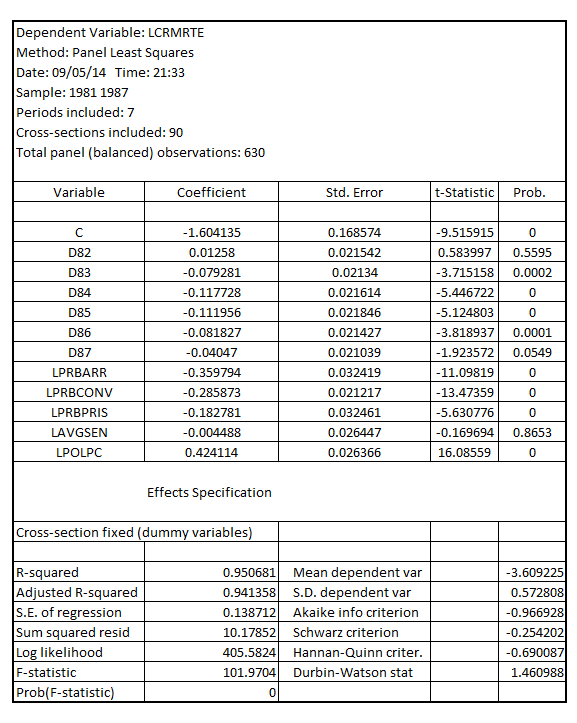
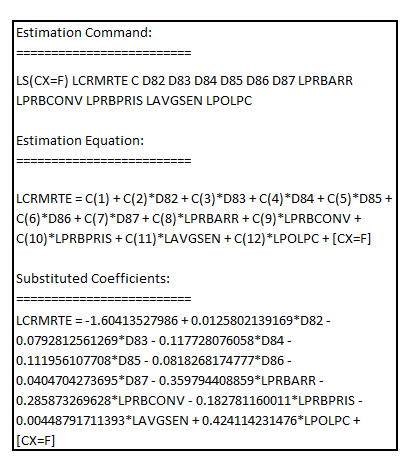
    <div class=answer> (i) Estimating the unobserved effects model for crime using the fixed effects rather than differencing, such that   is the dependent variable and   are the year dummy variables and   are the other explanatory variables, the result is:     On comparing the result of the unobserved effects model for crime using the fixed effects that   is the dependent variable and   are the year dummy variables and   are the other explanatory variables, with the results of the differenced model( with 1982 as the Base year), the overall result is:

    <div class=answer> (i) Estimating the unobserved effects model for crime using the fixed effects rather than differencing, such that   is the dependent variable and   are the year dummy variables and   are the other explanatory variables, the result is:     On comparing the result of the unobserved effects model for crime using the fixed effects that   is the dependent variable and   are the year dummy variables and   are the other explanatory variables, with the results of the differenced model( with 1982 as the Base year), the overall result is:

On comparing the result of the unobserved effects model for crime using the fixed effects that     <div class=answer> (i) Estimating the unobserved effects model for crime using the fixed effects rather than differencing, such that   is the dependent variable and   are the year dummy variables and   are the other explanatory variables, the result is:     On comparing the result of the unobserved effects model for crime using the fixed effects that   is the dependent variable and   are the year dummy variables and   are the other explanatory variables, with the results of the differenced model( with 1982 as the Base year), the overall result is: is the dependent variable and     <div class=answer> (i) Estimating the unobserved effects model for crime using the fixed effects rather than differencing, such that   is the dependent variable and   are the year dummy variables and   are the other explanatory variables, the result is:     On comparing the result of the unobserved effects model for crime using the fixed effects that   is the dependent variable and   are the year dummy variables and   are the other explanatory variables, with the results of the differenced model( with 1982 as the Base year), the overall result is: are the year dummy variables and     <div class=answer> (i) Estimating the unobserved effects model for crime using the fixed effects rather than differencing, such that   is the dependent variable and   are the year dummy variables and   are the other explanatory variables, the result is:     On comparing the result of the unobserved effects model for crime using the fixed effects that   is the dependent variable and   are the year dummy variables and   are the other explanatory variables, with the results of the differenced model( with 1982 as the Base year), the overall result is: are the other explanatory variables, with the results of the differenced model( with 1982 as the Base year), the overall result is:


Step 2 of 5


Step 3 of 5


Step 4 of 5


Step 5 of 5

close menu
Introductory Econometrics: A Modern Approach 6th Edition by Jeffrey M Wooldridge
cross icon







