





 Chat with AI


Introductory Econometrics: A Modern Approach 6th Edition by Jeffrey M Wooldridge
Edition 6ISBN: 130527010XIntroductory Econometrics: A Modern Approach 6th Edition by Jeffrey M Wooldridge
Edition 6ISBN: 130527010XUse the data in MURDER.RAW for this exercise.
(i) Using the years 1990 and 1993, estimate the equation
by pooled OLS and report the results in the usual form. Do not worry that the usual OLS standard errors are inappropriate because of the presence of ai. Do you estimate a deterrent effect of capital punishment?
(ii) Compute the FD estimates (use only the differences from 1990 to 1993; you should have 51 observations in the FD regression). Now what do you conclude about a deterrent effect?
(iii) In the FD regression from part (ii), obtain the residuals, say, e.. Run the Breusch-Pagan regression e2 on Aexec,, Aunem. and compute the F test for heteroskedas-ticity. Do the same for the special case of the White test [that is, regress e2. on y., y2, where the fitted values are from part (ii)]. What do you conclude about heteroskedasticity in the FD equation?
(iv) Run the same regression from part (ii), but obtain the heteroskedasticity-robust t statistics. What happens?
(v) Which t statistic on Aexeci do you feel more comfortable relying on, the usual one or the heteroskedasticity-robust one? Why?
![Use the data in MURDER.RAW for this exercise. <blockquote> (i) Using the years 1990 and 1993, estimate the equation by pooled OLS and report the results in the usual form. Do not worry that the usual OLS standard errors are inappropriate because of the presence of ai. Do you estimate a deterrent effect of capital punishment? (ii) Compute the FD estimates (use only the differences from 1990 to 1993; you should have 51 observations in the FD regression). Now what do you conclude about a deterrent effect? (iii) In the FD regression from part (ii), obtain the residuals, say, e.. Run the Breusch-Pagan regression e2 on Aexec,, Aunem. and compute the F test for heteroskedas-ticity. Do the same for the special case of the White test [that is, regress e2. on y., y2, where the fitted values are from part (ii)]. What do you conclude about heteroskedasticity in the FD equation? (iv) Run the same regression from part (ii), but obtain the heteroskedasticity-robust t statistics. What happens? (v) Which t statistic on Aexeci do you feel more comfortable relying on, the usual one or the heteroskedasticity-robust one? Why? </blockquote>](https://d2lvgg3v3hfg70.cloudfront.net/SMCC2709/853c861a_707e_4b21_aa00_f4688d59525e_SMCC2709_11.jpg)
 Verified
Step 1 of 6
(i)
Estimating the equation using pooled OLS:

The result is:
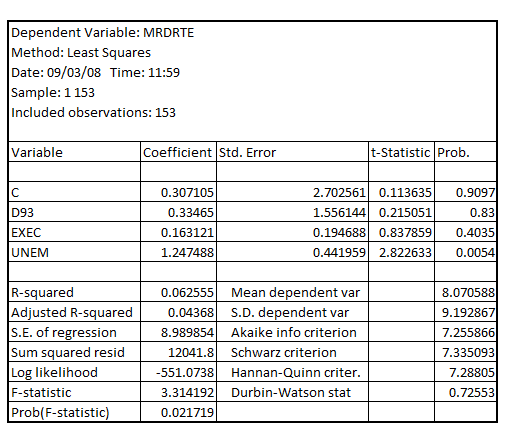
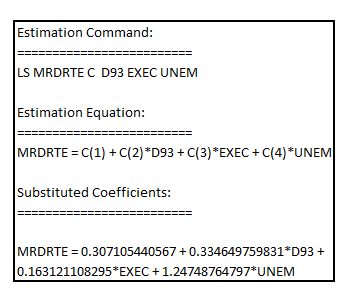
The standard form of the result is:

Where 
The coefficient of  is positive and is 0.16312 indicating that there is no deterrent effect of capital punishment
Step 2 of 6
Step 3 of 6
Step 4 of 6
Step 5 of 6
Step 6 of 6


Why don’t you like this exercise?
Other






