





 Chat with AI


Introductory Econometrics: A Modern Approach 6th Edition by Jeffrey M Wooldridge
Edition 6ISBN: 130527010XIntroductory Econometrics: A Modern Approach 6th Edition by Jeffrey M Wooldridge
Edition 6ISBN: 130527010XUse GPA3.RAW for this exercise. The data set is for 366 student-athletes from a large university for fall and spring semesters. [A similar analysis is in Maloney and McCormick (1993), but here we use a true panel data set.] Because you have two terms of data for each student, an unobserved effects model is appropriate. The primary question of interest is this: Do athletes perform more poorly in school during the semester their sport is in season?
(i) Use pooled OLS to estimate a model with term GPA (trmgpa) as the dependent variable. The explanatory variables are spring, sat, hsperc, female, black, white, frstsem, tothrs, crsgpa, and season. Interpret the coefficient on season. Is it statistically significant?
(ii) Most of the athletes who play their sport only in the fall are football players. Suppose the ability levels of football players differ systematically from those of other athletes. If ability is not adequately captured by SAT score and high school percentile, explain why the pooled OLS estimators will be biased.
(iii) Now, use the data differenced across the two terms. Which variables drop out? Now, test for an in-season effect.
(iv) Can you think of one or more potentially important, time-varying variables that have been omitted from the analysis?
 Verified
Step 1 of 5
(i)
Estimating the pooled OLS with  as the dependent variable and
  as explanatory variables, the result is:
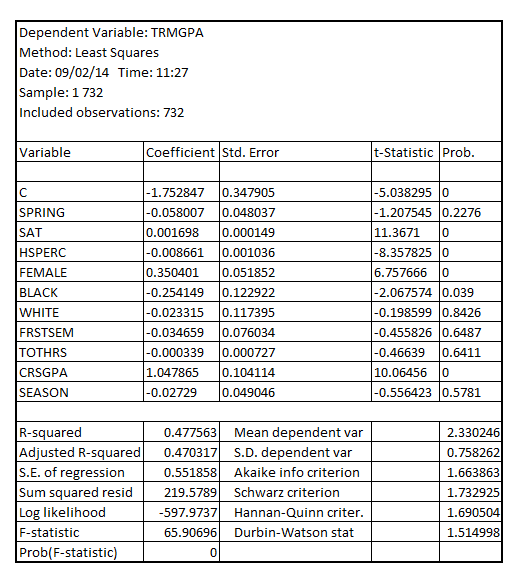
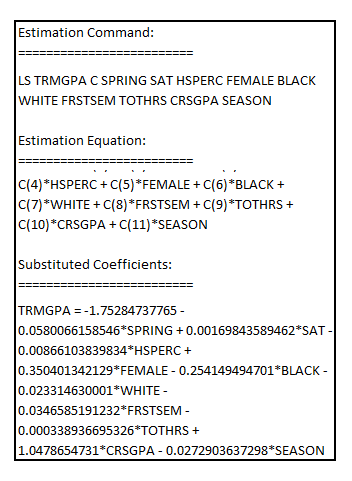
The coefficient of  is -0.02729.It is interpreted as the student-athlete’s
  being lower by 0.02729 points when their sport is in season.
The p-value of the coefficient of  is 0.5781 which is greater than the critical p-value 0.05 at 5% level of significance, indicating that the coefficient of
  is statistically insignificant at 5% level of significance.
Step 2 of 5
Step 3 of 5
Step 4 of 5
Step 5 of 5


Why don’t you like this exercise?
Other






