expand icon
book Introductory Econometrics: A Modern Approach 6th Edition by Jeffrey M Wooldridge cover

Introductory Econometrics: A Modern Approach 6th Edition by Jeffrey M Wooldridge

Edition 6ISBN: 130527010X
book Introductory Econometrics: A Modern Approach 6th Edition by Jeffrey M Wooldridge cover

Introductory Econometrics: A Modern Approach 6th Edition by Jeffrey M Wooldridge

Edition 6ISBN: 130527010X
Exercise 14

A partial adjustment model is

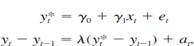
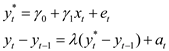
 A partial adjustment model is   where yt* is the desired or optimal level of y, and yt is the actual (observed) level. For example, yt* is the desired growth in firm inventories, and xt is growth in firm sales. The parameter ?1 measures the effect of xt on yt*. The second equation describes how the actual y adjusts depending on the relationship between the desired y in time t and the actual y in time t - 1. The parameter ? measures the speed of adjustment and satisfies 0 ? ? ? 1. <blockquote> (i) Plug the first equation for yt* into the second equation and show that we can write   In particular, find the ?j in terms of the ?j and ? and find ut in terms of et and at. Therefore, the partial adjustment model leads to a model with a lagged dependent variable and a contemporaneous x.   </blockquote>

where yt* is the desired or optimal level of y, and yt is the actual (observed) level. For example, yt* is the desired growth in firm inventories, and xt is growth in firm sales. The parameter ?1 measures the effect of xt on yt*. The second equation describes how the actual y adjusts depending on the relationship between the desired y in time t and the actual y in time t - 1. The parameter ? measures the speed of adjustment and satisfies 0 ? ? ? 1.

(i) Plug the first equation for yt* into the second equation and show that we can write

 A partial adjustment model is   where yt* is the desired or optimal level of y, and yt is the actual (observed) level. For example, yt* is the desired growth in firm inventories, and xt is growth in firm sales. The parameter ?1 measures the effect of xt on yt*. The second equation describes how the actual y adjusts depending on the relationship between the desired y in time t and the actual y in time t - 1. The parameter ? measures the speed of adjustment and satisfies 0 ? ? ? 1. <blockquote> (i) Plug the first equation for yt* into the second equation and show that we can write   In particular, find the ?j in terms of the ?j and ? and find ut in terms of et and at. Therefore, the partial adjustment model leads to a model with a lagged dependent variable and a contemporaneous x.   </blockquote>   In particular, find the ?j in terms of the ?j and ? and find ut in terms of et and at.

Therefore, the partial adjustment model leads to a model with a lagged dependent variable and a contemporaneous x.

 A partial adjustment model is   where yt* is the desired or optimal level of y, and yt is the actual (observed) level. For example, yt* is the desired growth in firm inventories, and xt is growth in firm sales. The parameter ?1 measures the effect of xt on yt*. The second equation describes how the actual y adjusts depending on the relationship between the desired y in time t and the actual y in time t - 1. The parameter ? measures the speed of adjustment and satisfies 0 ? ? ? 1. <blockquote> (i) Plug the first equation for yt* into the second equation and show that we can write   In particular, find the ?j in terms of the ?j and ? and find ut in terms of et and at. Therefore, the partial adjustment model leads to a model with a lagged dependent variable and a contemporaneous x.   </blockquote>

Step-by-step solution
Verified
like image
like image

Step 1 of 4

(i)

Consider     <div class=answer> (i) Consider   is the desired level of   and   is the actual level of   .   Plug in   in the following equation   The result is as follows:   is the desired level of     <div class=answer> (i) Consider   is the desired level of   and   is the actual level of   .   Plug in   in the following equation   The result is as follows:   and    <div class=answer> (i) Consider   is the desired level of   and   is the actual level of   .   Plug in   in the following equation   The result is as follows:   is the actual level of    <div class=answer> (i) Consider   is the desired level of   and   is the actual level of   .   Plug in   in the following equation   The result is as follows:   .
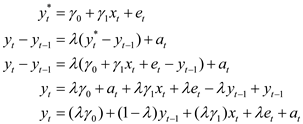
    <div class=answer> (i) Consider   is the desired level of   and   is the actual level of   .   Plug in   in the following equation   The result is as follows:

Plug in    <div class=answer> (i) Consider   is the desired level of   and   is the actual level of   .   Plug in   in the following equation   The result is as follows:   in the following equation

    <div class=answer> (i) Consider   is the desired level of   and   is the actual level of   .   Plug in   in the following equation   The result is as follows:

The result is as follows:

    <div class=answer> (i) Consider   is the desired level of   and   is the actual level of   .   Plug in   in the following equation   The result is as follows:


Step 2 of 4


Step 3 of 4


Step 4 of 4

close menu
Introductory Econometrics: A Modern Approach 6th Edition by Jeffrey M Wooldridge
cross icon