





 Chat with AI


Introductory Econometrics: A Modern Approach 6th Edition by Jeffrey M Wooldridge
Edition 6ISBN: 130527010XIntroductory Econometrics: A Modern Approach 6th Edition by Jeffrey M Wooldridge
Edition 6ISBN: 130527010XUse the data in MINWAGE.RAW for this exercise. In particular, use the employment and wage series for sector 232 (Men's and Boy's Furnishings). The variable gwage232 is the monthly growth (change in logs) in the average wage in sector 232, gemp232 is the growth in employment in sector 232, gmwage is the growth in the federal minimum wage, and gcpi is the growth in the (urban) Consumer Price Index.
(i) Run the regression gwage232 on gmwage, gcpi. Do the sign and magnitude of Pgmwage make sense to you? Explain. Is gmwage statistically significant?
(ii) Add lags 1 through 12 of gmwage to the equation in part (i). Do you think it is necessary to include these lags to estimate the long-run effect of minimum wage growth on wage growth in sector 232? Explain.
(iii) Run the regression gemp232 on gmwage,gcpi. Does minimum wage growth appear to have a contemporaneous effect on gemp232?
(iv) Add lags 1 through 12 to the employment growth equation. Does growth in the minimum wage have a statistically significant effect on employment growth, either in the short run or long run? Explain.
 Verified
Step 1 of 7
(i)
Estimate the regression of the variable  on
on to get the result as:
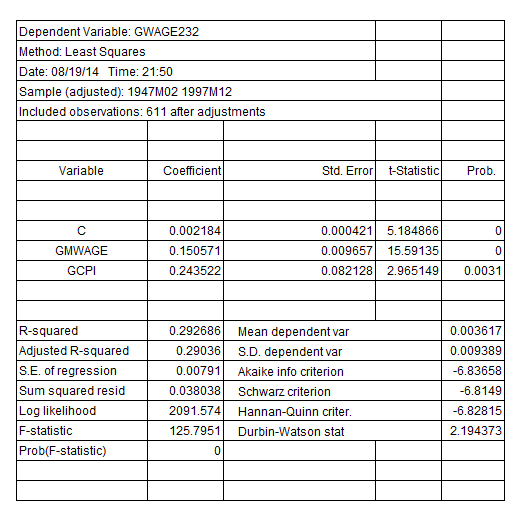
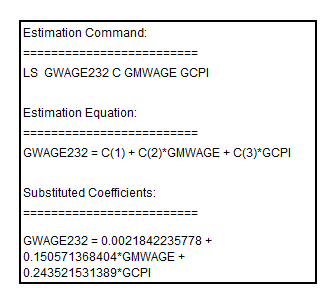
The sign of the coefficients of  and
and  is positive. It indicates that when the minimum wage
  increase by 1% point, on average ,the hourly wage for sector 232 increases by 15.05% points and when the inflation rate increases by 1% point, the hourly wage on an average increases by 24.35%
The p-value of the coefficient of  is 0.0000 which is less than the critical p-value of 0.05 at 5% level of significance, indicating that the variable
  is significant in explaining
Step 2 of 7
Step 3 of 7
Step 4 of 7
Step 5 of 7
Step 6 of 7
Step 7 of 7


Why don’t you like this exercise?
Other






