expand icon
book Introductory Econometrics: A Modern Approach 6th Edition by Jeffrey M Wooldridge cover

Introductory Econometrics: A Modern Approach 6th Edition by Jeffrey M Wooldridge

Edition 6ISBN: 130527010X
book Introductory Econometrics: A Modern Approach 6th Edition by Jeffrey M Wooldridge cover

Introductory Econometrics: A Modern Approach 6th Edition by Jeffrey M Wooldridge

Edition 6ISBN: 130527010X
Exercise 7

Use the data for the year 1990 in INFMRT.RAW for this exercise.

(i) Reestimate equation, but now include a dummy variable for the observation on the District of Columbia (called DC). Interpret the coefficient on DC and com¬ment on its size and significance.

 Use the data for the year 1990 in INFMRT.RAW for this exercise. <blockquote> (i) Reestimate equation, but now include a dummy variable for the observation on the District of Columbia (called DC). Interpret the coefficient on DC and com¬ment on its size and significance.   = 33.86 - 4.68 log(pcinc) + 4.15 log(physic) (20.43) (2.60) (1.51) _.088 log(popul) (.287) n = 51, R<span class=sup>2</span>=139,R<span class=sup>2</span>=.084. (ii) Compare the estimates and standard errors from part (i) with those from equation. What do you conclude about including a dummy variable for a single observation?   =23.95-.57 log(pcinc)-2.74 log(physic) (12.42) (1.64) (1.19) +.629 log(popul) (.191) n = 50, R<span class=sup>2</span>= .273,   <span class=sup>2</span> =.226s. </blockquote>   = 33.86 - 4.68 log(pcinc) + 4.15 log(physic)

(20.43) (2.60) (1.51)

_.088 log(popul)

(.287)

n = 51, R2=139,R2=.084.

(ii) Compare the estimates and standard errors from part (i) with those from equation. What do you conclude about including a dummy variable for a single observation?

 Use the data for the year 1990 in INFMRT.RAW for this exercise. <blockquote> (i) Reestimate equation, but now include a dummy variable for the observation on the District of Columbia (called DC). Interpret the coefficient on DC and com¬ment on its size and significance.   = 33.86 - 4.68 log(pcinc) + 4.15 log(physic) (20.43) (2.60) (1.51) _.088 log(popul) (.287) n = 51, R<span class=sup>2</span>=139,R<span class=sup>2</span>=.084. (ii) Compare the estimates and standard errors from part (i) with those from equation. What do you conclude about including a dummy variable for a single observation?   =23.95-.57 log(pcinc)-2.74 log(physic) (12.42) (1.64) (1.19) +.629 log(popul) (.191) n = 50, R<span class=sup>2</span>= .273,   <span class=sup>2</span> =.226s. </blockquote>   =23.95-.57 log(pcinc)-2.74 log(physic)

(12.42) (1.64) (1.19)

+.629 log(popul)

(.191)

n = 50, R2= .273, Use the data for the year 1990 in INFMRT.RAW for this exercise. <blockquote> (i) Reestimate equation, but now include a dummy variable for the observation on the District of Columbia (called DC). Interpret the coefficient on DC and com¬ment on its size and significance.   = 33.86 - 4.68 log(pcinc) + 4.15 log(physic) (20.43) (2.60) (1.51) _.088 log(popul) (.287) n = 51, R<span class=sup>2</span>=139,R<span class=sup>2</span>=.084. (ii) Compare the estimates and standard errors from part (i) with those from equation. What do you conclude about including a dummy variable for a single observation?   =23.95-.57 log(pcinc)-2.74 log(physic) (12.42) (1.64) (1.19) +.629 log(popul) (.191) n = 50, R<span class=sup>2</span>= .273,   <span class=sup>2</span> =.226s. </blockquote>   2 =.226s.

Step-by-step solution
Verified
like image
like image

Step 1 of 3

(i)

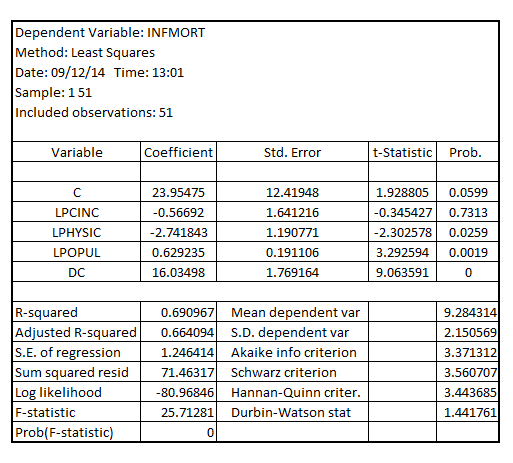
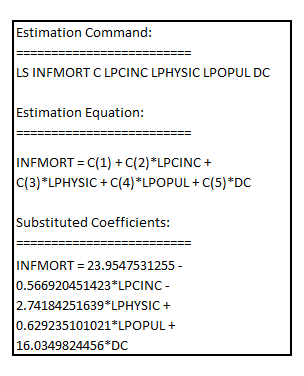
Using the data for the year 1990 and estimating the model with the inclusion of a dummy variable for the observation on the District of Columbia (called    <div class=answer> (i) Using the data for the year 1990 and estimating the model with the inclusion of a dummy variable for the observation on the District of Columbia (called   ), the result is:       The coefficient of   is 16.03498 It is interpreted as the infant mortality rate being 16.03498 for the State of District of Columbia ), the result is:

    <div class=answer> (i) Using the data for the year 1990 and estimating the model with the inclusion of a dummy variable for the observation on the District of Columbia (called   ), the result is:       The coefficient of   is 16.03498 It is interpreted as the infant mortality rate being 16.03498 for the State of District of Columbia

    <div class=answer> (i) Using the data for the year 1990 and estimating the model with the inclusion of a dummy variable for the observation on the District of Columbia (called   ), the result is:       The coefficient of   is 16.03498 It is interpreted as the infant mortality rate being 16.03498 for the State of District of Columbia

    <div class=answer> (i) Using the data for the year 1990 and estimating the model with the inclusion of a dummy variable for the observation on the District of Columbia (called   ), the result is:       The coefficient of   is 16.03498 It is interpreted as the infant mortality rate being 16.03498 for the State of District of Columbia

The coefficient of     <div class=answer> (i) Using the data for the year 1990 and estimating the model with the inclusion of a dummy variable for the observation on the District of Columbia (called   ), the result is:       The coefficient of   is 16.03498 It is interpreted as the infant mortality rate being 16.03498 for the State of District of Columbia is 16.03498

It is interpreted as the infant mortality rate being 16.03498 for the State of District of Columbia


Step 2 of 3


Step 3 of 3

close menu
Introductory Econometrics: A Modern Approach 6th Edition by Jeffrey M Wooldridge
cross icon