


expand icon
book Introductory Econometrics: A Modern Approach 6th Edition by Jeffrey M Wooldridge cover

Introductory Econometrics: A Modern Approach 6th Edition by Jeffrey M Wooldridge

Edition 6ISBN: 130527010X
book Introductory Econometrics: A Modern Approach 6th Edition by Jeffrey M Wooldridge cover

Introductory Econometrics: A Modern Approach 6th Edition by Jeffrey M Wooldridge

Edition 6ISBN: 130527010X
Exercise 21

Use the data in FERTIL2.RAW to answer this question.

(i) Estimate the model

 Use the data in FERTIL2.RAW to answer this question. (i) Estimate the model <i>   </i> and report the usual and heteroskedasticity-robust standard errors. Are the robust standard errors always bigger than the nonrobust ones? (ii) Add the three religious dummy variables and test whether they are jointly significant. What are the <i>p</i>-values for the nonrobust and robust tests? (iii) From the regresion in part (ii), obtain the fitted values <i>   </i>and the residuals, <i>   </i> Regress <i>   </i>and test the joint significance of the two regressors. Conclude that heteroskedasticity is present in the equation for <i>children</i>. (iv) Would you say the heteroskedasticity you found in part (iii) is practically important?

and report the usual and heteroskedasticity-robust standard errors. Are the robust standard errors always bigger than the nonrobust ones?

(ii) Add the three religious dummy variables and test whether they are jointly significant. What are the p-values for the nonrobust and robust tests?

(iii) From the regresion in part (ii), obtain the fitted values  Use the data in FERTIL2.RAW to answer this question. (i) Estimate the model <i>   </i> and report the usual and heteroskedasticity-robust standard errors. Are the robust standard errors always bigger than the nonrobust ones? (ii) Add the three religious dummy variables and test whether they are jointly significant. What are the <i>p</i>-values for the nonrobust and robust tests? (iii) From the regresion in part (ii), obtain the fitted values <i>   </i>and the residuals, <i>   </i> Regress <i>   </i>and test the joint significance of the two regressors. Conclude that heteroskedasticity is present in the equation for <i>children</i>. (iv) Would you say the heteroskedasticity you found in part (iii) is practically important? and the residuals,  Use the data in FERTIL2.RAW to answer this question. (i) Estimate the model <i>   </i> and report the usual and heteroskedasticity-robust standard errors. Are the robust standard errors always bigger than the nonrobust ones? (ii) Add the three religious dummy variables and test whether they are jointly significant. What are the <i>p</i>-values for the nonrobust and robust tests? (iii) From the regresion in part (ii), obtain the fitted values <i>   </i>and the residuals, <i>   </i> Regress <i>   </i>and test the joint significance of the two regressors. Conclude that heteroskedasticity is present in the equation for <i>children</i>. (iv) Would you say the heteroskedasticity you found in part (iii) is practically important? Regress  Use the data in FERTIL2.RAW to answer this question. (i) Estimate the model <i>   </i> and report the usual and heteroskedasticity-robust standard errors. Are the robust standard errors always bigger than the nonrobust ones? (ii) Add the three religious dummy variables and test whether they are jointly significant. What are the <i>p</i>-values for the nonrobust and robust tests? (iii) From the regresion in part (ii), obtain the fitted values <i>   </i>and the residuals, <i>   </i> Regress <i>   </i>and test the joint significance of the two regressors. Conclude that heteroskedasticity is present in the equation for <i>children</i>. (iv) Would you say the heteroskedasticity you found in part (iii) is practically important? and test the joint significance of the two regressors. Conclude that heteroskedasticity is present in the equation for children.

(iv) Would you say the heteroskedasticity you found in part (iii) is practically important?

Step-by-step solution
Verified
like image
like image

Step 1 of 7

(i)

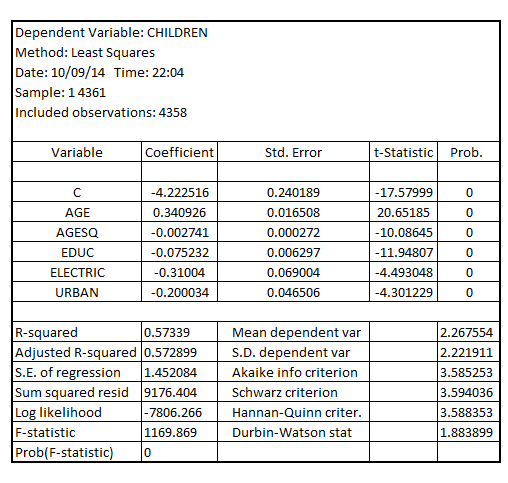
Estimating the model using the usual-OLS standard error, given by:

    <div class=answer> (i) Estimating the model using the usual-OLS standard error, given by:     Estimating the model using the heteroscedasticity-robust standard error, given by:     On comparing the usual-OLS standard error with the heteroscedasticity-robust standard error, the result is:   It shall be noted that the heteroscedasticity-robust standard error are not always bigger than the non-robust (usual-OLS) standard error For the explanatory variables   heteroscedasticity-robust standard error are slightly larger than the usual-OLS standard error, but for   , heteroscedasticity-robust standard error are smaller than the usual-OLS standard error

    <div class=answer> (i) Estimating the model using the usual-OLS standard error, given by:     Estimating the model using the heteroscedasticity-robust standard error, given by:     On comparing the usual-OLS standard error with the heteroscedasticity-robust standard error, the result is:   It shall be noted that the heteroscedasticity-robust standard error are not always bigger than the non-robust (usual-OLS) standard error For the explanatory variables   heteroscedasticity-robust standard error are slightly larger than the usual-OLS standard error, but for   , heteroscedasticity-robust standard error are smaller than the usual-OLS standard error
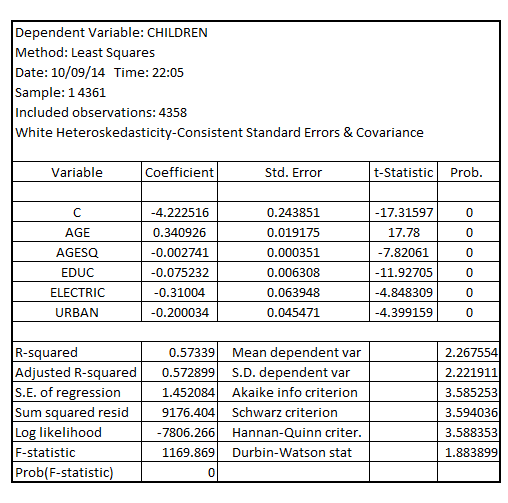
Estimating the model using the heteroscedasticity-robust standard error, given by:

    <div class=answer> (i) Estimating the model using the usual-OLS standard error, given by:     Estimating the model using the heteroscedasticity-robust standard error, given by:     On comparing the usual-OLS standard error with the heteroscedasticity-robust standard error, the result is:   It shall be noted that the heteroscedasticity-robust standard error are not always bigger than the non-robust (usual-OLS) standard error For the explanatory variables   heteroscedasticity-robust standard error are slightly larger than the usual-OLS standard error, but for   , heteroscedasticity-robust standard error are smaller than the usual-OLS standard error

    <div class=answer> (i) Estimating the model using the usual-OLS standard error, given by:     Estimating the model using the heteroscedasticity-robust standard error, given by:     On comparing the usual-OLS standard error with the heteroscedasticity-robust standard error, the result is:   It shall be noted that the heteroscedasticity-robust standard error are not always bigger than the non-robust (usual-OLS) standard error For the explanatory variables   heteroscedasticity-robust standard error are slightly larger than the usual-OLS standard error, but for   , heteroscedasticity-robust standard error are smaller than the usual-OLS standard error

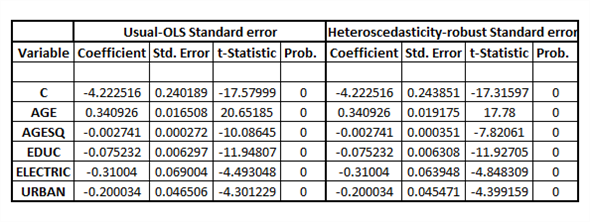
On comparing the usual-OLS standard error with the heteroscedasticity-robust standard error, the result is:
    <div class=answer> (i) Estimating the model using the usual-OLS standard error, given by:     Estimating the model using the heteroscedasticity-robust standard error, given by:     On comparing the usual-OLS standard error with the heteroscedasticity-robust standard error, the result is:   It shall be noted that the heteroscedasticity-robust standard error are not always bigger than the non-robust (usual-OLS) standard error For the explanatory variables   heteroscedasticity-robust standard error are slightly larger than the usual-OLS standard error, but for   , heteroscedasticity-robust standard error are smaller than the usual-OLS standard error

It shall be noted that the heteroscedasticity-robust standard error are not always bigger than the non-robust (usual-OLS) standard error

For the explanatory variables     <div class=answer> (i) Estimating the model using the usual-OLS standard error, given by:     Estimating the model using the heteroscedasticity-robust standard error, given by:     On comparing the usual-OLS standard error with the heteroscedasticity-robust standard error, the result is:   It shall be noted that the heteroscedasticity-robust standard error are not always bigger than the non-robust (usual-OLS) standard error For the explanatory variables   heteroscedasticity-robust standard error are slightly larger than the usual-OLS standard error, but for   , heteroscedasticity-robust standard error are smaller than the usual-OLS standard error heteroscedasticity-robust standard error are slightly larger than the usual-OLS standard error, but for    <div class=answer> (i) Estimating the model using the usual-OLS standard error, given by:     Estimating the model using the heteroscedasticity-robust standard error, given by:     On comparing the usual-OLS standard error with the heteroscedasticity-robust standard error, the result is:   It shall be noted that the heteroscedasticity-robust standard error are not always bigger than the non-robust (usual-OLS) standard error For the explanatory variables   heteroscedasticity-robust standard error are slightly larger than the usual-OLS standard error, but for   , heteroscedasticity-robust standard error are smaller than the usual-OLS standard error , heteroscedasticity-robust standard error are smaller than the usual-OLS standard error


Step 2 of 7


Step 3 of 7


Step 4 of 7


Step 5 of 7


Step 6 of 7


Step 7 of 7

close menu
Introductory Econometrics: A Modern Approach 6th Edition by Jeffrey M Wooldridge
cross icon



