expand icon
book Introductory Econometrics: A Modern Approach 6th Edition by Jeffrey M Wooldridge cover

Introductory Econometrics: A Modern Approach 6th Edition by Jeffrey M Wooldridge

Edition 6ISBN: 130527010X
book Introductory Econometrics: A Modern Approach 6th Edition by Jeffrey M Wooldridge cover

Introductory Econometrics: A Modern Approach 6th Edition by Jeffrey M Wooldridge

Edition 6ISBN: 130527010X
Exercise 11

Use the data in CHARITY.RAW to answer this question. The variable respond is a dummy variable equal to one if a person responded with a contribution on the most recent mailing sent by a charitable organization. The variable resplast is a dummy variable equal to one if the person responded to the previous mailing, avggift is the average of past gifts (in Dutch guilders), and propresp is the proportion of times the person has responded to past mailings.

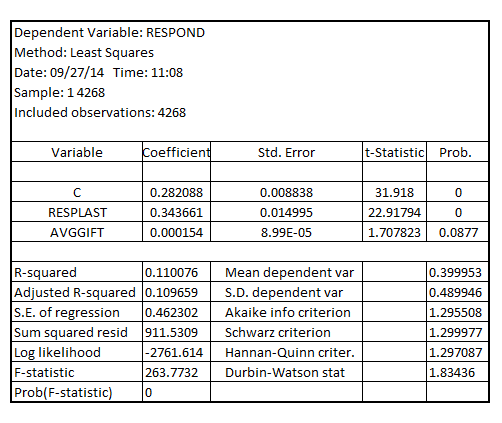
(i) Estimate a linear probability model relating respond to resplast and avggift. Report the results in the usual form, and interpret the coefficient on resplast.

(ii) Does the average value of past gifts seem to affect the probability of responding?

(iii) Add the variable propresp to the model, and interpret its coefficient. (Be careful here: an increase of one in propresp is the largest possible change.)

(iv) What happened to the coefficient on resplast when propresp was added to the regression? Does this make sense?

(v) Add mailsyear, the number of mailings per year, to the model. How big is its estimated effect? Why might this not be a good estimate of the causal effect of mailings on responding?

Step-by-step solution
Verified
like image
like image

Step 1 of 5

(i)

Estimating the linear probability model relating    <div class=answer> (i) Estimating the linear probability model relating   to   and   , the result is:   The usual form is:   The coefficient of   is 0.343661 It is interpreted as the probability of responding to the most recent mail with a gift is <span style=border: 1px solid black;>34.3661%</span> to    <div class=answer> (i) Estimating the linear probability model relating   to   and   , the result is:   The usual form is:   The coefficient of   is 0.343661 It is interpreted as the probability of responding to the most recent mail with a gift is <span style=border: 1px solid black;>34.3661%</span> and    <div class=answer> (i) Estimating the linear probability model relating   to   and   , the result is:   The usual form is:   The coefficient of   is 0.343661 It is interpreted as the probability of responding to the most recent mail with a gift is <span style=border: 1px solid black;>34.3661%</span> , the result is:

    <div class=answer> (i) Estimating the linear probability model relating   to   and   , the result is:   The usual form is:   The coefficient of   is 0.343661 It is interpreted as the probability of responding to the most recent mail with a gift is <span style=border: 1px solid black;>34.3661%</span>

The usual form is:

    <div class=answer> (i) Estimating the linear probability model relating   to   and   , the result is:   The usual form is:   The coefficient of   is 0.343661 It is interpreted as the probability of responding to the most recent mail with a gift is <span style=border: 1px solid black;>34.3661%</span>

The coefficient of    <div class=answer> (i) Estimating the linear probability model relating   to   and   , the result is:   The usual form is:   The coefficient of   is 0.343661 It is interpreted as the probability of responding to the most recent mail with a gift is <span style=border: 1px solid black;>34.3661%</span> is 0.343661

It is interpreted as the probability of responding to the most recent mail with a gift is 34.3661%


Step 2 of 5


Step 3 of 5


Step 4 of 5


Step 5 of 5

close menu
Introductory Econometrics: A Modern Approach 6th Edition by Jeffrey M Wooldridge
cross icon