


expand icon
book Introductory Econometrics: A Modern Approach 6th Edition by Jeffrey M Wooldridge cover

Introductory Econometrics: A Modern Approach 6th Edition by Jeffrey M Wooldridge

Edition 6ISBN: 130527010X
book Introductory Econometrics: A Modern Approach 6th Edition by Jeffrey M Wooldridge cover

Introductory Econometrics: A Modern Approach 6th Edition by Jeffrey M Wooldridge

Edition 6ISBN: 130527010X
Exercise 8

The following model allows the return to education to depend upon the total amount of both parents’ education, called pareduc: log(wage) = ????0 + ????1educ + ????2educ.pareduc + ????3exper + ????4tenure + u.

(i) Show that, in decimal form, the return to another year of education in this model is ?log(wage)/?educ = ????1 + ????2pareduc. What sign do you expect for _2? Why?

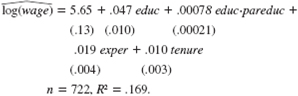
(ii) Using the data in WAGE2.RAW, the estimated equation is

 The following model allows the return to education to depend upon the total amount of both parents’ education, called pareduc: log(wage) = ????<span class=sub>0</span> + ????<span class=sub>1</span>educ + ????<span class=sub>2</span>educ.pareduc + ????<span class=sub>3</span>exper + ????<span class=sub>4</span>tenure + u. <blockquote> (i) Show that, in decimal form, the return to another year of education in this model is ?log(wage)/?educ = ????<span class=sub>1</span> + ????<span class=sub>2</span>pareduc. What sign do you expect for _2? Why? (ii) Using the data in WAGE2.RAW, the estimated equation is   (Only 722 observations contain full information on parents’ education.) Interpret the coefficient on the interaction term. It might help to choose two specific values for pareduc—for example, pareduc = 32 if both parents have a college education, or pareduc = 24 if both parents have a high school education—and to compare the estimated return to educ. (iii) When pareduc is added as a separate variable to the equation, we get:   Does the estimated return to education now depend positively on parent education? Test the null hypothesis that the return to education does not depend on parent education. </blockquote>

(Only 722 observations contain full information on parents’ education.) Interpret the coefficient on the interaction term. It might help to choose two specific values for pareduc—for example, pareduc = 32 if both parents have a college education, or pareduc = 24 if both parents have a high school education—and to compare the estimated return to educ.

(iii) When pareduc is added as a separate variable to the equation, we get:

 The following model allows the return to education to depend upon the total amount of both parents’ education, called pareduc: log(wage) = ????<span class=sub>0</span> + ????<span class=sub>1</span>educ + ????<span class=sub>2</span>educ.pareduc + ????<span class=sub>3</span>exper + ????<span class=sub>4</span>tenure + u. <blockquote> (i) Show that, in decimal form, the return to another year of education in this model is ?log(wage)/?educ = ????<span class=sub>1</span> + ????<span class=sub>2</span>pareduc. What sign do you expect for _2? Why? (ii) Using the data in WAGE2.RAW, the estimated equation is   (Only 722 observations contain full information on parents’ education.) Interpret the coefficient on the interaction term. It might help to choose two specific values for pareduc—for example, pareduc = 32 if both parents have a college education, or pareduc = 24 if both parents have a high school education—and to compare the estimated return to educ. (iii) When pareduc is added as a separate variable to the equation, we get:   Does the estimated return to education now depend positively on parent education? Test the null hypothesis that the return to education does not depend on parent education. </blockquote>   Does the estimated return to education now depend positively on parent education? Test the null hypothesis that the return to education does not depend on parent education.
Step-by-step solution
Verified
like image
like image

Step 1 of 8

The given model is written below:

    <div class=answer> The given model is written below:


Step 2 of 8


Step 3 of 8


Step 4 of 8


Step 5 of 8


Step 6 of 8


Step 7 of 8


Step 8 of 8

close menu
Introductory Econometrics: A Modern Approach 6th Edition by Jeffrey M Wooldridge
cross icon



