





 Chat with AI


Introductory Econometrics: A Modern Approach 6th Edition by Jeffrey M Wooldridge
Edition 6ISBN: 130527010XIntroductory Econometrics: A Modern Approach 6th Edition by Jeffrey M Wooldridge
Edition 6ISBN: 130527010XConsider the setup of the Frisch-Waugh Theorem.
(i) Using partitioned matrices, show that the first order conditions
can be written as
(ii) Multiply the first set of equations by
and subtract the result from the second set of equations to show that
where
. Conclude that
(iii) Use part (ii) to show that
(iv) Use the fact that M1X1 = 0 to show that the residuals ü from the regression ÿ on
are identical to the residuals ü from the regression y on X1, X2. [Hint: By definition and the FW theorem,
Now you do the rest.]
![Consider the setup of the Frisch-Waugh Theorem. <blockquote> (i) Using partitioned matrices, show that the first order conditions can be written as (ii) Multiply the first set of equations by and subtract the result from the second set of equations to show that where . Conclude that (iii) Use part (ii) to show that (iv) Use the fact that M <sub>1</sub> X <sub>1</sub> = 0 to show that the residuals ü from the regression ÿ on are identical to the residuals ü from the regression y on X <sub>1</sub>, X <sub>2</sub>. [<i>Hint</i>: By definition and the FW theorem, Now you do the rest.] </blockquote>](https://d2lvgg3v3hfg70.cloudfront.net/SMCC2709/f0cfbcaa_05c5_4be2_9efe_2dc7f1667a13_SMCC2709_11.jpg)
![Consider the setup of the Frisch-Waugh Theorem. <blockquote> (i) Using partitioned matrices, show that the first order conditions can be written as (ii) Multiply the first set of equations by and subtract the result from the second set of equations to show that where . Conclude that (iii) Use part (ii) to show that (iv) Use the fact that M <sub>1</sub> X <sub>1</sub> = 0 to show that the residuals ü from the regression ÿ on are identical to the residuals ü from the regression y on X <sub>1</sub>, X <sub>2</sub>. [<i>Hint</i>: By definition and the FW theorem, Now you do the rest.] </blockquote>](https://d2lvgg3v3hfg70.cloudfront.net/SMCC2709/09f05ec5_ad64_4067_a4d0_8c0a46cdf178_SMCC2709_11.jpg)
![Consider the setup of the Frisch-Waugh Theorem. <blockquote> (i) Using partitioned matrices, show that the first order conditions can be written as (ii) Multiply the first set of equations by and subtract the result from the second set of equations to show that where . Conclude that (iii) Use part (ii) to show that (iv) Use the fact that M <sub>1</sub> X <sub>1</sub> = 0 to show that the residuals ü from the regression ÿ on are identical to the residuals ü from the regression y on X <sub>1</sub>, X <sub>2</sub>. [<i>Hint</i>: By definition and the FW theorem, Now you do the rest.] </blockquote>](https://d2lvgg3v3hfg70.cloudfront.net/SMCC2709/946480af_063e_497d_9d74_4827475c3b55_SMCC2709_11.jpg)
![Consider the setup of the Frisch-Waugh Theorem. <blockquote> (i) Using partitioned matrices, show that the first order conditions can be written as (ii) Multiply the first set of equations by and subtract the result from the second set of equations to show that where . Conclude that (iii) Use part (ii) to show that (iv) Use the fact that M <sub>1</sub> X <sub>1</sub> = 0 to show that the residuals ü from the regression ÿ on are identical to the residuals ü from the regression y on X <sub>1</sub>, X <sub>2</sub>. [<i>Hint</i>: By definition and the FW theorem, Now you do the rest.] </blockquote>](https://d2lvgg3v3hfg70.cloudfront.net/SMCC2709/50a6ba5b_e073_4807_b5c7_52bcaf193a2b_SMCC2709_11.jpg)
![Consider the setup of the Frisch-Waugh Theorem. <blockquote> (i) Using partitioned matrices, show that the first order conditions can be written as (ii) Multiply the first set of equations by and subtract the result from the second set of equations to show that where . Conclude that (iii) Use part (ii) to show that (iv) Use the fact that M <sub>1</sub> X <sub>1</sub> = 0 to show that the residuals ü from the regression ÿ on are identical to the residuals ü from the regression y on X <sub>1</sub>, X <sub>2</sub>. [<i>Hint</i>: By definition and the FW theorem, Now you do the rest.] </blockquote>](https://d2lvgg3v3hfg70.cloudfront.net/SMCC2709/8a25cffc_cecc_4d22_a8ea_2299d44e1a3d_SMCC2709_11.jpg)
 Verified
Step 1 of 6
(i)
Consider that matrix X have n rows and k columns. Matrix X is partitioned as below:

Here,

The transpose of matrix X is written below:

Therefore, can be written as shown below:

Consider that vector  have k rows and 1 column. Vector
  is partitioned as below:

Here,

Therefore, can be written as shown below:

The first order conditions 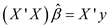 is written below:
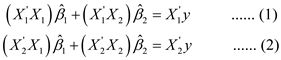
This is because:

Step 2 of 6
Step 3 of 6
Step 4 of 6
Step 5 of 6
Step 6 of 6


Why don’t you like this exercise?
Other






