


expand icon
book Introductory Econometrics: A Modern Approach 6th Edition by Jeffrey M Wooldridge cover

Introductory Econometrics: A Modern Approach 6th Edition by Jeffrey M Wooldridge

Edition 6ISBN: 130527010X
book Introductory Econometrics: A Modern Approach 6th Edition by Jeffrey M Wooldridge cover

Introductory Econometrics: A Modern Approach 6th Edition by Jeffrey M Wooldridge

Edition 6ISBN: 130527010X
Exercise 4

For positive random variables X and Y, suppose the expected value of Y given X is E(Y/X) = ?X. The unknown parameter shows how the expected value of Y changes with X.

(i) Define the random variable Z =Y/X. Show that E(Z) = ?.

(ii) Use part (i) to prove that the estimator W1 = n-1  For positive random variables X and Y, suppose the expected value of Y given X is E(Y/X) = ?X. The unknown parameter shows how the expected value of Y changes with X. <blockquote> (i) Define the random variable Z =Y/X. Show that E(Z) = ?. (ii) Use part (i) to prove that the estimator W<span class=sub>1</span> = n<span class=sup>-1</span>   (Y<span class=sub>i</span> /X<span class=sub>i</span>) is unbiased for ?, where {(X<span class=sub>i</span>,Y<span class=sub>i</span>): i = 1, 2,…., n} is a random sample (iii) Explain why the estimator W<span class=sub>2</span> =   , where the overbars denote sample averages, is not the same as W<span class=sub>1</span>. Nevertheless, show that W<span class=sub>2</span> is also unbiased for ?. (iv) The following table contains data on corn yields for several counties in Iowa. The USDA predicts the number of hectares of corn in each county based on satellite photos. Researchers count the number of “pixels” of corn in the satellite picture (as opposed to,for example, the number of pixels of soybeans or of uncultivated land) and use these to predict the actual number of hectares. To develop a prediction equation to be used for counties in general, the USDA surveyed farmers in selected counties to obtain corn yields in hectares. Let Y<span class=sub>i</span>= corn yield in county i and let X<span class=sub>i</span> = number of corn pixels in the satellite picture for county i. There are n=17 observations for eight counties. Use this sample to compute the estimates of ? devised in parts (ii) and (iii). Are the estimates similar? </blockquote>   <table cellspacing=0 cellpadding=0 border=1>    <tbody>     <tr>      <td valign=top> Plot </td>      <td valign=top> Corn Yield </td>      <td valign=top> Corn Pixels </td>     </tr>     <tr>      <td valign=top> 1 </td>      <td valign=top> 165.76 </td>      <td valign=top> 374 </td>     </tr>     <tr>      <td valign=top> 2 </td>      <td valign=top> 96.32 </td>      <td valign=top> 209 </td>     </tr>     <tr>      <td valign=top> 3 </td>      <td valign=top> 76.08 </td>      <td valign=top> 253 </td>     </tr>     <tr>      <td valign=top> 4 </td>      <td valign=top> 185.35 </td>      <td valign=top> 432 </td>     </tr>     <tr>      <td valign=top> 5 </td>      <td valign=top> 116.43 </td>      <td valign=top> 367 </td>     </tr>     <tr>      <td valign=top> 6 </td>      <td valign=top> 162.08 </td>      <td valign=top> 361 </td>     </tr>     <tr>      <td valign=top> 7 </td>      <td valign=top> 152.04 </td>      <td valign=top> 288 </td>     </tr>     <tr>      <td valign=top> 8 </td>      <td valign=top> 161.75 </td>      <td valign=top> 369 </td>     </tr>     <tr>      <td valign=top> 9 </td>      <td valign=top> 92.88 </td>      <td valign=top> 206 </td>     </tr>     <tr>      <td valign=top> 10 </td>      <td valign=top> 149.94 </td>      <td valign=top> 316 </td>     </tr>     <tr>      <td valign=top> 11 </td>      <td valign=top> 64.75 </td>      <td valign=top> 145 </td>     </tr>     <tr>      <td valign=top> 12 </td>      <td valign=top> 127.07 </td>      <td valign=top> 355 </td>     </tr>     <tr>      <td valign=top> 13 </td>      <td valign=top> 133.55 </td>      <td valign=top> 295 </td>     </tr>     <tr>      <td valign=top> 14 </td>      <td valign=top> 77.70 </td>      <td valign=top> 223 </td>     </tr>     <tr>      <td valign=top> 15 </td>      <td valign=top> 206.39 </td>      <td valign=top> 459 </td>     </tr>     <tr>      <td valign=top> 16 </td>      <td valign=top> 108.33 </td>      <td valign=top> 290 </td>     </tr>     <tr>      <td valign=top> 17 </td>      <td valign=top> 118.17 </td>      <td valign=top> 307 </td>     </tr>    </tbody>   </table>   (Yi /Xi) is unbiased for ?, where {(Xi,Yi): i = 1, 2,…., n} is a random sample

(iii) Explain why the estimator W2 =  For positive random variables X and Y, suppose the expected value of Y given X is E(Y/X) = ?X. The unknown parameter shows how the expected value of Y changes with X. <blockquote> (i) Define the random variable Z =Y/X. Show that E(Z) = ?. (ii) Use part (i) to prove that the estimator W<span class=sub>1</span> = n<span class=sup>-1</span>   (Y<span class=sub>i</span> /X<span class=sub>i</span>) is unbiased for ?, where {(X<span class=sub>i</span>,Y<span class=sub>i</span>): i = 1, 2,…., n} is a random sample (iii) Explain why the estimator W<span class=sub>2</span> =   , where the overbars denote sample averages, is not the same as W<span class=sub>1</span>. Nevertheless, show that W<span class=sub>2</span> is also unbiased for ?. (iv) The following table contains data on corn yields for several counties in Iowa. The USDA predicts the number of hectares of corn in each county based on satellite photos. Researchers count the number of “pixels” of corn in the satellite picture (as opposed to,for example, the number of pixels of soybeans or of uncultivated land) and use these to predict the actual number of hectares. To develop a prediction equation to be used for counties in general, the USDA surveyed farmers in selected counties to obtain corn yields in hectares. Let Y<span class=sub>i</span>= corn yield in county i and let X<span class=sub>i</span> = number of corn pixels in the satellite picture for county i. There are n=17 observations for eight counties. Use this sample to compute the estimates of ? devised in parts (ii) and (iii). Are the estimates similar? </blockquote>   <table cellspacing=0 cellpadding=0 border=1>    <tbody>     <tr>      <td valign=top> Plot </td>      <td valign=top> Corn Yield </td>      <td valign=top> Corn Pixels </td>     </tr>     <tr>      <td valign=top> 1 </td>      <td valign=top> 165.76 </td>      <td valign=top> 374 </td>     </tr>     <tr>      <td valign=top> 2 </td>      <td valign=top> 96.32 </td>      <td valign=top> 209 </td>     </tr>     <tr>      <td valign=top> 3 </td>      <td valign=top> 76.08 </td>      <td valign=top> 253 </td>     </tr>     <tr>      <td valign=top> 4 </td>      <td valign=top> 185.35 </td>      <td valign=top> 432 </td>     </tr>     <tr>      <td valign=top> 5 </td>      <td valign=top> 116.43 </td>      <td valign=top> 367 </td>     </tr>     <tr>      <td valign=top> 6 </td>      <td valign=top> 162.08 </td>      <td valign=top> 361 </td>     </tr>     <tr>      <td valign=top> 7 </td>      <td valign=top> 152.04 </td>      <td valign=top> 288 </td>     </tr>     <tr>      <td valign=top> 8 </td>      <td valign=top> 161.75 </td>      <td valign=top> 369 </td>     </tr>     <tr>      <td valign=top> 9 </td>      <td valign=top> 92.88 </td>      <td valign=top> 206 </td>     </tr>     <tr>      <td valign=top> 10 </td>      <td valign=top> 149.94 </td>      <td valign=top> 316 </td>     </tr>     <tr>      <td valign=top> 11 </td>      <td valign=top> 64.75 </td>      <td valign=top> 145 </td>     </tr>     <tr>      <td valign=top> 12 </td>      <td valign=top> 127.07 </td>      <td valign=top> 355 </td>     </tr>     <tr>      <td valign=top> 13 </td>      <td valign=top> 133.55 </td>      <td valign=top> 295 </td>     </tr>     <tr>      <td valign=top> 14 </td>      <td valign=top> 77.70 </td>      <td valign=top> 223 </td>     </tr>     <tr>      <td valign=top> 15 </td>      <td valign=top> 206.39 </td>      <td valign=top> 459 </td>     </tr>     <tr>      <td valign=top> 16 </td>      <td valign=top> 108.33 </td>      <td valign=top> 290 </td>     </tr>     <tr>      <td valign=top> 17 </td>      <td valign=top> 118.17 </td>      <td valign=top> 307 </td>     </tr>    </tbody>   </table>   , where the overbars denote sample averages, is not the same as W1. Nevertheless, show that W2 is also unbiased for ?.

(iv) The following table contains data on corn yields for several counties in Iowa. The USDA predicts the number of hectares of corn in each county based on satellite photos. Researchers count the number of “pixels” of corn in the satellite picture (as opposed to,for example, the number of pixels of soybeans or of uncultivated land) and use these to predict the actual number of hectares. To develop a prediction equation to be used for counties in general, the USDA surveyed farmers in selected counties to obtain corn yields in hectares. Let Yi= corn yield in county i and let Xi = number of corn pixels in the satellite picture for county i. There are n=17 observations for eight counties. Use this sample to compute the estimates of ? devised in parts (ii) and (iii). Are the estimates similar?

Plot

Corn Yield

Corn Pixels

1

165.76

374

2

96.32

209

3

76.08

253

4

185.35

432

5

116.43

367

6

162.08

361

7

152.04

288

8

161.75

369

9

92.88

206

10

149.94

316

11

64.75

145

12

127.07

355

13

133.55

295

14

77.70

223

15

206.39

459

16

108.33

290

17

118.17

307

Step-by-step solution
Verified
like image
like image

Step 1 of 5

(i)

Given that there are two positive random variables X and Y

    <div class=answer> (i) Given that there are two positive random variables X and Y   Also assume that the random variable   Then, this implies:   Using Property that follows the law of iterated expectations
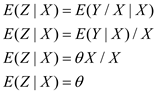

Also assume that the random variable     <div class=answer> (i) Given that there are two positive random variables X and Y   Also assume that the random variable   Then, this implies:   Using Property that follows the law of iterated expectations

Then, this implies:

    <div class=answer> (i) Given that there are two positive random variables X and Y   Also assume that the random variable   Then, this implies:   Using Property that follows the law of iterated expectations

Using Property that follows the law of iterated expectations    <div class=answer> (i) Given that there are two positive random variables X and Y   Also assume that the random variable   Then, this implies:   Using Property that follows the law of iterated expectations


Step 2 of 5


Step 3 of 5


Step 4 of 5


Step 5 of 5

close menu
Introductory Econometrics: A Modern Approach 6th Edition by Jeffrey M Wooldridge
cross icon



