


expand icon
book Introductory Econometrics: A Modern Approach 6th Edition by Jeffrey M Wooldridge cover

Introductory Econometrics: A Modern Approach 6th Edition by Jeffrey M Wooldridge

Edition 6ISBN: 130527010X
book Introductory Econometrics: A Modern Approach 6th Edition by Jeffrey M Wooldridge cover

Introductory Econometrics: A Modern Approach 6th Edition by Jeffrey M Wooldridge

Edition 6ISBN: 130527010X
Exercise 1

Let Y1, Y2, Y3, and Y4 be independent, identically distributed random variables from a population with mean ? and variance ?2. Let  Let Y<span class=sub>1</span>, Y<span class=sub>2</span>, Y<span class=sub>3</span>, and Y<span class=sub>4</span> be independent, identically distributed random variables from a population with mean ? and variance ?<span class=sup>2</span>. Let   =   (Y<span class=sub>1</span>+Y<span class=sub>2</span> + Y<span class=sub>3</span> + Y<span class=sub>4</span>) denote the average of these four random variables. <blockquote> (i) What are the expected value and variance of   P in terms of ? and ?<span class=sup>2</span>? (ii) Now, consider a different estimator of ?: W =   Y<span class=sub>1</span>+   Y<span class=sub>2</span> +   Y<span class=sub>3</span> +   Y<span class=sub>4</span>. This is an example of a weighted average of the Yi. Show that W is also an unbiased estimator of ?. Find the variance of W. (iii) Based on your answers to parts (i) and (ii), which estimator of ? do you prefer,   or W? </blockquote>   =  Let Y<span class=sub>1</span>, Y<span class=sub>2</span>, Y<span class=sub>3</span>, and Y<span class=sub>4</span> be independent, identically distributed random variables from a population with mean ? and variance ?<span class=sup>2</span>. Let   =   (Y<span class=sub>1</span>+Y<span class=sub>2</span> + Y<span class=sub>3</span> + Y<span class=sub>4</span>) denote the average of these four random variables. <blockquote> (i) What are the expected value and variance of   P in terms of ? and ?<span class=sup>2</span>? (ii) Now, consider a different estimator of ?: W =   Y<span class=sub>1</span>+   Y<span class=sub>2</span> +   Y<span class=sub>3</span> +   Y<span class=sub>4</span>. This is an example of a weighted average of the Yi. Show that W is also an unbiased estimator of ?. Find the variance of W. (iii) Based on your answers to parts (i) and (ii), which estimator of ? do you prefer,   or W? </blockquote>   (Y1+Y2 + Y3 + Y4) denote the average of these four random variables.

(i) What are the expected value and variance of  Let Y<span class=sub>1</span>, Y<span class=sub>2</span>, Y<span class=sub>3</span>, and Y<span class=sub>4</span> be independent, identically distributed random variables from a population with mean ? and variance ?<span class=sup>2</span>. Let   =   (Y<span class=sub>1</span>+Y<span class=sub>2</span> + Y<span class=sub>3</span> + Y<span class=sub>4</span>) denote the average of these four random variables. <blockquote> (i) What are the expected value and variance of   P in terms of ? and ?<span class=sup>2</span>? (ii) Now, consider a different estimator of ?: W =   Y<span class=sub>1</span>+   Y<span class=sub>2</span> +   Y<span class=sub>3</span> +   Y<span class=sub>4</span>. This is an example of a weighted average of the Yi. Show that W is also an unbiased estimator of ?. Find the variance of W. (iii) Based on your answers to parts (i) and (ii), which estimator of ? do you prefer,   or W? </blockquote>   P in terms of ? and ?2?

(ii) Now, consider a different estimator of ?:

W =  Let Y<span class=sub>1</span>, Y<span class=sub>2</span>, Y<span class=sub>3</span>, and Y<span class=sub>4</span> be independent, identically distributed random variables from a population with mean ? and variance ?<span class=sup>2</span>. Let   =   (Y<span class=sub>1</span>+Y<span class=sub>2</span> + Y<span class=sub>3</span> + Y<span class=sub>4</span>) denote the average of these four random variables. <blockquote> (i) What are the expected value and variance of   P in terms of ? and ?<span class=sup>2</span>? (ii) Now, consider a different estimator of ?: W =   Y<span class=sub>1</span>+   Y<span class=sub>2</span> +   Y<span class=sub>3</span> +   Y<span class=sub>4</span>. This is an example of a weighted average of the Yi. Show that W is also an unbiased estimator of ?. Find the variance of W. (iii) Based on your answers to parts (i) and (ii), which estimator of ? do you prefer,   or W? </blockquote>   Y1+  Let Y<span class=sub>1</span>, Y<span class=sub>2</span>, Y<span class=sub>3</span>, and Y<span class=sub>4</span> be independent, identically distributed random variables from a population with mean ? and variance ?<span class=sup>2</span>. Let   =   (Y<span class=sub>1</span>+Y<span class=sub>2</span> + Y<span class=sub>3</span> + Y<span class=sub>4</span>) denote the average of these four random variables. <blockquote> (i) What are the expected value and variance of   P in terms of ? and ?<span class=sup>2</span>? (ii) Now, consider a different estimator of ?: W =   Y<span class=sub>1</span>+   Y<span class=sub>2</span> +   Y<span class=sub>3</span> +   Y<span class=sub>4</span>. This is an example of a weighted average of the Yi. Show that W is also an unbiased estimator of ?. Find the variance of W. (iii) Based on your answers to parts (i) and (ii), which estimator of ? do you prefer,   or W? </blockquote>   Y2 +  Let Y<span class=sub>1</span>, Y<span class=sub>2</span>, Y<span class=sub>3</span>, and Y<span class=sub>4</span> be independent, identically distributed random variables from a population with mean ? and variance ?<span class=sup>2</span>. Let   =   (Y<span class=sub>1</span>+Y<span class=sub>2</span> + Y<span class=sub>3</span> + Y<span class=sub>4</span>) denote the average of these four random variables. <blockquote> (i) What are the expected value and variance of   P in terms of ? and ?<span class=sup>2</span>? (ii) Now, consider a different estimator of ?: W =   Y<span class=sub>1</span>+   Y<span class=sub>2</span> +   Y<span class=sub>3</span> +   Y<span class=sub>4</span>. This is an example of a weighted average of the Yi. Show that W is also an unbiased estimator of ?. Find the variance of W. (iii) Based on your answers to parts (i) and (ii), which estimator of ? do you prefer,   or W? </blockquote>   Y3 +  Let Y<span class=sub>1</span>, Y<span class=sub>2</span>, Y<span class=sub>3</span>, and Y<span class=sub>4</span> be independent, identically distributed random variables from a population with mean ? and variance ?<span class=sup>2</span>. Let   =   (Y<span class=sub>1</span>+Y<span class=sub>2</span> + Y<span class=sub>3</span> + Y<span class=sub>4</span>) denote the average of these four random variables. <blockquote> (i) What are the expected value and variance of   P in terms of ? and ?<span class=sup>2</span>? (ii) Now, consider a different estimator of ?: W =   Y<span class=sub>1</span>+   Y<span class=sub>2</span> +   Y<span class=sub>3</span> +   Y<span class=sub>4</span>. This is an example of a weighted average of the Yi. Show that W is also an unbiased estimator of ?. Find the variance of W. (iii) Based on your answers to parts (i) and (ii), which estimator of ? do you prefer,   or W? </blockquote>   Y4.

This is an example of a weighted average of the Yi. Show that W is also an unbiased estimator of ?. Find the variance of W.

(iii) Based on your answers to parts (i) and (ii), which estimator of ? do you prefer,  Let Y<span class=sub>1</span>, Y<span class=sub>2</span>, Y<span class=sub>3</span>, and Y<span class=sub>4</span> be independent, identically distributed random variables from a population with mean ? and variance ?<span class=sup>2</span>. Let   =   (Y<span class=sub>1</span>+Y<span class=sub>2</span> + Y<span class=sub>3</span> + Y<span class=sub>4</span>) denote the average of these four random variables. <blockquote> (i) What are the expected value and variance of   P in terms of ? and ?<span class=sup>2</span>? (ii) Now, consider a different estimator of ?: W =   Y<span class=sub>1</span>+   Y<span class=sub>2</span> +   Y<span class=sub>3</span> +   Y<span class=sub>4</span>. This is an example of a weighted average of the Yi. Show that W is also an unbiased estimator of ?. Find the variance of W. (iii) Based on your answers to parts (i) and (ii), which estimator of ? do you prefer,   or W? </blockquote>   or W?

Step-by-step solution
Verified
like image
like image

Step 1 of 6

The following variables are random and independent variables with mean µ and variance s2.
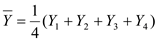
    <div class=answer> The following variables are random and independent variables with mean <i> µ </i>and variance <i> s </i><sup>2</sup><i> . </i>


Step 2 of 6


Step 3 of 6


Step 4 of 6


Step 5 of 6


Step 6 of 6

close menu
Introductory Econometrics: A Modern Approach 6th Edition by Jeffrey M Wooldridge
cross icon



