


expand icon
book Fundamentals of Cost Accounting 3rd Edition by William N. Lanen, Shannon W. Anderson, Michael Maher cover

Fundamentals of Cost Accounting 3rd Edition by William N. Lanen, Shannon W. Anderson, Michael Maher

Edition 3ISBN: 0073527114
book Fundamentals of Cost Accounting 3rd Edition by William N. Lanen, Shannon W. Anderson, Michael Maher cover

Fundamentals of Cost Accounting 3rd Edition by William N. Lanen, Shannon W. Anderson, Michael Maher

Edition 3ISBN: 0073527114
Exercise 39

Prepare a Production Cost Report: Weighted-Average Method

Douglas Toys is a manufacturer that uses the weighted-average process costing method to account for costs of production. It produces a plastic toy in three separate departments: Molding, Assembling, and Finishing. The following information was obtained for the Assembling Department for the month of September.

Work in process on September 1 had 100,000 units made up of the following:


Degree of


Amount

Completion

Prior department costs transferred in from the Molding Department.

$128,000

100%

Costs added by the Assembling Department


Direct materials

80,000

100%

Direct labor

28,800

60%

Manufacturing overhead

18,400

$127,200

50%

Work in process, September 1

$255,200


During September, 500,000 units were transferred in from the Molding Department at a cost of $640,000. The Assembling Department added the following costs:

Direct materials

$384,000

Direct labor

144 000

Manufacturing overhead

75,600

Total costs added

$603,600

Assembling finished 400,000 units and transferred them to the Finishing Department.

At September 30, 200,000 units were still in work-in-process inventory. The degree of completion of work-in-process inventory at September 30 was as follows:

Direct materials

90%

Direct labor

70

Manufacturing overhead

35

Required

a.Prepare a production cost report using the weighted-average method.


b.Management would like to decrease the costs of manufacturing the toy. In particular, it has set the following per unit targets for this product in the Assembling Department: Materials, $0.80; labor, $0.40; and manufacturing overhead, $0.18. Has the product achieved management’s cost targets in the Assembling Department? Write a short report to management stating your answer(s).

Step-by-step solution
Verified
like image
like image

Step 1 of 2

(a)

The required production cost report should be prepared in the following manner:
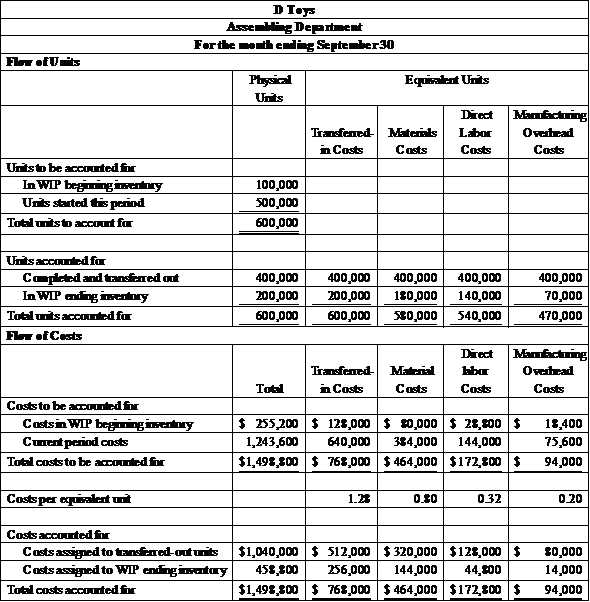
    <div class=answer> (a) The required production cost report should be prepared in the following manner:   Working notes: 1. Work-in-process ending inventory is 90% complete for materials, 70% complete for direct labor, and 35% complete for manufacturing overheads. Therefore, equivalent units of work-in-process ending inventory for materials is 180,000   , for direct labor is 140,000   , and for manufacturing overheads is 70,000   . 2. Cost per equivalent unit for each item has been computed by dividing total cost to be accounted for by total units to be accounted for. 3. Costs assigned to work-in-process ending inventory for each item has been computed by multiplying equivalent units by cost per equivalent unit.


Working notes:

1. Work-in-process ending inventory is 90% complete for materials, 70% complete for direct labor, and 35% complete for manufacturing overheads. Therefore, equivalent units of work-in-process ending inventory for materials is 180,000    <div class=answer> (a) The required production cost report should be prepared in the following manner:   Working notes: 1. Work-in-process ending inventory is 90% complete for materials, 70% complete for direct labor, and 35% complete for manufacturing overheads. Therefore, equivalent units of work-in-process ending inventory for materials is 180,000   , for direct labor is 140,000   , and for manufacturing overheads is 70,000   . 2. Cost per equivalent unit for each item has been computed by dividing total cost to be accounted for by total units to be accounted for. 3. Costs assigned to work-in-process ending inventory for each item has been computed by multiplying equivalent units by cost per equivalent unit. , for direct labor is 140,000    <div class=answer> (a) The required production cost report should be prepared in the following manner:   Working notes: 1. Work-in-process ending inventory is 90% complete for materials, 70% complete for direct labor, and 35% complete for manufacturing overheads. Therefore, equivalent units of work-in-process ending inventory for materials is 180,000   , for direct labor is 140,000   , and for manufacturing overheads is 70,000   . 2. Cost per equivalent unit for each item has been computed by dividing total cost to be accounted for by total units to be accounted for. 3. Costs assigned to work-in-process ending inventory for each item has been computed by multiplying equivalent units by cost per equivalent unit. , and for manufacturing overheads is 70,000    <div class=answer> (a) The required production cost report should be prepared in the following manner:   Working notes: 1. Work-in-process ending inventory is 90% complete for materials, 70% complete for direct labor, and 35% complete for manufacturing overheads. Therefore, equivalent units of work-in-process ending inventory for materials is 180,000   , for direct labor is 140,000   , and for manufacturing overheads is 70,000   . 2. Cost per equivalent unit for each item has been computed by dividing total cost to be accounted for by total units to be accounted for. 3. Costs assigned to work-in-process ending inventory for each item has been computed by multiplying equivalent units by cost per equivalent unit. .

2. Cost per equivalent unit for each item has been computed by dividing total cost to be accounted for by total units to be accounted for.

3. Costs assigned to work-in-process ending inventory for each item has been computed by multiplying equivalent units by cost per equivalent unit.


Step 2 of 2

close menu
Fundamentals of Cost Accounting 3rd Edition by William N. Lanen, Shannon W. Anderson, Michael Maher
cross icon




