


expand icon
book Fundamentals of Cost Accounting 3rd Edition by William N. Lanen, Shannon W. Anderson, Michael Maher cover

Fundamentals of Cost Accounting 3rd Edition by William N. Lanen, Shannon W. Anderson, Michael Maher

Edition 3ISBN: 0073527114
book Fundamentals of Cost Accounting 3rd Edition by William N. Lanen, Shannon W. Anderson, Michael Maher cover

Fundamentals of Cost Accounting 3rd Edition by William N. Lanen, Shannon W. Anderson, Michael Maher

Edition 3ISBN: 0073527114
Exercise 19

Profit Equation Components

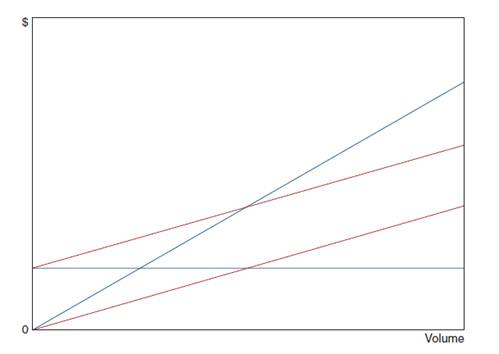
Identify each of the following profit equation components on the graph that follows:

a. The total cost line.


b. The total revenue line.


c. The total variable costs area.


d. Variable cost per unit.


e. The fixed costs area.


f. The break-even point.


g. The profit area (range of volumes leading to profit).


h. The loss area (range of volumes leading to loss).
 <span class=bold><span class=bold>Profit Equation Components</span></span> Identify each of the following profit equation components on the graph that follows: <span class=italics>a</span>. The total cost line. <span class=italics>b</span>. The total revenue line. <span class=italics>c</span>. The total variable costs area. <span class=italics>d</span>. Variable cost per unit. <span class=italics>e</span>. The fixed costs area. <span class=italics>f</span>. The break-even point. <span class=italics>g</span>. The profit area (range of volumes leading to profit). <span class=italics>h</span>. The loss area (range of volumes leading to loss).

Step-by-step solution
Verified
like image
like image

Step 1 of 4

Profit Equation Components

The profit equation is the key to CVP analysis. The components of the profit equation are operating profit, total revenues, and total costs. The operating profit is equal to the difference of total revenues and total costs. The profit equation is provided below:

    <div class=answer> <u> Profit Equation Components </u> The profit equation is the key to CVP analysis. The components of the profit equation are operating profit, total revenues, and total costs. The operating profit is equal to the difference of total revenues and total costs. The profit equation is provided below:   The break-even point is the point at which total costs equal total revenues.

The break-even point is the point at which total costs equal total revenues.


Step 2 of 4


Step 3 of 4


Step 4 of 4

close menu
Fundamentals of Cost Accounting 3rd Edition by William N. Lanen, Shannon W. Anderson, Michael Maher
cross icon



