


expand icon
book Accounting: What the Numbers Mean 9th Edition by Wayne W McManus, Daniel F Viele, David H Marshall cover

Accounting: What the Numbers Mean 9th Edition by Wayne W McManus, Daniel F Viele, David H Marshall

Edition 9ISBN: 0073527068
book Accounting: What the Numbers Mean 9th Edition by Wayne W McManus, Daniel F Viele, David H Marshall cover

Accounting: What the Numbers Mean 9th Edition by Wayne W McManus, Daniel F Viele, David H Marshall

Edition 9ISBN: 0073527068
Exercise 89

CVP application—allow special discount? Assume you are a sales representative for Sweet Tooth Candy Company. One of your customers is interested in buying some candy that will be given to the members of a high school Substance Abuse Awareness Club. The club members will be marching in a community parade and will give the candy to children who are watching the parade. Your customer has asked that you discount the normal selling price of the candy to be given to the club by 30%. You know that the contribution margin ratio of the candy, based on the regular selling price, is 40%.

Required:

Identify the pros and cons of complying with the customer’s request, and state the recommendation you would make to your sales manager.

Step-by-step solution
Verified
like image
like image

Step 1 of 3

The following can be the disadvantage to the company by giving discount:

If the units sold remains constant even after giving the discount then the contribution margin will reduce a lot and will not cover even the 40% which was the initial contribution margin of the company. This can be better explained with the following example:

Suppose the company sells 5,000 units of the candy at the selling price of $100, the contribution margin being 40% and the fixed expenses being $20,000.The calculation for contribution is as:

    <div class=answer> The following can be the disadvantage to the company by giving discount: If the units sold remains constant even after giving the discount then the contribution margin will reduce a lot and will not cover even the 40% which was the initial contribution margin of the company. This can be better explained with the following example: Suppose the company sells 5,000 units of the candy at the selling price of $100, the contribution margin being 40% and the fixed expenses being $20,000.The calculation for contribution is as:   Thus the contribution margin that is   But if the discount of 30% is given then the selling price per unit becomes $70, and thus the calculation becomes:   Thus the contribution margin reduces and thus is not profitable for the company.

Thus the contribution margin that is

    <div class=answer> The following can be the disadvantage to the company by giving discount: If the units sold remains constant even after giving the discount then the contribution margin will reduce a lot and will not cover even the 40% which was the initial contribution margin of the company. This can be better explained with the following example: Suppose the company sells 5,000 units of the candy at the selling price of $100, the contribution margin being 40% and the fixed expenses being $20,000.The calculation for contribution is as:   Thus the contribution margin that is   But if the discount of 30% is given then the selling price per unit becomes $70, and thus the calculation becomes:   Thus the contribution margin reduces and thus is not profitable for the company.

But if the discount of 30% is given then the selling price per unit becomes $70, and thus the calculation becomes:
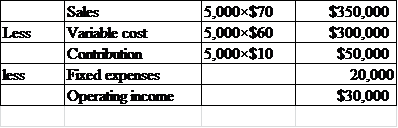
    <div class=answer> The following can be the disadvantage to the company by giving discount: If the units sold remains constant even after giving the discount then the contribution margin will reduce a lot and will not cover even the 40% which was the initial contribution margin of the company. This can be better explained with the following example: Suppose the company sells 5,000 units of the candy at the selling price of $100, the contribution margin being 40% and the fixed expenses being $20,000.The calculation for contribution is as:   Thus the contribution margin that is   But if the discount of 30% is given then the selling price per unit becomes $70, and thus the calculation becomes:   Thus the contribution margin reduces and thus is not profitable for the company.

Thus the contribution margin reduces and thus is not profitable for the company.


Step 2 of 3


Step 3 of 3

close menu
Accounting: What the Numbers Mean 9th Edition by Wayne W McManus, Daniel F Viele, David H Marshall
cross icon



