





 Chat with AI


Accounting: What the Numbers Mean 9th Edition by Wayne W McManus, Daniel F Viele, David H Marshall
Edition 9ISBN: 0073527068Accounting: What the Numbers Mean 9th Edition by Wayne W McManus, Daniel F Viele, David H Marshall
Edition 9ISBN: 0073527068Cost-flow assumptions—FIFO and LIFO using a periodic system Mower- Blower Sales Co. started business on January 20, 2010. Products sold were snow blowers and lawn mowers. Each product sold for $350. Purchases during 2010 were as follows:
| Blowers | Mowers |
January 21 | 20 @ $200 |
|
February 3 | 40 @ 195 |
|
February 28 | 30 @ 190 |
|
March 13 | 20 @ 190 |
|
April 6 |
| 20 @ $210 |
May 22 |
| 40 @ 215 |
June 3 |
| 40 @ 220 |
June 20 |
| 60 @ 230 |
August 15 |
| 20 @ 215 |
September 20 |
| 20 @ 210 |
November 7 | 20 @ 200 |
|
The December 31, 2010, inventory included 10 blowers and 25 mowers. Assume the company uses a periodic inventory system.
Required:
a. What will be the difference between ending inventory valuation at December 31, 2010, and cost of goods sold for 2010, under the FIFO and LIFO cost-flow assumptions? (Hint: Compute ending inventory and cost of goods sold under each method, and then compare results.)
b. If the cost of mowers had increased to $240 each by December 1, and if management had purchased 30 mowers at that time, which cost-flow assumption was probably being used by the firm? Explain your answer.
 Verified
Step 1 of 2
Cost – flow assumptions – LIFO and FIFO with a periodic system:
a. The difference between ending inventory estimation under two different periodic system of LIFO and FIFO are as follows:
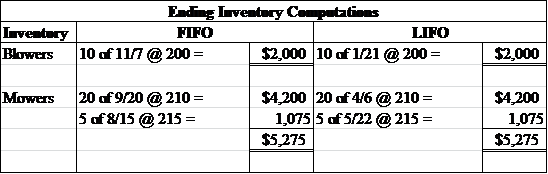
Interpretation of results:
The presented problem shows there is no distinction between ending inventories, and hence, there would not be any variation between amount costs of goods sold using either of the alternative methods. Neither the sum of goods available for sale (that is, the amount of the beginning inventory plus purchases amounts) nor the totals of ending inventory is changed by the use of inventory cost flow assumption.
Why? Look per unit cost of inventory that were purchased throughout the year. Note that per unit cost of the purchased items on September 20 & November 7 were the same.
Step 2 of 2


Why don’t you like this exercise?
Other






