


expand icon
book Accounting: What the Numbers Mean 9th Edition by Wayne W McManus, Daniel F Viele, David H Marshall cover

Accounting: What the Numbers Mean 9th Edition by Wayne W McManus, Daniel F Viele, David H Marshall

Edition 9ISBN: 0073527068
book Accounting: What the Numbers Mean 9th Edition by Wayne W McManus, Daniel F Viele, David H Marshall cover

Accounting: What the Numbers Mean 9th Edition by Wayne W McManus, Daniel F Viele, David H Marshall

Edition 9ISBN: 0073527068
Exercise 54
Step-by-step solution
Verified
like image
like image

Step 1 of 2

a.The solution approach is similar to that shown in Problem 2-9.  Gains or losses can be calculated for the sale (or collection) of each of Kimber Co.’s non-cash assets, as follows:
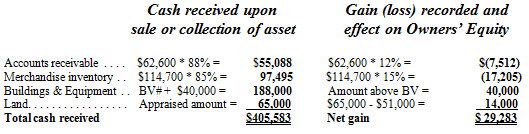
    <div class=answer> a.The solution approach is similar to that shown in Problem 2-9.  Gains or losses can be calculated for the sale (or collection) of each of Kimber Co.’s non-cash assets, as follows:   # $343,000 - $195,000 accumulated depreciation = $148,000 book value of buildings&equipment. The $405,583 cash received from the liquidation of non-cash assets would be added to the beginning cash balance of $18,400, and $423,983 is the amount of cash available to pay the claims of creditors and stockholders.  Liabilities would be paid first (including the amounts that are <span class=italics>not</span> shown on the balance sheet), and the balance would be paid to the stockholders: <table width=50% cellspacing=0 cellpadding=0 border=0>     <tbody>      <tr>       <td valign=top align=left> Total cash available </td>       <td valign=top align=center><p align=center>  </td>       <td valign=top align=center><p align=right>$423,983 </td>      </tr>      <tr>       <td valign=top align=left> Accounts payable </td>       <td valign=top align=center><p align=right>$46,700 <p align=center>  </td>       <td valign=top align=center><p align=center>  </td>      </tr>      <tr>       <td valign=top align=left> Notes payable </td>       <td valign=top align=center><p align=right>58,500 </td>       <td valign=top align=center><p align=center>  </td>      </tr>      <tr>       <td valign=top align=left> Wages payable (not shown on balance sheet) </td>       <td valign=top align=center><p align=right>2,400 </td>       <td valign=top align=center><p align=center>  </td>      </tr>      <tr>       <td valign=top align=left> Interest payable (not shown on balance sheet) </td>       <td valign=top align=center><p align=right>5,250 </td>       <td valign=top align=center><p align=center>  </td>      </tr>      <tr>       <td valign=top align=left> Long-term debt </td>       <td valign=top align=center><p align=right><span class=underline>64,800</span> </td>       <td valign=top align=center><p align=right><span class=underline>(177,650)</span> </td>      </tr>      <tr>       <td valign=top align=left> <span class=bold>Total cash available to stockholders</span> </td>       <td valign=top align=center><p align=center>  </td>       <td valign=top align=center><p align=right><span class=bold><span class=underline>$246,333</span></span> </td>      </tr>     </tbody>    </table> The total cash available to stockholders upon liquidation can be verified, as follows: <table width=40% cellspacing=0 cellpadding=0 border=0>     <tbody>      <tr>       <td valign=top align=left> Total owners’ equity (<span class=italics>unadjusted</span>, from balance sheet) </td>       <td valign=top align=right><p align=right>$224,700 </td>      </tr>      <tr>       <td valign=top align=left> Add: Gain on sale of buildings&equipment </td>       <td valign=top align=right><p align=right>40,000 </td>      </tr>      <tr>       <td valign=top align=left> Add: Gain on sale of land </td>       <td valign=top align=right><p align=right>14,000 </td>      </tr>      <tr>       <td valign=top align=left> Less: Loss on collection of accounts receivable </td>       <td valign=top align=right><p align=right>(7,512) </td>      </tr>      <tr>       <td valign=top align=left> Less: Loss on liquidation of merchandise inventory </td>       <td valign=top align=right><p align=right>(17,205) <p align=right>  </td>      </tr>      <tr>       <td valign=top align=left> Less: Unrecorded wages expense </td>       <td valign=top align=right><p align=right> (2,400) </td>      </tr>      <tr>       <td valign=top align=left> Less: Unrecorded interest expense </td>       <td valign=top align=right><p align=right><span class=underline>(5,250</span>) </td>      </tr>      <tr>       <td valign=top align=left> <span class=bold>Total owners’ equity, <span class=italics>as adjusted</span></span> </td>       <td valign=top align=right><p align=right><span class=bold><span class=underline>$246,333</span></span> </td>      </tr>     </tbody>    </table>

# $343,000 - $195,000 accumulated depreciation = $148,000 book value of buildings&equipment.

The $405,583 cash received from the liquidation of non-cash assets would be added to the beginning cash balance of $18,400, and $423,983 is the amount of cash available to pay the claims of creditors and stockholders.  Liabilities would be paid first (including the amounts that are not shown on the balance sheet), and the balance would be paid to the stockholders:

Total cash available


$423,983

Accounts payable

$46,700


Notes payable

58,500


Wages payable (not shown on balance sheet)

2,400


Interest payable (not shown on balance sheet)

5,250


Long-term debt

64,800

(177,650)

Total cash available to stockholders


$246,333

The total cash available to stockholders upon liquidation can be verified, as follows:

Total owners’ equity (unadjusted, from balance sheet)

$224,700

Add: Gain on sale of buildings&equipment

40,000

Add: Gain on sale of land

14,000

Less: Loss on collection of accounts receivable

(7,512)

Less: Loss on liquidation of merchandise inventory

(17,205)


Less: Unrecorded wages expense

 (2,400)

Less: Unrecorded interest expense

(5,250)

Total owners’ equity, as adjusted

$246,333


Step 2 of 2

close menu
Accounting: What the Numbers Mean 9th Edition by Wayne W McManus, Daniel F Viele, David H Marshall
cross icon



