





 Chat with AI


Concepts of Genetics 11th Edition by William Klug,Michael Cummings,Charlotte Spencer,Michael Palladino
Edition 11ISBN: 9781292139456Concepts of Genetics 11th Edition by William Klug,Michael Cummings,Charlotte Spencer,Michael Palladino
Edition 11ISBN: 9781292139456 Exercise 36
The development of antibiotic resistance by pathogenic bacteria represents a major health concern. One potential new antibiotic is evernimicin, which was isolated from Micromonospora carbonacea? Evernimicin is an oligosaccharide with antibiotic activity against a broad range of gram-positive pathogenic bacteria. To determine the mode of action of this drug, researchers have analyzed 23S ribosomal DNA mutants that showed reduced sensitivity to evernimicin (e.g., Adrian et al., 2000. Antimicrob. Ag. and Chemo. 44: 3101-3106). They discovered two classes of mutants that conferred resistance: In one class, the mutation occurs in 23 S rRNA nucleotides 2475-2483; in the other class, it occurs in ribosomal protein L16. This suggests that these two ribosomal components are structurally and functionally linked. It turns out that the tRNA anticodon stem-loop appears to bind to the A site of the ribosome at rRNA bases 2465-2485. This finding conforms to the proposed function of L16, which appears to be involved in attracting the aminoacyl stem of the tRNA to the ribosome at its A site. Using your sketch of the translation machinery from Problem 35 along with this information, designate where the proposed antibacterial action of evernimicin is likely to occur.
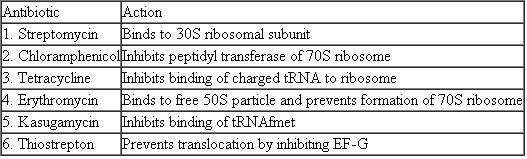
The emergence of antibiotic-resistant strains of Enterococci and transfer of resistant genes to other bacterial pathogens have highlighted the need for new generations of antibiotics to combat serious infections. To grasp the range of potential sites for the action of existing antibiotics, sketch the components of the translation machinery (e.g., see Step 3 of Figure), and using a series of numbered pointers, indicate the specific location for the action of the antibiotics shown in the following table.
 Figure
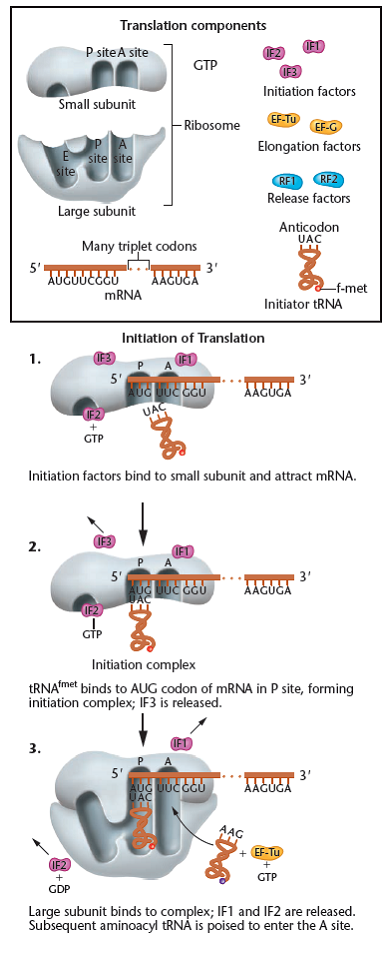
Initiation of translation. The separate components are depicted at the left of the figure.
The emergence of antibiotic-resistant strains of Enterococci and transfer of resistant genes to other bacterial pathogens have highlighted the need for new generations of antibiotics to combat serious infections. To grasp the range of potential sites for the action of existing antibiotics, sketch the components of the translation machinery (e.g., see Step 3 of Figure), and using a series of numbered pointers, indicate the specific location for the action of the antibiotics shown in the following table.
Figure Initiation of translation. The separate components are depicted at the left of the figure.
Explanation Verified
Verified
Antibiotic resistance is nothing but the...

Concepts of Genetics 11th Edition by William Klug,Michael Cummings,Charlotte Spencer,Michael Palladino

Why don’t you like this exercise?
Other Minimum 8 character and maximum 255 character
Character 255







