





 Chat with AI

Concepts of Genetics 11th Edition by William Klug,Michael Cummings,Charlotte Spencer,Michael Palladino
Edition 11ISBN: 9781292139456Concepts of Genetics 11th Edition by William Klug,Michael Cummings,Charlotte Spencer,Michael Palladino
Edition 11ISBN: 9781292139456 Exercise 23
Based on our discussion of the potential inaccuracy of mapping (see Figure , would you revise your answer to Problem? If so, how?
FIGURE
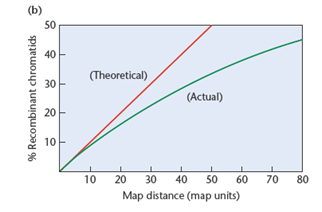
(a) A double crossover is undetected because no rearrangement of alleles occurs. (b) The theoretical and actual percentage of recombinant chromatids versus map distance. The straight line shows the theoretical relationship if a direct correlation between recombination and map distance exists. The curved line is the actual relationship derived from studies of Drosophila , Neurospora , and Zea mays.

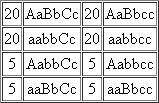
An organism of the genotype AaBbCc was testcrossed to a triply recessive organism ( aabbcc ). The genotypes of the progeny are presented in the following table.
 (a) If these three genes were all assorting independently, how many genotypic and phenotypic classes would result in the offspring, and in what proportion, assuming simple dominance and recessiveness in each gene pair?
(b) Answer part (a) again, assuming the three genes are so tightly linked on a single chromosome that no crossover gametes were recovered in the sample of offspring.
(c) What can you conclude from the actual data about the location of the three genes in relation to one another?
FIGURE
(a) A double crossover is undetected because no rearrangement of alleles occurs. (b) The theoretical and actual percentage of recombinant chromatids versus map distance. The straight line shows the theoretical relationship if a direct correlation between recombination and map distance exists. The curved line is the actual relationship derived from studies of Drosophila , Neurospora , and Zea mays.
An organism of the genotype AaBbCc was testcrossed to a triply recessive organism ( aabbcc ). The genotypes of the progeny are presented in the following table.
(a) If these three genes were all assorting independently, how many genotypic and phenotypic classes would result in the offspring, and in what proportion, assuming simple dominance and recessiveness in each gene pair?(b) Answer part (a) again, assuming the three genes are so tightly linked on a single chromosome that no crossover gametes were recovered in the sample of offspring.
(c) What can you conclude from the actual data about the location of the three genes in relation to one another?
Explanation Verified
Verified
The genotype of P 2 is aabbcc. The genot...

Concepts of Genetics 11th Edition by William Klug,Michael Cummings,Charlotte Spencer,Michael Palladino

Why don’t you like this exercise?
Other Minimum 8 character and maximum 255 character
Character 255







