





 Chat with AI

Concepts of Genetics 11th Edition by William Klug,Michael Cummings,Charlotte Spencer,Michael Palladino
Edition 11ISBN: 9781292139456Concepts of Genetics 11th Edition by William Klug,Michael Cummings,Charlotte Spencer,Michael Palladino
Edition 11ISBN: 9781292139456 Exercise 31
An alternative to using the expanded binomial equation and Pascal's triangle in determining probabilities of phenotypes in a subsequent generation when the parents' genotypes are known is to use the following equation:
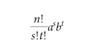
where n is the total number of offspring, s is the number of offspring in one phenotypic category, t is the number of offspring in the other phenotypic category, a is the probability of occurrence of the first phenotype, and b is the probability of the second phenotype. Using this equation, determine the probability of a family of 5 offspring having exactly 2 children afflicted with sickle-cell anemia (an autosomal recessive disease) when both parents are heterozygous for the sickle-cell allele.

where n is the total number of offspring, s is the number of offspring in one phenotypic category, t is the number of offspring in the other phenotypic category, a is the probability of occurrence of the first phenotype, and b is the probability of the second phenotype. Using this equation, determine the probability of a family of 5 offspring having exactly 2 children afflicted with sickle-cell anemia (an autosomal recessive disease) when both parents are heterozygous for the sickle-cell allele.
Explanation Verified
Verified

Concepts of Genetics 11th Edition by William Klug,Michael Cummings,Charlotte Spencer,Michael Palladino

Why don’t you like this exercise?
Other Minimum 8 character and maximum 255 character
Character 255







