





 Chat with AI

Deck 16: Chemistry of Benzene: Electrophilic Aromatic Substitution
Full screen (f)

Question
Exhibit 16-2
Consider the Friedel-Crafts alkylation reaction below to answer the following question(s):
Refer to Exhibit 16-2.What is the role of the AlCl3 in the reaction?
Consider the Friedel-Crafts alkylation reaction below to answer the following question(s):
Refer to Exhibit 16-2.What is the role of the AlCl3 in the reaction?

Question
Exhibit 16-1
MATCH a structure or term from the following list with each description below.Place the letter of the structure or term in the blank to the left of the description.
a.benzyne
e.+NO
b.+NO2
f.Meisenheimer complex
c.R3C+
g. d.electron-donating
h.electron-withdrawing
i.F-TEDA-BF4
______ The reactive electrophile in Friedel-Crafts acylation reactions.
MATCH a structure or term from the following list with each description below.Place the letter of the structure or term in the blank to the left of the description.
a.benzyne
e.+NO
b.+NO2
f.Meisenheimer complex
c.R3C+
g.
d.electron-donatingh.electron-withdrawing
i.F-TEDA-BF4
______ The reactive electrophile in Friedel-Crafts acylation reactions.
Question
Exhibit 16-1
MATCH a structure or term from the following list with each description below.Place the letter of the structure or term in the blank to the left of the description.
a.benzyne
e.+NO
b.+NO2
f.Meisenheimer complex
c.R3C+
g. d.electron-donating
h.electron-withdrawing
i.F-TEDA-BF4
______ The electrophile in aromatic nitration.
MATCH a structure or term from the following list with each description below.Place the letter of the structure or term in the blank to the left of the description.
a.benzyne
e.+NO
b.+NO2
f.Meisenheimer complex
c.R3C+
g.
d.electron-donatingh.electron-withdrawing
i.F-TEDA-BF4
______ The electrophile in aromatic nitration.
Question
Exhibit 16-1
MATCH a structure or term from the following list with each description below.Place the letter of the structure or term in the blank to the left of the description.
a.benzyne
e.+NO
b.+NO2
f.Meisenheimer complex
c.R3C+
g. d.electron-donating
h.electron-withdrawing
i.F-TEDA-BF4
______ Groups which activate aromatic rings towards electrophilic substitution.
MATCH a structure or term from the following list with each description below.Place the letter of the structure or term in the blank to the left of the description.
a.benzyne
e.+NO
b.+NO2
f.Meisenheimer complex
c.R3C+
g.
d.electron-donatingh.electron-withdrawing
i.F-TEDA-BF4
______ Groups which activate aromatic rings towards electrophilic substitution.
Question
Exhibit 16-3
Consider the data below to answer the following question(s).
The −NH2 group is listed in our textbook as the strongest o,p-directing activator in electrophilic aromatic substitution reactions.However,when aniline is subjected to standard nitration conditions poor yields of m-nitroaniline result.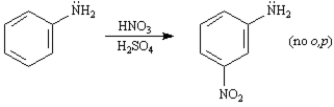
Refer to Exhibit 16-3.Draw all the resonance forms of aniline showing the electron-donating effect of the −NH2 substituent.
Consider the data below to answer the following question(s).
The −NH2 group is listed in our textbook as the strongest o,p-directing activator in electrophilic aromatic substitution reactions.However,when aniline is subjected to standard nitration conditions poor yields of m-nitroaniline result.
Refer to Exhibit 16-3.Draw all the resonance forms of aniline showing the electron-donating effect of the −NH2 substituent.
Question
Aniline reacts with nitrous acid,HNO2,to yield a stable diazonium salt.This diazonium salt undergoes electrophilic aromatic substitution on activated aromatic rings to yield brightly colored azo compounds that are widely used as dyes.The intermediate structures for the mechanism of this reaction are given below.Show all electron flow with arrows for this mechanism on the structures provided. 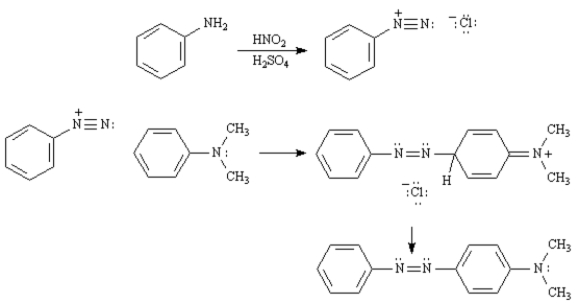
Question
Exhibit 16-2
Consider the Friedel-Crafts alkylation reaction below to answer the following question(s):
Refer to Exhibit 16-2.Write the complete stepwise mechanism for this reaction.Show all electron flow with arrows and include all intermediate structures.
Consider the Friedel-Crafts alkylation reaction below to answer the following question(s):
Refer to Exhibit 16-2.Write the complete stepwise mechanism for this reaction.Show all electron flow with arrows and include all intermediate structures.
Question
Exhibit 16-6
To answer the following question(s),refer to the data below:
Isobutylbenzene is the starting material for the industrial synthesis of the NSAID,ibuprofen.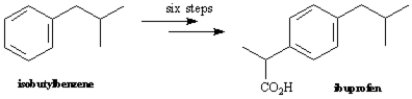
Refer to Exhibit 16-6.Propose a synthesis for isobutylbenzene which avoids the problems of direct Friedel-Crafts alkylation.
To answer the following question(s),refer to the data below:
Isobutylbenzene is the starting material for the industrial synthesis of the NSAID,ibuprofen.
Refer to Exhibit 16-6.Propose a synthesis for isobutylbenzene which avoids the problems of direct Friedel-Crafts alkylation.
Question
Exhibit 16-1
MATCH a structure or term from the following list with each description below.Place the letter of the structure or term in the blank to the left of the description.
a.benzyne
e.+NO
b.+NO2
f.Meisenheimer complex
c.R3C+
g. d.electron-donating
h.electron-withdrawing
i.F-TEDA-BF4
______ Groups which activate aromatic rings towards nucleophilic substitution.
MATCH a structure or term from the following list with each description below.Place the letter of the structure or term in the blank to the left of the description.
a.benzyne
e.+NO
b.+NO2
f.Meisenheimer complex
c.R3C+
g.
d.electron-donatingh.electron-withdrawing
i.F-TEDA-BF4
______ Groups which activate aromatic rings towards nucleophilic substitution.
Question
Would you expect (nitromethyl)benzene to be more reactive or less reactive than toluene toward electrophilic substitution? Explain. 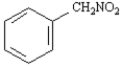
Question
Exhibit 16-2
Consider the Friedel-Crafts alkylation reaction below to answer the following question(s):
Refer to Exhibit 16-2.Draw the structure of the electrophilic intermediate in this reaction.
Consider the Friedel-Crafts alkylation reaction below to answer the following question(s):
Refer to Exhibit 16-2.Draw the structure of the electrophilic intermediate in this reaction.
Question
Exhibit 16-1
MATCH a structure or term from the following list with each description below.Place the letter of the structure or term in the blank to the left of the description.
a.benzyne
e.+NO
b.+NO2
f.Meisenheimer complex
c.R3C+
g. d.electron-donating
h.electron-withdrawing
i.F-TEDA-BF4
__________Source of F+ in fluorination reactions.
MATCH a structure or term from the following list with each description below.Place the letter of the structure or term in the blank to the left of the description.
a.benzyne
e.+NO
b.+NO2
f.Meisenheimer complex
c.R3C+
g.
d.electron-donatingh.electron-withdrawing
i.F-TEDA-BF4
__________Source of F+ in fluorination reactions.
Question
Exhibit 16-1
MATCH a structure or term from the following list with each description below.Place the letter of the structure or term in the blank to the left of the description.
a.benzyne
e.+NO
b.+NO2
f.Meisenheimer complex
c.R3C+
g. d.electron-donating
h.electron-withdrawing
i.F-TEDA-BF4
______ Intermediate in the elimination-addition mechanism of nucleophilic aromatic substitution.
MATCH a structure or term from the following list with each description below.Place the letter of the structure or term in the blank to the left of the description.
a.benzyne
e.+NO
b.+NO2
f.Meisenheimer complex
c.R3C+
g.
d.electron-donatingh.electron-withdrawing
i.F-TEDA-BF4
______ Intermediate in the elimination-addition mechanism of nucleophilic aromatic substitution.
Question
Exhibit 16-7
Consider the reaction below to answer the following question(s).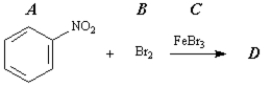
Refer to Exhibit 16-7.The Lewis acid catalyst in the reaction is:
Consider the reaction below to answer the following question(s).
Refer to Exhibit 16-7.The Lewis acid catalyst in the reaction is:
Question
Exhibit 16-6
To answer the following question(s),refer to the data below:
Isobutylbenzene is the starting material for the industrial synthesis of the NSAID,ibuprofen.
Refer to Exhibit 16-6.Attempts to prepare isobutylbenzene by direct Friedel-Crafts alkylation of benzene result in tert-butylbenzene as the major product.Write the complete stepwise mechanism for this reaction,showing all electron flow with arrows and showing all intermediate structures.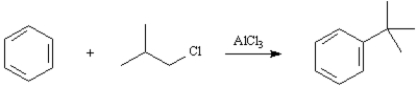
To answer the following question(s),refer to the data below:
Isobutylbenzene is the starting material for the industrial synthesis of the NSAID,ibuprofen.
Refer to Exhibit 16-6.Attempts to prepare isobutylbenzene by direct Friedel-Crafts alkylation of benzene result in tert-butylbenzene as the major product.Write the complete stepwise mechanism for this reaction,showing all electron flow with arrows and showing all intermediate structures.
Question
Exhibit 16-4
Consider the reaction below to answer the following question(s).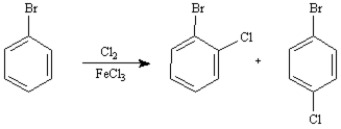
Refer to Exhibit 16-4.Draw resonance structures for the intermediate carbocation that explain the directing effect of the −Br.
Consider the reaction below to answer the following question(s).
Refer to Exhibit 16-4.Draw resonance structures for the intermediate carbocation that explain the directing effect of the −Br.
Question
Exhibit 16-7
Consider the reaction below to answer the following question(s).
Refer to Exhibit 16-7.This reaction proceeds _____ (faster or slower) than benzene.
Consider the reaction below to answer the following question(s).
Refer to Exhibit 16-7.This reaction proceeds _____ (faster or slower) than benzene.
Question
Exhibit 16-7
Consider the reaction below to answer the following question(s).
Refer to Exhibit 16-7.The nucleophile in the reaction is:
Consider the reaction below to answer the following question(s).
Refer to Exhibit 16-7.The nucleophile in the reaction is:
Question
Exhibit 16-3
Consider the data below to answer the following question(s).
The −NH2 group is listed in our textbook as the strongest o,p-directing activator in electrophilic aromatic substitution reactions.However,when aniline is subjected to standard nitration conditions poor yields of m-nitroaniline result.
Refer to Exhibit 16-3.Clearly,the reaction conditions are influencing the directing effect of the −NH2 group.Explain why this occurs,using both words and structures.
Consider the data below to answer the following question(s).
The −NH2 group is listed in our textbook as the strongest o,p-directing activator in electrophilic aromatic substitution reactions.However,when aniline is subjected to standard nitration conditions poor yields of m-nitroaniline result.
Refer to Exhibit 16-3.Clearly,the reaction conditions are influencing the directing effect of the −NH2 group.Explain why this occurs,using both words and structures.
Question
Exhibit 16-4
Consider the reaction below to answer the following question(s).
Refer to Exhibit 16-4.Write the complete stepwise mechanism for the formation of the ortho product.Show all intermediate structures and show all electron flow with arrows.
Consider the reaction below to answer the following question(s).
Refer to Exhibit 16-4.Write the complete stepwise mechanism for the formation of the ortho product.Show all intermediate structures and show all electron flow with arrows.
Question
Question
Question
Question
The following reaction proceeds by an intramolecular nucleophilic aromatic substitution mechanism.Write the complete stepwise mechanism,showing all intermediate structures and all electron flow with arrows. 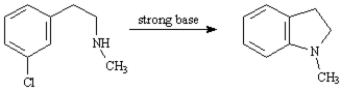
Question
Exhibit 16-7
Consider the reaction below to answer the following question(s).
Refer to Exhibit 16-7.Draw the structure of product D.
Consider the reaction below to answer the following question(s).
Refer to Exhibit 16-7.Draw the structure of product D.
Question
On the structural intermediates below,show all electron flow with arrows for the nucleophilic aromatic substitution reaction of p-nitrochlorobenzene with KOH. 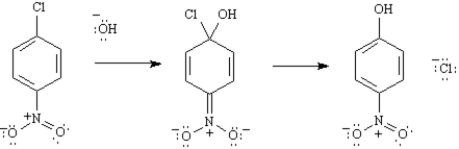
Question
Question
Question
Tetracyclone is often used to trap benzynes as Diels-Alder adducts.What is the structure of the Diels-Alder adduct that results when benzyne is trapped by tetracyclone? 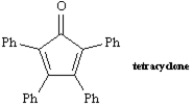
Question

Unlock Deck
Sign up to unlock the cards in this deck!
Unlock Deck
Unlock Deck
1/30

Play

Full screen (f)
Deck 16: Chemistry of Benzene: Electrophilic Aromatic Substitution
1
Exhibit 16-2
Consider the Friedel-Crafts alkylation reaction below to answer the following question(s):
Refer to Exhibit 16-2.What is the role of the AlCl3 in the reaction?
Consider the Friedel-Crafts alkylation reaction below to answer the following question(s):
Refer to Exhibit 16-2.What is the role of the AlCl3 in the reaction?
The AlCl3 is a Lewis acid catalyst that assists in the ionization of the alkyl halide to give the carbocation electrophile.
2
Exhibit 16-1
MATCH a structure or term from the following list with each description below.Place the letter of the structure or term in the blank to the left of the description.
a.benzyne
e.+NO
b.+NO2
f.Meisenheimer complex
c.R3C+
g. d.electron-donating
h.electron-withdrawing
i.F-TEDA-BF4
______ The reactive electrophile in Friedel-Crafts acylation reactions.
MATCH a structure or term from the following list with each description below.Place the letter of the structure or term in the blank to the left of the description.
a.benzyne
e.+NO
b.+NO2
f.Meisenheimer complex
c.R3C+
g.
d.electron-donatingh.electron-withdrawing
i.F-TEDA-BF4
______ The reactive electrophile in Friedel-Crafts acylation reactions.
g
3
Exhibit 16-1
MATCH a structure or term from the following list with each description below.Place the letter of the structure or term in the blank to the left of the description.
a.benzyne
e.+NO
b.+NO2
f.Meisenheimer complex
c.R3C+
g. d.electron-donating
h.electron-withdrawing
i.F-TEDA-BF4
______ The electrophile in aromatic nitration.
MATCH a structure or term from the following list with each description below.Place the letter of the structure or term in the blank to the left of the description.
a.benzyne
e.+NO
b.+NO2
f.Meisenheimer complex
c.R3C+
g.
d.electron-donatingh.electron-withdrawing
i.F-TEDA-BF4
______ The electrophile in aromatic nitration.
b
4
Exhibit 16-1
MATCH a structure or term from the following list with each description below.Place the letter of the structure or term in the blank to the left of the description.
a.benzyne
e.+NO
b.+NO2
f.Meisenheimer complex
c.R3C+
g. d.electron-donating
h.electron-withdrawing
i.F-TEDA-BF4
______ Groups which activate aromatic rings towards electrophilic substitution.
MATCH a structure or term from the following list with each description below.Place the letter of the structure or term in the blank to the left of the description.
a.benzyne
e.+NO
b.+NO2
f.Meisenheimer complex
c.R3C+
g.
d.electron-donatingh.electron-withdrawing
i.F-TEDA-BF4
______ Groups which activate aromatic rings towards electrophilic substitution.
Unlock Deck
Unlock for access to all 30 flashcards in this deck.
Unlock Deck
k this deck
5
Exhibit 16-3
Consider the data below to answer the following question(s).
The −NH2 group is listed in our textbook as the strongest o,p-directing activator in electrophilic aromatic substitution reactions.However,when aniline is subjected to standard nitration conditions poor yields of m-nitroaniline result.
Refer to Exhibit 16-3.Draw all the resonance forms of aniline showing the electron-donating effect of the −NH2 substituent.
Consider the data below to answer the following question(s).
The −NH2 group is listed in our textbook as the strongest o,p-directing activator in electrophilic aromatic substitution reactions.However,when aniline is subjected to standard nitration conditions poor yields of m-nitroaniline result.
Refer to Exhibit 16-3.Draw all the resonance forms of aniline showing the electron-donating effect of the −NH2 substituent.
Unlock Deck
Unlock for access to all 30 flashcards in this deck.
Unlock Deck
k this deck
6
Aniline reacts with nitrous acid,HNO2,to yield a stable diazonium salt.This diazonium salt undergoes electrophilic aromatic substitution on activated aromatic rings to yield brightly colored azo compounds that are widely used as dyes.The intermediate structures for the mechanism of this reaction are given below.Show all electron flow with arrows for this mechanism on the structures provided.
Unlock Deck
Unlock for access to all 30 flashcards in this deck.
Unlock Deck
k this deck
7
Exhibit 16-2
Consider the Friedel-Crafts alkylation reaction below to answer the following question(s):
Refer to Exhibit 16-2.Write the complete stepwise mechanism for this reaction.Show all electron flow with arrows and include all intermediate structures.
Consider the Friedel-Crafts alkylation reaction below to answer the following question(s):
Refer to Exhibit 16-2.Write the complete stepwise mechanism for this reaction.Show all electron flow with arrows and include all intermediate structures.
Unlock Deck
Unlock for access to all 30 flashcards in this deck.
Unlock Deck
k this deck
8
Exhibit 16-6
To answer the following question(s),refer to the data below:
Isobutylbenzene is the starting material for the industrial synthesis of the NSAID,ibuprofen.
Refer to Exhibit 16-6.Propose a synthesis for isobutylbenzene which avoids the problems of direct Friedel-Crafts alkylation.
To answer the following question(s),refer to the data below:
Isobutylbenzene is the starting material for the industrial synthesis of the NSAID,ibuprofen.
Refer to Exhibit 16-6.Propose a synthesis for isobutylbenzene which avoids the problems of direct Friedel-Crafts alkylation.
Unlock Deck
Unlock for access to all 30 flashcards in this deck.
Unlock Deck
k this deck
9
Exhibit 16-1
MATCH a structure or term from the following list with each description below.Place the letter of the structure or term in the blank to the left of the description.
a.benzyne
e.+NO
b.+NO2
f.Meisenheimer complex
c.R3C+
g. d.electron-donating
h.electron-withdrawing
i.F-TEDA-BF4
______ Groups which activate aromatic rings towards nucleophilic substitution.
MATCH a structure or term from the following list with each description below.Place the letter of the structure or term in the blank to the left of the description.
a.benzyne
e.+NO
b.+NO2
f.Meisenheimer complex
c.R3C+
g.
d.electron-donatingh.electron-withdrawing
i.F-TEDA-BF4
______ Groups which activate aromatic rings towards nucleophilic substitution.
Unlock Deck
Unlock for access to all 30 flashcards in this deck.
Unlock Deck
k this deck
10
Would you expect (nitromethyl)benzene to be more reactive or less reactive than toluene toward electrophilic substitution? Explain.
Unlock Deck
Unlock for access to all 30 flashcards in this deck.
Unlock Deck
k this deck
11
Exhibit 16-2
Consider the Friedel-Crafts alkylation reaction below to answer the following question(s):
Refer to Exhibit 16-2.Draw the structure of the electrophilic intermediate in this reaction.
Consider the Friedel-Crafts alkylation reaction below to answer the following question(s):
Refer to Exhibit 16-2.Draw the structure of the electrophilic intermediate in this reaction.
Unlock Deck
Unlock for access to all 30 flashcards in this deck.
Unlock Deck
k this deck
12
Exhibit 16-1
MATCH a structure or term from the following list with each description below.Place the letter of the structure or term in the blank to the left of the description.
a.benzyne
e.+NO
b.+NO2
f.Meisenheimer complex
c.R3C+
g. d.electron-donating
h.electron-withdrawing
i.F-TEDA-BF4
__________Source of F+ in fluorination reactions.
MATCH a structure or term from the following list with each description below.Place the letter of the structure or term in the blank to the left of the description.
a.benzyne
e.+NO
b.+NO2
f.Meisenheimer complex
c.R3C+
g.
d.electron-donatingh.electron-withdrawing
i.F-TEDA-BF4
__________Source of F+ in fluorination reactions.
Unlock Deck
Unlock for access to all 30 flashcards in this deck.
Unlock Deck
k this deck
13
Exhibit 16-1
MATCH a structure or term from the following list with each description below.Place the letter of the structure or term in the blank to the left of the description.
a.benzyne
e.+NO
b.+NO2
f.Meisenheimer complex
c.R3C+
g. d.electron-donating
h.electron-withdrawing
i.F-TEDA-BF4
______ Intermediate in the elimination-addition mechanism of nucleophilic aromatic substitution.
MATCH a structure or term from the following list with each description below.Place the letter of the structure or term in the blank to the left of the description.
a.benzyne
e.+NO
b.+NO2
f.Meisenheimer complex
c.R3C+
g.
d.electron-donatingh.electron-withdrawing
i.F-TEDA-BF4
______ Intermediate in the elimination-addition mechanism of nucleophilic aromatic substitution.
Unlock Deck
Unlock for access to all 30 flashcards in this deck.
Unlock Deck
k this deck
14
Exhibit 16-7
Consider the reaction below to answer the following question(s).
Refer to Exhibit 16-7.The Lewis acid catalyst in the reaction is:
Consider the reaction below to answer the following question(s).
Refer to Exhibit 16-7.The Lewis acid catalyst in the reaction is:
Unlock Deck
Unlock for access to all 30 flashcards in this deck.
Unlock Deck
k this deck
15
Exhibit 16-6
To answer the following question(s),refer to the data below:
Isobutylbenzene is the starting material for the industrial synthesis of the NSAID,ibuprofen.
Refer to Exhibit 16-6.Attempts to prepare isobutylbenzene by direct Friedel-Crafts alkylation of benzene result in tert-butylbenzene as the major product.Write the complete stepwise mechanism for this reaction,showing all electron flow with arrows and showing all intermediate structures.
To answer the following question(s),refer to the data below:
Isobutylbenzene is the starting material for the industrial synthesis of the NSAID,ibuprofen.
Refer to Exhibit 16-6.Attempts to prepare isobutylbenzene by direct Friedel-Crafts alkylation of benzene result in tert-butylbenzene as the major product.Write the complete stepwise mechanism for this reaction,showing all electron flow with arrows and showing all intermediate structures.
Unlock Deck
Unlock for access to all 30 flashcards in this deck.
Unlock Deck
k this deck
16
Exhibit 16-4
Consider the reaction below to answer the following question(s).
Refer to Exhibit 16-4.Draw resonance structures for the intermediate carbocation that explain the directing effect of the −Br.
Consider the reaction below to answer the following question(s).
Refer to Exhibit 16-4.Draw resonance structures for the intermediate carbocation that explain the directing effect of the −Br.
Unlock Deck
Unlock for access to all 30 flashcards in this deck.
Unlock Deck
k this deck
17
Exhibit 16-7
Consider the reaction below to answer the following question(s).
Refer to Exhibit 16-7.This reaction proceeds _____ (faster or slower) than benzene.
Consider the reaction below to answer the following question(s).
Refer to Exhibit 16-7.This reaction proceeds _____ (faster or slower) than benzene.
Unlock Deck
Unlock for access to all 30 flashcards in this deck.
Unlock Deck
k this deck
18
Exhibit 16-7
Consider the reaction below to answer the following question(s).
Refer to Exhibit 16-7.The nucleophile in the reaction is:
Consider the reaction below to answer the following question(s).
Refer to Exhibit 16-7.The nucleophile in the reaction is:
Unlock Deck
Unlock for access to all 30 flashcards in this deck.
Unlock Deck
k this deck
19
Exhibit 16-3
Consider the data below to answer the following question(s).
The −NH2 group is listed in our textbook as the strongest o,p-directing activator in electrophilic aromatic substitution reactions.However,when aniline is subjected to standard nitration conditions poor yields of m-nitroaniline result.
Refer to Exhibit 16-3.Clearly,the reaction conditions are influencing the directing effect of the −NH2 group.Explain why this occurs,using both words and structures.
Consider the data below to answer the following question(s).
The −NH2 group is listed in our textbook as the strongest o,p-directing activator in electrophilic aromatic substitution reactions.However,when aniline is subjected to standard nitration conditions poor yields of m-nitroaniline result.
Refer to Exhibit 16-3.Clearly,the reaction conditions are influencing the directing effect of the −NH2 group.Explain why this occurs,using both words and structures.
Unlock Deck
Unlock for access to all 30 flashcards in this deck.
Unlock Deck
k this deck
20
Exhibit 16-4
Consider the reaction below to answer the following question(s).
Refer to Exhibit 16-4.Write the complete stepwise mechanism for the formation of the ortho product.Show all intermediate structures and show all electron flow with arrows.
Consider the reaction below to answer the following question(s).
Refer to Exhibit 16-4.Write the complete stepwise mechanism for the formation of the ortho product.Show all intermediate structures and show all electron flow with arrows.
Unlock Deck
Unlock for access to all 30 flashcards in this deck.
Unlock Deck
k this deck
21
Which of the following is an ortho- and para- director and a deactivator?
A)-NO2
B)-F
C)-CN
D)-CH2CH3
E)none of these
A)-NO2
B)-F
C)-CN
D)-CH2CH3
E)none of these
Unlock Deck
Unlock for access to all 30 flashcards in this deck.
Unlock Deck
k this deck
22
Which of the following could successfully undergo a Friedel-Crafts alkylation? Assume an appropriate catalyst.
A)chlorobenzene reacting with benzene
B)2-chloroethene reacting with benzene
C)2-chloropropane reacting with benzaldehyde
D)2-chlorobutane reacting with benzene
A)chlorobenzene reacting with benzene
B)2-chloroethene reacting with benzene
C)2-chloropropane reacting with benzaldehyde
D)2-chlorobutane reacting with benzene
Unlock Deck
Unlock for access to all 30 flashcards in this deck.
Unlock Deck
k this deck
23
Arrange the following compounds in order of increasing reactivity to electrophilic aromatic substitution. bromobenzene nitrobenzene benzene phenol
A)phenol < benzene < bromobenzene < nitrobenzene
B)bromobenzene < nitrobenzene < benzene < phenol
C)nitrobenzene < bromobenene < benzene < phenol
D)nitrobenzene < benzene < bromobenzene < phenol
A)phenol < benzene < bromobenzene < nitrobenzene
B)bromobenzene < nitrobenzene < benzene < phenol
C)nitrobenzene < bromobenene < benzene < phenol
D)nitrobenzene < benzene < bromobenzene < phenol
Unlock Deck
Unlock for access to all 30 flashcards in this deck.
Unlock Deck
k this deck
24
The following reaction proceeds by an intramolecular nucleophilic aromatic substitution mechanism.Write the complete stepwise mechanism,showing all intermediate structures and all electron flow with arrows.
Unlock Deck
Unlock for access to all 30 flashcards in this deck.
Unlock Deck
k this deck
25
Exhibit 16-7
Consider the reaction below to answer the following question(s).
Refer to Exhibit 16-7.Draw the structure of product D.
Consider the reaction below to answer the following question(s).
Refer to Exhibit 16-7.Draw the structure of product D.
Unlock Deck
Unlock for access to all 30 flashcards in this deck.
Unlock Deck
k this deck
26
On the structural intermediates below,show all electron flow with arrows for the nucleophilic aromatic substitution reaction of p-nitrochlorobenzene with KOH.
Unlock Deck
Unlock for access to all 30 flashcards in this deck.
Unlock Deck
k this deck
27
Which of the following is a meta-deactivating group?
A)-CO2H
B)-I
C)-OH
D)-CH3
A)-CO2H
B)-I
C)-OH
D)-CH3
Unlock Deck
Unlock for access to all 30 flashcards in this deck.
Unlock Deck
k this deck
28
Which of the following is an ortho- and para- director?
A)-NO2
B)-NH2
C)-CN
D)-CO2CH3
A)-NO2
B)-NH2
C)-CN
D)-CO2CH3
Unlock Deck
Unlock for access to all 30 flashcards in this deck.
Unlock Deck
k this deck
29
Tetracyclone is often used to trap benzynes as Diels-Alder adducts.What is the structure of the Diels-Alder adduct that results when benzyne is trapped by tetracyclone?
Unlock Deck
Unlock for access to all 30 flashcards in this deck.
Unlock Deck
k this deck
30
Which of the following is a meta- director?
A)-OH
B)-Br
C)-CH2CH2CH3
D)-COCH3
A)-OH
B)-Br
C)-CH2CH2CH3
D)-COCH3
Unlock Deck
Unlock for access to all 30 flashcards in this deck.
Unlock Deck
k this deck
Unlock Deck
Unlock for access to all 30 flashcards in this deck.







