





 Chat with AI

Deck 23: Chemistry of the Nonmetals
Full screen (f)

Question

Question
Question
Question
Question
Question
Question
Question
Question
Question
Question
Question
Question
Question
Question
Question
Question
Question
Question
Question
Question
Question
Question
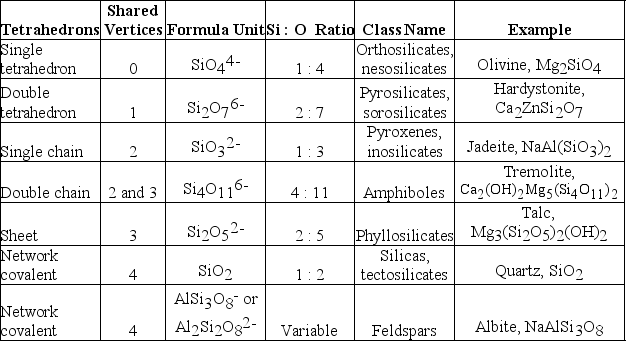
Refer to the table below.Use charge balance to determine the value of x in the pyrosilicate BaxSi2O7. Table 23.2 Types of Silicate Structures
A) 1
B) 3
C) 6
D) 4
E) 2
A) 1
B) 3
C) 6
D) 4
E) 2
Question
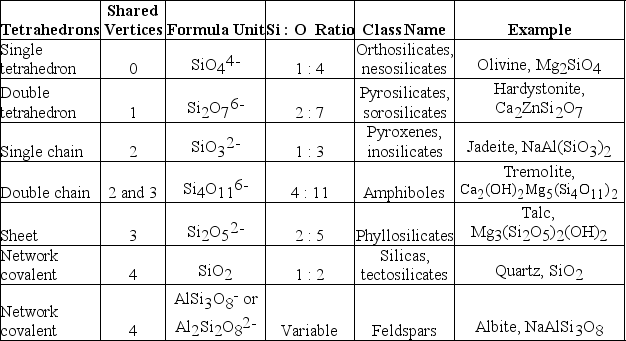
Refer to the table below.Use charge balance to determine the value of x in the pyroxene Srx(SiO3)2. Table 23.2 Types of Silicate Structures
A) 2
B) 1
C) 4
D) 6
E) 3
A) 2
B) 1
C) 4
D) 6
E) 3
Question
Question
Question
Question
Question
Question
Question
Question
Question
Question
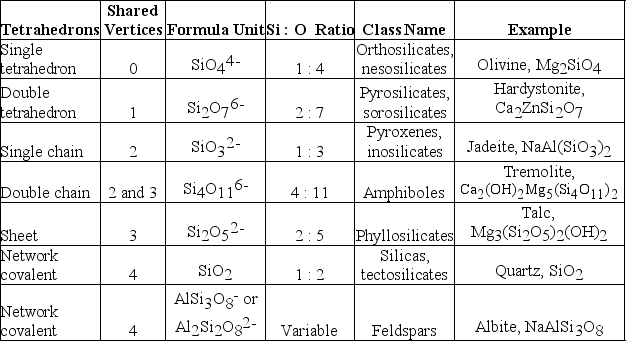
Refer to the table below.Use charge balance to determine the value of x in the orthosilicate BaxSiO4. Table 23.2 Types of Silicate Structures
A) 3
B) 1
C) 2
D) 4
E) 6
A) 3
B) 1
C) 2
D) 4
E) 6
Question
Question
Question
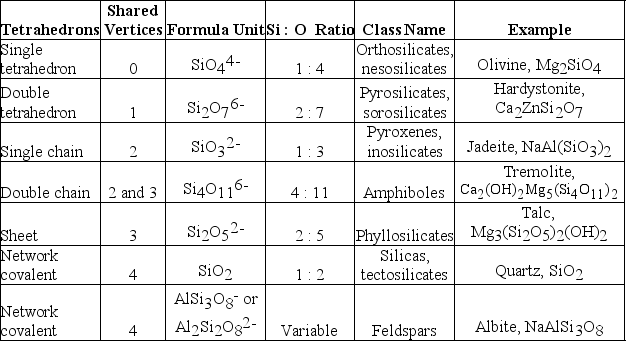
Refer to the table below.Use charge balance to determine the value of x in the phyllosilicate Zn3(Si2O5)2(OH)x. Table 23.2 Types of Silicate Structures
A) 6
B) 4
C) 3
D) 1
E) 2
A) 6
B) 4
C) 3
D) 1
E) 2
Question
Question
Question
Question
Question
Question
Question
Question
Question
Refer to the table below.Predict the silicate structure for CaZn(SiO4). Table 23.2 Types of Silicate Structures
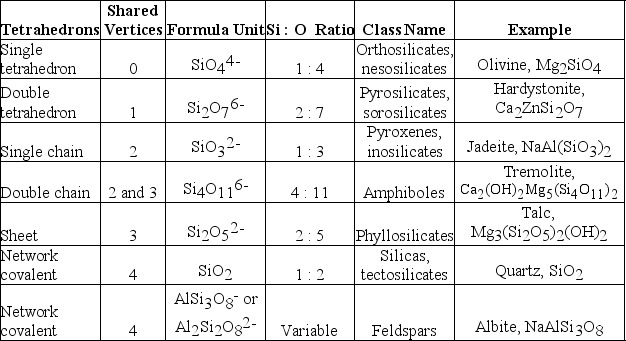
A) pyrosilicate
B) amphibole
C) orthosilicate
D) phyllosilicate
E) pyroxene
A) pyrosilicate
B) amphibole
C) orthosilicate
D) phyllosilicate
E) pyroxene
Question
Question
Question
Determine the oxidation state of nitrogen in KN3.
A) +1
B) +3
C) -2
D) -
E) -3
A) +1
B) +3
C) -2
D) -
E) -3
Question
Question
Question
Question
Refer to the table below.Predict the silicate structure for ZnBa2(Si2O7). Table 23.2 Types of Silicate Structures
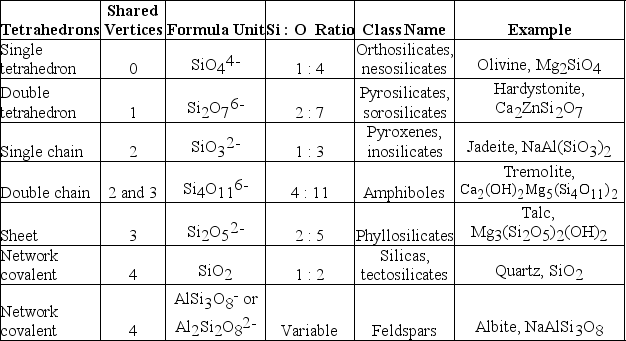
A) orthosilicate
B) pyrosilicate
C) pyroxene
D) amphibole
E) phyllosilicate
A) orthosilicate
B) pyrosilicate
C) pyroxene
D) amphibole
E) phyllosilicate
Question
Question
Question
Question
Question
Question
Refer to the table below.Use charge balance to determine the value of x in the amphibole Ca2(OH)2Znx(Si4O11)2. Table 23.2 Types of Silicate Structures
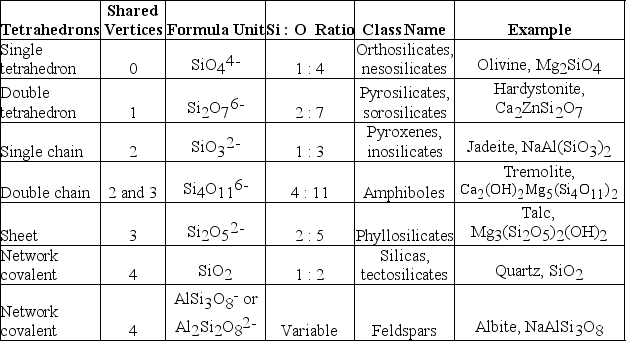
A) 1
B) 4
C) 2
D) 5
E) 3
A) 1
B) 4
C) 2
D) 5
E) 3
Question
Question
Refer to the table below.Predict the silicate structure for NaAl(SiO3)2. Table 23.2 Types of Silicate Structures
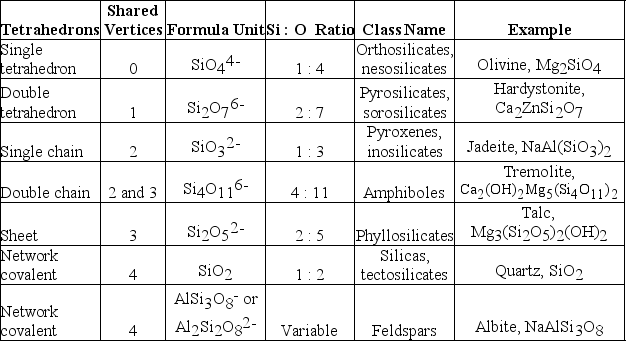
A) phyllosilicate
B) orthosilicate
C) amphibole
D) pyroxene
E) pyrosilicate
A) phyllosilicate
B) orthosilicate
C) amphibole
D) pyroxene
E) pyrosilicate
Question
Match between columns
Question
Question
Question
Question
Question

Unlock Deck
Sign up to unlock the cards in this deck!
Unlock Deck
Unlock Deck
1/67

Play

Full screen (f)
Deck 23: Chemistry of the Nonmetals
1
Determine the number of vertices and faces in the closo-Borane B7H72-.
A) vertices = 4, faces = 10
B) vertices = 7, faces = 14
C) vertices = 3, faces = 6
D) vertices = 14, faces = 24
E) vertices = 7, faces = 10
A) vertices = 4, faces = 10
B) vertices = 7, faces = 14
C) vertices = 3, faces = 6
D) vertices = 14, faces = 24
E) vertices = 7, faces = 10
vertices = 7, faces = 10
2
Determine the oxidation state of carbon in the carbon monoxide,CO.
A) +2
B) +4
C) +3
D) +6
E) +8
A) +2
B) +4
C) +3
D) +6
E) +8
+2
3
Determine the oxidation state of carbon in the ionic carbide,CaC2.
A) -2
B) +4
C) -1
D) +1
E) -4
A) -2
B) +4
C) -1
D) +1
E) -4
-1
4
Determine the number of vertices and faces in the closo-Borane B10H102-.
A) vertices = 10, faces = 16
B) vertices = 5, faces = 6
C) vertices = 5, faces = 10
D) vertices = 10, faces = 20
E) vertices = 20, faces = 36
A) vertices = 10, faces = 16
B) vertices = 5, faces = 6
C) vertices = 5, faces = 10
D) vertices = 10, faces = 20
E) vertices = 20, faces = 36
Unlock Deck
Unlock for access to all 67 flashcards in this deck.
Unlock Deck
k this deck
5
Which of the following statements is TRUE?
A) Boron oxide, when added to silicon oxide glass, forms a more heat stable glass called Pyrex.
B) Boron most commonly forms compounds that fulfill the octet rule.
C) Boron forms fairly weak bonds with oxygen, due to their large electronegativity difference.
D) Boron trichloride is an example of a strong Lewis base.
E) None of the above is true.
A) Boron oxide, when added to silicon oxide glass, forms a more heat stable glass called Pyrex.
B) Boron most commonly forms compounds that fulfill the octet rule.
C) Boron forms fairly weak bonds with oxygen, due to their large electronegativity difference.
D) Boron trichloride is an example of a strong Lewis base.
E) None of the above is true.
Unlock Deck
Unlock for access to all 67 flashcards in this deck.
Unlock Deck
k this deck
6
Which of the following statements is TRUE?
A) Each boron nitride unit contains six valence electrons.
B) Carbon nanotubes and boron nitride nanotubes are not similar.
C) Boron nitride contains BN units that are isoelectric with carbon.
D) Boron nitrides conduct an electrical current.
E) The size and electronegativity of a carbon atom are not close to the average of those properties for a boron atom and a nitrogen atom.
A) Each boron nitride unit contains six valence electrons.
B) Carbon nanotubes and boron nitride nanotubes are not similar.
C) Boron nitride contains BN units that are isoelectric with carbon.
D) Boron nitrides conduct an electrical current.
E) The size and electronegativity of a carbon atom are not close to the average of those properties for a boron atom and a nitrogen atom.
Unlock Deck
Unlock for access to all 67 flashcards in this deck.
Unlock Deck
k this deck
7
Identify baking powder.
A) lithium bicarbonate
B) sodium bicarbonate and an acid
C) magnesium carbonate and a base
D) magnesium oxide
E) sodium carbonate
A) lithium bicarbonate
B) sodium bicarbonate and an acid
C) magnesium carbonate and a base
D) magnesium oxide
E) sodium carbonate
Unlock Deck
Unlock for access to all 67 flashcards in this deck.
Unlock Deck
k this deck
8
List the name of powdered form of carbon,which is a component of soot.
A) diamond
B) graphite
C) fullerenes
D) buckyballs
E) carbon black
A) diamond
B) graphite
C) fullerenes
D) buckyballs
E) carbon black
Unlock Deck
Unlock for access to all 67 flashcards in this deck.
Unlock Deck
k this deck
9
Determine the formula for an aluminosilicate where one fourth of the silicons are replaced by an aluminum atom.The charge is balanced by sodium ions.
A) Na2(AlO2)2(SiO2)
B) Na2(AlO2)2(SiO2)3
C) Na(AlO2)2(SiO2)
D) Na2(AlO2)2(SiO2)2
E) Na(AlO2)(SiO2)3
A) Na2(AlO2)2(SiO2)
B) Na2(AlO2)2(SiO2)3
C) Na(AlO2)2(SiO2)
D) Na2(AlO2)2(SiO2)2
E) Na(AlO2)(SiO2)3
Unlock Deck
Unlock for access to all 67 flashcards in this deck.
Unlock Deck
k this deck
10
What is the major detraction from using bituminous coal as an energy source?
A) It has a very low carbon content.
B) It contains a high amount of sulfur, which when burned contributes to acid rain.
C) It has an extremely high surface area which makes it difficult to burn.
D) Bituminous coal is noncrystalline, which gives it a low energy/gram ratio.
E) There are no detractions from using bituminous coal.
A) It has a very low carbon content.
B) It contains a high amount of sulfur, which when burned contributes to acid rain.
C) It has an extremely high surface area which makes it difficult to burn.
D) Bituminous coal is noncrystalline, which gives it a low energy/gram ratio.
E) There are no detractions from using bituminous coal.
Unlock Deck
Unlock for access to all 67 flashcards in this deck.
Unlock Deck
k this deck
11
Which of the following statements is TRUE?
A) Silicon atoms are too large to form pi bonds between them.
B) Silicates are covalent atomic solids that contain silicon and oxygen.
C) Silicon is the most abundant element in the Earth's crust.
D) Silicon is one of the strongest oxidizing agents.
E) All of the above are true.
A) Silicon atoms are too large to form pi bonds between them.
B) Silicates are covalent atomic solids that contain silicon and oxygen.
C) Silicon is the most abundant element in the Earth's crust.
D) Silicon is one of the strongest oxidizing agents.
E) All of the above are true.
Unlock Deck
Unlock for access to all 67 flashcards in this deck.
Unlock Deck
k this deck
12
Determine the formula for an aluminosilicate where one half of the silicons are replaced by an aluminum atom.The charge is balanced by magnesium ions.
A) Mg(AlO2)2(SiO2)2
B) Mg2(AlO2)2(SiO2)2
C) Mg2(AlO2)2(SiO2)
D) Mg2(AlO2)(SiO2)2
E) Mg(AlO2)(SiO2)2
A) Mg(AlO2)2(SiO2)2
B) Mg2(AlO2)2(SiO2)2
C) Mg2(AlO2)2(SiO2)
D) Mg2(AlO2)(SiO2)2
E) Mg(AlO2)(SiO2)2
Unlock Deck
Unlock for access to all 67 flashcards in this deck.
Unlock Deck
k this deck
13
Which of the following statements is TRUE?
A) Coke is composed of charcoal and air.
B) Activated carbon has a low surface area.
C) Heating wood in the absence of air produces charcoal.
D) Carbon monoxide is nontoxic.
E) None of the above is true.
A) Coke is composed of charcoal and air.
B) Activated carbon has a low surface area.
C) Heating wood in the absence of air produces charcoal.
D) Carbon monoxide is nontoxic.
E) None of the above is true.
Unlock Deck
Unlock for access to all 67 flashcards in this deck.
Unlock Deck
k this deck
14
Which of the following statements is TRUE?
A) Ionic carbides form between carbon and another high electronegativity element.
B) Carbides are soft materials with low melting points.
C) Metallic carbides are more malleable than the pure metal.
D) Covalent carbides are formed between carbon and a low electronegativity nonmetal.
E) None of the above is true.
A) Ionic carbides form between carbon and another high electronegativity element.
B) Carbides are soft materials with low melting points.
C) Metallic carbides are more malleable than the pure metal.
D) Covalent carbides are formed between carbon and a low electronegativity nonmetal.
E) None of the above is true.
Unlock Deck
Unlock for access to all 67 flashcards in this deck.
Unlock Deck
k this deck
15
Which of the following statements is TRUE?
A) Boron is a large component of Earth's crust.
B) Boron is usually found in its elemental state in the Earth's crust.
C) Due to boron's small size and low electronegativity, it behaves as a semimetal instead of a metal.
D) Boron atoms don't typically bond to one another due to its small atomic radius.
E) There are at least 5 allotropes of elemental boron.
A) Boron is a large component of Earth's crust.
B) Boron is usually found in its elemental state in the Earth's crust.
C) Due to boron's small size and low electronegativity, it behaves as a semimetal instead of a metal.
D) Boron atoms don't typically bond to one another due to its small atomic radius.
E) There are at least 5 allotropes of elemental boron.
Unlock Deck
Unlock for access to all 67 flashcards in this deck.
Unlock Deck
k this deck
16
Determine the oxidation state of phosphorus in P2O74⁻.
A) +5
B) +4
C) +3
D) +7
E) +2
A) +5
B) +4
C) +3
D) +7
E) +2
Unlock Deck
Unlock for access to all 67 flashcards in this deck.
Unlock Deck
k this deck
17
Identify a nonmetal.
A) P
B) Ca
C) Pd
D) Ni
E) Ge
A) P
B) Ca
C) Pd
D) Ni
E) Ge
Unlock Deck
Unlock for access to all 67 flashcards in this deck.
Unlock Deck
k this deck
18
Determine the formula for an aluminosilicate where one third of the silicons are replaced by an aluminum atom.The charge is balanced by potassium ions.
A) K2(AlO2)(SiO2)2
B) K(AlO2)(SiO2)
C) K(AlO2)2(SiO2)2
D) K(AlO2)(SiO2)2
E) K2(AlO2)2(SiO2)2
A) K2(AlO2)(SiO2)2
B) K(AlO2)(SiO2)
C) K(AlO2)2(SiO2)2
D) K(AlO2)(SiO2)2
E) K2(AlO2)2(SiO2)2
Unlock Deck
Unlock for access to all 67 flashcards in this deck.
Unlock Deck
k this deck
19
Which of the following statements is TRUE?
A) All silicates are composed of SiO4 tetrahedra that bond together through an oxygen to form single chains.
B) The fibrous nature of asbestos comes from its silicate sheet structure.
C) In some silicates, ionic bonding between a metal ion and an SixOyz- ion is what holds the structure together.
D) The flakiness of mica comes from its single silicate chain structure.
E) None of the above is true.
A) All silicates are composed of SiO4 tetrahedra that bond together through an oxygen to form single chains.
B) The fibrous nature of asbestos comes from its silicate sheet structure.
C) In some silicates, ionic bonding between a metal ion and an SixOyz- ion is what holds the structure together.
D) The flakiness of mica comes from its single silicate chain structure.
E) None of the above is true.
Unlock Deck
Unlock for access to all 67 flashcards in this deck.
Unlock Deck
k this deck
20
Determine the number of vertices and faces in the closo-Borane B12H122-.
A) vertices = 12, faces = 24
B) vertices = 12, faces = 20
C) vertices = 8, faces = 16
D) vertices = 6, faces = 8
E) vertices = 8, faces = 12
A) vertices = 12, faces = 24
B) vertices = 12, faces = 20
C) vertices = 8, faces = 16
D) vertices = 6, faces = 8
E) vertices = 8, faces = 12
Unlock Deck
Unlock for access to all 67 flashcards in this deck.
Unlock Deck
k this deck
21
Which of the following statements is TRUE?
A) Ammonium nitrate is a good explosive.
B) Sodium nitrite is used as a meat preservative.
C) NO2 reacts with water to form nitric acid.
D) Hydrazine is a good reducing agent.
E) All of the above are true.
A) Ammonium nitrate is a good explosive.
B) Sodium nitrite is used as a meat preservative.
C) NO2 reacts with water to form nitric acid.
D) Hydrazine is a good reducing agent.
E) All of the above are true.
Unlock Deck
Unlock for access to all 67 flashcards in this deck.
Unlock Deck
k this deck
22
Which of the following is TRUE?
A) Phosphoric acid is used to produce the "fizziness" in soda.
B) Sodium phosphate is an additive in baked goods to give them a longer shelf life.
C) Phosphorus can range in oxidation state from -3 to +5.
D) The phosphorus in the phosphite ion has an oxidation state of - 3
E) None of the above is true.
A) Phosphoric acid is used to produce the "fizziness" in soda.
B) Sodium phosphate is an additive in baked goods to give them a longer shelf life.
C) Phosphorus can range in oxidation state from -3 to +5.
D) The phosphorus in the phosphite ion has an oxidation state of - 3
E) None of the above is true.
Unlock Deck
Unlock for access to all 67 flashcards in this deck.
Unlock Deck
k this deck
23
Refer to the table below.Use charge balance to determine the value of x in the pyrosilicate BaxSi2O7. Table 23.2 Types of Silicate Structures
A) 1
B) 3
C) 6
D) 4
E) 2
A) 1
B) 3
C) 6
D) 4
E) 2
Unlock Deck
Unlock for access to all 67 flashcards in this deck.
Unlock Deck
k this deck
24
Refer to the table below.Use charge balance to determine the value of x in the pyroxene Srx(SiO3)2. Table 23.2 Types of Silicate Structures
A) 2
B) 1
C) 4
D) 6
E) 3
A) 2
B) 1
C) 4
D) 6
E) 3
Unlock Deck
Unlock for access to all 67 flashcards in this deck.
Unlock Deck
k this deck
25
Identify a superoxide.
A) BaO2
B) MgO
C) Na2O2
D) Li2O
E) RbO2
A) BaO2
B) MgO
C) Na2O2
D) Li2O
E) RbO2
Unlock Deck
Unlock for access to all 67 flashcards in this deck.
Unlock Deck
k this deck
26
Identify a property of fluorine.
A) reacts with glass
B) has weakest X-X bond energy
C) oxidizes other substances quickly
D) reacts with xenon
E) all of the above
A) reacts with glass
B) has weakest X-X bond energy
C) oxidizes other substances quickly
D) reacts with xenon
E) all of the above
Unlock Deck
Unlock for access to all 67 flashcards in this deck.
Unlock Deck
k this deck
27
Write the balanced equation that represents the formation of hydrofluoric acid from the reaction of calcium fluoride with sulfuric acid.
A) CaF2 + H2S → CaS + 2 HF
B) CF4 + 2 H2S → 4 HF + CS2
C) CF4 + 2 H2SO4 → 4 HF + CS2 + CO2
D) CaF2 + H2SO4 → 2 HF + CaSO4
E) CaF2 + H2SO3 → CaSO3 + 2 HF
A) CaF2 + H2S → CaS + 2 HF
B) CF4 + 2 H2S → 4 HF + CS2
C) CF4 + 2 H2SO4 → 4 HF + CS2 + CO2
D) CaF2 + H2SO4 → 2 HF + CaSO4
E) CaF2 + H2SO3 → CaSO3 + 2 HF
Unlock Deck
Unlock for access to all 67 flashcards in this deck.
Unlock Deck
k this deck
28
Which of the following are major components of Earth's crust?
A) oxygen and silicon
B) calcium and silicon
C) oxygen and hydrogen
D) oxygen, magnesium and carbon
E) oxygen, hydrogen and carbon
A) oxygen and silicon
B) calcium and silicon
C) oxygen and hydrogen
D) oxygen, magnesium and carbon
E) oxygen, hydrogen and carbon
Unlock Deck
Unlock for access to all 67 flashcards in this deck.
Unlock Deck
k this deck
29
Tetraphosphorus decoxide reacts with water to produce phosphoric acid.Write a balanced reaction for this process.
A) P4O10 + 6 H2O → 4 H3PO4
B) P2O5 + 3 H2O → 2 H3PO3
C) P4 + 3 O2 + 6 H2O → 4 H3PO4
D) P4O10 + 4 H2O → 4 H2PO3
E) P4 + 3 O2 + 6 H2O → 4 H3PO3
A) P4O10 + 6 H2O → 4 H3PO4
B) P2O5 + 3 H2O → 2 H3PO3
C) P4 + 3 O2 + 6 H2O → 4 H3PO4
D) P4O10 + 4 H2O → 4 H2PO3
E) P4 + 3 O2 + 6 H2O → 4 H3PO3
Unlock Deck
Unlock for access to all 67 flashcards in this deck.
Unlock Deck
k this deck
30
Identify a characteristic of chlorine dioxide.
A) bleaches wood
B) powerful oxidizing agent
C) explosive
D) bleaches flour
E) all of the above
A) bleaches wood
B) powerful oxidizing agent
C) explosive
D) bleaches flour
E) all of the above
Unlock Deck
Unlock for access to all 67 flashcards in this deck.
Unlock Deck
k this deck
31
Which of the following statements is TRUE?
A) Water and H2S have the same bond angles.
B) Sulfuric acid is not a pollutant.
C) Sulfur is a stronger oxidizing agent than oxygen.
D) Water is less stable than H2S.
E) Sulfuric acid is a strong oxidizing agent.
A) Water and H2S have the same bond angles.
B) Sulfuric acid is not a pollutant.
C) Sulfur is a stronger oxidizing agent than oxygen.
D) Water is less stable than H2S.
E) Sulfuric acid is a strong oxidizing agent.
Unlock Deck
Unlock for access to all 67 flashcards in this deck.
Unlock Deck
k this deck
32
Identify a characteristic that natural oxygen does NOT have.
A) odorless
B) colorless
C) pale green liquid
D) diatomic
E) nonpolar
A) odorless
B) colorless
C) pale green liquid
D) diatomic
E) nonpolar
Unlock Deck
Unlock for access to all 67 flashcards in this deck.
Unlock Deck
k this deck
33
Determine the oxidation state of sulfur in S2O32-.
A) +3
B) +6
C) +2
D) +4
E) 0
A) +3
B) +6
C) +2
D) +4
E) 0
Unlock Deck
Unlock for access to all 67 flashcards in this deck.
Unlock Deck
k this deck
34
Refer to the table below.Use charge balance to determine the value of x in the orthosilicate BaxSiO4. Table 23.2 Types of Silicate Structures
A) 3
B) 1
C) 2
D) 4
E) 6
A) 3
B) 1
C) 2
D) 4
E) 6
Unlock Deck
Unlock for access to all 67 flashcards in this deck.
Unlock Deck
k this deck
35
Determine the oxidation state of sulfur in SO2.
A) +3
B) +6
C) +2
D) +4
E) 0
A) +3
B) +6
C) +2
D) +4
E) 0
Unlock Deck
Unlock for access to all 67 flashcards in this deck.
Unlock Deck
k this deck
36
Give the formula of the compound that is in quartz.
A) SiO4
B) Si2O3
C) SiO3
D) Si2O4
E) SiO2
A) SiO4
B) Si2O3
C) SiO3
D) Si2O4
E) SiO2
Unlock Deck
Unlock for access to all 67 flashcards in this deck.
Unlock Deck
k this deck
37
Refer to the table below.Use charge balance to determine the value of x in the phyllosilicate Zn3(Si2O5)2(OH)x. Table 23.2 Types of Silicate Structures
A) 6
B) 4
C) 3
D) 1
E) 2
A) 6
B) 4
C) 3
D) 1
E) 2
Unlock Deck
Unlock for access to all 67 flashcards in this deck.
Unlock Deck
k this deck
38
Identify the most reactive element.
A) N
B) H
C) C
D) O
E) F
A) N
B) H
C) C
D) O
E) F
Unlock Deck
Unlock for access to all 67 flashcards in this deck.
Unlock Deck
k this deck
39
Identify the compound that is formed by volcanos and is a coal pollutant.
A) SO2
B) H2SO3
C) H2SO4
D) S4
E) H2S
A) SO2
B) H2SO3
C) H2SO4
D) S4
E) H2S
Unlock Deck
Unlock for access to all 67 flashcards in this deck.
Unlock Deck
k this deck
40
Identify the oxygen compound that kills bacteria and is used as a disinfectant.
A) O3
B) O2
C) SO2
D) SO3
E) NO2
A) O3
B) O2
C) SO2
D) SO3
E) NO2
Unlock Deck
Unlock for access to all 67 flashcards in this deck.
Unlock Deck
k this deck
41
Give the shape of a boron tribromide.
A) trigonal planar
B) tetrahedral
C) T-shaped
D) trigonal bipyramidal
E) octahedral
A) trigonal planar
B) tetrahedral
C) T-shaped
D) trigonal bipyramidal
E) octahedral
Unlock Deck
Unlock for access to all 67 flashcards in this deck.
Unlock Deck
k this deck
42
Determine the oxidation state of carbon in the carbonate ion,Na2CO3 .
A) +2
B) +4
C) +3
D) -6
E) +8
A) +2
B) +4
C) +3
D) -6
E) +8
Unlock Deck
Unlock for access to all 67 flashcards in this deck.
Unlock Deck
k this deck
43
What is the oxidation number of oxygen in H2O2?
A) -4
B) +2
C) -3
D) -1
E) +1
A) -4
B) +2
C) -3
D) -1
E) +1
Unlock Deck
Unlock for access to all 67 flashcards in this deck.
Unlock Deck
k this deck
44
Give the bond angle of a boron triiodide.
A) 90°
B) 45°
C) 120°
D) 107°
E) 103°
A) 90°
B) 45°
C) 120°
D) 107°
E) 103°
Unlock Deck
Unlock for access to all 67 flashcards in this deck.
Unlock Deck
k this deck
45
Identify the form of carbon that is added to tires to strength the tire and maintain flexibility.
A) carbon black
B) buckyball
C) graphite
D) coal
E) fullerene
A) carbon black
B) buckyball
C) graphite
D) coal
E) fullerene
Unlock Deck
Unlock for access to all 67 flashcards in this deck.
Unlock Deck
k this deck
46
Refer to the table below.Predict the silicate structure for CaZn(SiO4). Table 23.2 Types of Silicate Structures
A) pyrosilicate
B) amphibole
C) orthosilicate
D) phyllosilicate
E) pyroxene
A) pyrosilicate
B) amphibole
C) orthosilicate
D) phyllosilicate
E) pyroxene
Unlock Deck
Unlock for access to all 67 flashcards in this deck.
Unlock Deck
k this deck
47
Determine the oxidation state of nitrogen in KNO3 .
A) +1
B) +6
C) -2
D) +4
E) +5
A) +1
B) +6
C) -2
D) +4
E) +5
Unlock Deck
Unlock for access to all 67 flashcards in this deck.
Unlock Deck
k this deck
48
Identify the form of carbon that is used for gems.
A) coal
B) charcoal
C) gasoline
D) diamond
E) fullerene
A) coal
B) charcoal
C) gasoline
D) diamond
E) fullerene
Unlock Deck
Unlock for access to all 67 flashcards in this deck.
Unlock Deck
k this deck
49
Determine the oxidation state of nitrogen in KN3.
A) +1
B) +3
C) -2
D) -
E) -3
A) +1
B) +3
C) -2
D) -
E) -3
Unlock Deck
Unlock for access to all 67 flashcards in this deck.
Unlock Deck
k this deck
50
Identify the form of coal that has a high carbon content.
A) nanotube
B) graphite
C) anthracite
D) fullerene
E) gasoline
A) nanotube
B) graphite
C) anthracite
D) fullerene
E) gasoline
Unlock Deck
Unlock for access to all 67 flashcards in this deck.
Unlock Deck
k this deck
51
Why are phosphate compounds added to detergents?
Unlock Deck
Unlock for access to all 67 flashcards in this deck.
Unlock Deck
k this deck
52
Identify an example of a nitrite.
A) KNO2
B) NO
C) N2O
D) NaNO3
E) NO4
A) KNO2
B) NO
C) N2O
D) NaNO3
E) NO4
Unlock Deck
Unlock for access to all 67 flashcards in this deck.
Unlock Deck
k this deck
53
Refer to the table below.Predict the silicate structure for ZnBa2(Si2O7). Table 23.2 Types of Silicate Structures
A) orthosilicate
B) pyrosilicate
C) pyroxene
D) amphibole
E) phyllosilicate
A) orthosilicate
B) pyrosilicate
C) pyroxene
D) amphibole
E) phyllosilicate
Unlock Deck
Unlock for access to all 67 flashcards in this deck.
Unlock Deck
k this deck
54
What is the oxidation number of oxygen in Na2O?
A) -4
B) +2
C) -2
D) -3
E) 0
A) -4
B) +2
C) -2
D) -3
E) 0
Unlock Deck
Unlock for access to all 67 flashcards in this deck.
Unlock Deck
k this deck
55
Identify an example of a nitrate.
A) LiN3
B) NaNO2
C) NaNO3
D) NO2
E) NO
A) LiN3
B) NaNO2
C) NaNO3
D) NO2
E) NO
Unlock Deck
Unlock for access to all 67 flashcards in this deck.
Unlock Deck
k this deck
56
Determine the oxidation state of chlorine in ClO-.
A) 0
B) +1
C) -2
D) -1
E) +2
A) 0
B) +1
C) -2
D) -1
E) +2
Unlock Deck
Unlock for access to all 67 flashcards in this deck.
Unlock Deck
k this deck
57
Determine the oxidation state of nitrogen in LiNO2 .
A) +1
B) -2
C) +5
D) 0
E) +3
A) +1
B) -2
C) +5
D) 0
E) +3
Unlock Deck
Unlock for access to all 67 flashcards in this deck.
Unlock Deck
k this deck
58
Identify the compound that smells like a rotten egg.
A) SO
B) H2SO2
C) H2SO4
D) S4
E) H2S
A) SO
B) H2SO2
C) H2SO4
D) S4
E) H2S
Unlock Deck
Unlock for access to all 67 flashcards in this deck.
Unlock Deck
k this deck
59
Refer to the table below.Use charge balance to determine the value of x in the amphibole Ca2(OH)2Znx(Si4O11)2. Table 23.2 Types of Silicate Structures
A) 1
B) 4
C) 2
D) 5
E) 3
A) 1
B) 4
C) 2
D) 5
E) 3
Unlock Deck
Unlock for access to all 67 flashcards in this deck.
Unlock Deck
k this deck
60
Match the following.
A)Si2O52-
B)SiO44-
C)Si4O116-
D)Si2O76-
E)SiO32-
1)orthosilicate
2)pyroxene
3)pyrosilicate
4)amphibole
5)phyllosilicate
A)Si2O52-
B)SiO44-
C)Si4O116-
D)Si2O76-
E)SiO32-
1)orthosilicate
2)pyroxene
3)pyrosilicate
4)amphibole
5)phyllosilicate
Unlock Deck
Unlock for access to all 67 flashcards in this deck.
Unlock Deck
k this deck
60
Refer to the table below.Predict the silicate structure for NaAl(SiO3)2. Table 23.2 Types of Silicate Structures
A) phyllosilicate
B) orthosilicate
C) amphibole
D) pyroxene
E) pyrosilicate
A) phyllosilicate
B) orthosilicate
C) amphibole
D) pyroxene
E) pyrosilicate
Unlock Deck
Unlock for access to all 67 flashcards in this deck.
Unlock Deck
k this deck
61
Match between columns
Unlock Deck
Unlock for access to all 67 flashcards in this deck.
Unlock Deck
k this deck
62
Draw the Lewis structure for IF4⁻ and determine the geometry of the ion.
Unlock Deck
Unlock for access to all 67 flashcards in this deck.
Unlock Deck
k this deck
63
Write the balanced reaction that shows the formation of ICl3 from its elements.
Unlock Deck
Unlock for access to all 67 flashcards in this deck.
Unlock Deck
k this deck
64
Describe the Frasch process for obtaining sulfur.
Unlock Deck
Unlock for access to all 67 flashcards in this deck.
Unlock Deck
k this deck
65
Why are the chemical properties of nitrogen and phosphorus so different when they are in the same family?
Unlock Deck
Unlock for access to all 67 flashcards in this deck.
Unlock Deck
k this deck
66
Describe the major production method for obtaining oxygen.
Unlock Deck
Unlock for access to all 67 flashcards in this deck.
Unlock Deck
k this deck
Unlock Deck
Unlock for access to all 67 flashcards in this deck.







