





 Chat with AI

Deck 11: DNA Biology
Full screen (f)

Question

Question
Question
Question
Question
Question
Question
Question
Question
Question
Question
Question
Question
This figure represents 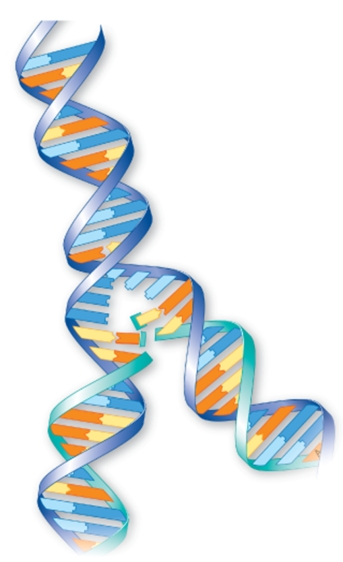
A) replication.
B) translation.
C) transcription.
D) transformation.
E) base pairing.
A) replication.
B) translation.
C) transcription.
D) transformation.
E) base pairing.
Question
Question
Question
Question
Question
Question
Question
Question
Question
Question
Question
Question
Question
Question
Question
Question
Question
Figure: 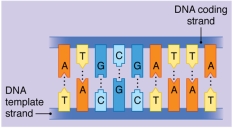
The sequence of the mRNA that would result from transcribing the gene pictured would be
A) AUGCGAUUA.
B) AUUAGCGUA.
C) UACGCUAAU.
D) UAAUCGCAU.
E) ATGCGATTA.
The sequence of the mRNA that would result from transcribing the gene pictured would be
A) AUGCGAUUA.
B) AUUAGCGUA.
C) UACGCUAAU.
D) UAAUCGCAU.
E) ATGCGATTA.
Question
Question
Question
Question
Question
Question
Question
Question
Figure:
The sequence of the peptide that would result from transcribing and translating the gene pictured would be
A) Tyr-Ala-Asn.
B) Ile-Ser-Val.
C) no peptide would be made, the first codon means "stop."
D) Met-Arg-Leu.
E) Tyr-Ser-Val.
The sequence of the peptide that would result from transcribing and translating the gene pictured would be
A) Tyr-Ala-Asn.
B) Ile-Ser-Val.
C) no peptide would be made, the first codon means "stop."
D) Met-Arg-Leu.
E) Tyr-Ser-Val.
Question
Question
Question
Question
Question
Question
Question
Question
Question
Question
Question
Question
Question
Question
Question
Question
Question
Question
Question

Unlock Deck
Sign up to unlock the cards in this deck!
Unlock Deck
Unlock Deck
1/57

Play

Full screen (f)
Deck 11: DNA Biology
1
What chemical force must be overcome in order to separate the two DNA strands during replication?
A) hydrophobic interactions
B) intrastrand folding
C) ionic bonds
D) phosphodiester bonds
E) hydrogen bonds
A) hydrophobic interactions
B) intrastrand folding
C) ionic bonds
D) phosphodiester bonds
E) hydrogen bonds
E
2
For a DNA strand that contains the sequence AGT in the 5' to 3' direction,what nucleotides are found on the other DNA strand in the 5' to 3' direction?
A) ACT
B) TGA
C) AGT
D) TCA
E) GTA
A) ACT
B) TGA
C) AGT
D) TCA
E) GTA
A
3
If an organism's DNA contains 20% adenine nucleotides,what percentage of its DNA is composed of thymine nucleotides?
A) 10%
B) 15%
C) 20%
D) 30%
E) 40%
A) 10%
B) 15%
C) 20%
D) 30%
E) 40%
C
4
Which of the following enzymes is needed to seal breaks in the sugar-phosphate backbone during replication?
A) DNA polymerase
B) RNA polymerase
C) RNA ligase
D) helicase
E) DNA ligase
A) DNA polymerase
B) RNA polymerase
C) RNA ligase
D) helicase
E) DNA ligase
Unlock Deck
Unlock for access to all 57 flashcards in this deck.
Unlock Deck
k this deck
5
The central dogma of molecular biology states that the information contained within genes flows in which direction?
A) DNA to DNA to protein
B) mRNA to DNA to protein
C) DNA to mRNA to protein
D) DNA to tRNA to mRNA to protein
E) DNA to rRNA to protein
A) DNA to DNA to protein
B) mRNA to DNA to protein
C) DNA to mRNA to protein
D) DNA to tRNA to mRNA to protein
E) DNA to rRNA to protein
Unlock Deck
Unlock for access to all 57 flashcards in this deck.
Unlock Deck
k this deck
6
tRNAs carrying the correct amino acid recognize the proper codons on the mRNA because
A) the anticodon of the tRNA hydrogen binds to the codon of the mRNA by complementary base pairing.
B) the codon of the tRNA binds to the anticodon of the ribosome by complementary base pairing.
C) the anticodon of the tRNA carries the correct amino acid.
D) the amino acid binds to the anticodon of the mRNA and brings the correct tRNA with it.
E) the codon of the mRNA binds the correct amino acid, and the tRNA stabilizes this interaction.
A) the anticodon of the tRNA hydrogen binds to the codon of the mRNA by complementary base pairing.
B) the codon of the tRNA binds to the anticodon of the ribosome by complementary base pairing.
C) the anticodon of the tRNA carries the correct amino acid.
D) the amino acid binds to the anticodon of the mRNA and brings the correct tRNA with it.
E) the codon of the mRNA binds the correct amino acid, and the tRNA stabilizes this interaction.
Unlock Deck
Unlock for access to all 57 flashcards in this deck.
Unlock Deck
k this deck
7
Which of the following is an incorrect match?
A) transcription - removal of introns
B) translation - polypeptide formation
C) transcription - tRNA formation
D) translation - mRNA binding to rRNA
E) replication - copying of DNA
A) transcription - removal of introns
B) translation - polypeptide formation
C) transcription - tRNA formation
D) translation - mRNA binding to rRNA
E) replication - copying of DNA
Unlock Deck
Unlock for access to all 57 flashcards in this deck.
Unlock Deck
k this deck
8
If an organism's DNA contains 20% adenine nucleotides,what percentage of its DNA is composed of guanine nucleotides?
A) 10%
B) 15%
C) 20%
D) 30%
E) 40%
A) 10%
B) 15%
C) 20%
D) 30%
E) 40%
Unlock Deck
Unlock for access to all 57 flashcards in this deck.
Unlock Deck
k this deck
9
DNA replication is called semiconservative because
A) one of the two resulting DNA molecules is new.
B) the two resulting DNA molecules each have one new DNA strand and one old strand from the original DNA molecule.
C) both of the resulting DNA molecules are composed of new strands of nucleotides.
D) no extra nucleotides are incorporated into the replicated DNA molecules.
E) the sequence of nucleotides in one strand is conserved, whereas the new DNA molecule consists of a unique sequence of nucleotides
A) one of the two resulting DNA molecules is new.
B) the two resulting DNA molecules each have one new DNA strand and one old strand from the original DNA molecule.
C) both of the resulting DNA molecules are composed of new strands of nucleotides.
D) no extra nucleotides are incorporated into the replicated DNA molecules.
E) the sequence of nucleotides in one strand is conserved, whereas the new DNA molecule consists of a unique sequence of nucleotides
Unlock Deck
Unlock for access to all 57 flashcards in this deck.
Unlock Deck
k this deck
10
mRNA must be processed in the cytoplasm before being used in protein synthesis.
Unlock Deck
Unlock for access to all 57 flashcards in this deck.
Unlock Deck
k this deck
11
During the elongation cycle of translation,the A site on a ribosome functions in
A) receiving a new tRNA with the correct amino acid.
B) holding a polypeptide as amino acids are added.
C) attaching the small subunits of rRNA to the large subunit.
D) releasing the completed polypeptide.
E) processing the rRNA.
A) receiving a new tRNA with the correct amino acid.
B) holding a polypeptide as amino acids are added.
C) attaching the small subunits of rRNA to the large subunit.
D) releasing the completed polypeptide.
E) processing the rRNA.
Unlock Deck
Unlock for access to all 57 flashcards in this deck.
Unlock Deck
k this deck
12
For a DNA strand composed of the sequence AGT in the 5' to 3' direction,the free phosphate is on the ____ nucleotide and the free hydroxyl is on the ____ nucleotide.
A) T; A
B) A; G
C) A; A
D) G; T
E) A; T
A) T; A
B) A; G
C) A; A
D) G; T
E) A; T
Unlock Deck
Unlock for access to all 57 flashcards in this deck.
Unlock Deck
k this deck
13
This figure represents
A) replication.
B) translation.
C) transcription.
D) transformation.
E) base pairing.
A) replication.
B) translation.
C) transcription.
D) transformation.
E) base pairing.
Unlock Deck
Unlock for access to all 57 flashcards in this deck.
Unlock Deck
k this deck
14
The genetic code in bacteria is different than the genetic code in animals and plants.
Unlock Deck
Unlock for access to all 57 flashcards in this deck.
Unlock Deck
k this deck
15
For a DNA strand that is two nucleotides long,how many different sequences are possible?
A) 2
B) 4
C) 8
D) 16
E) 64
A) 2
B) 4
C) 8
D) 16
E) 64
Unlock Deck
Unlock for access to all 57 flashcards in this deck.
Unlock Deck
k this deck
16
The x-ray diffraction pattern of DNA discovered by Rosalind Franklin showed that DNA
A) is helical.
B) has a repeated pattern.
C) is both helical and has a repeated pattern.
D) contains beta sheets arranged in a repeated pattern.
E) contains alpha helices and beta sheets.
A) is helical.
B) has a repeated pattern.
C) is both helical and has a repeated pattern.
D) contains beta sheets arranged in a repeated pattern.
E) contains alpha helices and beta sheets.
Unlock Deck
Unlock for access to all 57 flashcards in this deck.
Unlock Deck
k this deck
17
The three steps that are required for DNA replication are
A) unwinding, complementary base pairing, and joining.
B) base doubling, unwinding, and joining.
C) complementary base pairing, transcription, and translation.
D) unwinding, transcription, and translation.
E) unwinding, base doubling, and base pairing.
A) unwinding, complementary base pairing, and joining.
B) base doubling, unwinding, and joining.
C) complementary base pairing, transcription, and translation.
D) unwinding, transcription, and translation.
E) unwinding, base doubling, and base pairing.
Unlock Deck
Unlock for access to all 57 flashcards in this deck.
Unlock Deck
k this deck
18
A defect in DNA ligase would most likely cause
A) normal replication, but gaps remain in the sugar-phosphate DNA backbone.
B) failure to remove introns from the primary mRNA.
C) incompletely processed primary mRNA that does not get translated properly.
D) translation to initiate normally, but fail to proceed to elongation.
E) DNA strands to separate normally, but fail to join nucleotides in the growing nucleotide chain.
A) normal replication, but gaps remain in the sugar-phosphate DNA backbone.
B) failure to remove introns from the primary mRNA.
C) incompletely processed primary mRNA that does not get translated properly.
D) translation to initiate normally, but fail to proceed to elongation.
E) DNA strands to separate normally, but fail to join nucleotides in the growing nucleotide chain.
Unlock Deck
Unlock for access to all 57 flashcards in this deck.
Unlock Deck
k this deck
19
According to Chargaff's rules,___ always pairs with ____,and _____ always pairs with _____.
A) A; G; T; C
B) A; T; G; C
C) A; C; G; T
D) C; T; G; A
E) G; U; A; C
A) A; G; T; C
B) A; T; G; C
C) A; C; G; T
D) C; T; G; A
E) G; U; A; C
Unlock Deck
Unlock for access to all 57 flashcards in this deck.
Unlock Deck
k this deck
20
If an organism's DNA contains 17% adenine nucleotides and 33% guanine nucleotides,what percentage of its DNA is composed of cytosine nucleotides?
A) 8.5%
B) 17%
C) 25%
D) 33%
E) 50%
A) 8.5%
B) 17%
C) 25%
D) 33%
E) 50%
Unlock Deck
Unlock for access to all 57 flashcards in this deck.
Unlock Deck
k this deck
21
Which of the following events in gene expression control does not occur in the nucleus?
A) chromatin condensation
B) mRNA translation
C) DNA transcription
D) mRNA processing
E) transcription factor binding
A) chromatin condensation
B) mRNA translation
C) DNA transcription
D) mRNA processing
E) transcription factor binding
Unlock Deck
Unlock for access to all 57 flashcards in this deck.
Unlock Deck
k this deck
22
Which of the following processes does not occur within the nucleus?
A) DNA replication
B) transcription
C) intron removal
D) translation
E) primary mRNA splicing
A) DNA replication
B) transcription
C) intron removal
D) translation
E) primary mRNA splicing
Unlock Deck
Unlock for access to all 57 flashcards in this deck.
Unlock Deck
k this deck
23
Heterochromatin differs from euchromatin in that heterochromatin
A) is transcriptionally active, whereas euchromatin is not.
B) is not found in Barr bodies.
C) is transcriptionally inactive.
D) is the result of the unpacking of euchromatin.
E) contains DNA with accessible promoters.
A) is transcriptionally active, whereas euchromatin is not.
B) is not found in Barr bodies.
C) is transcriptionally inactive.
D) is the result of the unpacking of euchromatin.
E) contains DNA with accessible promoters.
Unlock Deck
Unlock for access to all 57 flashcards in this deck.
Unlock Deck
k this deck
24
The two DNA strands must be separated before DNA replication or transcription can occur.
Unlock Deck
Unlock for access to all 57 flashcards in this deck.
Unlock Deck
k this deck
25
RNA differs from DNA because RNA
A) is double-stranded, whereas DNA is not.
B) may double back and base pair with itself, whereas DNA does not.
C) is never single-stranded, whereas DNA may or may not be.
D) can self-replicate, whereas DNA replication requires enzymes.
E) is replicated along with DNA, but does not require strand separation like DNA does.
A) is double-stranded, whereas DNA is not.
B) may double back and base pair with itself, whereas DNA does not.
C) is never single-stranded, whereas DNA may or may not be.
D) can self-replicate, whereas DNA replication requires enzymes.
E) is replicated along with DNA, but does not require strand separation like DNA does.
Unlock Deck
Unlock for access to all 57 flashcards in this deck.
Unlock Deck
k this deck
26
Which of the DNA sequences shown in the figure is/are bound by a regulatory protein?
A) 1
B) 2
C) 3
D) 1 and 4
E) 2 and 3
A) 1
B) 2
C) 3
D) 1 and 4
E) 2 and 3
Unlock Deck
Unlock for access to all 57 flashcards in this deck.
Unlock Deck
k this deck
27
During translation,initiation occurs normally,but elongation fails to occur.Which process is mostly likely faulty?
A) translocation of ribosome
B) binding of tRNA-methionine to start codon
C) association of the small and large ribosomal subunits
D) processing of primary mRNA
E) joining of nucleotides
A) translocation of ribosome
B) binding of tRNA-methionine to start codon
C) association of the small and large ribosomal subunits
D) processing of primary mRNA
E) joining of nucleotides
Unlock Deck
Unlock for access to all 57 flashcards in this deck.
Unlock Deck
k this deck
28
The information contained within a gene is not directly copied into which of the following chemical forms?
A) tRNA, rRNA
B) mRNA, tRNA
C) rRNA, protein
D) mRNA, protein
E) tRNA, protein
A) tRNA, rRNA
B) mRNA, tRNA
C) rRNA, protein
D) mRNA, protein
E) tRNA, protein
Unlock Deck
Unlock for access to all 57 flashcards in this deck.
Unlock Deck
k this deck
29
Which of the following mutations would cause early termination of translation of the gene pictured?
A) Change the 4th nucleotide of the top strand from C to T, and change the 4th nucleotide of the bottom strand from G to A
B) Change the 5th nucleotide of the top strand from G to C, and change the 4th nucleotide of the bottom strand from C to G
C) Change the 4th nucleotide of the top strand from C to A, and change the 4th nucleotide of the bottom strand from G to T
D) Change the 6th nucleotide of the top strand from A to T, and change the 4th nucleotide of the bottom strand from T to A
E) Change the last nucleotide of the top strand from A to G, and change the 4th nucleotide of the bottom strand from T to C
A) Change the 4th nucleotide of the top strand from C to T, and change the 4th nucleotide of the bottom strand from G to A
B) Change the 5th nucleotide of the top strand from G to C, and change the 4th nucleotide of the bottom strand from C to G
C) Change the 4th nucleotide of the top strand from C to A, and change the 4th nucleotide of the bottom strand from G to T
D) Change the 6th nucleotide of the top strand from A to T, and change the 4th nucleotide of the bottom strand from T to A
E) Change the last nucleotide of the top strand from A to G, and change the 4th nucleotide of the bottom strand from T to C
Unlock Deck
Unlock for access to all 57 flashcards in this deck.
Unlock Deck
k this deck
30
Figure:
The sequence of the mRNA that would result from transcribing the gene pictured would be
A) AUGCGAUUA.
B) AUUAGCGUA.
C) UACGCUAAU.
D) UAAUCGCAU.
E) ATGCGATTA.
The sequence of the mRNA that would result from transcribing the gene pictured would be
A) AUGCGAUUA.
B) AUUAGCGUA.
C) UACGCUAAU.
D) UAAUCGCAU.
E) ATGCGATTA.
Unlock Deck
Unlock for access to all 57 flashcards in this deck.
Unlock Deck
k this deck
31
Using three bases to represent each amino acid in a polypeptide
A) ensures that all amino acids are represented at least once by the code.
B) ensures that other organisms can read the code too.
C) ensures that DNA can replicate properly.
D) prevents the wrong amino acid from being incorporated into a protein.
E) prevents early termination of transcription.
A) ensures that all amino acids are represented at least once by the code.
B) ensures that other organisms can read the code too.
C) ensures that DNA can replicate properly.
D) prevents the wrong amino acid from being incorporated into a protein.
E) prevents early termination of transcription.
Unlock Deck
Unlock for access to all 57 flashcards in this deck.
Unlock Deck
k this deck
32
Which of the DNA sequences shown in the figure are transcribed and translated to produce proteins?
A) 1, 2, 3, and 4
B) 2 and 3
C) 2, 3, and 4
D) 1, 2, and 3
E) 1 and 4
A) 1, 2, 3, and 4
B) 2 and 3
C) 2, 3, and 4
D) 1, 2, and 3
E) 1 and 4
Unlock Deck
Unlock for access to all 57 flashcards in this deck.
Unlock Deck
k this deck
33
The stages of translation are
A) transcription, mRNA processing, and termination.
B) DNA replication, transcription, and termination.
C) initiation, transcription, elongation cycle, and termination.
D) initiation, elongation cycle, and termination.
E) initiation, transcription, mRNA processing, and termination.
A) transcription, mRNA processing, and termination.
B) DNA replication, transcription, and termination.
C) initiation, transcription, elongation cycle, and termination.
D) initiation, elongation cycle, and termination.
E) initiation, transcription, mRNA processing, and termination.
Unlock Deck
Unlock for access to all 57 flashcards in this deck.
Unlock Deck
k this deck
34
Which process requires the participation of all three types of RNA?
A) transcription
B) translation
C) RNA processing
D) replication
E) complementary base pairing
A) transcription
B) translation
C) RNA processing
D) replication
E) complementary base pairing
Unlock Deck
Unlock for access to all 57 flashcards in this deck.
Unlock Deck
k this deck
35
Failure to remove introns from a primary mRNA would most likely cause
A) irregularities in transcription.
B) abnormal translation.
C) DNA to mutate.
D) DNA replication to fail.
E) transcription to terminate early.
A) irregularities in transcription.
B) abnormal translation.
C) DNA to mutate.
D) DNA replication to fail.
E) transcription to terminate early.
Unlock Deck
Unlock for access to all 57 flashcards in this deck.
Unlock Deck
k this deck
36
If RNA polymerase malfunctions
A) one of the subunits of rRNA will not be transcribed from DNA.
B) amino acids will not be joined to their tRNA.
C) mRNA cannot bind to rRNA.
D) an mRNA will not be formed.
E) mRNA cannot copy itself.
A) one of the subunits of rRNA will not be transcribed from DNA.
B) amino acids will not be joined to their tRNA.
C) mRNA cannot bind to rRNA.
D) an mRNA will not be formed.
E) mRNA cannot copy itself.
Unlock Deck
Unlock for access to all 57 flashcards in this deck.
Unlock Deck
k this deck
37
DNA replication makes a(n)____ copy of the DNA strand,while transcription makes a(n)____ copy of the DNA strand.
A) mRNA; DNA
B) DNA; mRNA
C) DNA; tRNA
D) mRNA; tRNA
E) mRNA; rRNA
A) mRNA; DNA
B) DNA; mRNA
C) DNA; tRNA
D) mRNA; tRNA
E) mRNA; rRNA
Unlock Deck
Unlock for access to all 57 flashcards in this deck.
Unlock Deck
k this deck
38
Figure:
The sequence of the peptide that would result from transcribing and translating the gene pictured would be
A) Tyr-Ala-Asn.
B) Ile-Ser-Val.
C) no peptide would be made, the first codon means "stop."
D) Met-Arg-Leu.
E) Tyr-Ser-Val.
The sequence of the peptide that would result from transcribing and translating the gene pictured would be
A) Tyr-Ala-Asn.
B) Ile-Ser-Val.
C) no peptide would be made, the first codon means "stop."
D) Met-Arg-Leu.
E) Tyr-Ser-Val.
Unlock Deck
Unlock for access to all 57 flashcards in this deck.
Unlock Deck
k this deck
39
Which of the following allows a cell to decipher the genetic code?
A) rRNA
B) tRNA
C) mRNA
D) DNA
E) protein
A) rRNA
B) tRNA
C) mRNA
D) DNA
E) protein
Unlock Deck
Unlock for access to all 57 flashcards in this deck.
Unlock Deck
k this deck
40
Which base is found in DNA,but not in RNA?
A) cytosine
B) uracil
C) thymine
D) adenine
E) guanine
A) cytosine
B) uracil
C) thymine
D) adenine
E) guanine
Unlock Deck
Unlock for access to all 57 flashcards in this deck.
Unlock Deck
k this deck
41
Prokaryotes regulate gene expression with a promoter.
Unlock Deck
Unlock for access to all 57 flashcards in this deck.
Unlock Deck
k this deck
42
The unpacking of heterochromatin into euchromatin does not immediately result in DNA transcription because
A) Barr bodies are still present.
B) histones still block the binding of RNA polymerase to the promoter.
C) euchromatin is always transcriptionally inactive.
D) transcription factors still block the binding of RNA polymerase to the promoter.
E) heterochromatin contains DNA with accessible promoters.
A) Barr bodies are still present.
B) histones still block the binding of RNA polymerase to the promoter.
C) euchromatin is always transcriptionally inactive.
D) transcription factors still block the binding of RNA polymerase to the promoter.
E) heterochromatin contains DNA with accessible promoters.
Unlock Deck
Unlock for access to all 57 flashcards in this deck.
Unlock Deck
k this deck
43
The protein derived from a particular gene is different when it is found in a neuron than in a muscle cell.This is most likely due to
A) alternative mRNA processing.
B) regulation of mRNA translation.
C) alteration of protein activity.
D) mRNA editing.
E) DNA excision.
A) alternative mRNA processing.
B) regulation of mRNA translation.
C) alteration of protein activity.
D) mRNA editing.
E) DNA excision.
Unlock Deck
Unlock for access to all 57 flashcards in this deck.
Unlock Deck
k this deck
44
Prokaryotes cannot regulate gene expression at which of the following levels?
A) mRNA transcription and mRNA translation
B) mRNA translation
C) alternative mRNA processing and chromatin compaction
D) mRNA translation and longevity of mRNA
E) mRNA transcription and longevity of mRNA
A) mRNA transcription and mRNA translation
B) mRNA translation
C) alternative mRNA processing and chromatin compaction
D) mRNA translation and longevity of mRNA
E) mRNA transcription and longevity of mRNA
Unlock Deck
Unlock for access to all 57 flashcards in this deck.
Unlock Deck
k this deck
45
A point mutation in the operator of the lac operon would most likely cause
A) no transcription of the lactose metabolizing genes, even when lactose is absent.
B) no transcription of the lactose metabolizing genes, even when lactose is present.
C) no binding of the repressor protein to the operator even when lactose is absent.
D) binding of the repressor protein to the regulatory gene in both the presence and absence of lactose.
E) no transcription of the regulatory gene, even in the presence of lactose.
A) no transcription of the lactose metabolizing genes, even when lactose is absent.
B) no transcription of the lactose metabolizing genes, even when lactose is present.
C) no binding of the repressor protein to the operator even when lactose is absent.
D) binding of the repressor protein to the regulatory gene in both the presence and absence of lactose.
E) no transcription of the regulatory gene, even in the presence of lactose.
Unlock Deck
Unlock for access to all 57 flashcards in this deck.
Unlock Deck
k this deck
46
Signal transduction pathways can stimulate transcription activators.
Unlock Deck
Unlock for access to all 57 flashcards in this deck.
Unlock Deck
k this deck
47
Which section of the DNA is inactive?
A) heterochromatin
B) intron
C) exon
D) euchromatin
E) nucleosome
A) heterochromatin
B) intron
C) exon
D) euchromatin
E) nucleosome
Unlock Deck
Unlock for access to all 57 flashcards in this deck.
Unlock Deck
k this deck
48
What would be the most likely result on the regulation of the lac operon from a non-functional repressor protein?
A) transcription of the lactose metabolizing genes, even when lactose is absent
B) no transcription of the lactose metabolizing genes, even when lactose is present
C) binding of the repressor protein to the operator even when lactose is present
D) binding of the repressor protein to the regulatory gene in both the presence and absence of lactose
E) no transcription of the regulatory gene, even in the presence of lactose
A) transcription of the lactose metabolizing genes, even when lactose is absent
B) no transcription of the lactose metabolizing genes, even when lactose is present
C) binding of the repressor protein to the operator even when lactose is present
D) binding of the repressor protein to the regulatory gene in both the presence and absence of lactose
E) no transcription of the regulatory gene, even in the presence of lactose
Unlock Deck
Unlock for access to all 57 flashcards in this deck.
Unlock Deck
k this deck
49
Transcription activators are different from transcription factors in that
A) transcription activators are required for RNA polymerase binding, while transcription factors slow RNA polymerase binding.
B) transcription activators accelerate transcription, while transcription factors assist RNA polymerase binding.
C) transcription activators slow transcription, while transcription factors accelerate transcription.
D) transcription factors prevent RNA polymerase binding, while transcription activators assist RNA polymerase binding.
E) transcription factors are required for RNA polymerase binding, while transcription activators accelerate transcription.
A) transcription activators are required for RNA polymerase binding, while transcription factors slow RNA polymerase binding.
B) transcription activators accelerate transcription, while transcription factors assist RNA polymerase binding.
C) transcription activators slow transcription, while transcription factors accelerate transcription.
D) transcription factors prevent RNA polymerase binding, while transcription activators assist RNA polymerase binding.
E) transcription factors are required for RNA polymerase binding, while transcription activators accelerate transcription.
Unlock Deck
Unlock for access to all 57 flashcards in this deck.
Unlock Deck
k this deck
50
In eukaryotes,one gene may specify the construction of several proteins.
Unlock Deck
Unlock for access to all 57 flashcards in this deck.
Unlock Deck
k this deck
51
Proteins are active immediately after translation occurs.
Unlock Deck
Unlock for access to all 57 flashcards in this deck.
Unlock Deck
k this deck
52
What is the hereditary material found in all cells?
A) DNA
B) rRNA
C) mRNA
D) tRNA
E) ATP
A) DNA
B) rRNA
C) mRNA
D) tRNA
E) ATP
Unlock Deck
Unlock for access to all 57 flashcards in this deck.
Unlock Deck
k this deck
53
Which of the following series of events is in the correct order?
A) chemical binds to receptor, signal transduction pathway stimulates transcription activator, target gene is transcribed and translated
B) signal transduction pathway stimulates receptor, transcription activator is activated by target gene
C) chemical binds to receptor, target gene is transcribed and translated, signal transduction pathway stimulates proteins that bring about desired changes
D) signal transduction pathway activates receptor, chemical binds to receptor, target gene stimulates transcription activator
E) chemical binds to receptor, signal transduction pathway stimulates target gene, target gene stimulates transcription activator
A) chemical binds to receptor, signal transduction pathway stimulates transcription activator, target gene is transcribed and translated
B) signal transduction pathway stimulates receptor, transcription activator is activated by target gene
C) chemical binds to receptor, target gene is transcribed and translated, signal transduction pathway stimulates proteins that bring about desired changes
D) signal transduction pathway activates receptor, chemical binds to receptor, target gene stimulates transcription activator
E) chemical binds to receptor, signal transduction pathway stimulates target gene, target gene stimulates transcription activator
Unlock Deck
Unlock for access to all 57 flashcards in this deck.
Unlock Deck
k this deck
54
Histone displacement is necessary for transcription to occur in euchromatin.
Unlock Deck
Unlock for access to all 57 flashcards in this deck.
Unlock Deck
k this deck
55
An intervening sequence of DNA that is not expressed is called a(n)
A) intron.
B) exon.
C) gene.
D) replicon.
E) promoter.
A) intron.
B) exon.
C) gene.
D) replicon.
E) promoter.
Unlock Deck
Unlock for access to all 57 flashcards in this deck.
Unlock Deck
k this deck
56
Female mammals form Barr bodies because
A) compacting the chromatin of one of their X chromosomes allows them to inactivate it and produce the same amount of gene product as a male.
B) unpacking one of their X chromosomes allows them to produce more gene product than a male.
C) compacting the chromatin in one of their X chromosomes allows them to conserve histone proteins.
D) compacting the chromatin in one of their X chromosomes allows them to produce more gene product than a male from the other X chromosome.
E) unpacking one of their X chromosomes allows them to choose which allele they wish to express, which a male cannot do.
A) compacting the chromatin of one of their X chromosomes allows them to inactivate it and produce the same amount of gene product as a male.
B) unpacking one of their X chromosomes allows them to produce more gene product than a male.
C) compacting the chromatin in one of their X chromosomes allows them to conserve histone proteins.
D) compacting the chromatin in one of their X chromosomes allows them to produce more gene product than a male from the other X chromosome.
E) unpacking one of their X chromosomes allows them to choose which allele they wish to express, which a male cannot do.
Unlock Deck
Unlock for access to all 57 flashcards in this deck.
Unlock Deck
k this deck
57
If the maternal X chromosome is inactive and seen as Barr body in one cell,then it is the maternal X chromosome that is inactive and seen as a Barr body in every cell of that woman's body.
Unlock Deck
Unlock for access to all 57 flashcards in this deck.
Unlock Deck
k this deck
Unlock Deck
Unlock for access to all 57 flashcards in this deck.







