





 Chat with AI

Deck 32: A: Plant Physiology
Full screen (f)

Question

Question
Question
Question
Question
Question
Question
Question
Question
Question
Question
Question
Question
Question
Question
Question
Question
Question
Question
Question
Question
Question
Question
Question
Question
Question
Question
Question
Question
Question
Question
Question
Question
Question
Question
Question
Question
Question
Question
Question
Question
Use the diagram to answer Questions 52-60.
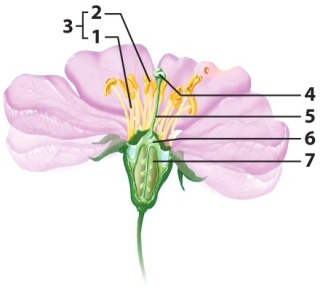
This is the stamen.
A) 1
B) 2
C) 3
D) 4
E) 6
This is the stamen.
A) 1
B) 2
C) 3
D) 4
E) 6
Question
Question
Question
Use the diagram to answer Questions 52-60.
These are the male reproductive structures of the flower.
A) 1 and 2
B) 2 and 7
C) 4 and 5
D) 4, 5, and 6
E) 4, 5, and 7
These are the male reproductive structures of the flower.
A) 1 and 2
B) 2 and 7
C) 4 and 5
D) 4, 5, and 6
E) 4, 5, and 7
Question
Use the diagram to answer Questions 52-60.
This is the anther.
A) 1
B) 2
C) 3
D) 4
E) 6
This is the anther.
A) 1
B) 2
C) 3
D) 4
E) 6
Question
Question
Use the diagram to answer Questions 52-60.
This is the style.
A) 3
B) 4
C) 5
D) 6
E) 7
This is the style.
A) 3
B) 4
C) 5
D) 6
E) 7
Question
Question
Question
Use the diagram to answer Questions 52-60.
This is the stigma.
A) 3
B) 4
C) 5
D) 6
E) 7
This is the stigma.
A) 3
B) 4
C) 5
D) 6
E) 7
Question
Question
Question
Use the diagram to answer Questions 52-60.
Eggs are found within this structure.
A) 2
B) 3
C) 4
D) 5
E) 6
Eggs are found within this structure.
A) 2
B) 3
C) 4
D) 5
E) 6
Question
Use the diagram to answer Questions 52-60.
This is the filament.
A) 1
B) 2
C) 3
D) 4
E) 5
This is the filament.
A) 1
B) 2
C) 3
D) 4
E) 5
Question
Question
Use the diagram to answer Questions 52-60.
Pollen is deposited here.
A) 2
B) 3
C) 4
D) 5
E) 6
Pollen is deposited here.
A) 2
B) 3
C) 4
D) 5
E) 6
Question
Use the diagram to answer Questions 52-60.
Pollen is located here.
A) 1
B) 2
C) 3
D) 4
E) 5
Pollen is located here.
A) 1
B) 2
C) 3
D) 4
E) 5
Question
Question
Question
Question
Question
Question
Question
Question
Question
Question
Question
Question
Question
Question
Question
Question
Question
Question
Question
Question
Question
Question
Question

Unlock Deck
Sign up to unlock the cards in this deck!
Unlock Deck
Unlock Deck
1/90

Play

Full screen (f)
Deck 32: A: Plant Physiology
1
In plants,______ transports ______ from ______.
A) xylem; sugars; leaves to roots
B) xylem; water; leaves to roots
C) xylem; water; roots to leaves
D) phloem; water; leaves to roots and roots to leaves
E) phloem; water; roots to leaves
A) xylem; sugars; leaves to roots
B) xylem; water; leaves to roots
C) xylem; water; roots to leaves
D) phloem; water; leaves to roots and roots to leaves
E) phloem; water; roots to leaves
C
2
The primary role of the stem is _______.
A) anchoring
B) reproduction
C) photosynthesis
D) support
E) water acquisition
A) anchoring
B) reproduction
C) photosynthesis
D) support
E) water acquisition
D
3
In most plants,photosynthesis takes place _______.
A) in the leaves
B) in the stems
C) in the roots
D) A and B
E) A, B, and C
A) in the leaves
B) in the stems
C) in the roots
D) A and B
E) A, B, and C
A
4
Sugars are transported by the _______.
Unlock Deck
Unlock for access to all 90 flashcards in this deck.
Unlock Deck
k this deck
5
The central vacuole _______.
A) is the command and control center of the plant cell
B) is the organelle responsible for photosynthesis
C) surrounds the cell membrane
D) helps keep the cell wall rigid
E) takes in carbon dioxide for photosynthesis
A) is the command and control center of the plant cell
B) is the organelle responsible for photosynthesis
C) surrounds the cell membrane
D) helps keep the cell wall rigid
E) takes in carbon dioxide for photosynthesis
Unlock Deck
Unlock for access to all 90 flashcards in this deck.
Unlock Deck
k this deck
6
The organelle that creates a plant cell's turgor pressure is the _______.
A) chloroplast
B) vacuole
C) nucleus
D) secondary cell wall
E) endoplasmic reticulum
A) chloroplast
B) vacuole
C) nucleus
D) secondary cell wall
E) endoplasmic reticulum
Unlock Deck
Unlock for access to all 90 flashcards in this deck.
Unlock Deck
k this deck
7
The aboveground support structure of most plants is(are)the _______.
A)taproot
B)root hairs
C)stem
D)leaves
E)A and C.
A)taproot
B)root hairs
C)stem
D)leaves
E)A and C.
Unlock Deck
Unlock for access to all 90 flashcards in this deck.
Unlock Deck
k this deck
8
Secondary walls of xylem cells are composed largely of _______.
A) acetaldehyde
B) phosphofructose
C) cellulose
D) lignin
E) chitin
A) acetaldehyde
B) phosphofructose
C) cellulose
D) lignin
E) chitin
Unlock Deck
Unlock for access to all 90 flashcards in this deck.
Unlock Deck
k this deck
9
The organelle responsible for photosynthesis is the _______.
A) nucleus
B) chloroplast
C) central vacuole
D) cell wall
E) turgor pressure
A) nucleus
B) chloroplast
C) central vacuole
D) cell wall
E) turgor pressure
Unlock Deck
Unlock for access to all 90 flashcards in this deck.
Unlock Deck
k this deck
10
We often think of water moving from the ground up through the plant,and sugar being produced in the leaves and moving down through the plant.However,sugar can also move from the leaves where it is produced and up through the plant.Explain why and when this would happen.
Unlock Deck
Unlock for access to all 90 flashcards in this deck.
Unlock Deck
k this deck
11
Leaves are typically covered with a waxy layer called _______,which reduces water loss.
A) the cuticle
B) keratin
C) chitin
D) lignin
E) ambergris
A) the cuticle
B) keratin
C) chitin
D) lignin
E) ambergris
Unlock Deck
Unlock for access to all 90 flashcards in this deck.
Unlock Deck
k this deck
12
The site of water uptake in the root is the _______.
A) root cap
B) pistils
C) ethylene
D) stomata
E) root hairs
A) root cap
B) pistils
C) ethylene
D) stomata
E) root hairs
Unlock Deck
Unlock for access to all 90 flashcards in this deck.
Unlock Deck
k this deck
13
In plants,_____ transports ______ from ______.
A) xylem; sugars; leaves to roots
B) phloem; sugars; leaves to roots
C) xylem; water; leaves to roots and roots to leaves
D) phloem; sugars; leaves to roots and roots to leaves
E) xylem; water; leaves to roots
A) xylem; sugars; leaves to roots
B) phloem; sugars; leaves to roots
C) xylem; water; leaves to roots and roots to leaves
D) phloem; sugars; leaves to roots and roots to leaves
E) xylem; water; leaves to roots
Unlock Deck
Unlock for access to all 90 flashcards in this deck.
Unlock Deck
k this deck
14
Water vapor leaves plants through openings called _______.
A) stamens
B) pistil
C) stomata
D) root hairs
E) cuticles
A) stamens
B) pistil
C) stomata
D) root hairs
E) cuticles
Unlock Deck
Unlock for access to all 90 flashcards in this deck.
Unlock Deck
k this deck
15
Water is transported by the _______.
Unlock Deck
Unlock for access to all 90 flashcards in this deck.
Unlock Deck
k this deck
16
In most plants,water and minerals are absorbed by _______.
A) the leaves
B) the stems
C) the roots
D) B and C
E) A, B, and C
A) the leaves
B) the stems
C) the roots
D) B and C
E) A, B, and C
Unlock Deck
Unlock for access to all 90 flashcards in this deck.
Unlock Deck
k this deck
17
Explain transpiration.
Unlock Deck
Unlock for access to all 90 flashcards in this deck.
Unlock Deck
k this deck
18
Leaves are typically covered with a waxy layer called _______,which reduces water loss.
Unlock Deck
Unlock for access to all 90 flashcards in this deck.
Unlock Deck
k this deck
19
The primary roles of the roots are water acquisition and _______.
A) anchoring
B) reproduction
C) photosynthesis
D) support
E) sugar transport
A) anchoring
B) reproduction
C) photosynthesis
D) support
E) sugar transport
Unlock Deck
Unlock for access to all 90 flashcards in this deck.
Unlock Deck
k this deck
20
The main photosynthetic organs of most plants are the _______.
A) chloroplasts
B) roots
C) stems
D) leaves
E) flowers
A) chloroplasts
B) roots
C) stems
D) leaves
E) flowers
Unlock Deck
Unlock for access to all 90 flashcards in this deck.
Unlock Deck
k this deck
21
In general,plants obtain _______ from the atmosphere and _______ from the soil.
A) carbon dioxide; nitrogen and other nutrients
B) nitrogen; carbon dioxide
C) nitrogen; carbon dioxide and other nutrients
D) carbon dioxide; nitrogen and insects
E) carbon dioxide; nitrogen
A) carbon dioxide; nitrogen and other nutrients
B) nitrogen; carbon dioxide
C) nitrogen; carbon dioxide and other nutrients
D) carbon dioxide; nitrogen and insects
E) carbon dioxide; nitrogen
Unlock Deck
Unlock for access to all 90 flashcards in this deck.
Unlock Deck
k this deck
22
Carnivorous plants often live in acidic soils where nitrogen-fixing ________ are unable to survive.
A) fungi
B) bacteria
C) roots
D) yeasts
E) protists
A) fungi
B) bacteria
C) roots
D) yeasts
E) protists
Unlock Deck
Unlock for access to all 90 flashcards in this deck.
Unlock Deck
k this deck
23
Many desert plants close their stomata during the _______.
A) night
B) summer
C) fall
D) day
E) evening
A) night
B) summer
C) fall
D) day
E) evening
Unlock Deck
Unlock for access to all 90 flashcards in this deck.
Unlock Deck
k this deck
24
You would expect insectivorous/carnivorous plants to be most common _______.
A) in habitats where soils are rich in nitrogen
B) in habitats where soils are poor in nitrogen
C) in habitats where soil is lacking, such as rocky outcrops
D) in habitats where soil is poor in potassium
E) in habitats where soil is poor in phosphates
A) in habitats where soils are rich in nitrogen
B) in habitats where soils are poor in nitrogen
C) in habitats where soil is lacking, such as rocky outcrops
D) in habitats where soil is poor in potassium
E) in habitats where soil is poor in phosphates
Unlock Deck
Unlock for access to all 90 flashcards in this deck.
Unlock Deck
k this deck
25
Carnivorous plants often live in acidic soils where ________ -fixing bacteria are unable to survive.
A) phosphorus
B) sulfur
C) molybdenum
D) nitrogen
E) potassium
A) phosphorus
B) sulfur
C) molybdenum
D) nitrogen
E) potassium
Unlock Deck
Unlock for access to all 90 flashcards in this deck.
Unlock Deck
k this deck
26
In temperate climates,many trees lose their leaves in the winter because _______.
A) days are short, so the trees don't have enough light to drive photosynthesis
B) when the ground freezes, they don't have enough water to support photosynthesis
C) transpiration only works in the summer
D) A and B
E) A, B, and C
A) days are short, so the trees don't have enough light to drive photosynthesis
B) when the ground freezes, they don't have enough water to support photosynthesis
C) transpiration only works in the summer
D) A and B
E) A, B, and C
Unlock Deck
Unlock for access to all 90 flashcards in this deck.
Unlock Deck
k this deck
27
Plants obtain carbon from _______.
A) water
B) the soil
C) animals
D) fossil fuels
E) the air
A) water
B) the soil
C) animals
D) fossil fuels
E) the air
Unlock Deck
Unlock for access to all 90 flashcards in this deck.
Unlock Deck
k this deck
28
In extremely hot,arid environments,plants may _______.
A) close stomata during the day and collect carbon dioxide at night
B) have adaptations allowing them to absorb carbon dioxide from leaf spaces when the stomata are closed
C) open stomata during the day because they need the carbon dioxide for photosynthesis
D) keep stomata closed to maximize sugar production
E) A and B
A) close stomata during the day and collect carbon dioxide at night
B) have adaptations allowing them to absorb carbon dioxide from leaf spaces when the stomata are closed
C) open stomata during the day because they need the carbon dioxide for photosynthesis
D) keep stomata closed to maximize sugar production
E) A and B
Unlock Deck
Unlock for access to all 90 flashcards in this deck.
Unlock Deck
k this deck
29
Most plants get their nitrogen with the help of nitrogen fixing _______.
A) fungi
B) bacteria
C) roots
D) yeasts
E) protists
A) fungi
B) bacteria
C) roots
D) yeasts
E) protists
Unlock Deck
Unlock for access to all 90 flashcards in this deck.
Unlock Deck
k this deck
30
Transpiration is an effective mechanism for moving water to the leaves in 300-foot-tall trees because of _______.
A) the cellulose and lignin in the walls of xylem cells
B) the cohesive strength of water that holds water molecules together
C) the force of gravity
D) the ability of plants to open and close their stomata
E) the ability of the central vacuole to release water
A) the cellulose and lignin in the walls of xylem cells
B) the cohesive strength of water that holds water molecules together
C) the force of gravity
D) the ability of plants to open and close their stomata
E) the ability of the central vacuole to release water
Unlock Deck
Unlock for access to all 90 flashcards in this deck.
Unlock Deck
k this deck
31
In temperate (not extremely hot,dry)climates,plants typically _______.
A) keep stomata open all day
B) perform both parts of photosynthesis at the same time
C) have thick, waxy cuticles on their leaves to prevent water loss
D) A and B
E) A, B, and C
A) keep stomata open all day
B) perform both parts of photosynthesis at the same time
C) have thick, waxy cuticles on their leaves to prevent water loss
D) A and B
E) A, B, and C
Unlock Deck
Unlock for access to all 90 flashcards in this deck.
Unlock Deck
k this deck
32
Transpiration _______.
A) is the process by which water evaporates from leaves, pulling more water up from the roots
B) relies on openings in the leaves called stomata
C) relies on the central vacuole to release water from the xylem
D) A and B
E) A, B, and C
A) is the process by which water evaporates from leaves, pulling more water up from the roots
B) relies on openings in the leaves called stomata
C) relies on the central vacuole to release water from the xylem
D) A and B
E) A, B, and C
Unlock Deck
Unlock for access to all 90 flashcards in this deck.
Unlock Deck
k this deck
33
The primary nutrient carnivorous plants seek from capturing insects is _______.
A) phosphorus
B) sulfur
C) carbon
D) nitrogen
E) potassium
A) phosphorus
B) sulfur
C) carbon
D) nitrogen
E) potassium
Unlock Deck
Unlock for access to all 90 flashcards in this deck.
Unlock Deck
k this deck
34
How is this shading a water conservation strategy?
Unlock Deck
Unlock for access to all 90 flashcards in this deck.
Unlock Deck
k this deck
35
A typical cactus found in an American desert has a green,fleshy stem and leaves reduced to brown and/or white needles and/or fine hairs.Why are the leaves reduced,and where do you think photosynthesis takes place? Explain.
Unlock Deck
Unlock for access to all 90 flashcards in this deck.
Unlock Deck
k this deck
36
The leaves of deciduous trees change color in the fall because _______.
A) trees substitute other pigments-better adapted for cool fall temperatures-for chlorophyll at this time
B) chloroplasts die in the fall and are replaced with other organelles using other pigments
C) trees produce other pigments in addition to chlorophyll; as chlorophyll production is shut down, the other pigments can be seen
D) B and C
E) A, B, and C
A) trees substitute other pigments-better adapted for cool fall temperatures-for chlorophyll at this time
B) chloroplasts die in the fall and are replaced with other organelles using other pigments
C) trees produce other pigments in addition to chlorophyll; as chlorophyll production is shut down, the other pigments can be seen
D) B and C
E) A, B, and C
Unlock Deck
Unlock for access to all 90 flashcards in this deck.
Unlock Deck
k this deck
37
A plant whose leaves and other tissues are white is missing _______ and must be a(n)_______.
A) chloroplasts; heterotroph
B) chloroplasts; autotroph
C) nucleus; heterotroph
D) nucleus; autotroph
E) central vacuole; autotroph
A) chloroplasts; heterotroph
B) chloroplasts; autotroph
C) nucleus; heterotroph
D) nucleus; autotroph
E) central vacuole; autotroph
Unlock Deck
Unlock for access to all 90 flashcards in this deck.
Unlock Deck
k this deck
38
How would a reduction in surface area reduce water loss?
Unlock Deck
Unlock for access to all 90 flashcards in this deck.
Unlock Deck
k this deck
39
Why do leaves of deciduous trees change color in the fall?
Unlock Deck
Unlock for access to all 90 flashcards in this deck.
Unlock Deck
k this deck
40
To conserve water,many desert plants close their _______ during the day.
A) flowers
B) stomata
C) leaves
D) root hairs
E) endodermis
A) flowers
B) stomata
C) leaves
D) root hairs
E) endodermis
Unlock Deck
Unlock for access to all 90 flashcards in this deck.
Unlock Deck
k this deck
41
Use the diagram to answer Questions 52-60.
This is the stamen.
A) 1
B) 2
C) 3
D) 4
E) 6
This is the stamen.
A) 1
B) 2
C) 3
D) 4
E) 6
Unlock Deck
Unlock for access to all 90 flashcards in this deck.
Unlock Deck
k this deck
42
Why don't wind-pollinated flowers have big showy petals?
Unlock Deck
Unlock for access to all 90 flashcards in this deck.
Unlock Deck
k this deck
43
The female sexual organ of the plant is the _______.
A) flower
B) pistil
C) filament
D) stamen
E) receptacle
A) flower
B) pistil
C) filament
D) stamen
E) receptacle
Unlock Deck
Unlock for access to all 90 flashcards in this deck.
Unlock Deck
k this deck
44
Use the diagram to answer Questions 52-60.
These are the male reproductive structures of the flower.
A) 1 and 2
B) 2 and 7
C) 4 and 5
D) 4, 5, and 6
E) 4, 5, and 7
These are the male reproductive structures of the flower.
A) 1 and 2
B) 2 and 7
C) 4 and 5
D) 4, 5, and 6
E) 4, 5, and 7
Unlock Deck
Unlock for access to all 90 flashcards in this deck.
Unlock Deck
k this deck
45
Use the diagram to answer Questions 52-60.
This is the anther.
A) 1
B) 2
C) 3
D) 4
E) 6
This is the anther.
A) 1
B) 2
C) 3
D) 4
E) 6
Unlock Deck
Unlock for access to all 90 flashcards in this deck.
Unlock Deck
k this deck
46
Flowering plants' eggs are produced inside _______.
A) pollen
B) receptacles
C) petaloids
D) sepals
E) ovules
A) pollen
B) receptacles
C) petaloids
D) sepals
E) ovules
Unlock Deck
Unlock for access to all 90 flashcards in this deck.
Unlock Deck
k this deck
47
Use the diagram to answer Questions 52-60.
This is the style.
A) 3
B) 4
C) 5
D) 6
E) 7
This is the style.
A) 3
B) 4
C) 5
D) 6
E) 7
Unlock Deck
Unlock for access to all 90 flashcards in this deck.
Unlock Deck
k this deck
48
Which of the following plants do NOT produce seeds?
A) apples
B) pine trees
C) gymnosperms
D) angiosperms
E) All of the above.
A) apples
B) pine trees
C) gymnosperms
D) angiosperms
E) All of the above.
Unlock Deck
Unlock for access to all 90 flashcards in this deck.
Unlock Deck
k this deck
49
If you were trying to tap maple trees to gather sap for maple syrup and had your choice of trees with yellow,orange,or flaming red leaves,which would you pick? Why?
Unlock Deck
Unlock for access to all 90 flashcards in this deck.
Unlock Deck
k this deck
50
Use the diagram to answer Questions 52-60.
This is the stigma.
A) 3
B) 4
C) 5
D) 6
E) 7
This is the stigma.
A) 3
B) 4
C) 5
D) 6
E) 7
Unlock Deck
Unlock for access to all 90 flashcards in this deck.
Unlock Deck
k this deck
51
The pistil consists of the _______,_______,and _______.
Unlock Deck
Unlock for access to all 90 flashcards in this deck.
Unlock Deck
k this deck
52
List at least three ways plants disperse their seeds.
Unlock Deck
Unlock for access to all 90 flashcards in this deck.
Unlock Deck
k this deck
53
Use the diagram to answer Questions 52-60.
Eggs are found within this structure.
A) 2
B) 3
C) 4
D) 5
E) 6
Eggs are found within this structure.
A) 2
B) 3
C) 4
D) 5
E) 6
Unlock Deck
Unlock for access to all 90 flashcards in this deck.
Unlock Deck
k this deck
54
Use the diagram to answer Questions 52-60.
This is the filament.
A) 1
B) 2
C) 3
D) 4
E) 5
This is the filament.
A) 1
B) 2
C) 3
D) 4
E) 5
Unlock Deck
Unlock for access to all 90 flashcards in this deck.
Unlock Deck
k this deck
55
The male sexual organ of the plant is the _______.
A) flower
B) pistil
C) filament
D) stamen
E) receptacle
A) flower
B) pistil
C) filament
D) stamen
E) receptacle
Unlock Deck
Unlock for access to all 90 flashcards in this deck.
Unlock Deck
k this deck
56
Use the diagram to answer Questions 52-60.
Pollen is deposited here.
A) 2
B) 3
C) 4
D) 5
E) 6
Pollen is deposited here.
A) 2
B) 3
C) 4
D) 5
E) 6
Unlock Deck
Unlock for access to all 90 flashcards in this deck.
Unlock Deck
k this deck
57
Use the diagram to answer Questions 52-60.
Pollen is located here.
A) 1
B) 2
C) 3
D) 4
E) 5
Pollen is located here.
A) 1
B) 2
C) 3
D) 4
E) 5
Unlock Deck
Unlock for access to all 90 flashcards in this deck.
Unlock Deck
k this deck
58
If you were a flower that relied on a bee to bring you pollen and you wanted to be sure that the pollen you received came from another plant (not you),which arrangement of reproductive parts would be best? Remember that nectar is found at the base of the flower; that's what the bees are after.
A) anthers above the stigma
B) anthers above the ovary
C) stigma above the anthers
D) stigma above the stamen
E) ovary above the anther
A) anthers above the stigma
B) anthers above the ovary
C) stigma above the anthers
D) stigma above the stamen
E) ovary above the anther
Unlock Deck
Unlock for access to all 90 flashcards in this deck.
Unlock Deck
k this deck
59
The role of a flower's petals is to _______.
A) protect the stigma
B) hold the ovary
C) attract a pollinator
D) produce pollen
E) produce ovules
A) protect the stigma
B) hold the ovary
C) attract a pollinator
D) produce pollen
E) produce ovules
Unlock Deck
Unlock for access to all 90 flashcards in this deck.
Unlock Deck
k this deck
60
Flowering plants' sperm are produced inside _______.
A) pollen
B) receptacles
C) petaloids
D) sepals
E) ovules
A) pollen
B) receptacles
C) petaloids
D) sepals
E) ovules
Unlock Deck
Unlock for access to all 90 flashcards in this deck.
Unlock Deck
k this deck
61
In roots,where it is concentrated,auxin causes plant cells to _______.
A) mature
B) elongate less than other cells
C) shorten
D) grow toward light
E) grow away from gravity
A) mature
B) elongate less than other cells
C) shorten
D) grow toward light
E) grow away from gravity
Unlock Deck
Unlock for access to all 90 flashcards in this deck.
Unlock Deck
k this deck
62
When light shines on one side of a plant more than another,auxin becomes concentrated on _______.
A)the sunny side
B)the shady side
C)the side that is down-in the direction of gravity
D)the side that is up-away from the direction of gravity
E)A and C.
A)the sunny side
B)the shady side
C)the side that is down-in the direction of gravity
D)the side that is up-away from the direction of gravity
E)A and C.
Unlock Deck
Unlock for access to all 90 flashcards in this deck.
Unlock Deck
k this deck
63
Explain how auxin controls phototropism.
Unlock Deck
Unlock for access to all 90 flashcards in this deck.
Unlock Deck
k this deck
64
Walking through a remote tropical forest,you discover a bright,round object about the size of a golf ball.It smells sweet and,when you cut it open,you see a collection of seeds inside white,juicy flesh.From this,you conclude that you have discovered a fruit.The plant it came from is _______.
A) an angiosperm
B) a gymnosperm
C) a club moss
D) equally likely to be an angiosperm or a gymnosperm; you can't tell from the available evidence
E) B and C
A) an angiosperm
B) a gymnosperm
C) a club moss
D) equally likely to be an angiosperm or a gymnosperm; you can't tell from the available evidence
E) B and C
Unlock Deck
Unlock for access to all 90 flashcards in this deck.
Unlock Deck
k this deck
65
High levels of _______ promote seed dormancy.
A) auxin
B) gibberellin
C) ethylene
D) cytokinins
E) abscisic acid
A) auxin
B) gibberellin
C) ethylene
D) cytokinins
E) abscisic acid
Unlock Deck
Unlock for access to all 90 flashcards in this deck.
Unlock Deck
k this deck
66
A seed is best described as _______.
A) a plant embryo
B) a plant embryo along with nutrients for early growth and development
C) a plant embryo along with nutrients and a cone
D) a plant embryo along with nutrients and a fruit to attract dispersers
E) a plant embryo with nutrients and a structure to allow wind dispersal
A) a plant embryo
B) a plant embryo along with nutrients for early growth and development
C) a plant embryo along with nutrients and a cone
D) a plant embryo along with nutrients and a fruit to attract dispersers
E) a plant embryo with nutrients and a structure to allow wind dispersal
Unlock Deck
Unlock for access to all 90 flashcards in this deck.
Unlock Deck
k this deck
67
Gravitropism is assisted by a hormone in cells called _______.
A) cytokinins
B) gravitropins
C) auxins
D) thigmons
E) giberellins
A) cytokinins
B) gravitropins
C) auxins
D) thigmons
E) giberellins
Unlock Deck
Unlock for access to all 90 flashcards in this deck.
Unlock Deck
k this deck
68
Except in roots,where it is concentrated,auxin causes plant cells to _______.
A) mature
B) elongate
C) shorten
D) grow toward light
E) grow toward gravity
A) mature
B) elongate
C) shorten
D) grow toward light
E) grow toward gravity
Unlock Deck
Unlock for access to all 90 flashcards in this deck.
Unlock Deck
k this deck
69
Low levels of _______ promote germination.
A) auxin
B) gibberellin
C) ethylene
D) cytokinins
E) abscisic acid
A) auxin
B) gibberellin
C) ethylene
D) cytokinins
E) abscisic acid
Unlock Deck
Unlock for access to all 90 flashcards in this deck.
Unlock Deck
k this deck
70
Rotten fruit can give off _______.
A) auxin
B) gibberellin
C) ethylene
D) cytokinins
E) brassinosteroids
A) auxin
B) gibberellin
C) ethylene
D) cytokinins
E) brassinosteroids
Unlock Deck
Unlock for access to all 90 flashcards in this deck.
Unlock Deck
k this deck
71
Walking through a remote tropical forest,you discover a bright,round object about the size of a golf ball.It smells sweet and,when you cut it open,you see a collection of seeds inside white,juicy flesh.From this,you conclude that you have discovered a fruit.The seeds from this fruit are most likely dispersed by _______.
A) wind
B) water
C) hummingbirds
D) ballistics: seeds are shot out of the fruit by water pressure
E) an animal who eats the fruit and deposits the seeds in feces
A) wind
B) water
C) hummingbirds
D) ballistics: seeds are shot out of the fruit by water pressure
E) an animal who eats the fruit and deposits the seeds in feces
Unlock Deck
Unlock for access to all 90 flashcards in this deck.
Unlock Deck
k this deck
72
Auxin is _______.
A) a plant hormone
B) a chemical involved in photosynthesis
C) critical for seed dispersal
D) responsible for helping fruit to ripen
E) All of the above.
A) a plant hormone
B) a chemical involved in photosynthesis
C) critical for seed dispersal
D) responsible for helping fruit to ripen
E) All of the above.
Unlock Deck
Unlock for access to all 90 flashcards in this deck.
Unlock Deck
k this deck
73
When a plant stem is lying on its side,auxin becomes more concentrated on _______.
A)the sunny side
B)the shady side
C)the side that is down-in the direction of gravity
D)the side that is up-away from the direction of gravity
E)A and C.
A)the sunny side
B)the shady side
C)the side that is down-in the direction of gravity
D)the side that is up-away from the direction of gravity
E)A and C.
Unlock Deck
Unlock for access to all 90 flashcards in this deck.
Unlock Deck
k this deck
74
Vines can curl around trellises because auxin becomes concentrated _______.
A) on the side of the stem touching the trellis
B) on the side of the stem away from the trellis
C) on the sunny side
D) on the shady side
E) on the side that is down-in the direction of gravity
A) on the side of the stem touching the trellis
B) on the side of the stem away from the trellis
C) on the sunny side
D) on the shady side
E) on the side that is down-in the direction of gravity
Unlock Deck
Unlock for access to all 90 flashcards in this deck.
Unlock Deck
k this deck
75
Which of the following promotes fruit ripening?
A) auxin
B) gibberellin
C) ethylene
D) cytokinins
E) brassinosteroids
A) auxin
B) gibberellin
C) ethylene
D) cytokinins
E) brassinosteroids
Unlock Deck
Unlock for access to all 90 flashcards in this deck.
Unlock Deck
k this deck
76
You need ripe (soft)avocados to make guacamole for a party in 3 days,but you need to do your shopping today.Although the avocados at the grocery store are all labeled with a sticker proclaiming "Ripe!" each is hard as a rock.How can you get them soft in time? Explain.
Unlock Deck
Unlock for access to all 90 flashcards in this deck.
Unlock Deck
k this deck
77
Response to light is called _______.
A) autotropism
B) thigmotropism
C) phototropism
D) lichtotropism
E) gravitropism
A) autotropism
B) thigmotropism
C) phototropism
D) lichtotropism
E) gravitropism
Unlock Deck
Unlock for access to all 90 flashcards in this deck.
Unlock Deck
k this deck
78
_______ produce _______ whereas _______ produce _______.
A) Gymnosperms; cones; angiosperms; seeds
B) Gymnosperms; seeds in cones; angiosperms; seeds in fruit
C) Gymnosperms; seeds; angiosperms; cones
D) Gymnosperms; seeds in cones; angiosperms; fruits in seeds
E) None of the above.
A) Gymnosperms; cones; angiosperms; seeds
B) Gymnosperms; seeds in cones; angiosperms; seeds in fruit
C) Gymnosperms; seeds; angiosperms; cones
D) Gymnosperms; seeds in cones; angiosperms; fruits in seeds
E) None of the above.
Unlock Deck
Unlock for access to all 90 flashcards in this deck.
Unlock Deck
k this deck
79
In plants,the aging process (including ripening)is regulated by _______.
A) auxin
B) ethylene
C) gibberellin
D) abscisic acid
E) A and B
A) auxin
B) ethylene
C) gibberellin
D) abscisic acid
E) A and B
Unlock Deck
Unlock for access to all 90 flashcards in this deck.
Unlock Deck
k this deck
80
Ethylene can make fruit look ripe,but it does not increase their sugar content.Can you explain the bland taste of many tomatoes in winter using these facts?
Unlock Deck
Unlock for access to all 90 flashcards in this deck.
Unlock Deck
k this deck
Unlock Deck
Unlock for access to all 90 flashcards in this deck.







