





 Chat with AI

Deck 3: Preschool Years
Full screen (f)

Question

Question
Question
Question
Question
Question
Question
Question
Question
Question
Question
Question
Question
Question
Question
Question
Question
Question
Question
Question
Question
Question
Question
Question
Question
Question
Question
Question
Question
Question
Question
Question
Question
Question
Question
Question
Question
Question
Question
Question
Question
Question
Question
Question
Question
Question
Question
Question
Question
Question
Question
Question
Question
Question
Pair together the most similar words in the A and B columns.
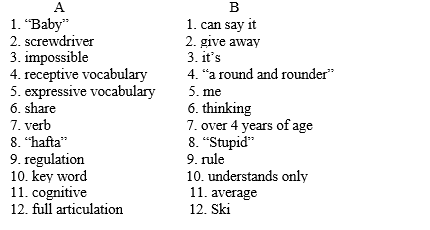
Question
Question
Question
Question
Question
Question
Question
Question
Question
Question
Question
Question
Question
Question
Question
Match between columns

Unlock Deck
Sign up to unlock the cards in this deck!
Unlock Deck
Unlock Deck
1/69

Play

Full screen (f)
Deck 3: Preschool Years
1
A good number of four-year-olds can distinguish rhyming words.
True
2
Self-commentary is seen more in older rather than younger preschoolers.
False
3
Preschoolers tend to focus on the superficial properties of new objects they encounter.
True
4
Consonants are formed by fully opening the vocal tract.
Unlock Deck
Unlock for access to all 69 flashcards in this deck.
Unlock Deck
k this deck
5
It is not professional to point out to children different features of their environment;it is more memorable if they discover it for themselves.
Unlock Deck
Unlock for access to all 69 flashcards in this deck.
Unlock Deck
k this deck
6
Metalinguistic awareness is displayed in the following child statement: "The table has four legs and iron sides."
Unlock Deck
Unlock for access to all 69 flashcards in this deck.
Unlock Deck
k this deck
7
The difference between receptive and productive vocabulary is displayed when the young child upon request successfully retrieves slippers from an upstairs closet but has a speaking vocabulary of only 10 to 20 words.
Unlock Deck
Unlock for access to all 69 flashcards in this deck.
Unlock Deck
k this deck
8
Words or phrases that are fun to say appeal to preschoolers,especially clever words in stories,books,children's TV programs,and movies.
Unlock Deck
Unlock for access to all 69 flashcards in this deck.
Unlock Deck
k this deck
9
The child's saying "Moo" when he sees a horse is an example of his use of pragmatic vocabulary.
Unlock Deck
Unlock for access to all 69 flashcards in this deck.
Unlock Deck
k this deck
10
The usual rate of learning words during the preschool years is 25 to 35 per day.
Unlock Deck
Unlock for access to all 69 flashcards in this deck.
Unlock Deck
k this deck
11
Many adults as well as preschoolers talk to themselves out loud.
Unlock Deck
Unlock for access to all 69 flashcards in this deck.
Unlock Deck
k this deck
12
Besides learning new words during the preschool years,the child establishes links between words and concepts.
Unlock Deck
Unlock for access to all 69 flashcards in this deck.
Unlock Deck
k this deck
13
Naming an object for a child may promote the child's observation of its distinct features.
Unlock Deck
Unlock for access to all 69 flashcards in this deck.
Unlock Deck
k this deck
14
Most toddlers reveal their thinking in their speech rather than in the actions they are performing.
Unlock Deck
Unlock for access to all 69 flashcards in this deck.
Unlock Deck
k this deck
15
Regularization and overextended speech describe a mature phenomenon that occurs in most preschoolers' speech.
Unlock Deck
Unlock for access to all 69 flashcards in this deck.
Unlock Deck
k this deck
16
It is common for the speech of two-year-olds to include many omissions and distortions.
Unlock Deck
Unlock for access to all 69 flashcards in this deck.
Unlock Deck
k this deck
17
In our culture it is not unusual for sexually related words to be spoken by preschoolers.
Unlock Deck
Unlock for access to all 69 flashcards in this deck.
Unlock Deck
k this deck
18
A teacher can expect to have one or more hesitant-to-speak preschoolers who actually have well-developed speech abilities in most preschool classrooms.
Unlock Deck
Unlock for access to all 69 flashcards in this deck.
Unlock Deck
k this deck
19
Preschool children group objects and form categories using the same criteria or distinguishing features as older children.
Unlock Deck
Unlock for access to all 69 flashcards in this deck.
Unlock Deck
k this deck
20
The use of pragmatic speech is typical in very young two-year-olds.
Unlock Deck
Unlock for access to all 69 flashcards in this deck.
Unlock Deck
k this deck
21
The quality of preschooler's forming mental categories depends on the quality and quantity of his experiences and human interactions.
Unlock Deck
Unlock for access to all 69 flashcards in this deck.
Unlock Deck
k this deck
22
A child who pronounces words correctly 95 percent of the time is probably
A)an articulate two-year-old.
B)a slow-developing three-year-old.
C)a typical four-year-old.
D)a grammar school child.
A)an articulate two-year-old.
B)a slow-developing three-year-old.
C)a typical four-year-old.
D)a grammar school child.
Unlock Deck
Unlock for access to all 69 flashcards in this deck.
Unlock Deck
k this deck
23
Use of the word aminal displays
A)faulty hearing.
B)poor enunciation.
C)omitting sounds.
D)substituting sounds.
A)faulty hearing.
B)poor enunciation.
C)omitting sounds.
D)substituting sounds.
Unlock Deck
Unlock for access to all 69 flashcards in this deck.
Unlock Deck
k this deck
24
It is professional for a teacher to tell a child,"That kind of talk is unacceptable," if the child's words are socially questionable.
Unlock Deck
Unlock for access to all 69 flashcards in this deck.
Unlock Deck
k this deck
25
Children use make-believe,fantasy,and role-playing in group play.
Unlock Deck
Unlock for access to all 69 flashcards in this deck.
Unlock Deck
k this deck
26
At group times,to promote turn taking teachers sometimes use a "your turn to listen,and my turn to talk" prop.
Unlock Deck
Unlock for access to all 69 flashcards in this deck.
Unlock Deck
k this deck
27
Verbs have regular and irregular forms,and 'drank' is a regular past tense form.
Unlock Deck
Unlock for access to all 69 flashcards in this deck.
Unlock Deck
k this deck
28
At about age 4 preschoolers add tag endings to their questions such as "right?"
Unlock Deck
Unlock for access to all 69 flashcards in this deck.
Unlock Deck
k this deck
29
The best response to a preschooler who stammers or stutters when speaking is to ask him or her to repeat the speech until it is error-free.
Unlock Deck
Unlock for access to all 69 flashcards in this deck.
Unlock Deck
k this deck
30
An early pruning of unused or rarely experienced mental data is believed to take place as early as age four.
Unlock Deck
Unlock for access to all 69 flashcards in this deck.
Unlock Deck
k this deck
31
At three years of age,most children can
A)monologue and dialogue.
B)display an advanced,productive vocabulary of 2,400 words.
C)repeat a sentence of six words or more
D)none of these answers
A)monologue and dialogue.
B)display an advanced,productive vocabulary of 2,400 words.
C)repeat a sentence of six words or more
D)none of these answers
Unlock Deck
Unlock for access to all 69 flashcards in this deck.
Unlock Deck
k this deck
32
A preschooler who acts terrified when seeing a large life-like bee replica is exhibiting overextension.
Unlock Deck
Unlock for access to all 69 flashcards in this deck.
Unlock Deck
k this deck
33
Hearing other playmates speech has the greatest influence on whether a child self-corrects his/her speech errors.
Unlock Deck
Unlock for access to all 69 flashcards in this deck.
Unlock Deck
k this deck
34
If a child uses four or less than four word sentences,you'd suspect he is about 4 years old.
Unlock Deck
Unlock for access to all 69 flashcards in this deck.
Unlock Deck
k this deck
35
At one or two years of age if a toddler has an average vocabulary size of 200 words,you would estimate that at five years of age he'd have 10 times that amount or more words in his vocabulary.
Unlock Deck
Unlock for access to all 69 flashcards in this deck.
Unlock Deck
k this deck
36
A preschooler who does not use self-talk frequently needs close observation to determine if there is a problem.
Unlock Deck
Unlock for access to all 69 flashcards in this deck.
Unlock Deck
k this deck
37
The subdued or shy preschooler may not be able to form an answer if anxious.
Unlock Deck
Unlock for access to all 69 flashcards in this deck.
Unlock Deck
k this deck
38
An illogical preschooler's statement needs to be ignored.
Unlock Deck
Unlock for access to all 69 flashcards in this deck.
Unlock Deck
k this deck
39
A child just beginning to use forms of the verb to be is probably a
A)two-year-old.
B)three-year-old.
C)four-year-old.
D)none of these answers
A)two-year-old.
B)three-year-old.
C)four-year-old.
D)none of these answers
Unlock Deck
Unlock for access to all 69 flashcards in this deck.
Unlock Deck
k this deck
40
Self-talk may help children
A)sequence actions.
B)control behavior.
C)be flexible in their thinking.
D)all of these answers
A)sequence actions.
B)control behavior.
C)be flexible in their thinking.
D)all of these answers
Unlock Deck
Unlock for access to all 69 flashcards in this deck.
Unlock Deck
k this deck
41
A good way to promote the learning of new skills is to
A)present many of them at the same time.
B)have interesting room furnishings and play things.
C)make sure the child has a degree of success.
D)praise him lavishly.
A)present many of them at the same time.
B)have interesting room furnishings and play things.
C)make sure the child has a degree of success.
D)praise him lavishly.
Unlock Deck
Unlock for access to all 69 flashcards in this deck.
Unlock Deck
k this deck
42
A lot of young preschoolers' comments describe
A)sophisticated features of objects.
B)details and cause-and-effect environmental relationships.
C)what they have done and what they are doing.
D)what others are doing wrong.
A)sophisticated features of objects.
B)details and cause-and-effect environmental relationships.
C)what they have done and what they are doing.
D)what others are doing wrong.
Unlock Deck
Unlock for access to all 69 flashcards in this deck.
Unlock Deck
k this deck
43
Preschoolers use self talk to
A)influence others
B)keep some of their ideas a secret
C)direct their actions.
D)communicate new ideas to others.
A)influence others
B)keep some of their ideas a secret
C)direct their actions.
D)communicate new ideas to others.
Unlock Deck
Unlock for access to all 69 flashcards in this deck.
Unlock Deck
k this deck
44
Creative speech for preschoolers evident in group play may include
A)role-playing.
B)imitating a cartoon character.
C)making up a silly saying and repeating it.
D)all of the above
A)role-playing.
B)imitating a cartoon character.
C)making up a silly saying and repeating it.
D)all of the above
Unlock Deck
Unlock for access to all 69 flashcards in this deck.
Unlock Deck
k this deck
45
Most preschoolers can produce
A)all the vowel sounds.
B)all the sounds in their native language.
C)all consonants.
D)none of these answers
A)all the vowel sounds.
B)all the sounds in their native language.
C)all consonants.
D)none of these answers
Unlock Deck
Unlock for access to all 69 flashcards in this deck.
Unlock Deck
k this deck
46
Preschool playmate friendships become
A)more volatile with age.
B)more fixed and stable with age.
C)more important with age.
D)less important with age.
A)more volatile with age.
B)more fixed and stable with age.
C)more important with age.
D)less important with age.
Unlock Deck
Unlock for access to all 69 flashcards in this deck.
Unlock Deck
k this deck
47
Most preschoolers' logic as expressed in their verbal statements is
A)immature but develops in kindergarten.
B)faulty.
C)logical considering their past experience.
D)all of the above.
A)immature but develops in kindergarten.
B)faulty.
C)logical considering their past experience.
D)all of the above.
Unlock Deck
Unlock for access to all 69 flashcards in this deck.
Unlock Deck
k this deck
48
When preschoolers first begin to imitate the actions of others,their play will probably involve
A)the behavior of cartoon characters
B)their peer's actions
C)things seen at home
D)things seen at their play center
A)the behavior of cartoon characters
B)their peer's actions
C)things seen at home
D)things seen at their play center
Unlock Deck
Unlock for access to all 69 flashcards in this deck.
Unlock Deck
k this deck
49
Asked to put a wide range of objects in categories,a child puts those of the same color together.He is sorting
A)by function.
B)by a visual attribute.
C)in an intellectually immature manner.
D)none of the above.
A)by function.
B)by a visual attribute.
C)in an intellectually immature manner.
D)none of the above.
Unlock Deck
Unlock for access to all 69 flashcards in this deck.
Unlock Deck
k this deck
50
A consonant can be described as
A)both a speech sound and a characteristic of some alphabet letters.
B)the alphabet letter U.
C)something that happens frequently.
D)none of the above.
A)both a speech sound and a characteristic of some alphabet letters.
B)the alphabet letter U.
C)something that happens frequently.
D)none of the above.
Unlock Deck
Unlock for access to all 69 flashcards in this deck.
Unlock Deck
k this deck
51
While watching a clown fall down,which statement by a young preschooler would be most typical?
A)"Did he hurt himself?"
B)"He dead?"
C)"He fell down."
D)"What a joke."
A)"Did he hurt himself?"
B)"He dead?"
C)"He fell down."
D)"What a joke."
Unlock Deck
Unlock for access to all 69 flashcards in this deck.
Unlock Deck
k this deck
52
If all of a sudden a child who hears well doesn't anymore,suspect
A)earwigs.
B)a cold or infection.
C)he is choosing to fool you.
D)boredom.
A)earwigs.
B)a cold or infection.
C)he is choosing to fool you.
D)boredom.
Unlock Deck
Unlock for access to all 69 flashcards in this deck.
Unlock Deck
k this deck
53
The wind blows the door shut,and the children insist another teacher or a mother closed the door.This is an example of children
A)making an inference.
B)being humorous.
C)being creative.
D)who have a tendency to guess when they do not know.
A)making an inference.
B)being humorous.
C)being creative.
D)who have a tendency to guess when they do not know.
Unlock Deck
Unlock for access to all 69 flashcards in this deck.
Unlock Deck
k this deck
54
Pair together the most similar words in the A and B columns.
Unlock Deck
Unlock for access to all 69 flashcards in this deck.
Unlock Deck
k this deck
55
Being presented with an unknown kiwi fruit and told to eat it,a preschooler refuses saying,"No,it's ugly" because he is probably
A)making a judgment based upon superficial properties.
B)testing if he has to eat it.
C)being negative and contrary.
D)an adventurous child.
A)making a judgment based upon superficial properties.
B)testing if he has to eat it.
C)being negative and contrary.
D)an adventurous child.
Unlock Deck
Unlock for access to all 69 flashcards in this deck.
Unlock Deck
k this deck
56
The best thing about using impact words a preschooler may find is
A)you can insult others.
B)it can cause an uproar or gain attention.
C)it makes a child feel like a mom or dad.
D)it always gets laughs.
A)you can insult others.
B)it can cause an uproar or gain attention.
C)it makes a child feel like a mom or dad.
D)it always gets laughs.
Unlock Deck
Unlock for access to all 69 flashcards in this deck.
Unlock Deck
k this deck
57
A preschooler with a vocabulary of about 4,000 words would be considered
A)a slow developer.
B)advanced.
C)very advanced.
D)moderately delayed.
A)a slow developer.
B)advanced.
C)very advanced.
D)moderately delayed.
Unlock Deck
Unlock for access to all 69 flashcards in this deck.
Unlock Deck
k this deck
58
A child using the word pee pee
A)is bound to get into trouble.
B)is teasing.
C)may be using the only word he knows for the function.
D)is using a forbidden word.
A)is bound to get into trouble.
B)is teasing.
C)may be using the only word he knows for the function.
D)is using a forbidden word.
Unlock Deck
Unlock for access to all 69 flashcards in this deck.
Unlock Deck
k this deck
59
Arrange the following statements in the sequence they most often appear in preschoolers' past-tense speech development.
1.Over-regularities.Example adds '-ed'.
2.Learns both regular and irregular forms.
3.Uses irregular tense endings correctly.
4.Forms an internal rule.
1.Over-regularities.Example adds '-ed'.
2.Learns both regular and irregular forms.
3.Uses irregular tense endings correctly.
4.Forms an internal rule.
Unlock Deck
Unlock for access to all 69 flashcards in this deck.
Unlock Deck
k this deck
60
One thing to expect in the make-believe play of older preschoolers is
A)it causes hurt feelings.
B)no one wants to be the dog.
C)it displays more speech complexity and depth.
D)they will want the teacher to join in.
A)it causes hurt feelings.
B)no one wants to be the dog.
C)it displays more speech complexity and depth.
D)they will want the teacher to join in.
Unlock Deck
Unlock for access to all 69 flashcards in this deck.
Unlock Deck
k this deck
61
Write a paragraph that discusses teacher strategies to promote a child's joy in a new learning.
Unlock Deck
Unlock for access to all 69 flashcards in this deck.
Unlock Deck
k this deck
62
What is meant by the statement,"Preschoolers are beginning to understand words are arbitrary symbols"?
Unlock Deck
Unlock for access to all 69 flashcards in this deck.
Unlock Deck
k this deck
63
Discuss in a few sentences why so much of preschoolers' speech lacks clarity.
Unlock Deck
Unlock for access to all 69 flashcards in this deck.
Unlock Deck
k this deck
64
How does a teacher know when a word is part of a young child's receptive vocabulary?
Unlock Deck
Unlock for access to all 69 flashcards in this deck.
Unlock Deck
k this deck
65
Write two examples of telegraphic speech and discuss why staff members may not understand the child's intent.
Unlock Deck
Unlock for access to all 69 flashcards in this deck.
Unlock Deck
k this deck
66
When brain synapses are "pruned," they
Unlock Deck
Unlock for access to all 69 flashcards in this deck.
Unlock Deck
k this deck
67
Discuss preschoolers' increasing maturity in the questions he asks others using examples when necessary.
Unlock Deck
Unlock for access to all 69 flashcards in this deck.
Unlock Deck
k this deck
68
What erroneous conclusion might an inexperienced teacher make about a child with an extensive vocabulary and clear pronunciation of words his peers have not mastered?
Unlock Deck
Unlock for access to all 69 flashcards in this deck.
Unlock Deck
k this deck
70
Match between columns
Unlock Deck
Unlock for access to all 69 flashcards in this deck.
Unlock Deck
k this deck
Unlock Deck
Unlock for access to all 69 flashcards in this deck.







