





 Chat with AI

Deck 10: Radical Reactions
Full screen (f)

Question

Question
Question
Question
Question
Question
Question
Question
What is the product of the following reaction? 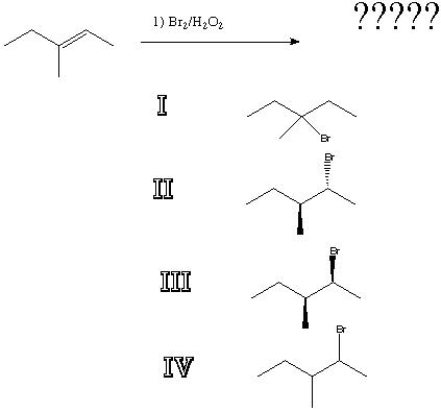
A) I
B) II
C) III
D) IV
A) I
B) II
C) III
D) IV
Question
Question

Unlock Deck
Sign up to unlock the cards in this deck!
Unlock Deck
Unlock Deck
1/10

Play

Full screen (f)
Deck 10: Radical Reactions
1
Radicals are formed through ___ .
A) Heterolysis
B) Homolysis
C) Ozonolysis
A) Heterolysis
B) Homolysis
C) Ozonolysis
Homolysis
2
___ and ___ can be used to form radicals.
A) Light and high temperatures
B) Light and cool temperatures
C) Dark and high temperatures
D) Dark and cool temperatures
A) Light and high temperatures
B) Light and cool temperatures
C) Dark and high temperatures
D) Dark and cool temperatures
Light and high temperatures
3
What is the order of radical stability (from most stable to least stable)?
A) methyl > primary > secondary > tertiary
B) primary > secondary > tertiary > methyl
C) tertiary > secondary > primary > methyl
D) tertiary > primary > secondary > methyl
A) methyl > primary > secondary > tertiary
B) primary > secondary > tertiary > methyl
C) tertiary > secondary > primary > methyl
D) tertiary > primary > secondary > methyl
tertiary > secondary > primary > methyl
4
Radical halogenation reactions using ___ are the
Most ___ and often lead to multiple products. While radical halogenation reactions using ___ are the most ___ and produce primarily the major product.
A) bromine, selective, chlorine, reactive
B) bromine, reactive, chlorine, selective
C) chlorine, selective, bromine, reactive
D) chlorine, reactive, bromine, selective
Most ___ and often lead to multiple products. While radical halogenation reactions using ___ are the most ___ and produce primarily the major product.
A) bromine, selective, chlorine, reactive
B) bromine, reactive, chlorine, selective
C) chlorine, selective, bromine, reactive
D) chlorine, reactive, bromine, selective
Unlock Deck
Unlock for access to all 10 flashcards in this deck.
Unlock Deck
k this deck
5
Which of the following bonds would be most susceptible to radical formation?
A) carbon carbon single bond
B) oxygen oxygen single bond
C) hydrogen hydrogen single bond
D) oxygen hydrogen single bond
E) carbon hydrogen single bond
A) carbon carbon single bond
B) oxygen oxygen single bond
C) hydrogen hydrogen single bond
D) oxygen hydrogen single bond
E) carbon hydrogen single bond
Unlock Deck
Unlock for access to all 10 flashcards in this deck.
Unlock Deck
k this deck
6
What is the geometry of alkyl radicals?
A) tetrahedral
B) linear
C) trigonal planar
D) trigonal pyrimidal
A) tetrahedral
B) linear
C) trigonal planar
D) trigonal pyrimidal
Unlock Deck
Unlock for access to all 10 flashcards in this deck.
Unlock Deck
k this deck
7
Radical reactions produce a ___ .
A) racemic product
B) product with inversion of configuration
C) product with retention of configuration
D) Markovnikov product
A) racemic product
B) product with inversion of configuration
C) product with retention of configuration
D) Markovnikov product
Unlock Deck
Unlock for access to all 10 flashcards in this deck.
Unlock Deck
k this deck
8
What is the product of the following reaction?
A) I
B) II
C) III
D) IV
A) I
B) II
C) III
D) IV
Unlock Deck
Unlock for access to all 10 flashcards in this deck.
Unlock Deck
k this deck
9
The ozone layer protects us from harmful ___ that can cause skin cancer. The ozone layer has been depleted by ___ released from air conditioners and refrigerator refrigerants.
A) ultraviolet, bromine radicals
B) ultraviolet, chlorine radicals
C) infrared, bromine radicals
D) infrared, chlorine radicals
A) ultraviolet, bromine radicals
B) ultraviolet, chlorine radicals
C) infrared, bromine radicals
D) infrared, chlorine radicals
Unlock Deck
Unlock for access to all 10 flashcards in this deck.
Unlock Deck
k this deck
10
Light from the sun splits an ___ atom, which combines with another oxygen atom to create ozone. Ozone absorbs light from the sun and recreates the ___ atom. ___ radicals from CFCs decompose ozone instead of the sun light allowing the sunlight to reach the surface of the earth unfiltered.
A) ozone, oxygen, chlorine
B) oxygen, ozone, chlorine
C) oxygen, oxygen, chlorine
D) ozone, ozone, chlorine
A) ozone, oxygen, chlorine
B) oxygen, ozone, chlorine
C) oxygen, oxygen, chlorine
D) ozone, ozone, chlorine
Unlock Deck
Unlock for access to all 10 flashcards in this deck.
Unlock Deck
k this deck
Unlock Deck
Unlock for access to all 10 flashcards in this deck.







