





 Chat with AI

Deck 7: Health-Care Issues
Full screen (f)

Question

Question
Question
Question
Question
Question
Question
Question
Question
Question
Question
Question
Question
Question
Question
Question
Question
Question
Question
Question
Question
Question
Question
Question
Question
Question
Question
Question
Question
Question
Question
Question
Question
Question
Answer the next question on the basis of the following diagram:
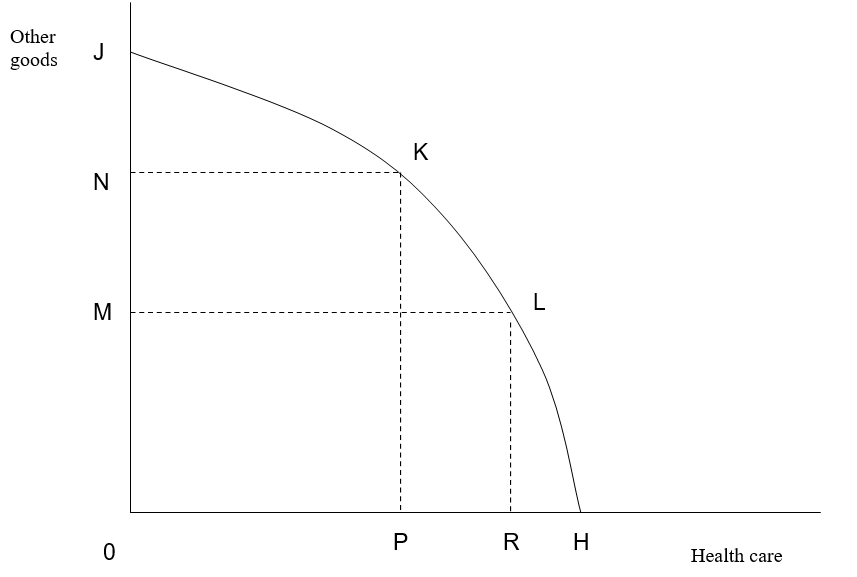
-If the economy is currently at point K, moving to point L:
A) entails a sacrifice of PR amount of health care to obtain NM amount of other goods
B) can be accomplished without the sacrifice of alternative goods
C) means that an increase in the output of health care is costless
D) requires society to sacrifice NM amount of other goods to obtain PR amount of health care
E) indicates that health care really can be a free good
-If the economy is currently at point K, moving to point L:
A) entails a sacrifice of PR amount of health care to obtain NM amount of other goods
B) can be accomplished without the sacrifice of alternative goods
C) means that an increase in the output of health care is costless
D) requires society to sacrifice NM amount of other goods to obtain PR amount of health care
E) indicates that health care really can be a free good
Question
Question
Question
Question
Question
Question
Question
Question
Question
Question
Question
Question

Unlock Deck
Sign up to unlock the cards in this deck!
Unlock Deck
Unlock Deck
1/46

Play

Full screen (f)
Deck 7: Health-Care Issues
1
Use a supply-and-demand diagram to demonstrate how the implementation of Medicare has led to higher health-care costs.
The implementation of Medicare has led to higher health-care costs due to the increase in demand for health services without a corresponding increase in supply.
In a supply-and-demand diagram, the demand curve for health services shifts to the right as more people are able to access healthcare through Medicare. This increased demand puts upward pressure on prices, leading to higher health-care costs.
Additionally, the implementation of Medicare may also lead to a decrease in the supply of healthcare services as providers may be less willing to accept lower Medicare reimbursement rates, leading to a shortage of healthcare services and further driving up costs.
Overall, the implementation of Medicare has led to higher health-care costs due to the imbalance between increased demand and limited supply of healthcare services.
In a supply-and-demand diagram, the demand curve for health services shifts to the right as more people are able to access healthcare through Medicare. This increased demand puts upward pressure on prices, leading to higher health-care costs.
Additionally, the implementation of Medicare may also lead to a decrease in the supply of healthcare services as providers may be less willing to accept lower Medicare reimbursement rates, leading to a shortage of healthcare services and further driving up costs.
Overall, the implementation of Medicare has led to higher health-care costs due to the imbalance between increased demand and limited supply of healthcare services.
2
Use a demand graph to show the case of inelastic demand for health care. Show the effects of a price increase upon the quantity demanded and relate the circumstances to the health-care sector.
In the case of inelastic demand for health care, a demand graph would show a steep, almost vertical demand curve. This indicates that the quantity demanded does not change significantly in response to changes in price.
When there is a price increase in the health care sector, the quantity demanded does not decrease proportionally. This means that even if the price of health care services goes up, people will still continue to demand the same amount of health care. This is because health care is often considered a necessity, and people are willing to pay higher prices to maintain their health and well-being.
In the health care sector, inelastic demand can lead to higher prices without a significant decrease in demand. This can result in financial strain for individuals and families who require health care services, as they may have to allocate more of their budget towards these services. It can also lead to issues of accessibility and affordability for those who cannot afford the higher prices.
Overall, the inelastic demand for health care means that price increases do not significantly reduce the quantity demanded, which can have significant implications for the affordability and accessibility of health care services for individuals and communities.
When there is a price increase in the health care sector, the quantity demanded does not decrease proportionally. This means that even if the price of health care services goes up, people will still continue to demand the same amount of health care. This is because health care is often considered a necessity, and people are willing to pay higher prices to maintain their health and well-being.
In the health care sector, inelastic demand can lead to higher prices without a significant decrease in demand. This can result in financial strain for individuals and families who require health care services, as they may have to allocate more of their budget towards these services. It can also lead to issues of accessibility and affordability for those who cannot afford the higher prices.
Overall, the inelastic demand for health care means that price increases do not significantly reduce the quantity demanded, which can have significant implications for the affordability and accessibility of health care services for individuals and communities.
3
List and discuss the relative merits of various proposals for health-care reform.
There are several proposals for health-care reform, each with its own merits and drawbacks. One proposal is to implement a single-payer system, where the government is the sole provider of health insurance. This could potentially reduce administrative costs and ensure universal coverage, but it may also lead to longer wait times and limited choice for patients.
Another proposal is to expand the Affordable Care Act (ACA) and create a public option, allowing individuals to buy into a government-run insurance plan. This could increase competition and lower costs, but it may also lead to higher taxes and government involvement in the healthcare industry.
Some advocate for a market-based approach, where individuals have more control over their healthcare spending through health savings accounts and high-deductible insurance plans. This could promote consumer choice and lower costs, but it may also leave some individuals without adequate coverage and lead to disparities in access to care.
Ultimately, the best approach to health-care reform may involve a combination of these proposals, taking into account the unique needs and challenges of the healthcare system. It is important to consider the relative merits of each proposal and work towards a solution that provides affordable, accessible, and high-quality care for all individuals.
Another proposal is to expand the Affordable Care Act (ACA) and create a public option, allowing individuals to buy into a government-run insurance plan. This could increase competition and lower costs, but it may also lead to higher taxes and government involvement in the healthcare industry.
Some advocate for a market-based approach, where individuals have more control over their healthcare spending through health savings accounts and high-deductible insurance plans. This could promote consumer choice and lower costs, but it may also leave some individuals without adequate coverage and lead to disparities in access to care.
Ultimately, the best approach to health-care reform may involve a combination of these proposals, taking into account the unique needs and challenges of the healthcare system. It is important to consider the relative merits of each proposal and work towards a solution that provides affordable, accessible, and high-quality care for all individuals.
4
The rate of inflation in medical services has been generally less than the rate of
inflation for the economy as a whole.
inflation for the economy as a whole.
Unlock Deck
Unlock for access to all 46 flashcards in this deck.
Unlock Deck
k this deck
5
All health-care services have the characteristics of public goods.
Unlock Deck
Unlock for access to all 46 flashcards in this deck.
Unlock Deck
k this deck
6
Public goods exhibit the characteristics of nonexcludability and nonrival consumption.
Unlock Deck
Unlock for access to all 46 flashcards in this deck.
Unlock Deck
k this deck
7
A health maintenance organization charges its subscribers on a fee-for-service basis.
Unlock Deck
Unlock for access to all 46 flashcards in this deck.
Unlock Deck
k this deck
8
Nursing home care is one of the fastest growing components of health-care expenditures.
Unlock Deck
Unlock for access to all 46 flashcards in this deck.
Unlock Deck
k this deck
9
Medical malpractice suits have been the most effective means of holding down health-care costs.
Unlock Deck
Unlock for access to all 46 flashcards in this deck.
Unlock Deck
k this deck
10
The demand for hospital services is highly inelastic while the demand for physician's services is highly elastic.
Unlock Deck
Unlock for access to all 46 flashcards in this deck.
Unlock Deck
k this deck
11
The National Organ Transplant Act of 1984 outlawed interstate commerce in human organs.
Unlock Deck
Unlock for access to all 46 flashcards in this deck.
Unlock Deck
k this deck
12
Physicians banded together in 1983 to develop a schedule of diagnostic related groups in order to contain health-care costs.
Unlock Deck
Unlock for access to all 46 flashcards in this deck.
Unlock Deck
k this deck
13
Medicare's prospective payment system sets fixed reimbursements to hospitals that treat patients covered by the program.
Unlock Deck
Unlock for access to all 46 flashcards in this deck.
Unlock Deck
k this deck
14
All evidence to date reveals that Medicare's prospective payment system has resulted in greatly diminished quality of care for aged patients.
Unlock Deck
Unlock for access to all 46 flashcards in this deck.
Unlock Deck
k this deck
15
"Customary, reasonable and prevailing rates" have been recommended as a replacement for the Resource-Based Relative Value Scale.
Unlock Deck
Unlock for access to all 46 flashcards in this deck.
Unlock Deck
k this deck
16
National health insurance was finally adopted in 2010 for the purpose of insuring the uninsured.
Unlock Deck
Unlock for access to all 46 flashcards in this deck.
Unlock Deck
k this deck
17
A benefit-received approach to pricing health care will allocate costs to consumers based upon their level of use.
Unlock Deck
Unlock for access to all 46 flashcards in this deck.
Unlock Deck
k this deck
18
The health-care market is one of the best illustrations of the independence between supplier and demander of a service.
Unlock Deck
Unlock for access to all 46 flashcards in this deck.
Unlock Deck
k this deck
19
Elective cosmetic surgery probably should be regarded as a private good.
Unlock Deck
Unlock for access to all 46 flashcards in this deck.
Unlock Deck
k this deck
20
The rise of third-party payers has been credited with fueling healthcare inflation since 1965.
Unlock Deck
Unlock for access to all 46 flashcards in this deck.
Unlock Deck
k this deck
21
The presence of insurance generally gives the health-care consumer and provider the incentive to contain costs.
Unlock Deck
Unlock for access to all 46 flashcards in this deck.
Unlock Deck
k this deck
22
"Defensive medicine" is the practice of consuming medication before the onset of disease.
Unlock Deck
Unlock for access to all 46 flashcards in this deck.
Unlock Deck
k this deck
23
A certificate of need is usually presented to a doctor in order to verify that the patient really needs the treatment.
Unlock Deck
Unlock for access to all 46 flashcards in this deck.
Unlock Deck
k this deck
24
Since the 1940s, the percentage of the population with health insurance has risen from roughly 10 percent to about 85 percent.
Unlock Deck
Unlock for access to all 46 flashcards in this deck.
Unlock Deck
k this deck
25
Certificates of need are required by some states to justify hospitals'capital expenditures and avoid duplicative and excess capacity.
Unlock Deck
Unlock for access to all 46 flashcards in this deck.
Unlock Deck
k this deck
26
The United States spends about 2½ times more per capita on health care than the median of countries in the Organization for Economic Cooperation and Development.
Unlock Deck
Unlock for access to all 46 flashcards in this deck.
Unlock Deck
k this deck
27
In 1983, Medicare:
A) instituted a prospective payment system for reimbursement to hospitals that provide services to Medicare patients.
B) decided to allow hospitals to charge customary, reasonable, and prevailing rates for Medicare patients
C) began paying hospitals on a fee-for-service basis
D) forced physicians to accept a DRG payment as payment-in-full for office visits
A) instituted a prospective payment system for reimbursement to hospitals that provide services to Medicare patients.
B) decided to allow hospitals to charge customary, reasonable, and prevailing rates for Medicare patients
C) began paying hospitals on a fee-for-service basis
D) forced physicians to accept a DRG payment as payment-in-full for office visits
Unlock Deck
Unlock for access to all 46 flashcards in this deck.
Unlock Deck
k this deck
28
Since medical services generally exhibit inelastic demand, raising prices by 10 percent will:
A) result in a greater than 10 percent reduction in the quantity of medical services consumed
B) result in a less than 10 percent reduction in the quantity of medical services consumed
C) result in a 10 percent reduction in the quantity of medical services consumed
D) result in less than a 10 percent increase in the quantity of medical services consumed
A) result in a greater than 10 percent reduction in the quantity of medical services consumed
B) result in a less than 10 percent reduction in the quantity of medical services consumed
C) result in a 10 percent reduction in the quantity of medical services consumed
D) result in less than a 10 percent increase in the quantity of medical services consumed
Unlock Deck
Unlock for access to all 46 flashcards in this deck.
Unlock Deck
k this deck
29
Which of the following is not a cost-push explanation for inflation in the health- care sector?
A) medical practitioners' risk of exposure to deadly diseases
B) rising prices for medical resources
C) medical malpractice suits
D) presence of third-party payers
A) medical practitioners' risk of exposure to deadly diseases
B) rising prices for medical resources
C) medical malpractice suits
D) presence of third-party payers
Unlock Deck
Unlock for access to all 46 flashcards in this deck.
Unlock Deck
k this deck
30
Hospital care is about ___ percent of national health expenditures.
A) 7
B) 31
C) 75
D) 100
A) 7
B) 31
C) 75
D) 100
Unlock Deck
Unlock for access to all 46 flashcards in this deck.
Unlock Deck
k this deck
31
The supply side of the health-care market is comprised of:
A) independent physicians, hospitals, HMOs, and other care providers
B) third party payers, the uninsured, HMOs, and major employers
C) DRGs, PPOs, and HMOs
D) drugstores, voodoo doctors, and the uninsured
A) independent physicians, hospitals, HMOs, and other care providers
B) third party payers, the uninsured, HMOs, and major employers
C) DRGs, PPOs, and HMOs
D) drugstores, voodoo doctors, and the uninsured
Unlock Deck
Unlock for access to all 46 flashcards in this deck.
Unlock Deck
k this deck
32
The current path projects that national health expenditures will:
A) hover around 16 to 17 percent of GDP
B) become more controllable under a national insurance scheme
C) fall to the range of 10 to 12 percent of GDP by 2015
D) reach over 20 percent of GDP by 2015.
E) be the best resort for economic stimulus
A) hover around 16 to 17 percent of GDP
B) become more controllable under a national insurance scheme
C) fall to the range of 10 to 12 percent of GDP by 2015
D) reach over 20 percent of GDP by 2015.
E) be the best resort for economic stimulus
Unlock Deck
Unlock for access to all 46 flashcards in this deck.
Unlock Deck
k this deck
33
Most public goods are characterized by:
A) only the nonexclusion principle
B) only the zero marginal cost principle
C) the nonexclusion principle, the zero marginal cost principle, or both
D) the nonexclusion principle, the zero marginal principle, but never both
A) only the nonexclusion principle
B) only the zero marginal cost principle
C) the nonexclusion principle, the zero marginal cost principle, or both
D) the nonexclusion principle, the zero marginal principle, but never both
Unlock Deck
Unlock for access to all 46 flashcards in this deck.
Unlock Deck
k this deck
34
Answer the next question on the basis of the following diagram:
-If the economy is currently at point K, moving to point L:
A) entails a sacrifice of PR amount of health care to obtain NM amount of other goods
B) can be accomplished without the sacrifice of alternative goods
C) means that an increase in the output of health care is costless
D) requires society to sacrifice NM amount of other goods to obtain PR amount of health care
E) indicates that health care really can be a free good
-If the economy is currently at point K, moving to point L:
A) entails a sacrifice of PR amount of health care to obtain NM amount of other goods
B) can be accomplished without the sacrifice of alternative goods
C) means that an increase in the output of health care is costless
D) requires society to sacrifice NM amount of other goods to obtain PR amount of health care
E) indicates that health care really can be a free good
Unlock Deck
Unlock for access to all 46 flashcards in this deck.
Unlock Deck
k this deck
35
Which of the following healthcare goods is likely to generate external benefits?
A) kidney transplant
B) flu vaccination
C) weight loss clinic
D) elective surgery
A) kidney transplant
B) flu vaccination
C) weight loss clinic
D) elective surgery
Unlock Deck
Unlock for access to all 46 flashcards in this deck.
Unlock Deck
k this deck
36
Suppose the presence of medical insurance reduces the incentive for the physician or patient to contain expenditures on testing, treatment, or fees. This is an illustration of:
A) moral hazard
B) a prospective payment
C) a certificate of need
D) a preferred provider organization
E) the Stockholm Syndrome
A) moral hazard
B) a prospective payment
C) a certificate of need
D) a preferred provider organization
E) the Stockholm Syndrome
Unlock Deck
Unlock for access to all 46 flashcards in this deck.
Unlock Deck
k this deck
37
A preferred provider organization:
A) is the best group of physicians that money can buy
B) is a contractual arrangement between an insurance company or employer with a group of physicians who agree to accept a certain payment as payment-in-full for a given medical expense
C) is a contractual arrangement where people elect to enroll in the organization for a prepaid fee and the organization agrees to cover all health-care needs
D) is an inpatient treatment center where patients vote on who is the best physician
A) is the best group of physicians that money can buy
B) is a contractual arrangement between an insurance company or employer with a group of physicians who agree to accept a certain payment as payment-in-full for a given medical expense
C) is a contractual arrangement where people elect to enroll in the organization for a prepaid fee and the organization agrees to cover all health-care needs
D) is an inpatient treatment center where patients vote on who is the best physician
Unlock Deck
Unlock for access to all 46 flashcards in this deck.
Unlock Deck
k this deck
38
"Fee-for-service" means:
A) a third-party payer establishes a fixed fee that it will pay for a medical service
B) the care provider establishes what the fee is for the service
C) patients admitted to the emergency room bid over who will be treated first
D) rationing health-care services by age
E) physicians compensation is determined by a bonus system
A) a third-party payer establishes a fixed fee that it will pay for a medical service
B) the care provider establishes what the fee is for the service
C) patients admitted to the emergency room bid over who will be treated first
D) rationing health-care services by age
E) physicians compensation is determined by a bonus system
Unlock Deck
Unlock for access to all 46 flashcards in this deck.
Unlock Deck
k this deck
39
The medical care services component of the consumer price index (CPI):
A) has tended to grow more slowly than the CPI
B) has increased at a pace that equals the increase in the CPI
C) has tended to increase faster than the CPI
D) is now controlled by a team of elected officials established by the Patient Protection and Affordable Care Act of 2010
A) has tended to grow more slowly than the CPI
B) has increased at a pace that equals the increase in the CPI
C) has tended to increase faster than the CPI
D) is now controlled by a team of elected officials established by the Patient Protection and Affordable Care Act of 2010
Unlock Deck
Unlock for access to all 46 flashcards in this deck.
Unlock Deck
k this deck
40
If the ability-to-pay principle were applied to the financing of a national health insurance plan, then:
A) health-care consumers would pay amounts that approximate the value of the care consumed
B) a flat percentage rate payroll tax would be used to raise the revenue
C) health care really would become free
D) uninsured people must buy insurance or pay a penalty
E) high-income groups would pay a larger share of health-care costs than low-income groups
A) health-care consumers would pay amounts that approximate the value of the care consumed
B) a flat percentage rate payroll tax would be used to raise the revenue
C) health care really would become free
D) uninsured people must buy insurance or pay a penalty
E) high-income groups would pay a larger share of health-care costs than low-income groups
Unlock Deck
Unlock for access to all 46 flashcards in this deck.
Unlock Deck
k this deck
41
What would be the likely outcome if transplantable human organs could be traded on the market?
A) the quantity of human organs available for transplants would increase as has happened in Iran
B) the quantity of human organs available for transplants would decrease
C) fewer transplants would be made
D) many people would kill their relatives in order to sell the organs
E) diplomatic relations with Iran are bound to improve
A) the quantity of human organs available for transplants would increase as has happened in Iran
B) the quantity of human organs available for transplants would decrease
C) fewer transplants would be made
D) many people would kill their relatives in order to sell the organs
E) diplomatic relations with Iran are bound to improve
Unlock Deck
Unlock for access to all 46 flashcards in this deck.
Unlock Deck
k this deck
42
The Patient Protection and Affordable Care Act of 2010:
A) expands Medicaid to include more people
B) requires employers with more than 50 employees to provide health insurance or pay a penalty
C) allows dependents to remain on their parent's health insurance policy until age 26
D) eliminates denial of health insurance coverage because of a preexisting condition
E) all of the above
A) expands Medicaid to include more people
B) requires employers with more than 50 employees to provide health insurance or pay a penalty
C) allows dependents to remain on their parent's health insurance policy until age 26
D) eliminates denial of health insurance coverage because of a preexisting condition
E) all of the above
Unlock Deck
Unlock for access to all 46 flashcards in this deck.
Unlock Deck
k this deck
43
Which of the following is driving health-care expenditures upward?
A) rising living standards
B) advances in medical technology
C) the increased dominance of third-party payers
D) all of the above
A) rising living standards
B) advances in medical technology
C) the increased dominance of third-party payers
D) all of the above
Unlock Deck
Unlock for access to all 46 flashcards in this deck.
Unlock Deck
k this deck
44
The Patient Protection and Affordable Care Act of 2010:
A) is expected to ensure that everyone has health insurance coverage
B) provides that everyone will be able to actually get health-care services
C) ensures that no one will ever lose their health insurance coverage
D) is estimated to cost nearly $1 trillion or more over ten years
A) is expected to ensure that everyone has health insurance coverage
B) provides that everyone will be able to actually get health-care services
C) ensures that no one will ever lose their health insurance coverage
D) is estimated to cost nearly $1 trillion or more over ten years
Unlock Deck
Unlock for access to all 46 flashcards in this deck.
Unlock Deck
k this deck
45
Tax-based programs to decrease the personal financial burden health-care costs include:
A) medical savings accounts
B) health savings accounts
C) flexible spending accounts
D) all of the above
A) medical savings accounts
B) health savings accounts
C) flexible spending accounts
D) all of the above
Unlock Deck
Unlock for access to all 46 flashcards in this deck.
Unlock Deck
k this deck
46
Health-care expenditures:
A) can be expected to double by 2018 if no countermeasures are taken
B) can be expected to fall
C) will be fully controlled by provisions in the Patient Protection and Affordable Care Act of 2010
D) are expected to be flat through 2018
A) can be expected to double by 2018 if no countermeasures are taken
B) can be expected to fall
C) will be fully controlled by provisions in the Patient Protection and Affordable Care Act of 2010
D) are expected to be flat through 2018
Unlock Deck
Unlock for access to all 46 flashcards in this deck.
Unlock Deck
k this deck
Unlock Deck
Unlock for access to all 46 flashcards in this deck.







