





 Chat with AI

Deck 14: Institutional Veto Players
Full screen (f)

Question

Question
Question
Question
Question
Question
Question
Question
Question
Question
Question
Question
Question
Question
Figure 1 illustrates a situation of a unicameral legislature in which there is a median voter (MV) and a status quo policy (SQ) arrayed along a single left-right issue dimension that runs from 0 (most left) to 10 (most right). The MV is assumed to have a single-peaked utility function and to vote for the policy that is located closest to her ideal point. Assume that a voter will vote for a new policy over the status quo if she is indifferent between them.
Figure 1: Illustrating a Unicameral Legislature

-In Figure 1, what is the range of policies that the median voter prefers to the status quo?
A) 3-5
B) 0-10
C) 3-6
D) 3-9
E) 6-10
Figure 1: Illustrating a Unicameral Legislature
-In Figure 1, what is the range of policies that the median voter prefers to the status quo?
A) 3-5
B) 0-10
C) 3-6
D) 3-9
E) 6-10
Question
Figure 1 illustrates a situation of a unicameral legislature in which there is a median voter (MV) and a status quo policy (SQ) arrayed along a single left-right issue dimension that runs from 0 (most left) to 10 (most right). The MV is assumed to have a single-peaked utility function and to vote for the policy that is located closest to her ideal point. Assume that a voter will vote for a new policy over the status quo if she is indifferent between them.
Figure 1: Illustrating a Unicameral Legislature
-If the median voter in the legislature in Figure 1 gets to propose a new policy, what would she propose?
A) 2
B) 3
C) 4
D) 5
E) 6
F) 7
G) 8
Figure 1: Illustrating a Unicameral Legislature
-If the median voter in the legislature in Figure 1 gets to propose a new policy, what would she propose?
A) 2
B) 3
C) 4
D) 5
E) 6
F) 7
G) 8
Question
Figure 1 illustrates a situation of a unicameral legislature in which there is a median voter (MV) and a status quo policy (SQ) arrayed along a single left-right issue dimension that runs from 0 (most left) to 10 (most right). The MV is assumed to have a single-peaked utility function and to vote for the policy that is located closest to her ideal point. Assume that a voter will vote for a new policy over the status quo if she is indifferent between them.
Figure 1: Illustrating a Unicameral Legislature
-In Figure 1, what would the outcome be after the median voter proposes a new policy and all members of the legislature vote between the new policy and the status quo?
A) 2
B) 3
C) 4
D) 5
E) 6
F) 7
G) 8
Figure 1: Illustrating a Unicameral Legislature
-In Figure 1, what would the outcome be after the median voter proposes a new policy and all members of the legislature vote between the new policy and the status quo?
A) 2
B) 3
C) 4
D) 5
E) 6
F) 7
G) 8
Question
In Figure 2, we illustrate a situation where we have a bicameral legislature. The location of the status quo policy is SQ, the location of the median voter in the lower chamber is LC, and the location of the median voter in the upper chamber is UC. Assume that both median voters have a single-peaked utility function and that the support of both chambers is needed to pass a new policy. Assume that a voter will vote for a new policy over the status quo if she is indifferent between them.
Figure 2: Illustrating a Bicameral Legislature

-In Figure 2, what is the range of policies that the median voter in the lower chamber prefers to the status quo?
A) 3-5
B) 0-10
C) 3-6
D) 3-9
E) 6-10
Figure 2: Illustrating a Bicameral Legislature
-In Figure 2, what is the range of policies that the median voter in the lower chamber prefers to the status quo?
A) 3-5
B) 0-10
C) 3-6
D) 3-9
E) 6-10
Question
In Figure 2, we illustrate a situation where we have a bicameral legislature. The location of the status quo policy is SQ, the location of the median voter in the lower chamber is LC, and the location of the median voter in the upper chamber is UC. Assume that both median voters have a single-peaked utility function and that the support of both chambers is needed to pass a new policy. Assume that a voter will vote for a new policy over the status quo if she is indifferent between them.
Figure 2: Illustrating a Bicameral Legislature
-In Figure 2, what is the range of policies that the median voter in the upper chamber prefers to the status quo?
A) 3-5
B) 0-10
C) 3-6
D) 3-9
E) 6-10
Figure 2: Illustrating a Bicameral Legislature
-In Figure 2, what is the range of policies that the median voter in the upper chamber prefers to the status quo?
A) 3-5
B) 0-10
C) 3-6
D) 3-9
E) 6-10
Question
In Figure 2, we illustrate a situation where we have a bicameral legislature. The location of the status quo policy is SQ, the location of the median voter in the lower chamber is LC, and the location of the median voter in the upper chamber is UC. Assume that both median voters have a single-peaked utility function and that the support of both chambers is needed to pass a new policy. Assume that a voter will vote for a new policy over the status quo if she is indifferent between them.
Figure 2: Illustrating a Bicameral Legislature
-In Figure 2, what is the overlapping range of policies preferred by both chambers to the status quo?
A) 3-5
B) 2-3
C) 3-6
D) 3-9
E) 6-10
Figure 2: Illustrating a Bicameral Legislature
-In Figure 2, what is the overlapping range of policies preferred by both chambers to the status quo?
A) 3-5
B) 2-3
C) 3-6
D) 3-9
E) 6-10
Question
In Figure 2, we illustrate a situation where we have a bicameral legislature. The location of the status quo policy is SQ, the location of the median voter in the lower chamber is LC, and the location of the median voter in the upper chamber is UC. Assume that both median voters have a single-peaked utility function and that the support of both chambers is needed to pass a new policy. Assume that a voter will vote for a new policy over the status quo if she is indifferent between them.
Figure 2: Illustrating a Bicameral Legislature
-If the lower chamber is the agenda setter and can make take-it-or-leave-it proposals, where on the left-right issue dimension will the lower chamber make its policy proposal?
A) 3
B) 4
C) 5
D) 6
E) 7
Figure 2: Illustrating a Bicameral Legislature
-If the lower chamber is the agenda setter and can make take-it-or-leave-it proposals, where on the left-right issue dimension will the lower chamber make its policy proposal?
A) 3
B) 4
C) 5
D) 6
E) 7
Question
In Figure 2, we illustrate a situation where we have a bicameral legislature. The location of the status quo policy is SQ, the location of the median voter in the lower chamber is LC, and the location of the median voter in the upper chamber is UC. Assume that both median voters have a single-peaked utility function and that the support of both chambers is needed to pass a new policy. Assume that a voter will vote for a new policy over the status quo if she is indifferent between them.
Figure 2: Illustrating a Bicameral Legislature
-If the upper chamber is the agenda setter and can make take-it-or-leave-it proposals, where on the left-right issue dimension will the lower chamber make its policy proposal?
A) 3
B) 4
C) 5
D) 6
E) 7
Figure 2: Illustrating a Bicameral Legislature
-If the upper chamber is the agenda setter and can make take-it-or-leave-it proposals, where on the left-right issue dimension will the lower chamber make its policy proposal?
A) 3
B) 4
C) 5
D) 6
E) 7
Question
In Figure 2, we illustrate a situation where we have a bicameral legislature. The location of the status quo policy is SQ, the location of the median voter in the lower chamber is LC, and the location of the median voter in the upper chamber is UC. Assume that both median voters have a single-peaked utility function and that the support of both chambers is needed to pass a new policy. Assume that a voter will vote for a new policy over the status quo if she is indifferent between them.
Figure 2: Illustrating a Bicameral Legislature
-Based on your answers to the previous two questions, does an institutional rule designating which chamber has agenda-setting power affect policy outcomes?
Figure 2: Illustrating a Bicameral Legislature
-Based on your answers to the previous two questions, does an institutional rule designating which chamber has agenda-setting power affect policy outcomes?
Question
In Figure 2, we illustrate a situation where we have a bicameral legislature. The location of the status quo policy is SQ, the location of the median voter in the lower chamber is LC, and the location of the median voter in the upper chamber is UC. Assume that both median voters have a single-peaked utility function and that the support of both chambers is needed to pass a new policy. Assume that a voter will vote for a new policy over the status quo if she is indifferent between them.
Figure 2: Illustrating a Bicameral Legislature
-Imagine that the status quo policy shown in Figure 2 were actually at 5 (assume that nothing else has changed). Would this different status quo affect the answers to the previous questions concerning Figure 2?
A) Yes, because the acceptable ranges for each median voter would be different. In fact, in this case the status quo could not be overturned in favor of any new policy.
B) No, all of the answers to the preceding questions would be the same.
Figure 2: Illustrating a Bicameral Legislature
-Imagine that the status quo policy shown in Figure 2 were actually at 5 (assume that nothing else has changed). Would this different status quo affect the answers to the previous questions concerning Figure 2?
A) Yes, because the acceptable ranges for each median voter would be different. In fact, in this case the status quo could not be overturned in favor of any new policy.
B) No, all of the answers to the preceding questions would be the same.
Question
Question
Question
Question
Question
Question
Question
Question
In Figure 3, we have two veto players, A and B, who are located in a two-dimensional issue space. The status quo policy is given by the point SQ. Potential policy proposals are denoted by X.
Figure 3: Two Veto Players
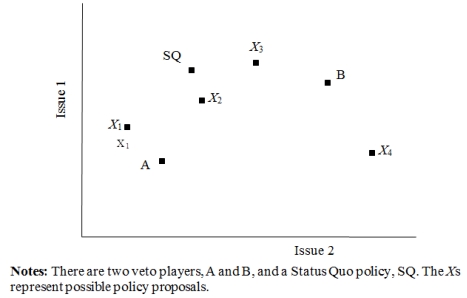
-Using Figure 3, draw indifference curves for each veto player (A and B) with respect to the status quo (SQ). Shade in the winset if there is one. Which of the potential policy proposals (labeled X1-X4), would win in a pairwise contest against the status quo?
A) X1
B) X2
C) X3
D) X4
Figure 3: Two Veto Players
-Using Figure 3, draw indifference curves for each veto player (A and B) with respect to the status quo (SQ). Shade in the winset if there is one. Which of the potential policy proposals (labeled X1-X4), would win in a pairwise contest against the status quo?
A) X1
B) X2
C) X3
D) X4
Question
In Figure 3, we have two veto players, A and B, who are located in a two-dimensional issue space. The status quo policy is given by the point SQ. Potential policy proposals are denoted by X.
Figure 3: Two Veto Players
-If Figure 3 remained the same except that B were no longer a veto player-that is, if A could choose policy independently-where would policy end up?
A) X1
B) X2
C) X3
D) X4
E) A
F) B
G) SQ
Figure 3: Two Veto Players
-If Figure 3 remained the same except that B were no longer a veto player-that is, if A could choose policy independently-where would policy end up?
A) X1
B) X2
C) X3
D) X4
E) A
F) B
G) SQ
Question
In Figure 3, we have two veto players, A and B, who are located in a two-dimensional issue space. The status quo policy is given by the point SQ. Potential policy proposals are denoted by X.
Figure 3: Two Veto Players
-If Figure 3 remained the same except that A were no longer a veto player-that is, if B could choose policy independently, where would policy end up?
A) X1
B) X2
C) X3
D) X4
E) A
F) B
G) SQ
Figure 3: Two Veto Players
-If Figure 3 remained the same except that A were no longer a veto player-that is, if B could choose policy independently, where would policy end up?
A) X1
B) X2
C) X3
D) X4
E) A
F) B
G) SQ
Question

Unlock Deck
Sign up to unlock the cards in this deck!
Unlock Deck
Unlock Deck
1/34

Play

Full screen (f)
Deck 14: Institutional Veto Players
1
The discussion of federalism in the chapter contains a distinction between de facto federalism and de jure federalism. The latter is referred to as "federalism in structure." To be classified as federal in structure, what features must a country have?
A) A unitary state.
B) Constitutionally regional governments that cannot be unilaterally abolished by the national government. Both the regional and the national government govern their own citizens directly, and both have independent bases of authority.
C) A bicameral legislature, in which legislative deliberations occur in two distinct assemblies.
D) devolution
E) all of these
A) A unitary state.
B) Constitutionally regional governments that cannot be unilaterally abolished by the national government. Both the regional and the national government govern their own citizens directly, and both have independent bases of authority.
C) A bicameral legislature, in which legislative deliberations occur in two distinct assemblies.
D) devolution
E) all of these
A
2
The majority of independent countries in the world today are federal in structure.
False
3
Imagine a country with an ethnically heterogeneous population. The different ethnic groups are geographically clustered so that if you consider particular areas of the country in isolation, they have relatively homogeneous populations. If such a country were to adopt a federal system, which type of federalism would you expect it to adopt?
A) congruent and symmetric
B) congruent and asymmetric
C) incongruent and symmetric
D) incongruent and asymmetric
A) congruent and symmetric
B) congruent and asymmetric
C) incongruent and symmetric
D) incongruent and asymmetric
D
4
It is nearly always the case that a researcher can determine how centralized a country is by looking at its constitution.
Unlock Deck
Unlock for access to all 34 flashcards in this deck.
Unlock Deck
k this deck
5
When researchers study federalism in practice (de facto federalism), what measure do they use to estimate how centralized a country is?
A) The effective number of parties.
B) The central government's share of tax revenue.
C) The number of regional subunits in the country.
A) The effective number of parties.
B) The central government's share of tax revenue.
C) The number of regional subunits in the country.
Unlock Deck
Unlock for access to all 34 flashcards in this deck.
Unlock Deck
k this deck
6
Political scientists tend to view federalism (de jure federalism) as a constitutional issue but decentralization (de facto federalism) as a budgetary one.
Unlock Deck
Unlock for access to all 34 flashcards in this deck.
Unlock Deck
k this deck
7
According to political scientists, what is the relationship between federalism and government accountability?
A) Federalism enhances accountability.
B) Federalism undermines government accountability.
C) Different political scientists have argued both (a) and (b) above.
A) Federalism enhances accountability.
B) Federalism undermines government accountability.
C) Different political scientists have argued both (a) and (b) above.
Unlock Deck
Unlock for access to all 34 flashcards in this deck.
Unlock Deck
k this deck
8
The majority of independent countries in the world today are bicameral in structure.
Unlock Deck
Unlock for access to all 34 flashcards in this deck.
Unlock Deck
k this deck
9
In which of the following countries would you expect to see legislators engaging in more credit-claiming behavior?
A) in bicameral parliamentary democracies
B) in unicameral parliamentary democracies
A) in bicameral parliamentary democracies
B) in unicameral parliamentary democracies
Unlock Deck
Unlock for access to all 34 flashcards in this deck.
Unlock Deck
k this deck
10
Even upper houses that are generally considered to be weak can, in some circumstances, significantly influence the legislative process.
Unlock Deck
Unlock for access to all 34 flashcards in this deck.
Unlock Deck
k this deck
11
In most bicameral systems, the upper house represents the citizens of subnational geographic units. Thus, the upper chamber often suffers from malapportionment.
Unlock Deck
Unlock for access to all 34 flashcards in this deck.
Unlock Deck
k this deck
12
The majority of bicameral countries in the world today are characterized by symmetric bicameralism in structure.
Unlock Deck
Unlock for access to all 34 flashcards in this deck.
Unlock Deck
k this deck
13
Over time, most countries have moved away from having class-based upper chambers, though territorially based upper chambers tend to be able to retain their legitimacy.
Unlock Deck
Unlock for access to all 34 flashcards in this deck.
Unlock Deck
k this deck
14
Figure 1 illustrates a situation of a unicameral legislature in which there is a median voter (MV) and a status quo policy (SQ) arrayed along a single left-right issue dimension that runs from 0 (most left) to 10 (most right). The MV is assumed to have a single-peaked utility function and to vote for the policy that is located closest to her ideal point. Assume that a voter will vote for a new policy over the status quo if she is indifferent between them.
Figure 1: Illustrating a Unicameral Legislature
-In Figure 1, what is the range of policies that the median voter prefers to the status quo?
A) 3-5
B) 0-10
C) 3-6
D) 3-9
E) 6-10
Figure 1: Illustrating a Unicameral Legislature
-In Figure 1, what is the range of policies that the median voter prefers to the status quo?
A) 3-5
B) 0-10
C) 3-6
D) 3-9
E) 6-10
Unlock Deck
Unlock for access to all 34 flashcards in this deck.
Unlock Deck
k this deck
15
Figure 1 illustrates a situation of a unicameral legislature in which there is a median voter (MV) and a status quo policy (SQ) arrayed along a single left-right issue dimension that runs from 0 (most left) to 10 (most right). The MV is assumed to have a single-peaked utility function and to vote for the policy that is located closest to her ideal point. Assume that a voter will vote for a new policy over the status quo if she is indifferent between them.
Figure 1: Illustrating a Unicameral Legislature
-If the median voter in the legislature in Figure 1 gets to propose a new policy, what would she propose?
A) 2
B) 3
C) 4
D) 5
E) 6
F) 7
G) 8
Figure 1: Illustrating a Unicameral Legislature
-If the median voter in the legislature in Figure 1 gets to propose a new policy, what would she propose?
A) 2
B) 3
C) 4
D) 5
E) 6
F) 7
G) 8
Unlock Deck
Unlock for access to all 34 flashcards in this deck.
Unlock Deck
k this deck
16
Figure 1 illustrates a situation of a unicameral legislature in which there is a median voter (MV) and a status quo policy (SQ) arrayed along a single left-right issue dimension that runs from 0 (most left) to 10 (most right). The MV is assumed to have a single-peaked utility function and to vote for the policy that is located closest to her ideal point. Assume that a voter will vote for a new policy over the status quo if she is indifferent between them.
Figure 1: Illustrating a Unicameral Legislature
-In Figure 1, what would the outcome be after the median voter proposes a new policy and all members of the legislature vote between the new policy and the status quo?
A) 2
B) 3
C) 4
D) 5
E) 6
F) 7
G) 8
Figure 1: Illustrating a Unicameral Legislature
-In Figure 1, what would the outcome be after the median voter proposes a new policy and all members of the legislature vote between the new policy and the status quo?
A) 2
B) 3
C) 4
D) 5
E) 6
F) 7
G) 8
Unlock Deck
Unlock for access to all 34 flashcards in this deck.
Unlock Deck
k this deck
17
In Figure 2, we illustrate a situation where we have a bicameral legislature. The location of the status quo policy is SQ, the location of the median voter in the lower chamber is LC, and the location of the median voter in the upper chamber is UC. Assume that both median voters have a single-peaked utility function and that the support of both chambers is needed to pass a new policy. Assume that a voter will vote for a new policy over the status quo if she is indifferent between them.
Figure 2: Illustrating a Bicameral Legislature
-In Figure 2, what is the range of policies that the median voter in the lower chamber prefers to the status quo?
A) 3-5
B) 0-10
C) 3-6
D) 3-9
E) 6-10
Figure 2: Illustrating a Bicameral Legislature
-In Figure 2, what is the range of policies that the median voter in the lower chamber prefers to the status quo?
A) 3-5
B) 0-10
C) 3-6
D) 3-9
E) 6-10
Unlock Deck
Unlock for access to all 34 flashcards in this deck.
Unlock Deck
k this deck
18
In Figure 2, we illustrate a situation where we have a bicameral legislature. The location of the status quo policy is SQ, the location of the median voter in the lower chamber is LC, and the location of the median voter in the upper chamber is UC. Assume that both median voters have a single-peaked utility function and that the support of both chambers is needed to pass a new policy. Assume that a voter will vote for a new policy over the status quo if she is indifferent between them.
Figure 2: Illustrating a Bicameral Legislature
-In Figure 2, what is the range of policies that the median voter in the upper chamber prefers to the status quo?
A) 3-5
B) 0-10
C) 3-6
D) 3-9
E) 6-10
Figure 2: Illustrating a Bicameral Legislature
-In Figure 2, what is the range of policies that the median voter in the upper chamber prefers to the status quo?
A) 3-5
B) 0-10
C) 3-6
D) 3-9
E) 6-10
Unlock Deck
Unlock for access to all 34 flashcards in this deck.
Unlock Deck
k this deck
19
In Figure 2, we illustrate a situation where we have a bicameral legislature. The location of the status quo policy is SQ, the location of the median voter in the lower chamber is LC, and the location of the median voter in the upper chamber is UC. Assume that both median voters have a single-peaked utility function and that the support of both chambers is needed to pass a new policy. Assume that a voter will vote for a new policy over the status quo if she is indifferent between them.
Figure 2: Illustrating a Bicameral Legislature
-In Figure 2, what is the overlapping range of policies preferred by both chambers to the status quo?
A) 3-5
B) 2-3
C) 3-6
D) 3-9
E) 6-10
Figure 2: Illustrating a Bicameral Legislature
-In Figure 2, what is the overlapping range of policies preferred by both chambers to the status quo?
A) 3-5
B) 2-3
C) 3-6
D) 3-9
E) 6-10
Unlock Deck
Unlock for access to all 34 flashcards in this deck.
Unlock Deck
k this deck
20
In Figure 2, we illustrate a situation where we have a bicameral legislature. The location of the status quo policy is SQ, the location of the median voter in the lower chamber is LC, and the location of the median voter in the upper chamber is UC. Assume that both median voters have a single-peaked utility function and that the support of both chambers is needed to pass a new policy. Assume that a voter will vote for a new policy over the status quo if she is indifferent between them.
Figure 2: Illustrating a Bicameral Legislature
-If the lower chamber is the agenda setter and can make take-it-or-leave-it proposals, where on the left-right issue dimension will the lower chamber make its policy proposal?
A) 3
B) 4
C) 5
D) 6
E) 7
Figure 2: Illustrating a Bicameral Legislature
-If the lower chamber is the agenda setter and can make take-it-or-leave-it proposals, where on the left-right issue dimension will the lower chamber make its policy proposal?
A) 3
B) 4
C) 5
D) 6
E) 7
Unlock Deck
Unlock for access to all 34 flashcards in this deck.
Unlock Deck
k this deck
21
In Figure 2, we illustrate a situation where we have a bicameral legislature. The location of the status quo policy is SQ, the location of the median voter in the lower chamber is LC, and the location of the median voter in the upper chamber is UC. Assume that both median voters have a single-peaked utility function and that the support of both chambers is needed to pass a new policy. Assume that a voter will vote for a new policy over the status quo if she is indifferent between them.
Figure 2: Illustrating a Bicameral Legislature
-If the upper chamber is the agenda setter and can make take-it-or-leave-it proposals, where on the left-right issue dimension will the lower chamber make its policy proposal?
A) 3
B) 4
C) 5
D) 6
E) 7
Figure 2: Illustrating a Bicameral Legislature
-If the upper chamber is the agenda setter and can make take-it-or-leave-it proposals, where on the left-right issue dimension will the lower chamber make its policy proposal?
A) 3
B) 4
C) 5
D) 6
E) 7
Unlock Deck
Unlock for access to all 34 flashcards in this deck.
Unlock Deck
k this deck
22
In Figure 2, we illustrate a situation where we have a bicameral legislature. The location of the status quo policy is SQ, the location of the median voter in the lower chamber is LC, and the location of the median voter in the upper chamber is UC. Assume that both median voters have a single-peaked utility function and that the support of both chambers is needed to pass a new policy. Assume that a voter will vote for a new policy over the status quo if she is indifferent between them.
Figure 2: Illustrating a Bicameral Legislature
-Based on your answers to the previous two questions, does an institutional rule designating which chamber has agenda-setting power affect policy outcomes?
Figure 2: Illustrating a Bicameral Legislature
-Based on your answers to the previous two questions, does an institutional rule designating which chamber has agenda-setting power affect policy outcomes?
Unlock Deck
Unlock for access to all 34 flashcards in this deck.
Unlock Deck
k this deck
23
In Figure 2, we illustrate a situation where we have a bicameral legislature. The location of the status quo policy is SQ, the location of the median voter in the lower chamber is LC, and the location of the median voter in the upper chamber is UC. Assume that both median voters have a single-peaked utility function and that the support of both chambers is needed to pass a new policy. Assume that a voter will vote for a new policy over the status quo if she is indifferent between them.
Figure 2: Illustrating a Bicameral Legislature
-Imagine that the status quo policy shown in Figure 2 were actually at 5 (assume that nothing else has changed). Would this different status quo affect the answers to the previous questions concerning Figure 2?
A) Yes, because the acceptable ranges for each median voter would be different. In fact, in this case the status quo could not be overturned in favor of any new policy.
B) No, all of the answers to the preceding questions would be the same.
Figure 2: Illustrating a Bicameral Legislature
-Imagine that the status quo policy shown in Figure 2 were actually at 5 (assume that nothing else has changed). Would this different status quo affect the answers to the previous questions concerning Figure 2?
A) Yes, because the acceptable ranges for each median voter would be different. In fact, in this case the status quo could not be overturned in favor of any new policy.
B) No, all of the answers to the preceding questions would be the same.
Unlock Deck
Unlock for access to all 34 flashcards in this deck.
Unlock Deck
k this deck
24
"Constitutionalism" refers to constitutions that are written in a single document, as opposed to constitutions that have several sources, some of which may be unwritten.
Unlock Deck
Unlock for access to all 34 flashcards in this deck.
Unlock Deck
k this deck
25
The majority of independent countries in the world today have codified constitutions.
Unlock Deck
Unlock for access to all 34 flashcards in this deck.
Unlock Deck
k this deck
26
In which of the following types of democracies would it be easier to change the current constitution?
A) in a country with an entrenched constitution
B) in a country with an unentrenched constitution
A) in a country with an entrenched constitution
B) in a country with an unentrenched constitution
Unlock Deck
Unlock for access to all 34 flashcards in this deck.
Unlock Deck
k this deck
27
In which of the following types of democracies would it be easier for the legislature to enact any policy change that it wanted to make (assuming a majority of legislators were in agreement), no matter how radical?
A) in a country with a legislative supremacy constitution.
B) in a country with a higher law constitution.
A) in a country with a legislative supremacy constitution.
B) in a country with a higher law constitution.
Unlock Deck
Unlock for access to all 34 flashcards in this deck.
Unlock Deck
k this deck
28
The adoption of higher law constitutions has often coincided with transitions to democracy. In many cases, the adoption of this type of constitution was a deliberate choice meant to provide individuals with additional protection from the state.
Unlock Deck
Unlock for access to all 34 flashcards in this deck.
Unlock Deck
k this deck
29
Is it possible to change the political status quo without the agreement of all of the institutional and the partisan veto players?
Unlock Deck
Unlock for access to all 34 flashcards in this deck.
Unlock Deck
k this deck
30
In the U.S. case, are actors such as the president and the Congress considered to be institutional veto players or partisan veto players?
A) institutional veto players
B) partisan veto players
A) institutional veto players
B) partisan veto players
Unlock Deck
Unlock for access to all 34 flashcards in this deck.
Unlock Deck
k this deck
31
In Figure 3, we have two veto players, A and B, who are located in a two-dimensional issue space. The status quo policy is given by the point SQ. Potential policy proposals are denoted by X.
Figure 3: Two Veto Players
-Using Figure 3, draw indifference curves for each veto player (A and B) with respect to the status quo (SQ). Shade in the winset if there is one. Which of the potential policy proposals (labeled X1-X4), would win in a pairwise contest against the status quo?
A) X1
B) X2
C) X3
D) X4
Figure 3: Two Veto Players
-Using Figure 3, draw indifference curves for each veto player (A and B) with respect to the status quo (SQ). Shade in the winset if there is one. Which of the potential policy proposals (labeled X1-X4), would win in a pairwise contest against the status quo?
A) X1
B) X2
C) X3
D) X4
Unlock Deck
Unlock for access to all 34 flashcards in this deck.
Unlock Deck
k this deck
32
In Figure 3, we have two veto players, A and B, who are located in a two-dimensional issue space. The status quo policy is given by the point SQ. Potential policy proposals are denoted by X.
Figure 3: Two Veto Players
-If Figure 3 remained the same except that B were no longer a veto player-that is, if A could choose policy independently-where would policy end up?
A) X1
B) X2
C) X3
D) X4
E) A
F) B
G) SQ
Figure 3: Two Veto Players
-If Figure 3 remained the same except that B were no longer a veto player-that is, if A could choose policy independently-where would policy end up?
A) X1
B) X2
C) X3
D) X4
E) A
F) B
G) SQ
Unlock Deck
Unlock for access to all 34 flashcards in this deck.
Unlock Deck
k this deck
33
In Figure 3, we have two veto players, A and B, who are located in a two-dimensional issue space. The status quo policy is given by the point SQ. Potential policy proposals are denoted by X.
Figure 3: Two Veto Players
-If Figure 3 remained the same except that A were no longer a veto player-that is, if B could choose policy independently, where would policy end up?
A) X1
B) X2
C) X3
D) X4
E) A
F) B
G) SQ
Figure 3: Two Veto Players
-If Figure 3 remained the same except that A were no longer a veto player-that is, if B could choose policy independently, where would policy end up?
A) X1
B) X2
C) X3
D) X4
E) A
F) B
G) SQ
Unlock Deck
Unlock for access to all 34 flashcards in this deck.
Unlock Deck
k this deck
34
Veto player theory suggests that countries containing many veto players with conflicting policy preferences are likely to be characterized by:
A) greater policy stability.
B) smaller shifts in policy.
C) less variation in policy shifts.
D) weaker agenda-setting powers.
E) all of these are characteristics likely to occur in such a situation.
A) greater policy stability.
B) smaller shifts in policy.
C) less variation in policy shifts.
D) weaker agenda-setting powers.
E) all of these are characteristics likely to occur in such a situation.
Unlock Deck
Unlock for access to all 34 flashcards in this deck.
Unlock Deck
k this deck
Unlock Deck
Unlock for access to all 34 flashcards in this deck.







