





 Chat with AI

Deck 22: Benzene and Other Aromatic Compounds: Electrophilic Substitution Reactions
Full screen (f)

Question

Question
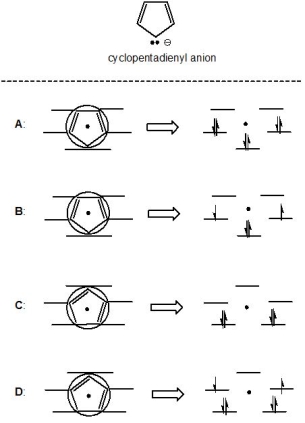
From the following Frost diagrams, A-D, pick out the correct one for a cyclopentadienyl anion:
A) A
B) B
C) C
D) D
A) A
B) B
C) C
D) D
Question
Question
Question
Question
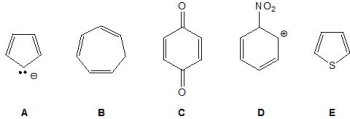
From the following species, A-E, pick out those which have uninterrupted (continuous) conjugation. Please select all that apply.
A) A
B) B
C) C
D) D
E) E
A) A
B) B
C) C
D) D
E) E
Question
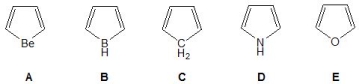
From the following molecules, A-E, pick out those which are aromatic. Please select all that apply.
A) A
B) B
C) C
D) D
E) E
A) A
B) B
C) C
D) D
E) E
Question
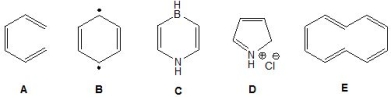
For the following species, A-E, pick out those which are aromatic. Please select all that apply.
A) A
B) B
C) C
D) D
E) E
A) A
B) B
C) C
D) D
E) E
Question
Which of the following compounds, A-E, exhibits the greatest resonance stabilisation?
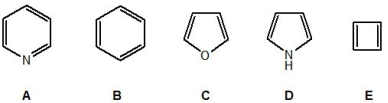
A) A
B) B
C) C
D) D
E) E
A) A
B) B
C) C
D) D
E) E
Question
From the following reactions, A-E, pick out those which give isopropylbenzene as the major product. Please select all that apply.
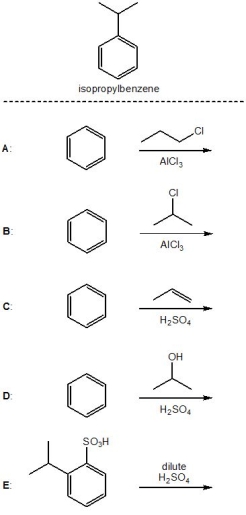
A) A
B) B
C) C
D) D
E) E
A) A
B) B
C) C
D) D
E) E
Question
What is the major product of the following reaction?
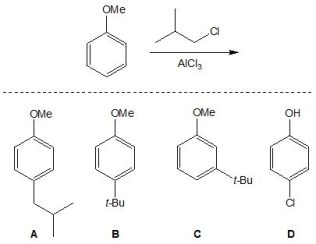
A) A
B) B
C) C
D) D
A) A
B) B
C) C
D) D
Question
From the following molecules, A-E, pick out the one which is most reactive towards aromatic bromination:
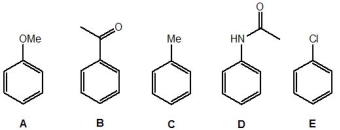
A) A
B) B
C) C
D) D
E) E
A) A
B) B
C) C
D) D
E) E
Question
From the following molecules, A-E, pick out the molecules which react to give predominantly meta-nitration products. Please select all that apply.
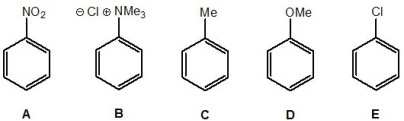
A) A
B) B
C) C
D) D
E) E
A) A
B) B
C) C
D) D
E) E
Question
For the following reaction, pick out the major product:
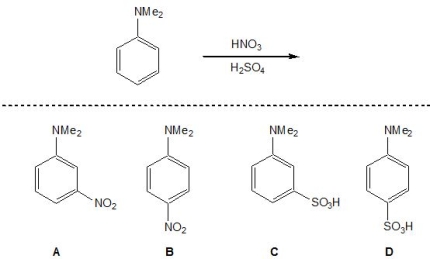
A) A
B) B
C) C
D) D
A) A
B) B
C) C
D) D
Question
Question
Question
Question
Question
Question
For the following reaction, pick out the major product:
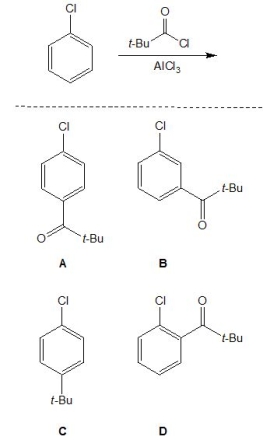
A) A
B) B
C) C
D) D
A) A
B) B
C) C
D) D
Question
From the following reaction, pick out the major product:
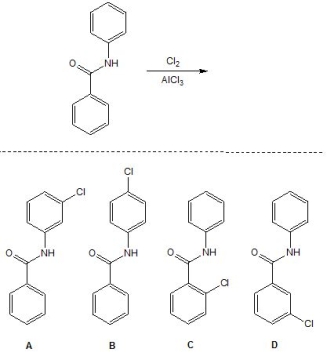
A) A
B) B
C) C
D) D
A) A
B) B
C) C
D) D
Question
From the following sequence of reactions, match the reagents to steps 1-4:
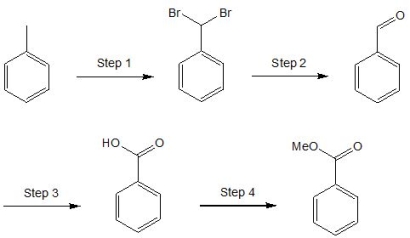
-H2O
A) Step 2
B) Step 4
C) Step 3
D) Step 1
-H2O
A) Step 2
B) Step 4
C) Step 3
D) Step 1
Question
From the following sequence of reactions, match the reagents to steps 1-4:
-MeOH, HCl
A) Step 2
B) Step 4
C) Step 3
D) Step 1
-MeOH, HCl
A) Step 2
B) Step 4
C) Step 3
D) Step 1
Question
From the following sequence of reactions, match the reagents to steps 1-4:
-KMnO4, H2O
A) Step 2
B) Step 4
C) Step 3
D) Step 1
-KMnO4, H2O
A) Step 2
B) Step 4
C) Step 3
D) Step 1
Question
From the following sequence of reactions, match the reagents to steps 1-4:
-excess Br2, hv
A) Step 2
B) Step 4
C) Step 3
D) Step 1
-excess Br2, hv
A) Step 2
B) Step 4
C) Step 3
D) Step 1
Question
From the following sequence of reactions, match the reagents to steps 1-4:
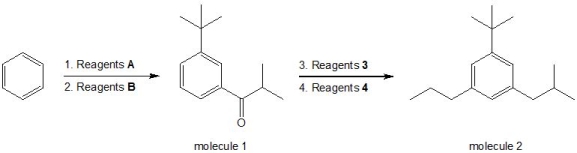
-EtCOCl, AlCl3
A) Reagents 3
B) Reagents 4
C) Reagents B
D) Reagents A
-EtCOCl, AlCl3
A) Reagents 3
B) Reagents 4
C) Reagents B
D) Reagents A
Question
From the following sequence of reactions, match the reagents to steps 1-4:
-Zn/Hg, HCl
A) Reagents 3
B) Reagents 4
C) Reagents B
D) Reagents A
-Zn/Hg, HCl
A) Reagents 3
B) Reagents 4
C) Reagents B
D) Reagents A
Question
From the following sequence of reactions, match the reagents to steps 1-4:
-t-BuCl, AlCl3
A) Reagents 3
B) Reagents 4
C) Reagents B
D) Reagents A
-t-BuCl, AlCl3
A) Reagents 3
B) Reagents 4
C) Reagents B
D) Reagents A
Question
From the following sequence of reactions, match the reagents to steps 1-4:
-i-PrCOCl, AlCl3
A) Reagents 3
B) Reagents 4
C) Reagents B
D) Reagents A
-i-PrCOCl, AlCl3
A) Reagents 3
B) Reagents 4
C) Reagents B
D) Reagents A
Question
For the following reaction sequence, match the products, A-C, to the given structures.
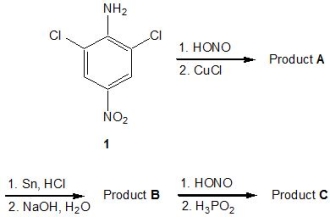
-
A) Product B
B) Product A
C) Product C
-
A) Product B
B) Product A
C) Product C
Question
For the following reaction sequence, match the products, A-C, to the given structures.
-
A) Product B
B) Product A
C) Product C
-
A) Product B
B) Product A
C) Product C
Question
For the following reaction sequence, match the products, A-C, to the given structures.
-
A) Product B
B) Product A
C) Product C
-
A) Product B
B) Product A
C) Product C
Question
Which of the following will be the dominant product of this reaction?
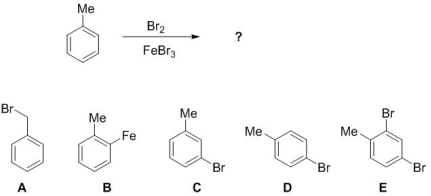
A) A
B) B
C) C
D) D
E) E
A) A
B) B
C) C
D) D
E) E
Question
Which of the following will be the dominant product of this reaction?
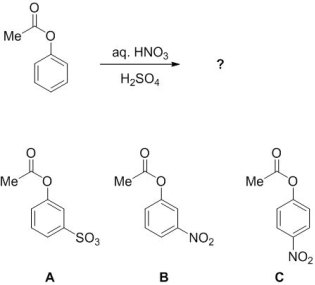
A) A
B) B
C) C
A) A
B) B
C) C
Question
Which of the following will be the dominant product of this reaction?
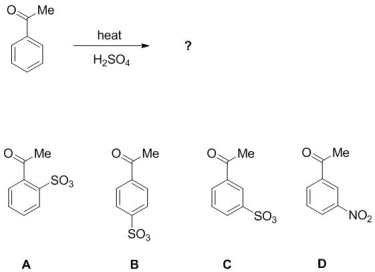
Redraw instructions from author: Product structures x4, should be SO3H (subscript 3), not SO3 (subscript 3) i.e. add an H to each of the four groups in A-D
A) A
B) B
C) C
D) D
Redraw instructions from author: Product structures x4, should be SO3H (subscript 3), not SO3 (subscript 3) i.e. add an H to each of the four groups in A-D
A) A
B) B
C) C
D) D
Question
Which of the following will be the dominant product of this reaction?
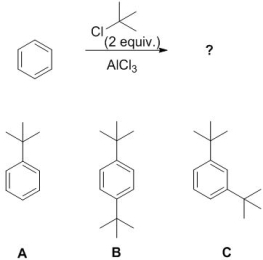
A) A
B) B
C) C
A) A
B) B
C) C
Question
Which of the following will be the dominant product of this reaction?
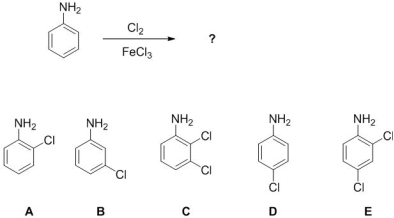
A) A
B) B
C) C
D) D
E) E
A) A
B) B
C) C
D) D
E) E

Unlock Deck
Sign up to unlock the cards in this deck!
Unlock Deck
Unlock Deck
1/37

Play

Full screen (f)
Deck 22: Benzene and Other Aromatic Compounds: Electrophilic Substitution Reactions
1
Place the following types of species in order of (electronic) stability, with 1 being the most stable and 5 the least stable:
A) Aromatic molecule
B) Radical
C) Anti-aromatic molecule
D) Alkene
E) Conjugated molecule
A) Aromatic molecule
B) Radical
C) Anti-aromatic molecule
D) Alkene
E) Conjugated molecule
A, E, D, B, C
2
From the following Frost diagrams, A-D, pick out the correct one for a cyclopentadienyl anion:
A) A
B) B
C) C
D) D
A) A
B) B
C) C
D) D
A
3
How many bonding molecular orbitals are present in cyclobutadiene?
A) 0
B) 1
C) 2
D) 3
E) 4
A) 0
B) 1
C) 2
D) 3
E) 4
B
4
Complete the following statement: 'For a molecule to be aromatic it must ….' Please select all that apply.
A) have (4n + 2) sigma-electrons.
B) have 6 pi-electrons.
C) possess uninterrupted (continuous) conjugation.
D) be cyclic.
E) be planar.
A) have (4n + 2) sigma-electrons.
B) have 6 pi-electrons.
C) possess uninterrupted (continuous) conjugation.
D) be cyclic.
E) be planar.
Unlock Deck
Unlock for access to all 37 flashcards in this deck.
Unlock Deck
k this deck
5
Which of the following statements are true? Please select all that apply.
A) All aromatic molecules have the same amount of resonance stabilisation.
B) Aromatic molecules are more stable than conjugated molecules.
C) Conjugated molecules can be either cyclic or acyclic.
D) All aromatic molecules have 4n pi-electrons.
E) Conjugated molecules are less stable than anti-aromatic molecules.
A) All aromatic molecules have the same amount of resonance stabilisation.
B) Aromatic molecules are more stable than conjugated molecules.
C) Conjugated molecules can be either cyclic or acyclic.
D) All aromatic molecules have 4n pi-electrons.
E) Conjugated molecules are less stable than anti-aromatic molecules.
Unlock Deck
Unlock for access to all 37 flashcards in this deck.
Unlock Deck
k this deck
6
From the following species, A-E, pick out those which have uninterrupted (continuous) conjugation. Please select all that apply.
A) A
B) B
C) C
D) D
E) E
A) A
B) B
C) C
D) D
E) E
Unlock Deck
Unlock for access to all 37 flashcards in this deck.
Unlock Deck
k this deck
7
From the following molecules, A-E, pick out those which are aromatic. Please select all that apply.
A) A
B) B
C) C
D) D
E) E
A) A
B) B
C) C
D) D
E) E
Unlock Deck
Unlock for access to all 37 flashcards in this deck.
Unlock Deck
k this deck
8
For the following species, A-E, pick out those which are aromatic. Please select all that apply.
A) A
B) B
C) C
D) D
E) E
A) A
B) B
C) C
D) D
E) E
Unlock Deck
Unlock for access to all 37 flashcards in this deck.
Unlock Deck
k this deck
9
Which of the following compounds, A-E, exhibits the greatest resonance stabilisation?
A) A
B) B
C) C
D) D
E) E
A) A
B) B
C) C
D) D
E) E
Unlock Deck
Unlock for access to all 37 flashcards in this deck.
Unlock Deck
k this deck
10
From the following reactions, A-E, pick out those which give isopropylbenzene as the major product. Please select all that apply.
A) A
B) B
C) C
D) D
E) E
A) A
B) B
C) C
D) D
E) E
Unlock Deck
Unlock for access to all 37 flashcards in this deck.
Unlock Deck
k this deck
11
What is the major product of the following reaction?
A) A
B) B
C) C
D) D
A) A
B) B
C) C
D) D
Unlock Deck
Unlock for access to all 37 flashcards in this deck.
Unlock Deck
k this deck
12
From the following molecules, A-E, pick out the one which is most reactive towards aromatic bromination:
A) A
B) B
C) C
D) D
E) E
A) A
B) B
C) C
D) D
E) E
Unlock Deck
Unlock for access to all 37 flashcards in this deck.
Unlock Deck
k this deck
13
From the following molecules, A-E, pick out the molecules which react to give predominantly meta-nitration products. Please select all that apply.
A) A
B) B
C) C
D) D
E) E
A) A
B) B
C) C
D) D
E) E
Unlock Deck
Unlock for access to all 37 flashcards in this deck.
Unlock Deck
k this deck
14
For the following reaction, pick out the major product:
A) A
B) B
C) C
D) D
A) A
B) B
C) C
D) D
Unlock Deck
Unlock for access to all 37 flashcards in this deck.
Unlock Deck
k this deck
15
Match the following electronic effects to the substituents:
--CH3
A) +I effect, no M effect
B) +I effect, +M effect
C) +I effect, -M effect
D) -I effect, +M effect
E) -I effect, -M effect
--CH3
A) +I effect, no M effect
B) +I effect, +M effect
C) +I effect, -M effect
D) -I effect, +M effect
E) -I effect, -M effect
Unlock Deck
Unlock for access to all 37 flashcards in this deck.
Unlock Deck
k this deck
16
Match the following electronic effects to the substituents:
--Ph
A) +I effect, no M effect
B) +I effect, +M effect
C) +I effect, -M effect
D) -I effect, +M effect
E) -I effect, -M effect
--Ph
A) +I effect, no M effect
B) +I effect, +M effect
C) +I effect, -M effect
D) -I effect, +M effect
E) -I effect, -M effect
Unlock Deck
Unlock for access to all 37 flashcards in this deck.
Unlock Deck
k this deck
17
Match the following electronic effects to the substituents:
--CH=CH-CHO
A) +I effect, no M effect
B) +I effect, +M effect
C) +I effect, -M effect
D) -I effect, +M effect
E) -I effect, -M effect
--CH=CH-CHO
A) +I effect, no M effect
B) +I effect, +M effect
C) +I effect, -M effect
D) -I effect, +M effect
E) -I effect, -M effect
Unlock Deck
Unlock for access to all 37 flashcards in this deck.
Unlock Deck
k this deck
18
Match the following electronic effects to the substituents:
--NH2
A) +I effect, no M effect
B) +I effect, +M effect
C) +I effect, -M effect
D) -I effect, +M effect
E) -I effect, -M effect
--NH2
A) +I effect, no M effect
B) +I effect, +M effect
C) +I effect, -M effect
D) -I effect, +M effect
E) -I effect, -M effect
Unlock Deck
Unlock for access to all 37 flashcards in this deck.
Unlock Deck
k this deck
19
Match the following electronic effects to the substituents:
--NO2
A) +I effect, no M effect
B) +I effect, +M effect
C) +I effect, -M effect
D) -I effect, +M effect
E) -I effect, -M effect
--NO2
A) +I effect, no M effect
B) +I effect, +M effect
C) +I effect, -M effect
D) -I effect, +M effect
E) -I effect, -M effect
Unlock Deck
Unlock for access to all 37 flashcards in this deck.
Unlock Deck
k this deck
20
For the following reaction, pick out the major product:
A) A
B) B
C) C
D) D
A) A
B) B
C) C
D) D
Unlock Deck
Unlock for access to all 37 flashcards in this deck.
Unlock Deck
k this deck
21
From the following reaction, pick out the major product:
A) A
B) B
C) C
D) D
A) A
B) B
C) C
D) D
Unlock Deck
Unlock for access to all 37 flashcards in this deck.
Unlock Deck
k this deck
22
From the following sequence of reactions, match the reagents to steps 1-4:
-H2O
A) Step 2
B) Step 4
C) Step 3
D) Step 1
-H2O
A) Step 2
B) Step 4
C) Step 3
D) Step 1
Unlock Deck
Unlock for access to all 37 flashcards in this deck.
Unlock Deck
k this deck
23
From the following sequence of reactions, match the reagents to steps 1-4:
-MeOH, HCl
A) Step 2
B) Step 4
C) Step 3
D) Step 1
-MeOH, HCl
A) Step 2
B) Step 4
C) Step 3
D) Step 1
Unlock Deck
Unlock for access to all 37 flashcards in this deck.
Unlock Deck
k this deck
24
From the following sequence of reactions, match the reagents to steps 1-4:
-KMnO4, H2O
A) Step 2
B) Step 4
C) Step 3
D) Step 1
-KMnO4, H2O
A) Step 2
B) Step 4
C) Step 3
D) Step 1
Unlock Deck
Unlock for access to all 37 flashcards in this deck.
Unlock Deck
k this deck
25
From the following sequence of reactions, match the reagents to steps 1-4:
-excess Br2, hv
A) Step 2
B) Step 4
C) Step 3
D) Step 1
-excess Br2, hv
A) Step 2
B) Step 4
C) Step 3
D) Step 1
Unlock Deck
Unlock for access to all 37 flashcards in this deck.
Unlock Deck
k this deck
26
From the following sequence of reactions, match the reagents to steps 1-4:
-EtCOCl, AlCl3
A) Reagents 3
B) Reagents 4
C) Reagents B
D) Reagents A
-EtCOCl, AlCl3
A) Reagents 3
B) Reagents 4
C) Reagents B
D) Reagents A
Unlock Deck
Unlock for access to all 37 flashcards in this deck.
Unlock Deck
k this deck
27
From the following sequence of reactions, match the reagents to steps 1-4:
-Zn/Hg, HCl
A) Reagents 3
B) Reagents 4
C) Reagents B
D) Reagents A
-Zn/Hg, HCl
A) Reagents 3
B) Reagents 4
C) Reagents B
D) Reagents A
Unlock Deck
Unlock for access to all 37 flashcards in this deck.
Unlock Deck
k this deck
28
From the following sequence of reactions, match the reagents to steps 1-4:
-t-BuCl, AlCl3
A) Reagents 3
B) Reagents 4
C) Reagents B
D) Reagents A
-t-BuCl, AlCl3
A) Reagents 3
B) Reagents 4
C) Reagents B
D) Reagents A
Unlock Deck
Unlock for access to all 37 flashcards in this deck.
Unlock Deck
k this deck
29
From the following sequence of reactions, match the reagents to steps 1-4:
-i-PrCOCl, AlCl3
A) Reagents 3
B) Reagents 4
C) Reagents B
D) Reagents A
-i-PrCOCl, AlCl3
A) Reagents 3
B) Reagents 4
C) Reagents B
D) Reagents A
Unlock Deck
Unlock for access to all 37 flashcards in this deck.
Unlock Deck
k this deck
30
For the following reaction sequence, match the products, A-C, to the given structures.
-
A) Product B
B) Product A
C) Product C
-
A) Product B
B) Product A
C) Product C
Unlock Deck
Unlock for access to all 37 flashcards in this deck.
Unlock Deck
k this deck
31
For the following reaction sequence, match the products, A-C, to the given structures.
-
A) Product B
B) Product A
C) Product C
-
A) Product B
B) Product A
C) Product C
Unlock Deck
Unlock for access to all 37 flashcards in this deck.
Unlock Deck
k this deck
32
For the following reaction sequence, match the products, A-C, to the given structures.
-
A) Product B
B) Product A
C) Product C
-
A) Product B
B) Product A
C) Product C
Unlock Deck
Unlock for access to all 37 flashcards in this deck.
Unlock Deck
k this deck
33
Which of the following will be the dominant product of this reaction?
A) A
B) B
C) C
D) D
E) E
A) A
B) B
C) C
D) D
E) E
Unlock Deck
Unlock for access to all 37 flashcards in this deck.
Unlock Deck
k this deck
34
Which of the following will be the dominant product of this reaction?
A) A
B) B
C) C
A) A
B) B
C) C
Unlock Deck
Unlock for access to all 37 flashcards in this deck.
Unlock Deck
k this deck
35
Which of the following will be the dominant product of this reaction?
Redraw instructions from author: Product structures x4, should be SO3H (subscript 3), not SO3 (subscript 3) i.e. add an H to each of the four groups in A-D
A) A
B) B
C) C
D) D
Redraw instructions from author: Product structures x4, should be SO3H (subscript 3), not SO3 (subscript 3) i.e. add an H to each of the four groups in A-D
A) A
B) B
C) C
D) D
Unlock Deck
Unlock for access to all 37 flashcards in this deck.
Unlock Deck
k this deck
36
Which of the following will be the dominant product of this reaction?
A) A
B) B
C) C
A) A
B) B
C) C
Unlock Deck
Unlock for access to all 37 flashcards in this deck.
Unlock Deck
k this deck
37
Which of the following will be the dominant product of this reaction?
A) A
B) B
C) C
D) D
E) E
A) A
B) B
C) C
D) D
E) E
Unlock Deck
Unlock for access to all 37 flashcards in this deck.
Unlock Deck
k this deck
Unlock Deck
Unlock for access to all 37 flashcards in this deck.







