





 Chat with AI

Deck 4: Global Human Resource Management
Full screen (f)

Question

Question
Question
Question
Question
Question
Question
Question
Question
Question
Question
Question
Question
Objective
The exercise is designed to have students review and consider the goals of various developmental approaches used by organizations.
Set Up the Exercise
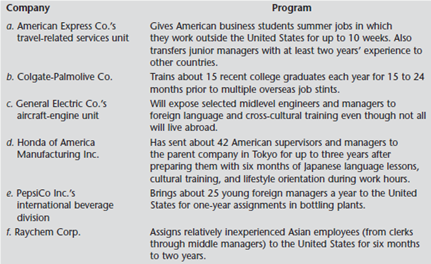
Review the six approaches ( a - f ) used to develop global managers in the table in Exhibit 4A-1. Answer the following for each approach.
1. What can the firm accomplish with the approach used?
2. What would the cost-benefit analysis for each approach illustrate?
3. How do your answers to questions 1 and 2 compare with those of other students?
4. Why are students' responses different?
EXHIBIT 4A-1 Developing Global Managers
The exercise is designed to have students review and consider the goals of various developmental approaches used by organizations.
Set Up the Exercise
Review the six approaches ( a - f ) used to develop global managers in the table in Exhibit 4A-1. Answer the following for each approach.
1. What can the firm accomplish with the approach used?
2. What would the cost-benefit analysis for each approach illustrate?
3. How do your answers to questions 1 and 2 compare with those of other students?
4. Why are students' responses different?
EXHIBIT 4A-1 Developing Global Managers
Question
Question
Question
Question
Question
Question
Question

Unlock Deck
Sign up to unlock the cards in this deck!
Unlock Deck
Unlock Deck
1/20

Play

Full screen (f)
Deck 4: Global Human Resource Management
1
In addition to having good technical skills, what other skills should an expatriate have in order to be successful in an international assignment?
Expatriate refers to individual who live in foreign country temporarily for work. They may also relinquish citizenship in their home country to become a citizen of another. They play important role to complete business assignments worldwide.
The factors that are involved in the expatriation selection are: -
• Technical ability - Technical skill is one of the important criteria for selection of expatriate because this help the individual to perform the required terms.
• Cross-cultural suitability - This include language skills, culture empathy, attitude towards new cultures and personal and emotional stability. So this can be evaluated by identifying whether the expatriate has the ability to create and maintain natural relationship.
• Family requirement - Family especially spouse contribute towards the success of overseas assignment and impact the accompanying spouse on early return.
• Organization-specific requirements - The selected candidate reject the offer of international assignment when the spouse in not able to work in the host country or lack of work permit prevent accompanying spouse may cause the spouse difficulty in adjusting and result in failure. So, multinational provide assistance in such case.
• Language - Knowledge of host country's language is considered important for top-level management positions and make the expatriates and their families comfortable in the new environment.
• MNE requirements - This include training skills which can make the expatriate to train the others in the foreign country and negotiation skills that is important in international business environment.
Apart from having good technical skills, the other skills an expatriate should have in order to be successful in international assignment are: -
• Self-image - The manager should be self-confident, have self-esteem and should have the ability to cope with stress.
• Communication style - This means the way manager interact with others, interpersonal style and sensitivity to nonverbal communication.
• Perpetual orientation of manager - ability to tolerate uncertainty, open-mindedness and acceptance of cultural differences.
The factors that are involved in the expatriation selection are: -
• Technical ability - Technical skill is one of the important criteria for selection of expatriate because this help the individual to perform the required terms.
• Cross-cultural suitability - This include language skills, culture empathy, attitude towards new cultures and personal and emotional stability. So this can be evaluated by identifying whether the expatriate has the ability to create and maintain natural relationship.
• Family requirement - Family especially spouse contribute towards the success of overseas assignment and impact the accompanying spouse on early return.
• Organization-specific requirements - The selected candidate reject the offer of international assignment when the spouse in not able to work in the host country or lack of work permit prevent accompanying spouse may cause the spouse difficulty in adjusting and result in failure. So, multinational provide assistance in such case.
• Language - Knowledge of host country's language is considered important for top-level management positions and make the expatriates and their families comfortable in the new environment.
• MNE requirements - This include training skills which can make the expatriate to train the others in the foreign country and negotiation skills that is important in international business environment.
Apart from having good technical skills, the other skills an expatriate should have in order to be successful in international assignment are: -
• Self-image - The manager should be self-confident, have self-esteem and should have the ability to cope with stress.
• Communication style - This means the way manager interact with others, interpersonal style and sensitivity to nonverbal communication.
• Perpetual orientation of manager - ability to tolerate uncertainty, open-mindedness and acceptance of cultural differences.
2
What types of information should be included in cross-cultural training for expatriates? Should spouses and family members be included in the training?
Expatriate refers to individual who live in foreign country temporarily for work. They may also relinquish citizenship in their home country to become a citizen of another. They play important role to complete business assignments worldwide.
Culture shock is nothing but the experience the individual has when he or she move to a different cultural environment. People might have culture shock when moving from one country to another, or changing the lifestyle, or social environment, etc. The four phases of culture shock are: -
• Honeymoon - the individual sees the old culture and the new culture in romantic way. Example liking the food of other culture, lifestyle, etc. This happens at the beginning of cultural changer.
• Negotiation - the individual sees the old culture and the new culture in anxious way. They feel frustrated and angry. They feel pressurized to accept the change with respect to communication, food, language, etc.
• Adjustment - the individual gets accustomed to new culture and accept the changes by developing routines. The person develops the problem-solving skills in order to deal with the cultural change and accept it in a more positive way.
• Adaptation - the individual gets used to new culture and participate actively and comfortably however they keep many traits of their previous culture. This stage is also referred as bicultural stage.
The types of information that should be included in cross-cultural training for expatriates are: -
• Building self-awareness that help the manager to understand where he or she will encounter cultural shock.
• Customized language instructions and intensive language training in order to make sure that the manager adjust to living and working in the host country.
• Information about business etiquette.
Spouses and family members should be included in the training as it will help them as well to cope up with the culture shock. Understanding the language of the foreign country will help them to adjust to the new culture.
Culture shock is nothing but the experience the individual has when he or she move to a different cultural environment. People might have culture shock when moving from one country to another, or changing the lifestyle, or social environment, etc. The four phases of culture shock are: -
• Honeymoon - the individual sees the old culture and the new culture in romantic way. Example liking the food of other culture, lifestyle, etc. This happens at the beginning of cultural changer.
• Negotiation - the individual sees the old culture and the new culture in anxious way. They feel frustrated and angry. They feel pressurized to accept the change with respect to communication, food, language, etc.
• Adjustment - the individual gets accustomed to new culture and accept the changes by developing routines. The person develops the problem-solving skills in order to deal with the cultural change and accept it in a more positive way.
• Adaptation - the individual gets used to new culture and participate actively and comfortably however they keep many traits of their previous culture. This stage is also referred as bicultural stage.
The types of information that should be included in cross-cultural training for expatriates are: -
• Building self-awareness that help the manager to understand where he or she will encounter cultural shock.
• Customized language instructions and intensive language training in order to make sure that the manager adjust to living and working in the host country.
• Information about business etiquette.
Spouses and family members should be included in the training as it will help them as well to cope up with the culture shock. Understanding the language of the foreign country will help them to adjust to the new culture.
3
What is culture shock? When does it occur? What can be done to reduce its negative effects?
Culture shock is nothing but the experience the individual has when he or she move to a different cultural environment. People might have culture shock when moving from one country to another, or changing the lifestyle, or social environment, etc.
Moving to a foreign country can cause expatriate managers to experience culture shock. The four phases of culture shock are: -
• Honeymoon - the individual sees the old culture and the new culture in romantic way. Example liking the food of other culture, lifestyle, etc. This happens at the beginning of cultural changer.
• Negotiation - the individual sees the old culture and the new culture in anxious way. They feel frustrated and angry. They feel pressurized to accept the change with respect to communication, food, language, etc.
• Adjustment - the individual gets accustomed to new culture and accept the changes by developing routines. The person develops the problem-solving skills in order to deal with the cultural change and accept it in a more positive way.
• Adaptation - the individual gets used to new culture and participate actively and comfortably however they keep many traits of their previous culture. This stage is also referred as bicultural stage.
The best strategies to cope with and minimize the impact of cultural shock from transition into another country and reentry home are: -
• Before moving to a new culture, it would be effective to research about it and gain knowledge so that it will be easy to adapt to the new environmen5. Having proper understanding of new culture would be beneficial.
• Communication can help to build new relation at new culture. Being communicative will definitely help to build trust with new people.
• Making effort to learn the culture , it's language, business etiquette etc. will be beneficial for both individual and organization to cope up with the cultural shock.
• Getting used to the social life style will help the individual and the organization to cope up with the changing environment.
• Respect the new culture and it's lifestyle which can help in getting connected to new people.
Moving to a foreign country can cause expatriate managers to experience culture shock. The four phases of culture shock are: -
• Honeymoon - the individual sees the old culture and the new culture in romantic way. Example liking the food of other culture, lifestyle, etc. This happens at the beginning of cultural changer.
• Negotiation - the individual sees the old culture and the new culture in anxious way. They feel frustrated and angry. They feel pressurized to accept the change with respect to communication, food, language, etc.
• Adjustment - the individual gets accustomed to new culture and accept the changes by developing routines. The person develops the problem-solving skills in order to deal with the cultural change and accept it in a more positive way.
• Adaptation - the individual gets used to new culture and participate actively and comfortably however they keep many traits of their previous culture. This stage is also referred as bicultural stage.
The best strategies to cope with and minimize the impact of cultural shock from transition into another country and reentry home are: -
• Before moving to a new culture, it would be effective to research about it and gain knowledge so that it will be easy to adapt to the new environmen5. Having proper understanding of new culture would be beneficial.
• Communication can help to build new relation at new culture. Being communicative will definitely help to build trust with new people.
• Making effort to learn the culture , it's language, business etiquette etc. will be beneficial for both individual and organization to cope up with the cultural shock.
• Getting used to the social life style will help the individual and the organization to cope up with the changing environment.
• Respect the new culture and it's lifestyle which can help in getting connected to new people.
4
Hofstede reports that the United States scored very high on the individualism dimension. Do you agree that Americans are highly individualistic? Provide examples.
Unlock Deck
Unlock for access to all 20 flashcards in this deck.
Unlock Deck
k this deck
5
Discuss the advantages and disadvantages of using PCNs and HCNs for filling key managerial and technical positions in an international organization.
Unlock Deck
Unlock for access to all 20 flashcards in this deck.
Unlock Deck
k this deck
6
Why are so many multinational companies using short-term international assignments (less that 1 year in length)? Should they do away with the long-term assignments altogether? Why or why not.
Unlock Deck
Unlock for access to all 20 flashcards in this deck.
Unlock Deck
k this deck
7
In your opinion, to what extent do laws like the Foreign Corrupt Practices Act deter or eliminate corruption and bribery in international business? What can the HR department do to prevent employees from unethical behaviors?
Unlock Deck
Unlock for access to all 20 flashcards in this deck.
Unlock Deck
k this deck
8
What are the Sullivan Principles? How have they helped organizations understand the ethical issues they face when conducting business in foreign cultures?
Unlock Deck
Unlock for access to all 20 flashcards in this deck.
Unlock Deck
k this deck
9
What steps can you suggest that might help John solve his labor problems for the new plant in Tokyo?
Unlock Deck
Unlock for access to all 20 flashcards in this deck.
Unlock Deck
k this deck
10
How could he persuade either the union or his joint venture partner to help him with this problem?
Unlock Deck
Unlock for access to all 20 flashcards in this deck.
Unlock Deck
k this deck
11
What types of cultural training, both here an in Japan, might be necessary for John's new venture to be successful?
Unlock Deck
Unlock for access to all 20 flashcards in this deck.
Unlock Deck
k this deck
12
What could John have done differently to eliminate some of his current labor problems?
Unlock Deck
Unlock for access to all 20 flashcards in this deck.
Unlock Deck
k this deck
13
Objective
The exercise is designed to have students review and consider the goals of various developmental approaches used by organizations.
Set Up the Exercise
Review the six approaches ( a - f ) used to develop global managers in the table in Exhibit 4A-1. Answer the following for each approach.
1. What can the firm accomplish with the approach used?
2. What would the cost-benefit analysis for each approach illustrate?
3. How do your answers to questions 1 and 2 compare with those of other students?
4. Why are students' responses different?
EXHIBIT 4A-1 Developing Global Managers
The exercise is designed to have students review and consider the goals of various developmental approaches used by organizations.
Set Up the Exercise
Review the six approaches ( a - f ) used to develop global managers in the table in Exhibit 4A-1. Answer the following for each approach.
1. What can the firm accomplish with the approach used?
2. What would the cost-benefit analysis for each approach illustrate?
3. How do your answers to questions 1 and 2 compare with those of other students?
4. Why are students' responses different?
EXHIBIT 4A-1 Developing Global Managers
Unlock Deck
Unlock for access to all 20 flashcards in this deck.
Unlock Deck
k this deck
14
What is your opinion of offshoring or moving jobs to international locations like India? Explain.
Unlock Deck
Unlock for access to all 20 flashcards in this deck.
Unlock Deck
k this deck
15
Identify and describe three macroeconomic drivers behind globalization.
Unlock Deck
Unlock for access to all 20 flashcards in this deck.
Unlock Deck
k this deck
16
If you were to take a job for an Indian company like Infosys or Wipro, what types of adjustments (if any) would you need to make compared to going to work for an American company?
Unlock Deck
Unlock for access to all 20 flashcards in this deck.
Unlock Deck
k this deck
17
Objective
This exercise is designed to have students use the Internet to uncover mistakes that multinational corporations have made while managing their human resources around the world.
Instructions
Students should read the exercise below, conduct research on the Internet, prepare a one-page report, and then, in groups of three to four, discuss the findings with their colleagues in class.
Exercise
Parent (or Headquarters) companies have experienced difficulties adjusting to host-nation management practices. Examples of blunders being made by American, Japanese, French, British, and Swedish firms have continued to make news for decades. For example, a Japanese company doing business in Indonesia hired primarily Bataks, members of an ethnic group with characteristics similar to the Japanese. Other Indonesians, however, resented this hiring practice, viewed it as discriminatory, and forced the company to change its policy.
As an assignment, students should use their favorite search engine on the Internet to collect examples of three blunders or problems that companies and organizations have encountered when addressing management practices in a host country and prepare a one-page summary on each of these examples for discussion with class colleagues.
This exercise is designed to have students use the Internet to uncover mistakes that multinational corporations have made while managing their human resources around the world.
Instructions
Students should read the exercise below, conduct research on the Internet, prepare a one-page report, and then, in groups of three to four, discuss the findings with their colleagues in class.
Exercise
Parent (or Headquarters) companies have experienced difficulties adjusting to host-nation management practices. Examples of blunders being made by American, Japanese, French, British, and Swedish firms have continued to make news for decades. For example, a Japanese company doing business in Indonesia hired primarily Bataks, members of an ethnic group with characteristics similar to the Japanese. Other Indonesians, however, resented this hiring practice, viewed it as discriminatory, and forced the company to change its policy.
As an assignment, students should use their favorite search engine on the Internet to collect examples of three blunders or problems that companies and organizations have encountered when addressing management practices in a host country and prepare a one-page summary on each of these examples for discussion with class colleagues.
Unlock Deck
Unlock for access to all 20 flashcards in this deck.
Unlock Deck
k this deck
18
How much do you know about Indian culture and working with Indian colleagues?
Unlock Deck
Unlock for access to all 20 flashcards in this deck.
Unlock Deck
k this deck
19
Assume that you've started to expand your company's operations into India and China. This is the first time that your company is "going international." Should the HR department recommend the company use an ethonocentric or polycentric staffing approach?
Unlock Deck
Unlock for access to all 20 flashcards in this deck.
Unlock Deck
k this deck
20
Assume that you have an interview with Tata. How would you go about researching the firm before your interview?
Unlock Deck
Unlock for access to all 20 flashcards in this deck.
Unlock Deck
k this deck
Unlock Deck
Unlock for access to all 20 flashcards in this deck.







