





 Chat with AI

Deck 35: Reproduction and Development in Flowering Plants
Full screen (f)

Question

Question
Question
Question
Figure 35-1 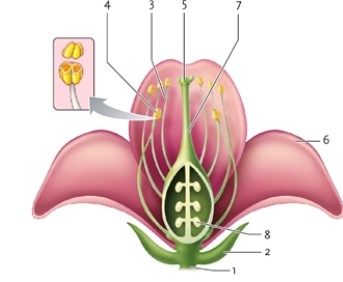
In Figure 35-1, what is item number 3?
A) a filament
B) a stigma
C) an anther
D) a receptacle
In Figure 35-1, what is item number 3?
A) a filament
B) a stigma
C) an anther
D) a receptacle
Question
Question
Question
Question
Figure 35-1
In Figure 35-1, what is item number 4?
A) an anther
B) a sepal
C) a receptacle
D) an ovule
In Figure 35-1, what is item number 4?
A) an anther
B) a sepal
C) a receptacle
D) an ovule
Question
Question
Question
Question
Question
Question
Figure 35-1
In Figure 35-1, what is item number 2?
A) a sepal
B) an anther
C) a petal
D) an ovule
In Figure 35-1, what is item number 2?
A) a sepal
B) an anther
C) a petal
D) an ovule
Question
Figure 35-1
In Figure 35-1, what is item number 1?
A) the sepal
B) the ovule
C) the style
D) the receptacle
In Figure 35-1, what is item number 1?
A) the sepal
B) the ovule
C) the style
D) the receptacle
Question
Question
Question
Question
Question
Question
Question
Question
Question
Question
Question
Figure 35-1
In Figure 35-1, what is item number 8?
A) a sepal
B) an anther
C) a style
D) an ovule
In Figure 35-1, what is item number 8?
A) a sepal
B) an anther
C) a style
D) an ovule
Question
Question
Question
Question
Question
Question
Figure 35-1
In Figure 35-1, what is item number 6?
A) a petal
B) a sepal
C) a receptacle
D) a style
In Figure 35-1, what is item number 6?
A) a petal
B) a sepal
C) a receptacle
D) a style
Question
Question
Figure 35-1
In Figure 35-1, what is item number 5?
A) an ovule
B) a stigma
C) a receptacle
D) an anther
In Figure 35-1, what is item number 5?
A) an ovule
B) a stigma
C) a receptacle
D) an anther
Question
Question
Question
Figure 35-1
In Figure 35-1, what is item number 7?
A) a filament
B) a style
C) a stigma
D) an ovule
In Figure 35-1, what is item number 7?
A) a filament
B) a style
C) a stigma
D) an ovule
Question
Question
Question
Question
Question
Question
Question
Question
Question
Question
Question
Question
Question
Question
Question
Question
Question
Question
Question
Question
Question
Question
Question
Question
Question
Question
Question
Question
Question
Question
Question
Question
Question

Unlock Deck
Sign up to unlock the cards in this deck!
Unlock Deck
Unlock Deck
1/70

Play

Full screen (f)
Deck 35: Reproduction and Development in Flowering Plants
1
Where is an anther typically found in a flower?
A) at the tip of a filament
B) at the tip of a carpel
C) at the tip of an ovule
D) at the tip of a calyx
A) at the tip of a filament
B) at the tip of a carpel
C) at the tip of an ovule
D) at the tip of a calyx
A
2
How many cells are in the female gametophyte of a flowering plant?
A) 4
B) 6
C) 7
D) 8
A) 4
B) 6
C) 7
D) 8
C
3
Where does the male gametophyte form in flowering plants?
A) in a stamen
B) in a carpel
C) in a receptacle
D) in a calyx
A) in a stamen
B) in a carpel
C) in a receptacle
D) in a calyx
A
4
Figure 35-1
In Figure 35-1, what is item number 3?
A) a filament
B) a stigma
C) an anther
D) a receptacle
In Figure 35-1, what is item number 3?
A) a filament
B) a stigma
C) an anther
D) a receptacle
Unlock Deck
Unlock for access to all 70 flashcards in this deck.
Unlock Deck
k this deck
5
Where does the female gametophyte form in flowering plants?
A) in a stamen
B) in a carpel
C) in a corolla
D) in a receptacle
A) in a stamen
B) in a carpel
C) in a corolla
D) in a receptacle
Unlock Deck
Unlock for access to all 70 flashcards in this deck.
Unlock Deck
k this deck
6
Which term refers to the landing platform for pollen in flowering plants?
A) the stigma
B) the filament
C) the style
D) the anther
A) the stigma
B) the filament
C) the style
D) the anther
Unlock Deck
Unlock for access to all 70 flashcards in this deck.
Unlock Deck
k this deck
7
What is it most likely that most seeds are packed with?
A) either water or starch
B) either starch or lipids
C) either starch or proteins
D) either lipids or proteins
A) either water or starch
B) either starch or lipids
C) either starch or proteins
D) either lipids or proteins
Unlock Deck
Unlock for access to all 70 flashcards in this deck.
Unlock Deck
k this deck
8
Figure 35-1
In Figure 35-1, what is item number 4?
A) an anther
B) a sepal
C) a receptacle
D) an ovule
In Figure 35-1, what is item number 4?
A) an anther
B) a sepal
C) a receptacle
D) an ovule
Unlock Deck
Unlock for access to all 70 flashcards in this deck.
Unlock Deck
k this deck
9
In a flowering plant, which structure includes the ovary?
A) the stamen
B) the ovule
C) the calyx
D) the carpel
A) the stamen
B) the ovule
C) the calyx
D) the carpel
Unlock Deck
Unlock for access to all 70 flashcards in this deck.
Unlock Deck
k this deck
10
Which of the following is the best analogy for a seed?
A) painting kit
B) lunch box
C) tool box
D) beauty case
A) painting kit
B) lunch box
C) tool box
D) beauty case
Unlock Deck
Unlock for access to all 70 flashcards in this deck.
Unlock Deck
k this deck
11
What must be present in a flower in order for it to make seeds?
A) sepals
B) carpels
C) stamens and sepals
D) stamens and carpels
A) sepals
B) carpels
C) stamens and sepals
D) stamens and carpels
Unlock Deck
Unlock for access to all 70 flashcards in this deck.
Unlock Deck
k this deck
12
Which of the following best describes an embryo in a seed after it has been fertilized?
A) It begins as a sporophyte and ends up as a gametophyte before germination.
B) It is usually a gametophyte but can be a sporophyte.
C) It is always a sporophyte.
D) It is always a gametophyte.
A) It begins as a sporophyte and ends up as a gametophyte before germination.
B) It is usually a gametophyte but can be a sporophyte.
C) It is always a sporophyte.
D) It is always a gametophyte.
Unlock Deck
Unlock for access to all 70 flashcards in this deck.
Unlock Deck
k this deck
13
Which of the following is usually the female gametophyte in flowering plants?
A) a single ovary
B) the complete pistil
C) the shoot parts bearing female flowers
D) the seven cells embedded in floral tissues
A) a single ovary
B) the complete pistil
C) the shoot parts bearing female flowers
D) the seven cells embedded in floral tissues
Unlock Deck
Unlock for access to all 70 flashcards in this deck.
Unlock Deck
k this deck
14
Figure 35-1
In Figure 35-1, what is item number 2?
A) a sepal
B) an anther
C) a petal
D) an ovule
In Figure 35-1, what is item number 2?
A) a sepal
B) an anther
C) a petal
D) an ovule
Unlock Deck
Unlock for access to all 70 flashcards in this deck.
Unlock Deck
k this deck
15
Figure 35-1
In Figure 35-1, what is item number 1?
A) the sepal
B) the ovule
C) the style
D) the receptacle
In Figure 35-1, what is item number 1?
A) the sepal
B) the ovule
C) the style
D) the receptacle
Unlock Deck
Unlock for access to all 70 flashcards in this deck.
Unlock Deck
k this deck
16
What kinds of cells are produced by meiosis in flowering plants?
A) diploid sporophytes
B) haploid sporophytes
C) haploid gametophytes
D) diploid gametophytes
A) diploid sporophytes
B) haploid sporophytes
C) haploid gametophytes
D) diploid gametophytes
Unlock Deck
Unlock for access to all 70 flashcards in this deck.
Unlock Deck
k this deck
17
Which are the male gametophytes in flowering plants?
A) sperm
B) anthers
C) pollen grains
D) stamens
A) sperm
B) anthers
C) pollen grains
D) stamens
Unlock Deck
Unlock for access to all 70 flashcards in this deck.
Unlock Deck
k this deck
18
What is the term for the end of a reproductive shoot where a flower develops?
A) ovule
B) receptacle
C) calyx
D) filament
A) ovule
B) receptacle
C) calyx
D) filament
Unlock Deck
Unlock for access to all 70 flashcards in this deck.
Unlock Deck
k this deck
19
Which sentence best describes the relationship between gametophyte and sporophyte in flowering plants?
A) The gametophytes are smaller than the sporophytes, and are retained inside sporophyte for all or part of their lives.
B) The gametophytes are smaller than the sporophytes, and do not nourish themselves.
C) The gametophytes and sporophytes are roughly equal in size, and both nourish themselves.
D) The gametophytes are usually larger than the sporophytes, but both gametophytes and sporophytes nourish themselves.
A) The gametophytes are smaller than the sporophytes, and are retained inside sporophyte for all or part of their lives.
B) The gametophytes are smaller than the sporophytes, and do not nourish themselves.
C) The gametophytes and sporophytes are roughly equal in size, and both nourish themselves.
D) The gametophytes are usually larger than the sporophytes, but both gametophytes and sporophytes nourish themselves.
Unlock Deck
Unlock for access to all 70 flashcards in this deck.
Unlock Deck
k this deck
20
Where in a flowering plant would meiosis be expected to occur?
A) in trichomes
B) in leaves
C) in roots
D) in flowers
A) in trichomes
B) in leaves
C) in roots
D) in flowers
Unlock Deck
Unlock for access to all 70 flashcards in this deck.
Unlock Deck
k this deck
21
Which structures make up the innermost whorl of a flower?
A) the receptacles
B) the carpels
C) the sepals
D) the stamens
A) the receptacles
B) the carpels
C) the sepals
D) the stamens
Unlock Deck
Unlock for access to all 70 flashcards in this deck.
Unlock Deck
k this deck
22
Which of the following give a flower its colour?
A) petals
B) sepals
C) anthers
D) stigma
A) petals
B) sepals
C) anthers
D) stigma
Unlock Deck
Unlock for access to all 70 flashcards in this deck.
Unlock Deck
k this deck
23
What is a plant species in which the plant can make either only male or only female flowers called, and what flowers does it always have?
A) monoecious; imperfect
B) dioecious; perfect
C) dioecious; imperfect
D) monoecious; perfect
A) monoecious; imperfect
B) dioecious; perfect
C) dioecious; imperfect
D) monoecious; perfect
Unlock Deck
Unlock for access to all 70 flashcards in this deck.
Unlock Deck
k this deck
24
Which phrase describes the events that occur in the production of a pollen grain from a microspore mother cell?
A) Only meiosis occurs.
B) First mitosis occurs, and then meiosis, followed by mitosis.
C) First meiosis occurs, and then mitosis.
D) First mitosis occurs, and then meiosis.
A) Only meiosis occurs.
B) First mitosis occurs, and then meiosis, followed by mitosis.
C) First meiosis occurs, and then mitosis.
D) First mitosis occurs, and then meiosis.
Unlock Deck
Unlock for access to all 70 flashcards in this deck.
Unlock Deck
k this deck
25
Which phrase best describes the micropyle?
A) a passageway through the style for sperm
B) the inner seed coat
C) the mature male gametophyte
D) a small opening at one end of an ovule
A) a passageway through the style for sperm
B) the inner seed coat
C) the mature male gametophyte
D) a small opening at one end of an ovule
Unlock Deck
Unlock for access to all 70 flashcards in this deck.
Unlock Deck
k this deck
26
Figure 35-1
In Figure 35-1, what is item number 8?
A) a sepal
B) an anther
C) a style
D) an ovule
In Figure 35-1, what is item number 8?
A) a sepal
B) an anther
C) a style
D) an ovule
Unlock Deck
Unlock for access to all 70 flashcards in this deck.
Unlock Deck
k this deck
27
Which parts of a flower are most likely to have distinctive colours, patterning, and shapes for attracting pollinators?
A) the petals
B) the receptacles
C) the sepals
D) the stamens
A) the petals
B) the receptacles
C) the sepals
D) the stamens
Unlock Deck
Unlock for access to all 70 flashcards in this deck.
Unlock Deck
k this deck
28
Which structures make up the outermost whorl of a flower?
A) the receptacles
B) the carpels
C) the petals
D) the sepals
A) the receptacles
B) the carpels
C) the petals
D) the sepals
Unlock Deck
Unlock for access to all 70 flashcards in this deck.
Unlock Deck
k this deck
29
Which term refers to a flower that lacks either stamens or carpels?
A) perfect
B) imperfect
C) incomplete
D) complete
A) perfect
B) imperfect
C) incomplete
D) complete
Unlock Deck
Unlock for access to all 70 flashcards in this deck.
Unlock Deck
k this deck
30
In flowering plants, how many sperm cells are typically produced from each microspore mother cell?
A) 1
B) 2
C) 4
D) 8
A) 1
B) 2
C) 4
D) 8
Unlock Deck
Unlock for access to all 70 flashcards in this deck.
Unlock Deck
k this deck
31
Which of the following is carpel composed of?
A) stigma, anther, and filament
B) stigma, style, and ovary
C) anther, filament, and ovary
D) style, stigma, and filament
A) stigma, anther, and filament
B) stigma, style, and ovary
C) anther, filament, and ovary
D) style, stigma, and filament
Unlock Deck
Unlock for access to all 70 flashcards in this deck.
Unlock Deck
k this deck
32
Figure 35-1
In Figure 35-1, what is item number 6?
A) a petal
B) a sepal
C) a receptacle
D) a style
In Figure 35-1, what is item number 6?
A) a petal
B) a sepal
C) a receptacle
D) a style
Unlock Deck
Unlock for access to all 70 flashcards in this deck.
Unlock Deck
k this deck
33
Which of the following is the female gametophyte in flowering plants?
A) the seed
B) the embryo sac
C) the megasporocyte
D) the ovule
A) the seed
B) the embryo sac
C) the megasporocyte
D) the ovule
Unlock Deck
Unlock for access to all 70 flashcards in this deck.
Unlock Deck
k this deck
34
Figure 35-1
In Figure 35-1, what is item number 5?
A) an ovule
B) a stigma
C) a receptacle
D) an anther
In Figure 35-1, what is item number 5?
A) an ovule
B) a stigma
C) a receptacle
D) an anther
Unlock Deck
Unlock for access to all 70 flashcards in this deck.
Unlock Deck
k this deck
35
Along with the egg, what would you expect to find in the part of an embryo sac next to the micropyle?
A) the seed
B) the central cell
C) the synergids
D) the antipodal cells
A) the seed
B) the central cell
C) the synergids
D) the antipodal cells
Unlock Deck
Unlock for access to all 70 flashcards in this deck.
Unlock Deck
k this deck
36
What makes up the female reproductive whorl of a flower?
A) the carpels
B) the receptacles
C) the stamens
D) the petals
A) the carpels
B) the receptacles
C) the stamens
D) the petals
Unlock Deck
Unlock for access to all 70 flashcards in this deck.
Unlock Deck
k this deck
37
Figure 35-1
In Figure 35-1, what is item number 7?
A) a filament
B) a style
C) a stigma
D) an ovule
In Figure 35-1, what is item number 7?
A) a filament
B) a style
C) a stigma
D) an ovule
Unlock Deck
Unlock for access to all 70 flashcards in this deck.
Unlock Deck
k this deck
38
Which parts of a flower are typically the most leaflike?
A) the receptacles
B) the carpels
C) the sepals
D) the petals
A) the receptacles
B) the carpels
C) the sepals
D) the petals
Unlock Deck
Unlock for access to all 70 flashcards in this deck.
Unlock Deck
k this deck
39
What would you expect to find in the part of an embryo sac farthest away from the micropyle?
A) the synergids
B) the seed
C) the antipodal cells
D) the pollen tube
A) the synergids
B) the seed
C) the antipodal cells
D) the pollen tube
Unlock Deck
Unlock for access to all 70 flashcards in this deck.
Unlock Deck
k this deck
40
Which structures make up the male reproductive whorl of a flower?
A) the sepals
B) the carpels
C) the stamens
D) the receptacles
A) the sepals
B) the carpels
C) the stamens
D) the receptacles
Unlock Deck
Unlock for access to all 70 flashcards in this deck.
Unlock Deck
k this deck
41
What does the fruit wall, or pericarp, develop from?
A) the ovary wall
B) the endosperm
C) the petals
D) the receptacle
A) the ovary wall
B) the endosperm
C) the petals
D) the receptacle
Unlock Deck
Unlock for access to all 70 flashcards in this deck.
Unlock Deck
k this deck
42
Which term refers to a fruit that develops from several ovaries in a single flower?
A) accessory fruit
B) aggregate fruit
C) simple fruit
D) multiple fruit
A) accessory fruit
B) aggregate fruit
C) simple fruit
D) multiple fruit
Unlock Deck
Unlock for access to all 70 flashcards in this deck.
Unlock Deck
k this deck
43
Which term refers to the embryonic root?
A) radicle
B) epicotyl
C) cotyledon
D) hypocotyl
A) radicle
B) epicotyl
C) cotyledon
D) hypocotyl
Unlock Deck
Unlock for access to all 70 flashcards in this deck.
Unlock Deck
k this deck
44
During double fertilization, what do the sperm fertilize?
A) the egg and its nucleus
B) the egg and the nucleus of the synergid
C) the egg and the nucleus of the antipodal cell
D) the egg and the nucleus of the central cell
A) the egg and its nucleus
B) the egg and the nucleus of the synergid
C) the egg and the nucleus of the antipodal cell
D) the egg and the nucleus of the central cell
Unlock Deck
Unlock for access to all 70 flashcards in this deck.
Unlock Deck
k this deck
45
What is the main mechanism by which fleshy fruits aid seed dispersal?
A) by being buried by animals
B) by falling directly under the parent plant
C) by being eaten by animals
D) by floating away from the parent plant
A) by being buried by animals
B) by falling directly under the parent plant
C) by being eaten by animals
D) by floating away from the parent plant
Unlock Deck
Unlock for access to all 70 flashcards in this deck.
Unlock Deck
k this deck
46
What is the term for the process of asexual reproduction in which a diploid embryo develops from an unfertilized egg or from diploid cells in ovule tissue?
A) grafting
B) somaclonal section
C) apomixis
D) fragmentation
A) grafting
B) somaclonal section
C) apomixis
D) fragmentation
Unlock Deck
Unlock for access to all 70 flashcards in this deck.
Unlock Deck
k this deck
47
Which type of reproduction involves the growth of a new plant on the margin of a leaf that eventually falls to the ground and grows independently?
A) grafting
B) fragmentation
C) apomixes
D) somaclonal section
A) grafting
B) fragmentation
C) apomixes
D) somaclonal section
Unlock Deck
Unlock for access to all 70 flashcards in this deck.
Unlock Deck
k this deck
48
Why does a pollen tube need to elongate?
A) One sperm can be recognized as self or nonself.
B) One sperm can travel inside to reach the egg.
C) Two sperm can travel inside to reach the egg.
D) Two sperm can reside inside until it is time for fertilization.
A) One sperm can be recognized as self or nonself.
B) One sperm can travel inside to reach the egg.
C) Two sperm can travel inside to reach the egg.
D) Two sperm can reside inside until it is time for fertilization.
Unlock Deck
Unlock for access to all 70 flashcards in this deck.
Unlock Deck
k this deck
49
Which structure is formed as a result of double fertilization?
A) the hypocotyl
B) the endosperm
C) the cotyledon
D) the seed coat
A) the hypocotyl
B) the endosperm
C) the cotyledon
D) the seed coat
Unlock Deck
Unlock for access to all 70 flashcards in this deck.
Unlock Deck
k this deck
50
Which sequence represents the most typical order of events in seed germination?
A) shoot cells divide and elongate
B) seed coat splits
C) water imbibition
D) water imbibition
A) shoot cells divide and elongate
B) seed coat splits
C) water imbibition
D) water imbibition
Unlock Deck
Unlock for access to all 70 flashcards in this deck.
Unlock Deck
k this deck
51
In flowering plants, how many egg cells are typically produced from each megaspore mother cell?
A) 1
B) 2
C) 3
D) 4
A) 1
B) 2
C) 3
D) 4
Unlock Deck
Unlock for access to all 70 flashcards in this deck.
Unlock Deck
k this deck
52
What is the purpose of self-incompatibility in flowers?
A) It prevents both self-fertilization and self-pollination.
B) It prevents self-pollination but not self-fertilization.
C) It prevents self-fertilization but not self-pollination.
D) It prevents self-fertilization and occasionally prevents self-pollination.
A) It prevents both self-fertilization and self-pollination.
B) It prevents self-pollination but not self-fertilization.
C) It prevents self-fertilization but not self-pollination.
D) It prevents self-fertilization and occasionally prevents self-pollination.
Unlock Deck
Unlock for access to all 70 flashcards in this deck.
Unlock Deck
k this deck
53
Which term refers to a fruit that develops from several ovaries in multiple flowers?
A) simple fruit
B) multiple fruit
C) aggregate fruit
D) accessory fruit
A) simple fruit
B) multiple fruit
C) aggregate fruit
D) accessory fruit
Unlock Deck
Unlock for access to all 70 flashcards in this deck.
Unlock Deck
k this deck
54
What happens when self pollen grain lands on the stigma?
A) It fertilizes the central cell.
B) It forms pollen tube.
C) It fertilizes the egg.
D) It is rejected.
A) It fertilizes the central cell.
B) It forms pollen tube.
C) It fertilizes the egg.
D) It is rejected.
Unlock Deck
Unlock for access to all 70 flashcards in this deck.
Unlock Deck
k this deck
55
Which term refers to a fruit that develops from a single ovary in a single flower?
A) simple fruit
B) accessory fruit
C) multiple fruit
D) aggregate fruit
A) simple fruit
B) accessory fruit
C) multiple fruit
D) aggregate fruit
Unlock Deck
Unlock for access to all 70 flashcards in this deck.
Unlock Deck
k this deck
56
What happens when pollen from one species lands on the stigma of a flower from another species?
A) The pollen tube typically forms and grows to the ovary, but then stops.
B) The pollen tube typically forms, but the sperm are killed.
C) The pollen tube typically forms, but the sperm cannot penetrate the egg.
D) The pollen tube typically does not develop.
A) The pollen tube typically forms and grows to the ovary, but then stops.
B) The pollen tube typically forms, but the sperm are killed.
C) The pollen tube typically forms, but the sperm cannot penetrate the egg.
D) The pollen tube typically does not develop.
Unlock Deck
Unlock for access to all 70 flashcards in this deck.
Unlock Deck
k this deck
57
For a typical flowering plant, how is the first cell of the triploid (3n) endosperm formed from?
A) from one sperm fused with two antipodal cells
B) from two sperm fused with a synergid
C) from two sperm fused with the egg
D) from one sperm fused with the central cell
A) from one sperm fused with two antipodal cells
B) from two sperm fused with a synergid
C) from two sperm fused with the egg
D) from one sperm fused with the central cell
Unlock Deck
Unlock for access to all 70 flashcards in this deck.
Unlock Deck
k this deck
58
Which term refers to a seed leaf?
A) hypocotyl
B) cotyledon
C) suspensor
D) endosperm
A) hypocotyl
B) cotyledon
C) suspensor
D) endosperm
Unlock Deck
Unlock for access to all 70 flashcards in this deck.
Unlock Deck
k this deck
59
Which term refers to a fruit that develops from tissues of the receptacle as well as from the ovary?
A) aggregate fruit
B) accessory fruit
C) multiple fruit
D) simple fruit
A) aggregate fruit
B) accessory fruit
C) multiple fruit
D) simple fruit
Unlock Deck
Unlock for access to all 70 flashcards in this deck.
Unlock Deck
k this deck
60
Some fully differentiated plant cells are totipotent. What does this mean?
A) They will grow roots if they touch the ground.
B) They have the potential to form a whole, fully functional plant.
C) They can fertilize an egg.
D) They can undergo meiosis.
A) They will grow roots if they touch the ground.
B) They have the potential to form a whole, fully functional plant.
C) They can fertilize an egg.
D) They can undergo meiosis.
Unlock Deck
Unlock for access to all 70 flashcards in this deck.
Unlock Deck
k this deck
61
Which term refers to growing useful mutants that develop from callus culture?
A) grafting
B) protoplast fusion
C) fragmentation
D) somatic embryogenesis
A) grafting
B) protoplast fusion
C) fragmentation
D) somatic embryogenesis
Unlock Deck
Unlock for access to all 70 flashcards in this deck.
Unlock Deck
k this deck
62
Match each flower part with its description.
a.parts that enclose and protect all other flower parts before the flower opens
b.male reproductive parts
c.female reproductive parts
d.often showy parts that function in attracting bees or other animal pollinators
petals
a.parts that enclose and protect all other flower parts before the flower opens
b.male reproductive parts
c.female reproductive parts
d.often showy parts that function in attracting bees or other animal pollinators
petals
Unlock Deck
Unlock for access to all 70 flashcards in this deck.
Unlock Deck
k this deck
63
When is the root-shoot axis established in the flowering plant Arabidopsis?
A) within hours after the seed germinates
B) shortly after the eight-cell embryo stage
C) during the torpedo stage of embryonic development
D) by the first cell division of the embryo
A) within hours after the seed germinates
B) shortly after the eight-cell embryo stage
C) during the torpedo stage of embryonic development
D) by the first cell division of the embryo
Unlock Deck
Unlock for access to all 70 flashcards in this deck.
Unlock Deck
k this deck
64
Match each flower part with its description.
a.parts that enclose and protect all other flower parts before the flower opens
b.male reproductive parts
c.female reproductive parts
d.often showy parts that function in attracting bees or other animal pollinators
sepals
a.parts that enclose and protect all other flower parts before the flower opens
b.male reproductive parts
c.female reproductive parts
d.often showy parts that function in attracting bees or other animal pollinators
sepals
Unlock Deck
Unlock for access to all 70 flashcards in this deck.
Unlock Deck
k this deck
65
Describe the process of double fertilization in flowering plants.
Unlock Deck
Unlock for access to all 70 flashcards in this deck.
Unlock Deck
k this deck
66
Match each flower part with its description.
a.parts that enclose and protect all other flower parts before the flower opens
b.male reproductive parts
c.female reproductive parts
d.often showy parts that function in attracting bees or other animal pollinators
carpels
a.parts that enclose and protect all other flower parts before the flower opens
b.male reproductive parts
c.female reproductive parts
d.often showy parts that function in attracting bees or other animal pollinators
carpels
Unlock Deck
Unlock for access to all 70 flashcards in this deck.
Unlock Deck
k this deck
67
What governs the course of the vegetative growth throughout the life of a plant?
A) Genes that govern plant development switch on in response only to a changing internal environment.
B) Genes that govern plant development switch on in response only to a changing external environment.
C) Genes that govern plant development switch on and off in response to a changing external environment.
D) Genes that govern plant development switch on and off in response to a changing internal environment.
A) Genes that govern plant development switch on in response only to a changing internal environment.
B) Genes that govern plant development switch on in response only to a changing external environment.
C) Genes that govern plant development switch on and off in response to a changing external environment.
D) Genes that govern plant development switch on and off in response to a changing internal environment.
Unlock Deck
Unlock for access to all 70 flashcards in this deck.
Unlock Deck
k this deck
68
Describe several ways that fruits can aid seed dispersal.
Unlock Deck
Unlock for access to all 70 flashcards in this deck.
Unlock Deck
k this deck
69
Which of the following provides a powerful importance of the plant Arabidopsis?
A) its entire genome that has been sequenced
B) its reproductive cycle
C) its ability to be cloned
D) its alternation of generations
A) its entire genome that has been sequenced
B) its reproductive cycle
C) its ability to be cloned
D) its alternation of generations
Unlock Deck
Unlock for access to all 70 flashcards in this deck.
Unlock Deck
k this deck
70
Match each flower part with its description.
a.parts that enclose and protect all other flower parts before the flower opens
b.male reproductive parts
c.female reproductive parts
d.often showy parts that function in attracting bees or other animal pollinators
stamens
a.parts that enclose and protect all other flower parts before the flower opens
b.male reproductive parts
c.female reproductive parts
d.often showy parts that function in attracting bees or other animal pollinators
stamens
Unlock Deck
Unlock for access to all 70 flashcards in this deck.
Unlock Deck
k this deck
Unlock Deck
Unlock for access to all 70 flashcards in this deck.







