





 Chat with AI

Deck 15: Data Preparation and Description
Full screen (f)

Question

Question
Question
Question
Question
Question
Question
Question

Unlock Deck
Sign up to unlock the cards in this deck!
Unlock Deck
Unlock Deck
1/8

Play

Full screen (f)
Deck 15: Data Preparation and Description
1
Define or explain:
a) Coding rules
b) Spreadsheet data entry
c) Bar codes
d) Precoded instruments
e) Content Analysis
f) Missing data
g) Optical mark recognition
a) Coding rules
b) Spreadsheet data entry
c) Bar codes
d) Precoded instruments
e) Content Analysis
f) Missing data
g) Optical mark recognition
a) Coding rules
Coding rules govern the establishment of category sets. The four rules are that category sets should be: (1) appropriate to the research problem or purpose, (2) exhaustive, (3) mutually exclusive, and (4) derived from only one classificatory principle.
b) Spreadsheet data entry
Spreadsheet data entry uses personal computer software for spreadsheet computation as a data entry device. Preliminary analysis, data manipulation, summary statistics, and graphics are frequently available in this medium.
c) Bar codes
Bar codes are digital/graphical labels used for tracking inventory movement and movement of a product or service through a service process stage. It is a multi-part identifier comprised of alpha and numeric characters that provides key elements of information, including producer, category, and product/service specifics. As a result it is one device that has made data mining more effective. Bar codes are most frequently used to track the responses to administrative questions in research (who did the interview, where and when the interview was collected, etc.).
d) Precoded instruments
Precoded instruments anticipate responses to questions and assign numerals or other symbols for those responses in advance.
e) Content Analysis
Content Analysis is a research technique for the objective, systematic, and quantitative description of the manifest content of a communication. Its application in research can be as a primary methodology or in the coding of open questions.
f) Missing data
Missing data are information from a participant or case that is not available for one or more variables of interest.
g) Optical mark recognition
This is a means of data entry in which a spreadsheet style interface is used to read and process user-created forms. It generates lower cost, faster and more accurate data by handling data entry and preliminary data analysis.
i) Measures of spread
Measures of spread is the description of a data's dispersion or variability. Measures of spread include the variance, standard deviation, range, interquartile range, and quartile deviation. They describe how scores cluster or scatter in a distribution.
Coding rules govern the establishment of category sets. The four rules are that category sets should be: (1) appropriate to the research problem or purpose, (2) exhaustive, (3) mutually exclusive, and (4) derived from only one classificatory principle.
b) Spreadsheet data entry
Spreadsheet data entry uses personal computer software for spreadsheet computation as a data entry device. Preliminary analysis, data manipulation, summary statistics, and graphics are frequently available in this medium.
c) Bar codes
Bar codes are digital/graphical labels used for tracking inventory movement and movement of a product or service through a service process stage. It is a multi-part identifier comprised of alpha and numeric characters that provides key elements of information, including producer, category, and product/service specifics. As a result it is one device that has made data mining more effective. Bar codes are most frequently used to track the responses to administrative questions in research (who did the interview, where and when the interview was collected, etc.).
d) Precoded instruments
Precoded instruments anticipate responses to questions and assign numerals or other symbols for those responses in advance.
e) Content Analysis
Content Analysis is a research technique for the objective, systematic, and quantitative description of the manifest content of a communication. Its application in research can be as a primary methodology or in the coding of open questions.
f) Missing data
Missing data are information from a participant or case that is not available for one or more variables of interest.
g) Optical mark recognition
This is a means of data entry in which a spreadsheet style interface is used to read and process user-created forms. It generates lower cost, faster and more accurate data by handling data entry and preliminary data analysis.
i) Measures of spread
Measures of spread is the description of a data's dispersion or variability. Measures of spread include the variance, standard deviation, range, interquartile range, and quartile deviation. They describe how scores cluster or scatter in a distribution.
2
How should the researcher handle "don't know" responses.
In the survey questionnaires, there are often two ways of collecting the data using either open ended questions or closed ended questions or using both. Researchers include the option "don't know" for the survey questions to better understand the respondent knowledge to the question. If this option is not provided, then a guess answer of respondent might give inaccurate interpretations to the subject. On the other side, the responses "don't know" can also causes problem for the data presentation if it is received most often. For instance: if 90% of the responses for the question are "don't know", then it may meet the research objectives or may the question is useless. The similar concerns can be raised in the interview technique.
The best way to deal with "don't responses" in survey technique is to design the questionnaire with better measurement. Researcher should provide this option to choose only for those questions which can meet the research objectives. In the interview technique, when the respondent provide "don't know" response, researcher should repeat the questions twice or thrice to get definite answer. Researchers can also record if any explanation or elaboration provided by the respondent to that question. In the tabulations, "don't know" responses are handles in many ways.
• If "don't know" response are few then it doesn't affect however it is handled.
• If "don't know" response can be justified, then it should be considered as separate reply category
• If it is not sure how to address the "don't know" response, then it should be considered as separate report category for decision making.
The best way to deal with "don't responses" in survey technique is to design the questionnaire with better measurement. Researcher should provide this option to choose only for those questions which can meet the research objectives. In the interview technique, when the respondent provide "don't know" response, researcher should repeat the questions twice or thrice to get definite answer. Researchers can also record if any explanation or elaboration provided by the respondent to that question. In the tabulations, "don't know" responses are handles in many ways.
• If "don't know" response are few then it doesn't affect however it is handled.
• If "don't know" response can be justified, then it should be considered as separate reply category
• If it is not sure how to address the "don't know" response, then it should be considered as separate report category for decision making.
3
A problem facing shoe store managers is that many shoes eventually must be sold at markdown prices. This prompts us to conduct a mail survey of shoe store managers in which we ask, "What methods have you found most successful for reducing the problem of high markdowns " We are interested in extracting as much information as possible form these answers to better understand the full range of strategies that store managers use. Establish what you thin are category sets to code 500 responses similar to the 14 given below. Try to develop an integrated set of categories that reflects your theory of markdown management. After developing the set, use it to code the 14 responses.
a) Have not found the answer. As long as we buy style shoes, we will have markdowns. We use PMs on slow merchandise, but it does not eliminate markdowns (PM stands for "push-money"… special item bonuses for selling a particular style of shoe.)
b) Using PMs before too old. Also reducing price during season. Holding meetings with salespeople indicating which shoes to push.
c) By putting PMs on any slow-selling items and promoting same. More careful check of shoes purchased.
d) Keep a close watch on your stock, and mark down when you have to. That is, rather than wait, take a small markdown on a show that is not moving at the time.
e) Using the PM method.
f) Less advance buying… more dependence on in-stock shoes.
g) Sales… catch bad guys before it's too late and close out.
h) Buy as much good merchandise as you can at special prices to help make up some markdown.
i) Reducing opening buys and depending on fill-in service. PMs for salespeople.
j) Buy more frequently, better buying, PMs on slow-moving merchandise.
k) Careful buying at lowest prices. Case on the buying line. Buying closeouts, FDs, overstock, "cancellations." (FD stands for factory-discontinued style.)
l) By buying less "chanceable" shoes. Buy only what you need, watch sizes, don't go overboard on new fads.
m) Buying more stable merchandise. Buying more from fewer lines. Sticking with better nationally advertised merchandise.
n) No successful method with the current style situation. Manufacturers are experimenting, the retailer takes the markdowns-cuts gross profit by about 3 percent-keep your stock at lowest level without losing sales.
a) Have not found the answer. As long as we buy style shoes, we will have markdowns. We use PMs on slow merchandise, but it does not eliminate markdowns (PM stands for "push-money"… special item bonuses for selling a particular style of shoe.)
b) Using PMs before too old. Also reducing price during season. Holding meetings with salespeople indicating which shoes to push.
c) By putting PMs on any slow-selling items and promoting same. More careful check of shoes purchased.
d) Keep a close watch on your stock, and mark down when you have to. That is, rather than wait, take a small markdown on a show that is not moving at the time.
e) Using the PM method.
f) Less advance buying… more dependence on in-stock shoes.
g) Sales… catch bad guys before it's too late and close out.
h) Buy as much good merchandise as you can at special prices to help make up some markdown.
i) Reducing opening buys and depending on fill-in service. PMs for salespeople.
j) Buy more frequently, better buying, PMs on slow-moving merchandise.
k) Careful buying at lowest prices. Case on the buying line. Buying closeouts, FDs, overstock, "cancellations." (FD stands for factory-discontinued style.)
l) By buying less "chanceable" shoes. Buy only what you need, watch sizes, don't go overboard on new fads.
m) Buying more stable merchandise. Buying more from fewer lines. Sticking with better nationally advertised merchandise.
n) No successful method with the current style situation. Manufacturers are experimenting, the retailer takes the markdowns-cuts gross profit by about 3 percent-keep your stock at lowest level without losing sales.
The current market fluctuations have compelled shoe stores to sell their products at markdown prices. It is not possible to sell the products at retail prices given the supply demand situation. This has led market researchers to undertake survey's in order to derive the strategies that are adopted by the shoe store managers to survive and earn profit in their business.
Given are the conditions, necessary to include while constructing the survey questions. Some of the results that are derived are as follows:
• Using bonus to sell the slow merchandise
• Tracking the time taken for the inventory to turn into sales
• Checking and auditing the outcomes of strategies to be adopted.
• In case of large inventory, adopt styles like overstock cancellations, factory discounts and buying closeouts.
• Avoid overburdening on sizes with latest fashion to see the trend.
Thus, in order to encompass these results, all the parameters are taken into consideration to draw the survey for shoe store managers.
Create a sample survey as shown below :
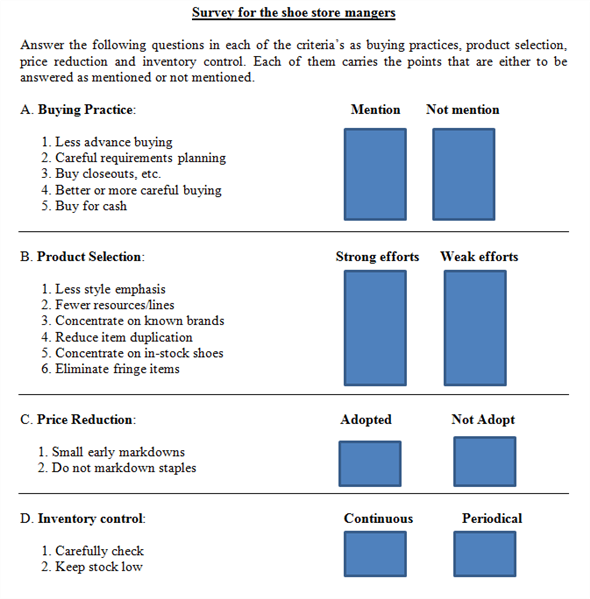 Thus, the survey includes the necessary questions that will help to arrive at the decisions taken by the shoe store managers including the given responses.
Given are the conditions, necessary to include while constructing the survey questions. Some of the results that are derived are as follows:
• Using bonus to sell the slow merchandise
• Tracking the time taken for the inventory to turn into sales
• Checking and auditing the outcomes of strategies to be adopted.
• In case of large inventory, adopt styles like overstock cancellations, factory discounts and buying closeouts.
• Avoid overburdening on sizes with latest fashion to see the trend.
Thus, in order to encompass these results, all the parameters are taken into consideration to draw the survey for shoe store managers.
Create a sample survey as shown below :
Thus, the survey includes the necessary questions that will help to arrive at the decisions taken by the shoe store managers including the given responses. 4
Select a small sample of class members, work associates, or friends and ask them to answer the following in a paragraph or two: "What are your career
aspirations for the next five years " Use one of the four basic units of content analysis to analyze their responses. Describe your findings as frequencies for the unit of analysis selected.
aspirations for the next five years " Use one of the four basic units of content analysis to analyze their responses. Describe your findings as frequencies for the unit of analysis selected.
Unlock Deck
Unlock for access to all 8 flashcards in this deck.
Unlock Deck
k this deck
5
Which data preparation process was Jason doing during data entry
Unlock Deck
Unlock for access to all 8 flashcards in this deck.
Unlock Deck
k this deck
6
Data entry followed data collection in the research profiled during the opening vignette. What concerned Jason about this process
Unlock Deck
Unlock for access to all 8 flashcards in this deck.
Unlock Deck
k this deck
7
Choose one of the cases from the text website that has an instrument (check the Case Abstracts section for a listing of all cases and an abstract for each). Code the instrument for data entry.
Unlock Deck
Unlock for access to all 8 flashcards in this deck.
Unlock Deck
k this deck
8
Simplement, Inc., which provides data sourcing solutions for Systems Applications and Products (SAP) customers, announced the achievement of subsecond response times for discovery and exploration in billion row datasets involving sales data collected in the sales and distribution module of SAP. Business users employing technologies like Microsoft Excel and Tableau can immediately explore and visualize supersized data sets leading to higher productivity and more meaningful insights. What other applications would you recommend to your organization, particularly marketing or IT staffs
Unlock Deck
Unlock for access to all 8 flashcards in this deck.
Unlock Deck
k this deck
Unlock Deck
Unlock for access to all 8 flashcards in this deck.







