





 Chat with AI

Deck 12: Measurement Scales
Full screen (f)

Question

Question
Question

Question
You receive the results of a paired-comparison preference test of four soft drinks from a sample of 200 persons. The results are as follows:
a. How do these brands rank in overall preference in this sample
b. Develop an interval scale for these four brands.
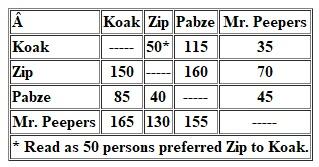
a. How do these brands rank in overall preference in this sample
b. Develop an interval scale for these four brands.
Question
Question
Question
Question
Question
Question

Unlock Deck
Sign up to unlock the cards in this deck!
Unlock Deck
Unlock Deck
1/10

Play

Full screen (f)
Deck 12: Measurement Scales
1
Discuss the relative merits of, and problems with:
a. Rating and ranking scales.
b. Likert and differential scales.
c. Unidimensional and multidimensional scales.
a. Rating and ranking scales.
b. Likert and differential scales.
c. Unidimensional and multidimensional scales.
The selection of measurement scale depends on many factors as those influence the validity and reliability of the scale. Those factors are as follows:
• Objectives of the research
• Type of responses designed for the research
• Properties of the data
• Number of dimensions of measurement scale
• Balanced or unbalanced rating scale
• Forced or unforced ranking choices
• Number of scale points
• Rater errors
a)
Rating and ranking scales
The factor 'type of responses' fall into four general types of measurement scale: rating scale, ranking scale, categorization and sorting.
Rating scales measures the participant's attitude towards the objects without making any comparison to the other similar objects. Different scales of rating are used to measure participant preference on object. Ranking scales measure the preferences of the people by asking them to rank the list of objects in comparison to other similar objects. The difference between these two scales are rating scales are interval measurement scales and ranking scales are ordinal measurement scales.
The relative merit of ranking and rating scale is that both are easy to construct and also easy to interpret the scores given to the objects by the participants. The problems with these two scales are that rating scale does not provide the correct judgement about participant's degree of preference and ranking scale force participants to make choice against the alternatives.
b)
Likert and differential scales
Likert and differential scales both are part of rating scales. Likert scale uses the statements that are assigned with numerical scores. Participants are asked to give numerical score for each statement to measure the degree of attitude either positive or negative. In the semantic differential scale, bipolar adjectives are used to measure the psychological meaning of an attitude. Usually, 7 points are used in the scale. The responses of this scale are measured using graphical representation.
The relative merit of Likert and differential scales are easy and efficient to measure attitudes on two extreme points. It is easy to discriminate the participant's attitude between like and dislike or agree and disagree.
The problems with Likert scale are that interpretations from the summation score may not give correct judgement because total score can be same for different patterns. The problems with differential scales are making a choice of right adjectives or phrases. These words must express the meaning of connotative otherwise it leads to neutral values which do not provide much information.
c)
Uni-dimensional and Multi-dimensional scales
Measurement scales can be either uni-dimensional or multi-dimensional. Uni-dimensional scale measure only one dimension of the object whereas the multi-dimensional scale measures more than on dimension of the object.
The relative merits of these two scales are that both are easy to construct and efficient way to measure the attitudes of an object.
The problems with unidimensional scale is that it over simplifies the measurement for the research study. For instance: Value of an object can be studied whether it is cheap or costly. The problems with multi - dimensional scale is that each dimension must be measured separately and then need to create an overall value for the object. For instance: Value for an object can be measured on its material quality, cost and durability. So, the measurement process is lengthy and time taking.
• Objectives of the research
• Type of responses designed for the research
• Properties of the data
• Number of dimensions of measurement scale
• Balanced or unbalanced rating scale
• Forced or unforced ranking choices
• Number of scale points
• Rater errors
a)
Rating and ranking scales
The factor 'type of responses' fall into four general types of measurement scale: rating scale, ranking scale, categorization and sorting.
Rating scales measures the participant's attitude towards the objects without making any comparison to the other similar objects. Different scales of rating are used to measure participant preference on object. Ranking scales measure the preferences of the people by asking them to rank the list of objects in comparison to other similar objects. The difference between these two scales are rating scales are interval measurement scales and ranking scales are ordinal measurement scales.
The relative merit of ranking and rating scale is that both are easy to construct and also easy to interpret the scores given to the objects by the participants. The problems with these two scales are that rating scale does not provide the correct judgement about participant's degree of preference and ranking scale force participants to make choice against the alternatives.
b)
Likert and differential scales
Likert and differential scales both are part of rating scales. Likert scale uses the statements that are assigned with numerical scores. Participants are asked to give numerical score for each statement to measure the degree of attitude either positive or negative. In the semantic differential scale, bipolar adjectives are used to measure the psychological meaning of an attitude. Usually, 7 points are used in the scale. The responses of this scale are measured using graphical representation.
The relative merit of Likert and differential scales are easy and efficient to measure attitudes on two extreme points. It is easy to discriminate the participant's attitude between like and dislike or agree and disagree.
The problems with Likert scale are that interpretations from the summation score may not give correct judgement because total score can be same for different patterns. The problems with differential scales are making a choice of right adjectives or phrases. These words must express the meaning of connotative otherwise it leads to neutral values which do not provide much information.
c)
Uni-dimensional and Multi-dimensional scales
Measurement scales can be either uni-dimensional or multi-dimensional. Uni-dimensional scale measure only one dimension of the object whereas the multi-dimensional scale measures more than on dimension of the object.
The relative merits of these two scales are that both are easy to construct and efficient way to measure the attitudes of an object.
The problems with unidimensional scale is that it over simplifies the measurement for the research study. For instance: Value of an object can be studied whether it is cheap or costly. The problems with multi - dimensional scale is that each dimension must be measured separately and then need to create an overall value for the object. For instance: Value for an object can be measured on its material quality, cost and durability. So, the measurement process is lengthy and time taking.
2
Assume you are Menu Foods and you planned a major research study just prior to the largest pet food recall in our history. You plan to proceed with the study and feel you must add one or more questions to measure the consumer's confidence that your firm will be able to recover. Draft a scale for each of the following types that will measure that confidence.
a. Constant-sum scale.
b. Liker - type summated scale.
c. Semantic differential scale.
d. Stapel scale.
e. Forced ranking scale.
a. Constant-sum scale.
b. Liker - type summated scale.
c. Semantic differential scale.
d. Stapel scale.
e. Forced ranking scale.
Rating scales measures the participant's attitude towards the objects without making any comparison to the other similar objects. There are different scales used to measure like or dislike; approve or disapprove of the participants. Ranking scales measures the preferences of the people by asking them to rank the list of objects based on their view. This is useful to compare the objects and make the choice among them.
In this case, the customer's confidence on the firm attributes needs to be measured. The measurement question using different scales is as follows:
a)
In constant sum scale, participants need to allocate points among different attributes, which would provide a constant sum i.e. either 10 or 100.
The measurement question: "Rate the following that drives you most to make purchase at M food center".
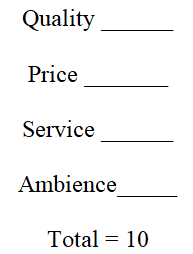 Here, participant should allocate 10 points among four options based on their preference. If participant provide, quality as 4, price as 3, service as 2 and ambience as 1, then quality and price are major confidence of customer for that firm to recover.
b)
In likert summated rating scale, participants are asked to give numerical score for each statement to measure the degree of attitude either positive or negative.
The measurement question: "How strongly do you believe that firm will be able to recover "
 Here, 5- point scale is used. Participant should rate the attributes by giving numerical value. The highest total among all the attributes are the major confidence of customer for that firm to recover.
c)
In the semantic differential scale, bipolar adjectives are used to measure the psychological meaning of an attitude. Usually, 7 points are used in the scale. The responses of this scale are measured using graphical representation.
Measurement question: "Rate your confidence that firm will be recovered"
 d)
d)
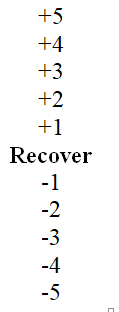
Staple scale is alternative to semantic differential scale, which is used when it is difficult to find the bipolar adjectives to match the question. The rating using staple scale ranges from +5 to -5.
The measurement question: "Rate your confidence that firm will be recovered"
 e)
e)
Forced ranking scale is the one of the ranking scales, in which participant is forced to give the ranking to the mentioned objects in comparison to the other objects.
The measurement question: Provide the order of preference using 1 to 4 numbers for the below attributes of restaurant (1 = first preference and 4 = last preference).
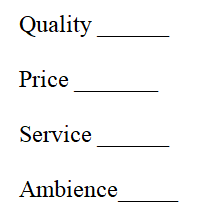
In this case, the customer's confidence on the firm attributes needs to be measured. The measurement question using different scales is as follows:
a)
In constant sum scale, participants need to allocate points among different attributes, which would provide a constant sum i.e. either 10 or 100.
The measurement question: "Rate the following that drives you most to make purchase at M food center".
Here, participant should allocate 10 points among four options based on their preference. If participant provide, quality as 4, price as 3, service as 2 and ambience as 1, then quality and price are major confidence of customer for that firm to recover. b)
In likert summated rating scale, participants are asked to give numerical score for each statement to measure the degree of attitude either positive or negative.
The measurement question: "How strongly do you believe that firm will be able to recover "
Here, 5- point scale is used. Participant should rate the attributes by giving numerical value. The highest total among all the attributes are the major confidence of customer for that firm to recover.c)
In the semantic differential scale, bipolar adjectives are used to measure the psychological meaning of an attitude. Usually, 7 points are used in the scale. The responses of this scale are measured using graphical representation.
Measurement question: "Rate your confidence that firm will be recovered"
d) Staple scale is alternative to semantic differential scale, which is used when it is difficult to find the bipolar adjectives to match the question. The rating using staple scale ranges from +5 to -5.
The measurement question: "Rate your confidence that firm will be recovered"
e)Forced ranking scale is the one of the ranking scales, in which participant is forced to give the ranking to the mentioned objects in comparison to the other objects.
The measurement question: Provide the order of preference using 1 to 4 numbers for the below attributes of restaurant (1 = first preference and 4 = last preference).
3
Unlock Deck
Unlock for access to all 10 flashcards in this deck.
Unlock Deck
k this deck
4
You receive the results of a paired-comparison preference test of four soft drinks from a sample of 200 persons. The results are as follows:
a. How do these brands rank in overall preference in this sample
b. Develop an interval scale for these four brands.
a. How do these brands rank in overall preference in this sample
b. Develop an interval scale for these four brands.
Unlock Deck
Unlock for access to all 10 flashcards in this deck.
Unlock Deck
k this deck
5
One of the problems in developing rating scales is the choice of response terms to use. Below are samples of some widely used scaling codes. Do you see any problem with them
a. Yes - Depends - No
b. Excellent - Good - Fair - Poor
c. Excellent - Good - Average - Fair - Poor
d. Strongly Approve - Approve - Uncertain - Disapprove - Strongly Disapprove
a. Yes - Depends - No
b. Excellent - Good - Fair - Poor
c. Excellent - Good - Average - Fair - Poor
d. Strongly Approve - Approve - Uncertain - Disapprove - Strongly Disapprove
Unlock Deck
Unlock for access to all 10 flashcards in this deck.
Unlock Deck
k this deck
6
You are working on a consumer perception study of four brands of bicycles. You will need to develop measurement questions and scales to accomplish the tasks listed below. Be sure to explain which data levels (nominal, ordinal, interval, ratio) are appropriate and which quantitative techniques you will use.
Prepare an overall assessment of all the brands
Provide a comparison of the brands for each of the following dimensions:
(1) Styling
(2) Durability
(3) Gear quality
(4) Brand image
Prepare an overall assessment of all the brands
Provide a comparison of the brands for each of the following dimensions:
(1) Styling
(2) Durability
(3) Gear quality
(4) Brand image
Unlock Deck
Unlock for access to all 10 flashcards in this deck.
Unlock Deck
k this deck
7
Unlock Deck
Unlock for access to all 10 flashcards in this deck.
Unlock Deck
k this deck
8
What is the basis of Jason and Myra's argument for the need of an arbitrary scale to address customer expectations
Unlock Deck
Unlock for access to all 10 flashcards in this deck.
Unlock Deck
k this deck
9
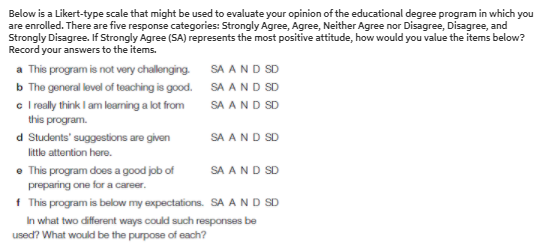
Using the response strategies within Exhibit 12-1 or 12-10, which would be appropriate and add insight to understanding the various indicants of student demand for the academic program in which the students are enrolled
Unlock Deck
Unlock for access to all 10 flashcards in this deck.
Unlock Deck
k this deck
10
The third generation iPad disappointed many who had expected not only a higher resolution screen (delivered) but Siri, Apple' s much ballyhooed speak-and-it-responds app developed for the iPhone 4S (not delivered). Apple indicated it wasn t included because Siri for the iPad wasn t ready. Design the question(s) that could have revealed expectations of iPad3 devotees.
Unlock Deck
Unlock for access to all 10 flashcards in this deck.
Unlock Deck
k this deck
Unlock Deck
Unlock for access to all 10 flashcards in this deck.







