





 Chat with AI

Deck 5: Product and Service Costing: Job-Order System
Full screen (f)

Question
Characteristics of Production Process, Cost Measurement
Refer to the data in Exercise 5.7. Vince Melders, owner of EcoScape, noticed that the watering systems for many houses in a local subdivision had the same layout and required virtually identical amounts of prime cost. Vince met with the subdivision builders and offered to install a basic watering system in each house. The idea was accepted enthusiastically, so Vince created a new company, Irrigation Specialties, to handle the subdivision business. In its first three months in business, Irrigation Specialties experienced the following:
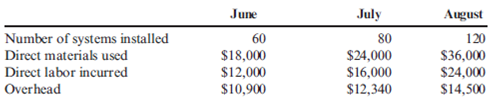
Required:
1. Should Irrigation Specialties use process costing or job-order costing? Explain.
2. If Irrigation Specialties uses an actual costing system, what is the cost of a single system installed in June? In July? In August? Round your answers to the nearest dollar.
3. Now assume that Irrigation Specialties uses a normal costing system. Estimated overhead for the year is $54,000, and estimated production is 600 watering systems. What is the predetermined overhead rate per system? What is the cost of a single system installed in June? In July? In August?
Refer to the data in Exercise 5.7. Vince Melders, owner of EcoScape, noticed that the watering systems for many houses in a local subdivision had the same layout and required virtually identical amounts of prime cost. Vince met with the subdivision builders and offered to install a basic watering system in each house. The idea was accepted enthusiastically, so Vince created a new company, Irrigation Specialties, to handle the subdivision business. In its first three months in business, Irrigation Specialties experienced the following:
Required:
1. Should Irrigation Specialties use process costing or job-order costing? Explain.
2. If Irrigation Specialties uses an actual costing system, what is the cost of a single system installed in June? In July? In August? Round your answers to the nearest dollar.
3. Now assume that Irrigation Specialties uses a normal costing system. Estimated overhead for the year is $54,000, and estimated production is 600 watering systems. What is the predetermined overhead rate per system? What is the cost of a single system installed in June? In July? In August?

Question
Unit Cost, Ending Work-in-Process Inventory, Journal Entries
During August, Skyler Company worked on three jobs. Data relating to these three jobs follow:
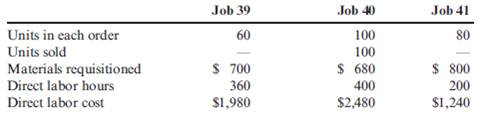
Overhead is assigned on the basis of direct labor hours at a rate of $2.30 per direct labor hour. During August, Jobs 39 and 40 were completed and transferred to Finished Goods Inventory. Job 40 was sold by the end of the month. Job 41 was the only unfinished job at the end of the month.
Required:
1. Calculate the per-unit cost of Jobs 39 and 40. (Round unit costs to nearest cent.)
2. Compute the ending balance in the work-in-process inventory account.
3. Prepare the journal entries reflecting the completion of Jobs 39 and 40 and the sale of Job 40. The selling price is 140 percent of cost.
During August, Skyler Company worked on three jobs. Data relating to these three jobs follow:
Overhead is assigned on the basis of direct labor hours at a rate of $2.30 per direct labor hour. During August, Jobs 39 and 40 were completed and transferred to Finished Goods Inventory. Job 40 was sold by the end of the month. Job 41 was the only unfinished job at the end of the month.
Required:
1. Calculate the per-unit cost of Jobs 39 and 40. (Round unit costs to nearest cent.)
2. Compute the ending balance in the work-in-process inventory account.
3. Prepare the journal entries reflecting the completion of Jobs 39 and 40 and the sale of Job 40. The selling price is 140 percent of cost.
Question
Case on Job-Order Costing: Dental Practice
Dr. Alyx Hemmings is employed by Mesa Dental. Mesa Dental recently installed a computerized job-order costing system to help monitor the cost of its services. Each patient is assigned a job number when he or she checks in with the receptionist. The receptionist-bookkeeper notes the time the patient enters the treatment area and when the patient leaves the area. This difference between the entry and exit times is the number of patient hours used and the direct labor time assigned to the dental assistant. (A dental assistant is constantly with the patient.) The direct labor time assigned to the dentist is 50 percent of the patient hours. (The dentist typically splits her time between two patients.)
The chart filled out by the dental assistant provides additional data that is entered into the computer. For example, the chart contains service codes that identify the nature of the treatment, such as whether the patient received a crown, a filling, or a root canal. The chart not only identifies the type of service but its level as well. For example, if a patient receives a filling, the dental assistant indicates (by a service-level code) whether the filling was one, two, three, or four surfaces. The service and service-level codes are used to determine the rate to be charged to the patient. The costs of providing different services and their levels also vary.
Costs assignable to a patient consist of materials, labor, and overhead. The types of materials used-and the quantity-are identified by the assistant and entered into the computer by the bookkeeper. Material prices are kept on file and accessed to provide the necessary cost information. Overhead is applied on the basis of patient hours. The rate used by Mesa Dental is $32 per patient hour. Direct labor cost is also computed using patient hours and the wage rates of the direct laborers. Dr. Hemmings is paid an average of $60 per hour for her services. Dental assistants are paid an average of $20 per hour. Given the treatment time, the software program calculates and assigns the labor cost for the dentist and her assistant; overhead cost is also assigned using the treatment time and the overhead rate.
The overhead rate does not include a charge for any X-rays. The X-Ray Department is separate from dental services; X-rays are billed and costed separately. The cost of an X-ray is $12 per film; the patient is charged $15 per film. If cleaning services are required, cleaning labor costs $35 per patient hour.
Glen Johnson, a patient (Job 267), spent 30 minutes in the treatment area and had a twosurface filling. He received two Novocaine shots and used three ampules of amalgam. The cost of the shots was $14 ($7 each). The cost of the amalgam was $6 per ampule. Other direct materials used are insignificant in amount and are included in the overhead rate. The rate charged to the patient for a two-surface filling is $110. One X-ray was taken.
Required:
1. Prepare a job-order cost sheet for Glen Johnson. What is the cost for providing a twosurface filling? What is the gross profit earned? Is the X-ray a direct cost of the service? Why are the X-rays costed separately from the overhead cost assignment?
2. Suppose that the patient time and associated patient charges are given for the following fillings:

Compute the cost for each filling and the gross profit for each type of filling. Assume that the cost of Novocaine is $14 for all fillings. Ampules of amalgam start at two and increase by one for each additional surface. Assume also that only one X-ray film is needed for all four cases. Does the increase in billing rate appear to be fair to the patient? Is it fair to the dental corporation?
Dr. Alyx Hemmings is employed by Mesa Dental. Mesa Dental recently installed a computerized job-order costing system to help monitor the cost of its services. Each patient is assigned a job number when he or she checks in with the receptionist. The receptionist-bookkeeper notes the time the patient enters the treatment area and when the patient leaves the area. This difference between the entry and exit times is the number of patient hours used and the direct labor time assigned to the dental assistant. (A dental assistant is constantly with the patient.) The direct labor time assigned to the dentist is 50 percent of the patient hours. (The dentist typically splits her time between two patients.)
The chart filled out by the dental assistant provides additional data that is entered into the computer. For example, the chart contains service codes that identify the nature of the treatment, such as whether the patient received a crown, a filling, or a root canal. The chart not only identifies the type of service but its level as well. For example, if a patient receives a filling, the dental assistant indicates (by a service-level code) whether the filling was one, two, three, or four surfaces. The service and service-level codes are used to determine the rate to be charged to the patient. The costs of providing different services and their levels also vary.
Costs assignable to a patient consist of materials, labor, and overhead. The types of materials used-and the quantity-are identified by the assistant and entered into the computer by the bookkeeper. Material prices are kept on file and accessed to provide the necessary cost information. Overhead is applied on the basis of patient hours. The rate used by Mesa Dental is $32 per patient hour. Direct labor cost is also computed using patient hours and the wage rates of the direct laborers. Dr. Hemmings is paid an average of $60 per hour for her services. Dental assistants are paid an average of $20 per hour. Given the treatment time, the software program calculates and assigns the labor cost for the dentist and her assistant; overhead cost is also assigned using the treatment time and the overhead rate.
The overhead rate does not include a charge for any X-rays. The X-Ray Department is separate from dental services; X-rays are billed and costed separately. The cost of an X-ray is $12 per film; the patient is charged $15 per film. If cleaning services are required, cleaning labor costs $35 per patient hour.
Glen Johnson, a patient (Job 267), spent 30 minutes in the treatment area and had a twosurface filling. He received two Novocaine shots and used three ampules of amalgam. The cost of the shots was $14 ($7 each). The cost of the amalgam was $6 per ampule. Other direct materials used are insignificant in amount and are included in the overhead rate. The rate charged to the patient for a two-surface filling is $110. One X-ray was taken.
Required:
1. Prepare a job-order cost sheet for Glen Johnson. What is the cost for providing a twosurface filling? What is the gross profit earned? Is the X-ray a direct cost of the service? Why are the X-rays costed separately from the overhead cost assignment?
2. Suppose that the patient time and associated patient charges are given for the following fillings:
Compute the cost for each filling and the gross profit for each type of filling. Assume that the cost of Novocaine is $14 for all fillings. Ampules of amalgam start at two and increase by one for each additional surface. Assume also that only one X-ray film is needed for all four cases. Does the increase in billing rate appear to be fair to the patient? Is it fair to the dental corporation?
Question
Job Costs Using a Plantwide Overhead Rate
Naranjo Company designs industrial prototypes for outside companies. Budgeted overhead for the year was $260,000, and budgeted direct labor hours were 20,000. The average wage rate for direct labor is expected to be $25 per hour. During June, Naranjo Company worked on four jobs. Data relating to these four jobs follow:

Overhead is assigned as a percentage of direct labor cost. During June, Jobs 39 and 40 were completed; Job 39 was sold at 130 percent of cost. (Naranjo had originally developed Job 40 to order for a customer; however, that customer was near bankruptcy and the chance of Naranjo being paid was growing dimmer. Naranjo decided to hold Job 40 in inventory while the customer worked out its financial difficulties. Job 40 is the only job in Finished Goods Inventory.) Jobs 41 and 42 remain unfinished at the end of the month.
Required:
1. Calculate the overhead rate based on direct labor cost.
2. Set up a simple job-order cost sheet for all jobs in process during June.
3. What if the expected direct labor rate at the beginning of the year was $20 instead of $25? What would the overhead rate be? How would the cost of the jobs be affected?
Naranjo Company designs industrial prototypes for outside companies. Budgeted overhead for the year was $260,000, and budgeted direct labor hours were 20,000. The average wage rate for direct labor is expected to be $25 per hour. During June, Naranjo Company worked on four jobs. Data relating to these four jobs follow:
Overhead is assigned as a percentage of direct labor cost. During June, Jobs 39 and 40 were completed; Job 39 was sold at 130 percent of cost. (Naranjo had originally developed Job 40 to order for a customer; however, that customer was near bankruptcy and the chance of Naranjo being paid was growing dimmer. Naranjo decided to hold Job 40 in inventory while the customer worked out its financial difficulties. Job 40 is the only job in Finished Goods Inventory.) Jobs 41 and 42 remain unfinished at the end of the month.
Required:
1. Calculate the overhead rate based on direct labor cost.
2. Set up a simple job-order cost sheet for all jobs in process during June.
3. What if the expected direct labor rate at the beginning of the year was $20 instead of $25? What would the overhead rate be? How would the cost of the jobs be affected?
Question
Question
Activity-Based Costing, Unit Cost, Ending Work-in-Process Inventory, Journal Entries
Feldspar Company uses an ABC system to apply overhead. There are three activity rates, shown on page 243.

During September, Feldspar worked on three jobs. Data relating to these jobs follow:
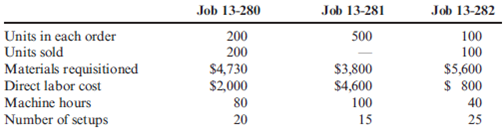
During September, Jobs 13-280 and 13-282 were completed and transferred to Finished Goods Inventory. Job 13-280 was sold by the end of the month. Job 13-281 was the only unfinished job at the end of the month.
Required:
1. Calculate the per-unit cost of Jobs 13-280 and 13-282. (Round unit cost to nearest cent.)
2. Compute the ending balance in the work-in-process inventory account.
3. Prepare the journal entries reflecting the completion of Jobs 13-280 and 13-282 and the sale of Job 13-280 on account. The selling price is 150 percent of cost.
Feldspar Company uses an ABC system to apply overhead. There are three activity rates, shown on page 243.
During September, Feldspar worked on three jobs. Data relating to these jobs follow:
During September, Jobs 13-280 and 13-282 were completed and transferred to Finished Goods Inventory. Job 13-280 was sold by the end of the month. Job 13-281 was the only unfinished job at the end of the month.
Required:
1. Calculate the per-unit cost of Jobs 13-280 and 13-282. (Round unit cost to nearest cent.)
2. Compute the ending balance in the work-in-process inventory account.
3. Prepare the journal entries reflecting the completion of Jobs 13-280 and 13-282 and the sale of Job 13-280 on account. The selling price is 150 percent of cost.
Question
Case on Job-Order Costing and Pricing Decisions
Nutratask, Inc., is a pharmaceutical manufacturer of amino-acid-chelated minerals and vitamin supplements. The company was founded in 1974 and is capable of performing all manufacturing functions, including packaging and laboratory functions. Currently, the company markets its products in the United States, Canada, Australia, Japan, and Belgium.
Mineral chelation enhances the mineral's availability to the body, making the mineral a more effective supplement. Most of the chelates supplied by Nutratask are in powder form, but the company has the capability to make tablets or capsules.
The production of all chelates follows a similar pattern. Upon receiving an order, the company's chemist prepares a load sheet (a bill of materials that specifies the product, the theoretical yield, and the quantities of materials that should be used). Once the load sheet is received by production, the materials are requisitioned and sent to the blending room. The chemicals and minerals are added in the order specified and blended together for two to eight hours, depending on the product. After blending, the mix is put on long trays and sent to the drying room, where it is allowed to dry until the moisture content is 7 to 9 percent. Drying time for most products is from one to three days.
After the product is dry, several small samples are taken and sent to a laboratory to be checked for bacterial level and to determine whether the product meets customer specifications. If the product is not fit for human consumption or if it fails to meet customer specifications, additional materials are added under the direction of the chemist to bring the product up to standard. Once the product passes inspection, it is ground into a powder of different meshes (particle sizes) according to customer specifications. The powder is then placed in heavy cardboard drums and shipped to the customer (or, if requested, put in tablet or capsule form and then shipped).
Since each order is customized to meet the special needs of its customers, Nutratask uses a job-order costing system. Recently, Nutratask received a request for a 300-kilogram order of potassium aspartate. The customer offered to pay $8.80/kg. Upon receiving the request and the customer's specifications, Lanny Smith, the marketing manager, requested a load sheet from the company's chemist. The load sheet prepared showed the following material requirements:
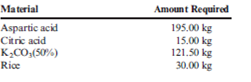
The theoretical yield is 300 kg.
Lanny also reviewed past jobs that were similar to the requested order and discovered that the expected direct labor time was 16 hours. The production workers at Nutratask earn an average of $6.50 per hour plus $6 per hour for taxes, insurance, and additional benefits.
Purchasing sent Lanny a list of prices for the materials needed for the job.
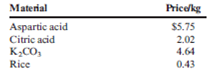
Overhead is applied using a companywide rate based on direct labor dollars. The rate for the current period is 110 percent of direct labor dollars.
Whenever a customer requests a bid, Nutratask usually estimates the manufacturing costs of the job and then adds a markup of 30 percent. This markup varies depending on the competition and general economic conditions. Currently, the industry is thriving, and Nutratask is operating at capacity.
Required:
1. Prepare a job-order cost sheet for the proposed job. What is the expected per-unit cost? Should Nutratask accept the price offered by the prospective customer? Why or why not?
2. Suppose Nutratask and the prospective customer agree on a price of cost plus 30 percent. What is the gross profit that Nutratask expects to earn on the job?
3. Suppose that the actual costs of producing 300 kg of potassium aspartate were as follows:
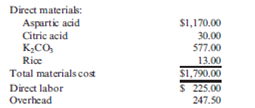
What is the actual per-unit cost? The bid price is based on expected costs. How much did Nutratask gain (or lose) because of the actual costs differing from the expected costs? Suggest some possible reasons why the actual costs differed from the projected costs.
4. Assume that the customer had agreed to pay actual manufacturing costs plus 30 percent. Suppose the actual costs are as described in Requirement 3 with one addition: an underapplied overhead variance is allocated to Cost of Goods Sold and spread across all jobs sold in proportion to their total cost (unadjusted cost of goods sold). Assume that the underapplied overhead cost added to the job in question is $30. Upon seeing the addition of the underapplied overhead in the itemized bill, the customer calls and complains about having to pay for Nutratask's inefficient use of overhead costs. If you were assigned to deal with this customer, what kind of response would you prepare? How would you explain and justify the addition of the underapplied overhead cost to the customer's bill?
Nutratask, Inc., is a pharmaceutical manufacturer of amino-acid-chelated minerals and vitamin supplements. The company was founded in 1974 and is capable of performing all manufacturing functions, including packaging and laboratory functions. Currently, the company markets its products in the United States, Canada, Australia, Japan, and Belgium.
Mineral chelation enhances the mineral's availability to the body, making the mineral a more effective supplement. Most of the chelates supplied by Nutratask are in powder form, but the company has the capability to make tablets or capsules.
The production of all chelates follows a similar pattern. Upon receiving an order, the company's chemist prepares a load sheet (a bill of materials that specifies the product, the theoretical yield, and the quantities of materials that should be used). Once the load sheet is received by production, the materials are requisitioned and sent to the blending room. The chemicals and minerals are added in the order specified and blended together for two to eight hours, depending on the product. After blending, the mix is put on long trays and sent to the drying room, where it is allowed to dry until the moisture content is 7 to 9 percent. Drying time for most products is from one to three days.
After the product is dry, several small samples are taken and sent to a laboratory to be checked for bacterial level and to determine whether the product meets customer specifications. If the product is not fit for human consumption or if it fails to meet customer specifications, additional materials are added under the direction of the chemist to bring the product up to standard. Once the product passes inspection, it is ground into a powder of different meshes (particle sizes) according to customer specifications. The powder is then placed in heavy cardboard drums and shipped to the customer (or, if requested, put in tablet or capsule form and then shipped).
Since each order is customized to meet the special needs of its customers, Nutratask uses a job-order costing system. Recently, Nutratask received a request for a 300-kilogram order of potassium aspartate. The customer offered to pay $8.80/kg. Upon receiving the request and the customer's specifications, Lanny Smith, the marketing manager, requested a load sheet from the company's chemist. The load sheet prepared showed the following material requirements:
The theoretical yield is 300 kg.
Lanny also reviewed past jobs that were similar to the requested order and discovered that the expected direct labor time was 16 hours. The production workers at Nutratask earn an average of $6.50 per hour plus $6 per hour for taxes, insurance, and additional benefits.
Purchasing sent Lanny a list of prices for the materials needed for the job.
Overhead is applied using a companywide rate based on direct labor dollars. The rate for the current period is 110 percent of direct labor dollars.
Whenever a customer requests a bid, Nutratask usually estimates the manufacturing costs of the job and then adds a markup of 30 percent. This markup varies depending on the competition and general economic conditions. Currently, the industry is thriving, and Nutratask is operating at capacity.
Required:
1. Prepare a job-order cost sheet for the proposed job. What is the expected per-unit cost? Should Nutratask accept the price offered by the prospective customer? Why or why not?
2. Suppose Nutratask and the prospective customer agree on a price of cost plus 30 percent. What is the gross profit that Nutratask expects to earn on the job?
3. Suppose that the actual costs of producing 300 kg of potassium aspartate were as follows:
What is the actual per-unit cost? The bid price is based on expected costs. How much did Nutratask gain (or lose) because of the actual costs differing from the expected costs? Suggest some possible reasons why the actual costs differed from the projected costs.
4. Assume that the customer had agreed to pay actual manufacturing costs plus 30 percent. Suppose the actual costs are as described in Requirement 3 with one addition: an underapplied overhead variance is allocated to Cost of Goods Sold and spread across all jobs sold in proportion to their total cost (unadjusted cost of goods sold). Assume that the underapplied overhead cost added to the job in question is $30. Upon seeing the addition of the underapplied overhead in the itemized bill, the customer calls and complains about having to pay for Nutratask's inefficient use of overhead costs. If you were assigned to deal with this customer, what kind of response would you prepare? How would you explain and justify the addition of the underapplied overhead cost to the customer's bill?
Question
Question
Question
Question
Question
Question
Question
Activity-Based Costing, Unit Cost, Ending Work-in-Process Inventory
Salazar Company is a job-order costing firm that uses activity-based costing to apply overhead to jobs. Salazar identified three overhead activities and related drivers. Budgeted information for the year is as follows:

Salazar worked on five jobs in March. Data are as follows:
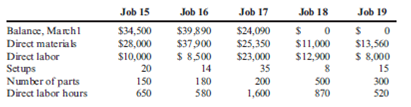
By March 31, Jobs 15, 16, and 17 were completed and sold. The remaining jobs were in process.
Required:
1. Calculate the activity rates for each of the three overhead activities.
2. Prepare job-order cost sheets for each job showing all costs through March 31. What is the cost of each job by the end of March?
3. Calculate the balance in Work in Process on March 31.
4. Calculate the cost of goods sold for March.
Salazar Company is a job-order costing firm that uses activity-based costing to apply overhead to jobs. Salazar identified three overhead activities and related drivers. Budgeted information for the year is as follows:
Salazar worked on five jobs in March. Data are as follows:
By March 31, Jobs 15, 16, and 17 were completed and sold. The remaining jobs were in process.
Required:
1. Calculate the activity rates for each of the three overhead activities.
2. Prepare job-order cost sheets for each job showing all costs through March 31. What is the cost of each job by the end of March?
3. Calculate the balance in Work in Process on March 31.
4. Calculate the cost of goods sold for March.
Question
Question
Question
Lorrimer Company has a job-order cost system. The following debits (credits) appeared in the Work-in-Process account for the month of June.

During the month of June, direct labor totaled $30,000 and $24,000 of overhead was applied to production. Finished Goods was debited $100,000 during June.
Lorrimer Company applies overhead at a predetermined rate of 80% of direct labor cost. Job number 83, the only job still in process at the end of June, has been charged with manufacturing overhead of $3,400. What was the amount of direct materials charged to Job number 83?
A) $3,400
B) $4,250
C) $8,350
D) $7,580
During the month of June, direct labor totaled $30,000 and $24,000 of overhead was applied to production. Finished Goods was debited $100,000 during June.
Lorrimer Company applies overhead at a predetermined rate of 80% of direct labor cost. Job number 83, the only job still in process at the end of June, has been charged with manufacturing overhead of $3,400. What was the amount of direct materials charged to Job number 83?
A) $3,400
B) $4,250
C) $8,350
D) $7,580
Question
Job Costs Using Activity-Based Costing
Heitger Company is a job-order costing firm that uses activity-based costing to apply overhead to jobs. Heitger identified three overhead activities and related drivers. Budgeted information for the year is as follows:

Heitger worked on four jobs in July. Data are as follows:


By July 31, Jobs 13-43 and 13-44 were completed and sold. Jobs 13-45 and 13-46 were still in process.
Required:
1. Calculate the activity rates for each of the three overhead activities.
2. Prepare job-order cost sheets for each job showing all costs through July 31.
3. Calculate the balance in Work in Process on July 31.
4. Calculate the cost of goods sold for July.
5. What if Job 13-46 required no engineering change orders? What is the new cost of Job 13-46? How would the cost of the other jobs be affected?
Heitger Company is a job-order costing firm that uses activity-based costing to apply overhead to jobs. Heitger identified three overhead activities and related drivers. Budgeted information for the year is as follows:
Heitger worked on four jobs in July. Data are as follows:
By July 31, Jobs 13-43 and 13-44 were completed and sold. Jobs 13-45 and 13-46 were still in process.
Required:
1. Calculate the activity rates for each of the three overhead activities.
2. Prepare job-order cost sheets for each job showing all costs through July 31.
3. Calculate the balance in Work in Process on July 31.
4. Calculate the cost of goods sold for July.
5. What if Job 13-46 required no engineering change orders? What is the new cost of Job 13-46? How would the cost of the other jobs be affected?
Question
Question
(2009 CPA Exam)
Merry Co. has two major categories of factory overhead: materials handling and quality control. The costs expected for these categories for the coming year are as follows:

The plant currently applies overhead based on direct labor hours. The estimated direct labor hours are 80,000 per year. The plant manager is asked to submit a bid and assembles the following data on a proposed job.

What amount is the estimated product cost on the proposed job?
a. $8,000
b. $10,000
c. $14,000
d. $18,000
Merry Co. has two major categories of factory overhead: materials handling and quality control. The costs expected for these categories for the coming year are as follows:
The plant currently applies overhead based on direct labor hours. The estimated direct labor hours are 80,000 per year. The plant manager is asked to submit a bid and assembles the following data on a proposed job.
What amount is the estimated product cost on the proposed job?
a. $8,000
b. $10,000
c. $14,000
d. $18,000
Question
Question
Job Costs, Ending Work in Process
During March, Aragon Company worked on three jobs. Data relating to these three jobs follow:
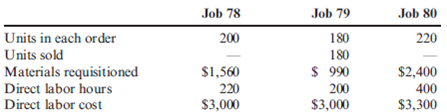
Overhead is assigned on the basis of direct labor hours at a rate of $8.40 per direct labor hour. During March, Jobs 78 and 79 were completed and transferred to Finished Goods Inventory. Job 79 was sold by the end of the month. Job 80 was the only unfinished job at the end of the month.
Required:
1. Calculate the per-unit cost of Jobs 78 and 79.
2. Compute the ending balance in the work-in-process inventory account.
3. Prepare the journal entries reflecting the completion of Jobs 78 and 79 and the sale of Job 79. The selling price is 140 percent of cost.
During March, Aragon Company worked on three jobs. Data relating to these three jobs follow:
Overhead is assigned on the basis of direct labor hours at a rate of $8.40 per direct labor hour. During March, Jobs 78 and 79 were completed and transferred to Finished Goods Inventory. Job 79 was sold by the end of the month. Job 80 was the only unfinished job at the end of the month.
Required:
1. Calculate the per-unit cost of Jobs 78 and 79.
2. Compute the ending balance in the work-in-process inventory account.
3. Prepare the journal entries reflecting the completion of Jobs 78 and 79 and the sale of Job 79. The selling price is 140 percent of cost.
Question
Question
Question
Question
Geneva, Inc., makes two products, X and Y, that require allocation of indirect manufacturing costs. The following data were compiled by the accountants before making any allocations:

The total cost of purchasing and receiving parts used in manufacturing is $60,000. The company uses a job-costing system with a single indirect cost rate. Under this system, allocated costs were $48,000 and $12,000 for X and Y, respectively. If an activity-based system is used, what would be the allocated costs for each product?
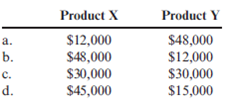
The total cost of purchasing and receiving parts used in manufacturing is $60,000. The company uses a job-costing system with a single indirect cost rate. Under this system, allocated costs were $48,000 and $12,000 for X and Y, respectively. If an activity-based system is used, what would be the allocated costs for each product?
Question
Question
Predetermined Overhead Rate, Application of Overhead to Jobs, Job Cost
On April 1, Sangvikar Company had the following balances in its inventory accounts:
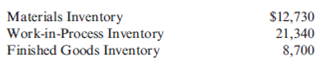
Work-in-process inventory is made up of three jobs with the following costs:

During April, Sangvikar experienced the transactions listed below.
a. Materials purchased on account, $29,000.
b. Materials requisitioned: Job 114, $16,500; Job 115, $12,200; and Job 116, $5,000.
c. Job tickets were collected and summarized: Job 114, 150 hours at $12 per hour; Job 115, 220 hours at $14 per hour; and Job 116, 80 hours at $18 per hour.
d. Overhead is applied on the basis of direct labor cost.
e. Actual overhead was $4,415.
f. Job 115 was completed and transferred to the finished goods warehouse.
g. Job 115 was shipped, and the customer was billed for 125 percent of the cost.
Required:
1. Calculate the predetermined overhead rate based on direct labor cost.
2. Calculate the ending balance for each job as of April 30.
3. Calculate the ending balance of Work in Process as of April 30.
4. Calculate the cost of goods sold for April.
5. Assuming that Sangvikar prices its jobs at cost plus 25 percent, calculate the price of the one job that was sold during April. (Round to the nearest dollar.)
On April 1, Sangvikar Company had the following balances in its inventory accounts:
Work-in-process inventory is made up of three jobs with the following costs:
During April, Sangvikar experienced the transactions listed below.
a. Materials purchased on account, $29,000.
b. Materials requisitioned: Job 114, $16,500; Job 115, $12,200; and Job 116, $5,000.
c. Job tickets were collected and summarized: Job 114, 150 hours at $12 per hour; Job 115, 220 hours at $14 per hour; and Job 116, 80 hours at $18 per hour.
d. Overhead is applied on the basis of direct labor cost.
e. Actual overhead was $4,415.
f. Job 115 was completed and transferred to the finished goods warehouse.
g. Job 115 was shipped, and the customer was billed for 125 percent of the cost.
Required:
1. Calculate the predetermined overhead rate based on direct labor cost.
2. Calculate the ending balance for each job as of April 30.
3. Calculate the ending balance of Work in Process as of April 30.
4. Calculate the cost of goods sold for April.
5. Assuming that Sangvikar prices its jobs at cost plus 25 percent, calculate the price of the one job that was sold during April. (Round to the nearest dollar.)
Question
Question
Question
Question
Journal Entries, T-Accounts, Cost of Goods Manufactured and Sold
During May, the following transactions were completed and reported by Jerico Company:
a. Materials purchased on account, $60,100.
b. Materials issued to production to fill job-order requisitions: direct materials, $50,000; indirect materials, $8,800.
c. Payroll for the month: direct labor, $75,000; indirect labor, $36,000; administrative, $28,000; sales, $19,000.
d. Depreciation on factory plant and equipment, $10,400.
e. Property taxes on the factory accrued during the month, $1,450.
f. Insurance on the factory expired with a credit to the prepaid insurance account, $6,200.
g. Factory utilities, $5,500.
h. Advertising paid with cash, $7,900.
i. Depreciation on office equipment, $800; on sales vehicles, $1,650.
j. Legal fees incurred but not yet paid for preparation of lease agreements, $750.
k. Overhead is charged to production at a rate of $18 per direct labor hour. Records show 4,000 direct labor hours were worked during the month.
l. Cost of jobs completed during the month, $160,000.
The company also reported the following beginning balances in its inventory accounts:

Required:
1. Prepare journal entries to record the transactions occurring in May.
2. Prepare T-accounts for Materials Inventory, Overhead Control, Work-in-Process Inventory, and Finished Goods Inventory. Post all relevant entries to these accounts.
3. Prepare a statement of cost of goods manufactured.
4. If the overhead variance is all allocated to cost of goods sold, by how much will cost of goods sold decrease or increase?
During May, the following transactions were completed and reported by Jerico Company:
a. Materials purchased on account, $60,100.
b. Materials issued to production to fill job-order requisitions: direct materials, $50,000; indirect materials, $8,800.
c. Payroll for the month: direct labor, $75,000; indirect labor, $36,000; administrative, $28,000; sales, $19,000.
d. Depreciation on factory plant and equipment, $10,400.
e. Property taxes on the factory accrued during the month, $1,450.
f. Insurance on the factory expired with a credit to the prepaid insurance account, $6,200.
g. Factory utilities, $5,500.
h. Advertising paid with cash, $7,900.
i. Depreciation on office equipment, $800; on sales vehicles, $1,650.
j. Legal fees incurred but not yet paid for preparation of lease agreements, $750.
k. Overhead is charged to production at a rate of $18 per direct labor hour. Records show 4,000 direct labor hours were worked during the month.
l. Cost of jobs completed during the month, $160,000.
The company also reported the following beginning balances in its inventory accounts:
Required:
1. Prepare journal entries to record the transactions occurring in May.
2. Prepare T-accounts for Materials Inventory, Overhead Control, Work-in-Process Inventory, and Finished Goods Inventory. Post all relevant entries to these accounts.
3. Prepare a statement of cost of goods manufactured.
4. If the overhead variance is all allocated to cost of goods sold, by how much will cost of goods sold decrease or increase?
Question
Question
Question
Overhead Application, Activity-Based Costing, Bid Prices
Firenza Company manufactures specialty tools to customer order. Budgeted overhead for the coming year is:
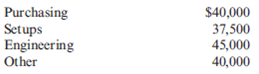
Previously, Sanjay Bhatt, Firenza Company's controller, had applied overhead on the basis of machine hours. Expected machine hours for the coming year are 50,000. Sanjay has been reading about activity-based costing, and he wonders whether or not it might offer some advantages to his company. He decided that appropriate drivers for overhead activities are purchase orders for purchasing, number of setups for setup cost, engineering hours for engineering cost, and machine hours for other. Budgeted amounts for these drivers are 5,000 purchase orders, 500 setups, and 2,500 engineering hours.
Sanjay has been asked to prepare bids for two jobs with the following information:
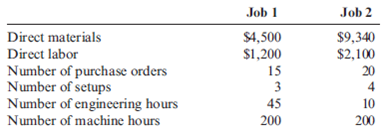
The typical bid price includes a 40 percent markup over full manufacturing cost.
Required:
1. Calculate a plantwide rate for Firenza Company based on machine hours. What is the bid price of each job using this rate?
2. Calculate activity rates for the four overhead activities. What is the bid price of each job using these rates?
3. Which bids are more accurate? Why?
Firenza Company manufactures specialty tools to customer order. Budgeted overhead for the coming year is:
Previously, Sanjay Bhatt, Firenza Company's controller, had applied overhead on the basis of machine hours. Expected machine hours for the coming year are 50,000. Sanjay has been reading about activity-based costing, and he wonders whether or not it might offer some advantages to his company. He decided that appropriate drivers for overhead activities are purchase orders for purchasing, number of setups for setup cost, engineering hours for engineering cost, and machine hours for other. Budgeted amounts for these drivers are 5,000 purchase orders, 500 setups, and 2,500 engineering hours.
Sanjay has been asked to prepare bids for two jobs with the following information:
The typical bid price includes a 40 percent markup over full manufacturing cost.
Required:
1. Calculate a plantwide rate for Firenza Company based on machine hours. What is the bid price of each job using this rate?
2. Calculate activity rates for the four overhead activities. What is the bid price of each job using these rates?
3. Which bids are more accurate? Why?
Question
Question
Question
Question
Question
Predetermined Overhead Rate, Application of Overhead to Jobs, Job Cost, Unit Cost
On August 1, Cairle Company's work-in-process inventory consisted of three jobs with the following costs:

During August, four more jobs were started. Information on costs added to the seven jobs during the month is as follows:

Before the end of August, Jobs 70, 72, 73, and 75 were completed. On August 31, Jobs 72 and 75 were sold.
Required:
1. Calculate the predetermined overhead rate based on direct labor cost.
2. Calculate the ending balance for each job as of August 31.
3. Calculate the ending balance of Work in Process as of August 31.
4. Calculate the cost of goods sold for August.
5. Assuming that Cairle prices its jobs at cost plus 20 percent, calculate Cairle's sales revenue for August.
On August 1, Cairle Company's work-in-process inventory consisted of three jobs with the following costs:
During August, four more jobs were started. Information on costs added to the seven jobs during the month is as follows:
Before the end of August, Jobs 70, 72, 73, and 75 were completed. On August 31, Jobs 72 and 75 were sold.
Required:
1. Calculate the predetermined overhead rate based on direct labor cost.
2. Calculate the ending balance for each job as of August 31.
3. Calculate the ending balance of Work in Process as of August 31.
4. Calculate the cost of goods sold for August.
5. Assuming that Cairle prices its jobs at cost plus 20 percent, calculate Cairle's sales revenue for August.
Question
Plantwide Overhead Rate versus Departmental Rates, Effects on Pricing Decisions
Cherise Ortega, marketing manager for Romer Company, was puzzled by the outcome of two recent bids. The company's policy was to bid 150 percent of the full manufacturing cost. One job (labeled Job 97-28) had been turned down by a prospective customer, who had indicated that the proposed price was $3 per unit higher than the winning bid. A second job (Job 97-35) had been accepted by a customer, who was amazed that Romer could offer such favorable terms. This customer revealed that Romer's price was $43 per unit lower than the next lowest bid.
Cherise has been informed that the company was more than competitive in terms of cost control. Accordingly, she began to suspect that the problem was related to cost assignment procedures. Upon investigating, Cherise was told that the company uses a plantwide overhead rate based on direct labor hours. The rate is computed at the beginning of the year using budgeted data. Selected budgeted data are given below.

Cherise also discovered that the overhead costs in Department B were higher than those in Department A because B has more equipment, higher maintenance, higher power consumption, higher depreciation, and higher setup costs. In addition to the general procedures for assigning overhead costs, Cherise was supplied with the following specific manufacturing data on Jobs 97-28 and 97-35:
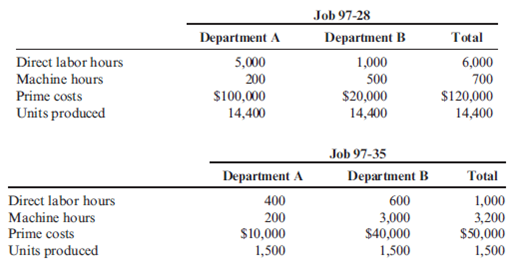
Required:
1. Using a plantwide overhead rate based on direct labor hours, develop the bid prices for Jobs 97-28 and 97-35 (express the bid prices on a per-unit basis).
2. Using departmental overhead rates (use direct labor hours for Department A and machine hours for Department B), develop per-unit bid prices for Jobs 97-28 and 97-35.
3. Compute the difference in gross profit that would have been earned had the company used departmental rates in its bids instead of the plantwide rate.
4. Explain why the use of departmental rates in this case provides a more accurate product cost.
Cherise Ortega, marketing manager for Romer Company, was puzzled by the outcome of two recent bids. The company's policy was to bid 150 percent of the full manufacturing cost. One job (labeled Job 97-28) had been turned down by a prospective customer, who had indicated that the proposed price was $3 per unit higher than the winning bid. A second job (Job 97-35) had been accepted by a customer, who was amazed that Romer could offer such favorable terms. This customer revealed that Romer's price was $43 per unit lower than the next lowest bid.
Cherise has been informed that the company was more than competitive in terms of cost control. Accordingly, she began to suspect that the problem was related to cost assignment procedures. Upon investigating, Cherise was told that the company uses a plantwide overhead rate based on direct labor hours. The rate is computed at the beginning of the year using budgeted data. Selected budgeted data are given below.
Cherise also discovered that the overhead costs in Department B were higher than those in Department A because B has more equipment, higher maintenance, higher power consumption, higher depreciation, and higher setup costs. In addition to the general procedures for assigning overhead costs, Cherise was supplied with the following specific manufacturing data on Jobs 97-28 and 97-35:
Required:
1. Using a plantwide overhead rate based on direct labor hours, develop the bid prices for Jobs 97-28 and 97-35 (express the bid prices on a per-unit basis).
2. Using departmental overhead rates (use direct labor hours for Department A and machine hours for Department B), develop per-unit bid prices for Jobs 97-28 and 97-35.
3. Compute the difference in gross profit that would have been earned had the company used departmental rates in its bids instead of the plantwide rate.
4. Explain why the use of departmental rates in this case provides a more accurate product cost.
Question
Question
Question
Cost of Spoiled Units
Lieu Company is a specialty print shop. Usually, printing jobs are priced at standard cost plus 50 percent. Job 2013-631 involved printing 400 wedding invitations with the following standard costs:
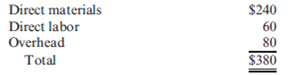
Normally, the invitations would be taken from the machine, the top one inspected for correct wording, spelling, and quality of print, and all of the invitations wrapped in plastic and stored on shelves designated for completed jobs. In this case, however, the technician decided to go to lunch before inspecting and wrapping the job. He stacked the unwrapped invitations beside the printing press and left. One hour later, he returned and found the invitations had fallen on the floor and been stepped on. It turned out that about 50 invitations were ruined and had to be discarded. An additional 50 invitations were then printed to complete the job.
Required:
1. Calculate the cost of the spoiled invitations. How should the spoilage cost be accounted for?
2. What is the price of Job 2013-631?
3. Suppose that another job, 2013-705, also required 400 wedding invitations. The standard costs are identical to those of Job 2013-631. However, Job 2013-705 required an unusual color of ink that could only be obtained in a formula that was difficult to use. Lieu printers know from experience that getting this ink color to print correctly requires trial and error. In the case of Job 2013-705, the first 50 invitations had to be discarded due to inconsistencies in the color of ink. What is the cost of the spoilage, and how would it be treated?
4. What is the price of Job 2013-705?
Lieu Company is a specialty print shop. Usually, printing jobs are priced at standard cost plus 50 percent. Job 2013-631 involved printing 400 wedding invitations with the following standard costs:
Normally, the invitations would be taken from the machine, the top one inspected for correct wording, spelling, and quality of print, and all of the invitations wrapped in plastic and stored on shelves designated for completed jobs. In this case, however, the technician decided to go to lunch before inspecting and wrapping the job. He stacked the unwrapped invitations beside the printing press and left. One hour later, he returned and found the invitations had fallen on the floor and been stepped on. It turned out that about 50 invitations were ruined and had to be discarded. An additional 50 invitations were then printed to complete the job.
Required:
1. Calculate the cost of the spoiled invitations. How should the spoilage cost be accounted for?
2. What is the price of Job 2013-631?
3. Suppose that another job, 2013-705, also required 400 wedding invitations. The standard costs are identical to those of Job 2013-631. However, Job 2013-705 required an unusual color of ink that could only be obtained in a formula that was difficult to use. Lieu printers know from experience that getting this ink color to print correctly requires trial and error. In the case of Job 2013-705, the first 50 invitations had to be discarded due to inconsistencies in the color of ink. What is the cost of the spoilage, and how would it be treated?
4. What is the price of Job 2013-705?
Question
Characteristics of Production Process, Cost Measurement
Vince Melders, of EcoScape Company, designs and installs custom lawn and garden irrigation systems for homes and businesses throughout the state. Each job is different, requiring different materials and labor for installing the systems. EcoScape estimated the following for the year:

During the year, the following actual amounts were experienced:

Required:
1. Should EcoScape use process costing or job-order costing? Explain.
2. If EcoScape uses a normal costing system and overhead is applied on the basis of direct labor hours, what is the average actual wage rate? What is the cost of an installation that takes $3,500 of direct materials and 20 direct labor hours?
3. Explain why EcoScape would have difficulty using an actual costing system.
Vince Melders, of EcoScape Company, designs and installs custom lawn and garden irrigation systems for homes and businesses throughout the state. Each job is different, requiring different materials and labor for installing the systems. EcoScape estimated the following for the year:
During the year, the following actual amounts were experienced:
Required:
1. Should EcoScape use process costing or job-order costing? Explain.
2. If EcoScape uses a normal costing system and overhead is applied on the basis of direct labor hours, what is the average actual wage rate? What is the cost of an installation that takes $3,500 of direct materials and 20 direct labor hours?
3. Explain why EcoScape would have difficulty using an actual costing system.
Question
Question
Cost of Reworked Units
Warren's Sporting Goods Store sells a variety of sporting goods and clothing. In a back room, Warren's has set up heat transfer equipment to personalize T-shirts for Little League teams. Typically, each team has the name of the individual player put on the back of the T-shirt. Last week, Shona Kohlmia, coach of the Terrors, brought in a list of names for her team. Her team consisted of 12 players with the following names: Mary Kate, Kayla, Katie, Tara, Heather, Emma, Kimberleigh, Jennifer, Dayna, Elizabeth, Kyle, and Wendy. Shona was quoted a price of $0.60 per letter.
Chip Russell, Warren's newest employee, took Shona's order and worked on the job. He selected the appropriate letters, arranged the letters in each name carefully on a shirt, and heat- pressed them on. When Shona returned, she was appalled to see that the names were on the front of the shirts. Jim Warren, owner of the sporting goods store, assured Shona that the letters could easily be removed by applying more heat and lifting them off. This process ruins the old letters, so new letters must then be placed correctly on the shirt backs. He promised to correct the job immediately and have it ready in an hour and a half.
Costs for heat transferring are as follows:

Shona's job originally took one hour and 12 minutes of direct labor time. The removal process goes more quickly and should take only 30 minutes.
Required:
1. What was the original cost of Shona's job?
2. What is the cost of rework on Shona's job? Assume that Chip failed to ask whether the names should be placed on the back or the front of the shirts. How should the rework cost be treated?
3. Now assume that Shona had mistakenly told Chip to put the names on the front of the shirts. In an effort to keep his customer happy, Jim suggested that Shona pay only for the new letters and the firm would pay for the labor cost. How much did Jim charge Shona in addition to the orginal price of the job?
Warren's Sporting Goods Store sells a variety of sporting goods and clothing. In a back room, Warren's has set up heat transfer equipment to personalize T-shirts for Little League teams. Typically, each team has the name of the individual player put on the back of the T-shirt. Last week, Shona Kohlmia, coach of the Terrors, brought in a list of names for her team. Her team consisted of 12 players with the following names: Mary Kate, Kayla, Katie, Tara, Heather, Emma, Kimberleigh, Jennifer, Dayna, Elizabeth, Kyle, and Wendy. Shona was quoted a price of $0.60 per letter.
Chip Russell, Warren's newest employee, took Shona's order and worked on the job. He selected the appropriate letters, arranged the letters in each name carefully on a shirt, and heat- pressed them on. When Shona returned, she was appalled to see that the names were on the front of the shirts. Jim Warren, owner of the sporting goods store, assured Shona that the letters could easily be removed by applying more heat and lifting them off. This process ruins the old letters, so new letters must then be placed correctly on the shirt backs. He promised to correct the job immediately and have it ready in an hour and a half.
Costs for heat transferring are as follows:
Shona's job originally took one hour and 12 minutes of direct labor time. The removal process goes more quickly and should take only 30 minutes.
Required:
1. What was the original cost of Shona's job?
2. What is the cost of rework on Shona's job? Assume that Chip failed to ask whether the names should be placed on the back or the front of the shirts. How should the rework cost be treated?
3. Now assume that Shona had mistakenly told Chip to put the names on the front of the shirts. In an effort to keep his customer happy, Jim suggested that Shona pay only for the new letters and the firm would pay for the labor cost. How much did Jim charge Shona in addition to the orginal price of the job?
Question
Question
Journal Entries, T-Accounts
Ehrling Brothers Company makes jobs to customer order. During the month of July, the following occurred:
a. Materials were purchased on account for $45,670.
b. Materials totaling $40,990 were requisitioned for use in producing various jobs.
c. Direct labor payroll for the month was $22,400 with an average wage of $14 per hour.
d. Actual overhead of $9,020 was incurred and paid in cash.
e. Manufacturing overhead is charged to production at the rate of $5.50 per direct labor hour.
f. Completed jobs costing $58,000 were transferred to Finished Goods.
g. Jobs costing $59,000 were sold on account for $73,750.
Beginning balances as of July 1 were:

Required:
1. Prepare the journal entries for the preceding events.
2. Calculate the ending balances of:
a. Materials Inventory
b. Work-in-Process Inventory
c. Overhead Control
d. Finished Goods Inventory
Ehrling Brothers Company makes jobs to customer order. During the month of July, the following occurred:
a. Materials were purchased on account for $45,670.
b. Materials totaling $40,990 were requisitioned for use in producing various jobs.
c. Direct labor payroll for the month was $22,400 with an average wage of $14 per hour.
d. Actual overhead of $9,020 was incurred and paid in cash.
e. Manufacturing overhead is charged to production at the rate of $5.50 per direct labor hour.
f. Completed jobs costing $58,000 were transferred to Finished Goods.
g. Jobs costing $59,000 were sold on account for $73,750.
Beginning balances as of July 1 were:
Required:
1. Prepare the journal entries for the preceding events.
2. Calculate the ending balances of:
a. Materials Inventory
b. Work-in-Process Inventory
c. Overhead Control
d. Finished Goods Inventory
Question
Job-Order Costing: Housing
Sutton Construction Inc. is a privately held, family-founded corporation that builds single- and multiple-unit housing. Most projects Sutton Construction undertakes involve the construction of multiple units. Sutton Construction has adopted a job-order costing system for determining the cost of each unit. The costing system is fully computerized. Each project's costs are divided into the following five categories:
1. General conditions, including construction site utilities, project insurance permits and licenses, architect's fees, decorating, field office salaries, and cleanup costs.
2. Hard costs, such as subcontractors, direct materials, and direct labor.
3. Finance costs, including title and recording fees, inspection fees, and taxes and discounts on mortgages.
4. Land costs, which refer to the purchase price of the construction site.
5. Marketing costs, such as advertising, sales commissions, and appraisal fees.
Recently, Sutton Construction purchased land for the purpose of developing 20 new singlefamily houses. The cost of the land was $250,000. Lot sizes vary from % to Y2 acre. The 20 lots occupy a total of eight acres.
General conditions costs for the project totaled $120,000. This $120,000 is common to all 20 units that were constructed on the building site.
Job 3, the third house built in the project, occupied a ¼-acre lot and had the following hard costs:

For Job 3, finance costs totaled $4,765 and marketing costs, $800. General conditions costs are allocated on the basis of units produced. Each unit's selling price is determined by adding 40 percent to the total of all costs.
Required:
1. Identify all production costs that are directly traceable to Job 3. Are all remaining production costs equivalent to overhead found in a manufacturing firm? Are there nonproduction costs that are directly traceable to the housing unit? Which ones?
2. Develop a job-order cost sheet for Job 3. What is the cost of building this house? Did you include finance and marketing costs in computing the unit cost? Why or why not? How did you determine the cost of land for Job 3?
3. Which of the five cost categories corresponds to overhead? Do you agree with the way in which this cost is allocated to individual housing units? Can you suggest a different allocation method?
4. Calculate the selling price of Job 3. Calculate the profit made on the sale of this unit.
Sutton Construction Inc. is a privately held, family-founded corporation that builds single- and multiple-unit housing. Most projects Sutton Construction undertakes involve the construction of multiple units. Sutton Construction has adopted a job-order costing system for determining the cost of each unit. The costing system is fully computerized. Each project's costs are divided into the following five categories:
1. General conditions, including construction site utilities, project insurance permits and licenses, architect's fees, decorating, field office salaries, and cleanup costs.
2. Hard costs, such as subcontractors, direct materials, and direct labor.
3. Finance costs, including title and recording fees, inspection fees, and taxes and discounts on mortgages.
4. Land costs, which refer to the purchase price of the construction site.
5. Marketing costs, such as advertising, sales commissions, and appraisal fees.
Recently, Sutton Construction purchased land for the purpose of developing 20 new singlefamily houses. The cost of the land was $250,000. Lot sizes vary from % to Y2 acre. The 20 lots occupy a total of eight acres.
General conditions costs for the project totaled $120,000. This $120,000 is common to all 20 units that were constructed on the building site.
Job 3, the third house built in the project, occupied a ¼-acre lot and had the following hard costs:
For Job 3, finance costs totaled $4,765 and marketing costs, $800. General conditions costs are allocated on the basis of units produced. Each unit's selling price is determined by adding 40 percent to the total of all costs.
Required:
1. Identify all production costs that are directly traceable to Job 3. Are all remaining production costs equivalent to overhead found in a manufacturing firm? Are there nonproduction costs that are directly traceable to the housing unit? Which ones?
2. Develop a job-order cost sheet for Job 3. What is the cost of building this house? Did you include finance and marketing costs in computing the unit cost? Why or why not? How did you determine the cost of land for Job 3?
3. Which of the five cost categories corresponds to overhead? Do you agree with the way in which this cost is allocated to individual housing units? Can you suggest a different allocation method?
4. Calculate the selling price of Job 3. Calculate the profit made on the sale of this unit.

Unlock Deck
Sign up to unlock the cards in this deck!
Unlock Deck
Unlock Deck
1/50

Play

Full screen (f)
Deck 5: Product and Service Costing: Job-Order System
1
Characteristics of Production Process, Cost Measurement
Refer to the data in Exercise 5.7. Vince Melders, owner of EcoScape, noticed that the watering systems for many houses in a local subdivision had the same layout and required virtually identical amounts of prime cost. Vince met with the subdivision builders and offered to install a basic watering system in each house. The idea was accepted enthusiastically, so Vince created a new company, Irrigation Specialties, to handle the subdivision business. In its first three months in business, Irrigation Specialties experienced the following:
Required:
1. Should Irrigation Specialties use process costing or job-order costing? Explain.
2. If Irrigation Specialties uses an actual costing system, what is the cost of a single system installed in June? In July? In August? Round your answers to the nearest dollar.
3. Now assume that Irrigation Specialties uses a normal costing system. Estimated overhead for the year is $54,000, and estimated production is 600 watering systems. What is the predetermined overhead rate per system? What is the cost of a single system installed in June? In July? In August?
Refer to the data in Exercise 5.7. Vince Melders, owner of EcoScape, noticed that the watering systems for many houses in a local subdivision had the same layout and required virtually identical amounts of prime cost. Vince met with the subdivision builders and offered to install a basic watering system in each house. The idea was accepted enthusiastically, so Vince created a new company, Irrigation Specialties, to handle the subdivision business. In its first three months in business, Irrigation Specialties experienced the following:
Required:
1. Should Irrigation Specialties use process costing or job-order costing? Explain.
2. If Irrigation Specialties uses an actual costing system, what is the cost of a single system installed in June? In July? In August? Round your answers to the nearest dollar.
3. Now assume that Irrigation Specialties uses a normal costing system. Estimated overhead for the year is $54,000, and estimated production is 600 watering systems. What is the predetermined overhead rate per system? What is the cost of a single system installed in June? In July? In August?
Vince Melders observed the watering system of many houses. The data of the irrigation facilities of the first three months is given in the question:
1.The irrigation specialties should use process costing than job-order costing because all the watering system is same, that is the cost of direct materials, direct labor and overhead remains same from job to job.
2.If the irrigation specialties uses an actual costing system, the average amounts for actual direct materials, actual direct labor, and actual overhead should be calculated for each month.
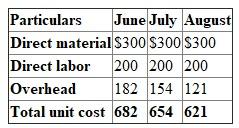 3.If the irrigation specialties uses normal costing system.
Given:


 The cost of the basic system does not change from month to month.
1.The irrigation specialties should use process costing than job-order costing because all the watering system is same, that is the cost of direct materials, direct labor and overhead remains same from job to job.
2.If the irrigation specialties uses an actual costing system, the average amounts for actual direct materials, actual direct labor, and actual overhead should be calculated for each month.
3.If the irrigation specialties uses normal costing system.Given:
The cost of the basic system does not change from month to month. 2
Unit Cost, Ending Work-in-Process Inventory, Journal Entries
During August, Skyler Company worked on three jobs. Data relating to these three jobs follow:
Overhead is assigned on the basis of direct labor hours at a rate of $2.30 per direct labor hour. During August, Jobs 39 and 40 were completed and transferred to Finished Goods Inventory. Job 40 was sold by the end of the month. Job 41 was the only unfinished job at the end of the month.
Required:
1. Calculate the per-unit cost of Jobs 39 and 40. (Round unit costs to nearest cent.)
2. Compute the ending balance in the work-in-process inventory account.
3. Prepare the journal entries reflecting the completion of Jobs 39 and 40 and the sale of Job 40. The selling price is 140 percent of cost.
During August, Skyler Company worked on three jobs. Data relating to these three jobs follow:
Overhead is assigned on the basis of direct labor hours at a rate of $2.30 per direct labor hour. During August, Jobs 39 and 40 were completed and transferred to Finished Goods Inventory. Job 40 was sold by the end of the month. Job 41 was the only unfinished job at the end of the month.
Required:
1. Calculate the per-unit cost of Jobs 39 and 40. (Round unit costs to nearest cent.)
2. Compute the ending balance in the work-in-process inventory account.
3. Prepare the journal entries reflecting the completion of Jobs 39 and 40 and the sale of Job 40. The selling price is 140 percent of cost.
We are given the data relating to three jobs being done by S Company. We are required to calculate the cost per unit, compute the ending balance in the work in process inventory account and prepare the journal entries.
1. Cost per unit is calculated as follows:
![We are given the data relating to three jobs being done by S Company. We are required to calculate the cost per unit, compute the ending balance in the work in process inventory account and prepare the journal entries. 1. Cost per unit is calculated as follows: 2. Ending balance in the work in process inventory account is the cost of Job 41 as follows: 3. Journal entry reflecting the completion of Job 39 is done as under: Finished goods 3,508 Work in Process 3,508 Journal entry reflecting the completion and sale of Job 40 is done as under: Finished Goods 4,080 Work in Process 4,080 Cost of goods sold 4,080 Finished Goods 4,080 Accounts Receivable 5,712 Sales Revenue 5,712 [$4,080 * 140%]](https://d2lvgg3v3hfg70.cloudfront.net/SM1592/11eb7449_c456_a81d_a720_c5e96d0f0d95_SM1592_00.jpg) 2. Ending balance in the work in process inventory account is the cost of Job 41 as follows:
2. Ending balance in the work in process inventory account is the cost of Job 41 as follows:
![We are given the data relating to three jobs being done by S Company. We are required to calculate the cost per unit, compute the ending balance in the work in process inventory account and prepare the journal entries. 1. Cost per unit is calculated as follows: 2. Ending balance in the work in process inventory account is the cost of Job 41 as follows: 3. Journal entry reflecting the completion of Job 39 is done as under: Finished goods 3,508 Work in Process 3,508 Journal entry reflecting the completion and sale of Job 40 is done as under: Finished Goods 4,080 Work in Process 4,080 Cost of goods sold 4,080 Finished Goods 4,080 Accounts Receivable 5,712 Sales Revenue 5,712 [$4,080 * 140%]](https://d2lvgg3v3hfg70.cloudfront.net/SM1592/11eb7449_c456_a81e_a720_6b0b22446ad8_SM1592_00.jpg) 3. Journal entry reflecting the completion of Job 39 is done as under:
3. Journal entry reflecting the completion of Job 39 is done as under:
Finished goods 3,508
Work in Process 3,508
Journal entry reflecting the completion and sale of Job 40 is done as under:
Finished Goods 4,080
Work in Process 4,080
Cost of goods sold 4,080
Finished Goods 4,080
Accounts Receivable 5,712
Sales Revenue 5,712
[$4,080 * 140%]
1. Cost per unit is calculated as follows:
2. Ending balance in the work in process inventory account is the cost of Job 41 as follows: 3. Journal entry reflecting the completion of Job 39 is done as under:Finished goods 3,508
Work in Process 3,508
Journal entry reflecting the completion and sale of Job 40 is done as under:
Finished Goods 4,080
Work in Process 4,080
Cost of goods sold 4,080
Finished Goods 4,080
Accounts Receivable 5,712
Sales Revenue 5,712
[$4,080 * 140%]
3
Case on Job-Order Costing: Dental Practice
Dr. Alyx Hemmings is employed by Mesa Dental. Mesa Dental recently installed a computerized job-order costing system to help monitor the cost of its services. Each patient is assigned a job number when he or she checks in with the receptionist. The receptionist-bookkeeper notes the time the patient enters the treatment area and when the patient leaves the area. This difference between the entry and exit times is the number of patient hours used and the direct labor time assigned to the dental assistant. (A dental assistant is constantly with the patient.) The direct labor time assigned to the dentist is 50 percent of the patient hours. (The dentist typically splits her time between two patients.)
The chart filled out by the dental assistant provides additional data that is entered into the computer. For example, the chart contains service codes that identify the nature of the treatment, such as whether the patient received a crown, a filling, or a root canal. The chart not only identifies the type of service but its level as well. For example, if a patient receives a filling, the dental assistant indicates (by a service-level code) whether the filling was one, two, three, or four surfaces. The service and service-level codes are used to determine the rate to be charged to the patient. The costs of providing different services and their levels also vary.
Costs assignable to a patient consist of materials, labor, and overhead. The types of materials used-and the quantity-are identified by the assistant and entered into the computer by the bookkeeper. Material prices are kept on file and accessed to provide the necessary cost information. Overhead is applied on the basis of patient hours. The rate used by Mesa Dental is $32 per patient hour. Direct labor cost is also computed using patient hours and the wage rates of the direct laborers. Dr. Hemmings is paid an average of $60 per hour for her services. Dental assistants are paid an average of $20 per hour. Given the treatment time, the software program calculates and assigns the labor cost for the dentist and her assistant; overhead cost is also assigned using the treatment time and the overhead rate.
The overhead rate does not include a charge for any X-rays. The X-Ray Department is separate from dental services; X-rays are billed and costed separately. The cost of an X-ray is $12 per film; the patient is charged $15 per film. If cleaning services are required, cleaning labor costs $35 per patient hour.
Glen Johnson, a patient (Job 267), spent 30 minutes in the treatment area and had a twosurface filling. He received two Novocaine shots and used three ampules of amalgam. The cost of the shots was $14 ($7 each). The cost of the amalgam was $6 per ampule. Other direct materials used are insignificant in amount and are included in the overhead rate. The rate charged to the patient for a two-surface filling is $110. One X-ray was taken.
Required:
1. Prepare a job-order cost sheet for Glen Johnson. What is the cost for providing a twosurface filling? What is the gross profit earned? Is the X-ray a direct cost of the service? Why are the X-rays costed separately from the overhead cost assignment?
2. Suppose that the patient time and associated patient charges are given for the following fillings:
Compute the cost for each filling and the gross profit for each type of filling. Assume that the cost of Novocaine is $14 for all fillings. Ampules of amalgam start at two and increase by one for each additional surface. Assume also that only one X-ray film is needed for all four cases. Does the increase in billing rate appear to be fair to the patient? Is it fair to the dental corporation?
Dr. Alyx Hemmings is employed by Mesa Dental. Mesa Dental recently installed a computerized job-order costing system to help monitor the cost of its services. Each patient is assigned a job number when he or she checks in with the receptionist. The receptionist-bookkeeper notes the time the patient enters the treatment area and when the patient leaves the area. This difference between the entry and exit times is the number of patient hours used and the direct labor time assigned to the dental assistant. (A dental assistant is constantly with the patient.) The direct labor time assigned to the dentist is 50 percent of the patient hours. (The dentist typically splits her time between two patients.)
The chart filled out by the dental assistant provides additional data that is entered into the computer. For example, the chart contains service codes that identify the nature of the treatment, such as whether the patient received a crown, a filling, or a root canal. The chart not only identifies the type of service but its level as well. For example, if a patient receives a filling, the dental assistant indicates (by a service-level code) whether the filling was one, two, three, or four surfaces. The service and service-level codes are used to determine the rate to be charged to the patient. The costs of providing different services and their levels also vary.
Costs assignable to a patient consist of materials, labor, and overhead. The types of materials used-and the quantity-are identified by the assistant and entered into the computer by the bookkeeper. Material prices are kept on file and accessed to provide the necessary cost information. Overhead is applied on the basis of patient hours. The rate used by Mesa Dental is $32 per patient hour. Direct labor cost is also computed using patient hours and the wage rates of the direct laborers. Dr. Hemmings is paid an average of $60 per hour for her services. Dental assistants are paid an average of $20 per hour. Given the treatment time, the software program calculates and assigns the labor cost for the dentist and her assistant; overhead cost is also assigned using the treatment time and the overhead rate.
The overhead rate does not include a charge for any X-rays. The X-Ray Department is separate from dental services; X-rays are billed and costed separately. The cost of an X-ray is $12 per film; the patient is charged $15 per film. If cleaning services are required, cleaning labor costs $35 per patient hour.
Glen Johnson, a patient (Job 267), spent 30 minutes in the treatment area and had a twosurface filling. He received two Novocaine shots and used three ampules of amalgam. The cost of the shots was $14 ($7 each). The cost of the amalgam was $6 per ampule. Other direct materials used are insignificant in amount and are included in the overhead rate. The rate charged to the patient for a two-surface filling is $110. One X-ray was taken.
Required:
1. Prepare a job-order cost sheet for Glen Johnson. What is the cost for providing a twosurface filling? What is the gross profit earned? Is the X-ray a direct cost of the service? Why are the X-rays costed separately from the overhead cost assignment?
2. Suppose that the patient time and associated patient charges are given for the following fillings:
Compute the cost for each filling and the gross profit for each type of filling. Assume that the cost of Novocaine is $14 for all fillings. Ampules of amalgam start at two and increase by one for each additional surface. Assume also that only one X-ray film is needed for all four cases. Does the increase in billing rate appear to be fair to the patient? Is it fair to the dental corporation?
The information about Mesa dental is given in the problem.
Given:
 Glen Johnson, a patient (job 267), spent 30 minutes in the treatment area and had two surface fillings.
Given:
 1.The job-order cost sheet for Glen Johnson is as follows:
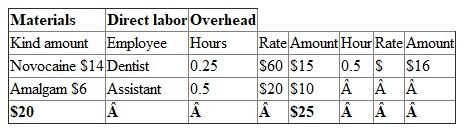 Cost summary:
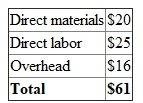 Gross profit computation:
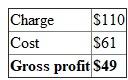 Assuming that X-ray is used in more than one treatment then, it is a common cost.
2.Cost for each filling and the gross profit for each type of filling is as below:
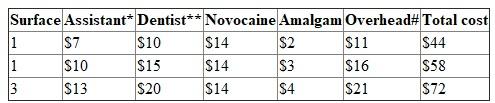 * ** #


 (the figures are rounded)
 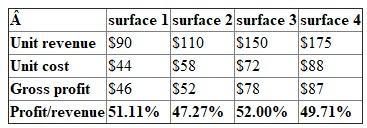 The gross profit increases with the increase in the surfaces. Whether this is fair or not depends on the return of the services.
Given:
Glen Johnson, a patient (job 267), spent 30 minutes in the treatment area and had two surface fillings.Given:
1.The job-order cost sheet for Glen Johnson is as follows: Cost summary: Gross profit computation: Assuming that X-ray is used in more than one treatment then, it is a common cost.2.Cost for each filling and the gross profit for each type of filling is as below:
* ** # (the figures are rounded) The gross profit increases with the increase in the surfaces. Whether this is fair or not depends on the return of the services. 4
Job Costs Using a Plantwide Overhead Rate
Naranjo Company designs industrial prototypes for outside companies. Budgeted overhead for the year was $260,000, and budgeted direct labor hours were 20,000. The average wage rate for direct labor is expected to be $25 per hour. During June, Naranjo Company worked on four jobs. Data relating to these four jobs follow:
Overhead is assigned as a percentage of direct labor cost. During June, Jobs 39 and 40 were completed; Job 39 was sold at 130 percent of cost. (Naranjo had originally developed Job 40 to order for a customer; however, that customer was near bankruptcy and the chance of Naranjo being paid was growing dimmer. Naranjo decided to hold Job 40 in inventory while the customer worked out its financial difficulties. Job 40 is the only job in Finished Goods Inventory.) Jobs 41 and 42 remain unfinished at the end of the month.
Required:
1. Calculate the overhead rate based on direct labor cost.
2. Set up a simple job-order cost sheet for all jobs in process during June.
3. What if the expected direct labor rate at the beginning of the year was $20 instead of $25? What would the overhead rate be? How would the cost of the jobs be affected?
Naranjo Company designs industrial prototypes for outside companies. Budgeted overhead for the year was $260,000, and budgeted direct labor hours were 20,000. The average wage rate for direct labor is expected to be $25 per hour. During June, Naranjo Company worked on four jobs. Data relating to these four jobs follow:
Overhead is assigned as a percentage of direct labor cost. During June, Jobs 39 and 40 were completed; Job 39 was sold at 130 percent of cost. (Naranjo had originally developed Job 40 to order for a customer; however, that customer was near bankruptcy and the chance of Naranjo being paid was growing dimmer. Naranjo decided to hold Job 40 in inventory while the customer worked out its financial difficulties. Job 40 is the only job in Finished Goods Inventory.) Jobs 41 and 42 remain unfinished at the end of the month.
Required:
1. Calculate the overhead rate based on direct labor cost.
2. Set up a simple job-order cost sheet for all jobs in process during June.
3. What if the expected direct labor rate at the beginning of the year was $20 instead of $25? What would the overhead rate be? How would the cost of the jobs be affected?
Unlock Deck
Unlock for access to all 50 flashcards in this deck.
Unlock Deck
k this deck
5
Why would some prefer normal activity to expected actual activity to compute a predetermined overhead rate?
Unlock Deck
Unlock for access to all 50 flashcards in this deck.
Unlock Deck
k this deck
6
Activity-Based Costing, Unit Cost, Ending Work-in-Process Inventory, Journal Entries
Feldspar Company uses an ABC system to apply overhead. There are three activity rates, shown on page 243.
During September, Feldspar worked on three jobs. Data relating to these jobs follow:
During September, Jobs 13-280 and 13-282 were completed and transferred to Finished Goods Inventory. Job 13-280 was sold by the end of the month. Job 13-281 was the only unfinished job at the end of the month.
Required:
1. Calculate the per-unit cost of Jobs 13-280 and 13-282. (Round unit cost to nearest cent.)
2. Compute the ending balance in the work-in-process inventory account.
3. Prepare the journal entries reflecting the completion of Jobs 13-280 and 13-282 and the sale of Job 13-280 on account. The selling price is 150 percent of cost.
Feldspar Company uses an ABC system to apply overhead. There are three activity rates, shown on page 243.
During September, Feldspar worked on three jobs. Data relating to these jobs follow:
During September, Jobs 13-280 and 13-282 were completed and transferred to Finished Goods Inventory. Job 13-280 was sold by the end of the month. Job 13-281 was the only unfinished job at the end of the month.
Required:
1. Calculate the per-unit cost of Jobs 13-280 and 13-282. (Round unit cost to nearest cent.)
2. Compute the ending balance in the work-in-process inventory account.
3. Prepare the journal entries reflecting the completion of Jobs 13-280 and 13-282 and the sale of Job 13-280 on account. The selling price is 150 percent of cost.
Unlock Deck
Unlock for access to all 50 flashcards in this deck.
Unlock Deck
k this deck
7
Case on Job-Order Costing and Pricing Decisions
Nutratask, Inc., is a pharmaceutical manufacturer of amino-acid-chelated minerals and vitamin supplements. The company was founded in 1974 and is capable of performing all manufacturing functions, including packaging and laboratory functions. Currently, the company markets its products in the United States, Canada, Australia, Japan, and Belgium.
Mineral chelation enhances the mineral's availability to the body, making the mineral a more effective supplement. Most of the chelates supplied by Nutratask are in powder form, but the company has the capability to make tablets or capsules.
The production of all chelates follows a similar pattern. Upon receiving an order, the company's chemist prepares a load sheet (a bill of materials that specifies the product, the theoretical yield, and the quantities of materials that should be used). Once the load sheet is received by production, the materials are requisitioned and sent to the blending room. The chemicals and minerals are added in the order specified and blended together for two to eight hours, depending on the product. After blending, the mix is put on long trays and sent to the drying room, where it is allowed to dry until the moisture content is 7 to 9 percent. Drying time for most products is from one to three days.
After the product is dry, several small samples are taken and sent to a laboratory to be checked for bacterial level and to determine whether the product meets customer specifications. If the product is not fit for human consumption or if it fails to meet customer specifications, additional materials are added under the direction of the chemist to bring the product up to standard. Once the product passes inspection, it is ground into a powder of different meshes (particle sizes) according to customer specifications. The powder is then placed in heavy cardboard drums and shipped to the customer (or, if requested, put in tablet or capsule form and then shipped).
Since each order is customized to meet the special needs of its customers, Nutratask uses a job-order costing system. Recently, Nutratask received a request for a 300-kilogram order of potassium aspartate. The customer offered to pay $8.80/kg. Upon receiving the request and the customer's specifications, Lanny Smith, the marketing manager, requested a load sheet from the company's chemist. The load sheet prepared showed the following material requirements:
The theoretical yield is 300 kg.
Lanny also reviewed past jobs that were similar to the requested order and discovered that the expected direct labor time was 16 hours. The production workers at Nutratask earn an average of $6.50 per hour plus $6 per hour for taxes, insurance, and additional benefits.
Purchasing sent Lanny a list of prices for the materials needed for the job.
Overhead is applied using a companywide rate based on direct labor dollars. The rate for the current period is 110 percent of direct labor dollars.
Whenever a customer requests a bid, Nutratask usually estimates the manufacturing costs of the job and then adds a markup of 30 percent. This markup varies depending on the competition and general economic conditions. Currently, the industry is thriving, and Nutratask is operating at capacity.
Required:
1. Prepare a job-order cost sheet for the proposed job. What is the expected per-unit cost? Should Nutratask accept the price offered by the prospective customer? Why or why not?
2. Suppose Nutratask and the prospective customer agree on a price of cost plus 30 percent. What is the gross profit that Nutratask expects to earn on the job?
3. Suppose that the actual costs of producing 300 kg of potassium aspartate were as follows:
What is the actual per-unit cost? The bid price is based on expected costs. How much did Nutratask gain (or lose) because of the actual costs differing from the expected costs? Suggest some possible reasons why the actual costs differed from the projected costs.
4. Assume that the customer had agreed to pay actual manufacturing costs plus 30 percent. Suppose the actual costs are as described in Requirement 3 with one addition: an underapplied overhead variance is allocated to Cost of Goods Sold and spread across all jobs sold in proportion to their total cost (unadjusted cost of goods sold). Assume that the underapplied overhead cost added to the job in question is $30. Upon seeing the addition of the underapplied overhead in the itemized bill, the customer calls and complains about having to pay for Nutratask's inefficient use of overhead costs. If you were assigned to deal with this customer, what kind of response would you prepare? How would you explain and justify the addition of the underapplied overhead cost to the customer's bill?
Nutratask, Inc., is a pharmaceutical manufacturer of amino-acid-chelated minerals and vitamin supplements. The company was founded in 1974 and is capable of performing all manufacturing functions, including packaging and laboratory functions. Currently, the company markets its products in the United States, Canada, Australia, Japan, and Belgium.
Mineral chelation enhances the mineral's availability to the body, making the mineral a more effective supplement. Most of the chelates supplied by Nutratask are in powder form, but the company has the capability to make tablets or capsules.
The production of all chelates follows a similar pattern. Upon receiving an order, the company's chemist prepares a load sheet (a bill of materials that specifies the product, the theoretical yield, and the quantities of materials that should be used). Once the load sheet is received by production, the materials are requisitioned and sent to the blending room. The chemicals and minerals are added in the order specified and blended together for two to eight hours, depending on the product. After blending, the mix is put on long trays and sent to the drying room, where it is allowed to dry until the moisture content is 7 to 9 percent. Drying time for most products is from one to three days.
After the product is dry, several small samples are taken and sent to a laboratory to be checked for bacterial level and to determine whether the product meets customer specifications. If the product is not fit for human consumption or if it fails to meet customer specifications, additional materials are added under the direction of the chemist to bring the product up to standard. Once the product passes inspection, it is ground into a powder of different meshes (particle sizes) according to customer specifications. The powder is then placed in heavy cardboard drums and shipped to the customer (or, if requested, put in tablet or capsule form and then shipped).
Since each order is customized to meet the special needs of its customers, Nutratask uses a job-order costing system. Recently, Nutratask received a request for a 300-kilogram order of potassium aspartate. The customer offered to pay $8.80/kg. Upon receiving the request and the customer's specifications, Lanny Smith, the marketing manager, requested a load sheet from the company's chemist. The load sheet prepared showed the following material requirements:
The theoretical yield is 300 kg.
Lanny also reviewed past jobs that were similar to the requested order and discovered that the expected direct labor time was 16 hours. The production workers at Nutratask earn an average of $6.50 per hour plus $6 per hour for taxes, insurance, and additional benefits.
Purchasing sent Lanny a list of prices for the materials needed for the job.
Overhead is applied using a companywide rate based on direct labor dollars. The rate for the current period is 110 percent of direct labor dollars.
Whenever a customer requests a bid, Nutratask usually estimates the manufacturing costs of the job and then adds a markup of 30 percent. This markup varies depending on the competition and general economic conditions. Currently, the industry is thriving, and Nutratask is operating at capacity.
Required:
1. Prepare a job-order cost sheet for the proposed job. What is the expected per-unit cost? Should Nutratask accept the price offered by the prospective customer? Why or why not?
2. Suppose Nutratask and the prospective customer agree on a price of cost plus 30 percent. What is the gross profit that Nutratask expects to earn on the job?
3. Suppose that the actual costs of producing 300 kg of potassium aspartate were as follows:
What is the actual per-unit cost? The bid price is based on expected costs. How much did Nutratask gain (or lose) because of the actual costs differing from the expected costs? Suggest some possible reasons why the actual costs differed from the projected costs.
4. Assume that the customer had agreed to pay actual manufacturing costs plus 30 percent. Suppose the actual costs are as described in Requirement 3 with one addition: an underapplied overhead variance is allocated to Cost of Goods Sold and spread across all jobs sold in proportion to their total cost (unadjusted cost of goods sold). Assume that the underapplied overhead cost added to the job in question is $30. Upon seeing the addition of the underapplied overhead in the itemized bill, the customer calls and complains about having to pay for Nutratask's inefficient use of overhead costs. If you were assigned to deal with this customer, what kind of response would you prepare? How would you explain and justify the addition of the underapplied overhead cost to the customer's bill?
Unlock Deck
Unlock for access to all 50 flashcards in this deck.
Unlock Deck
k this deck
8
What is cost measurement? Cost accumulation? What is the difference between the two?
Unlock Deck
Unlock for access to all 50 flashcards in this deck.
Unlock Deck
k this deck
9
Activity Levels Used to Compute Overhead Rates
Reggie Wilmore has just started a new business-building and installing custom garage organization systems. Reggie builds the cabinets and work benches in his workshop, then installs them in clients' garages. Reggie figures his overhead for the coming year will be $12,000. Since his business is labor intensive, he plans to use direct labor hours as his overhead driver. For the coming year, he expects to complete 100 jobs, averaging 25 direct labor hours each. However, he has the capacity to complete 125 jobs averaging 25 direct labor hours each.
Required:
1. Four measures of activity level were mentioned in the text. Which two measures is Reggie considering in computing a predetermined overhead rate?
2. Compute the predetermined overhead rates using each of the measures in your answer to Requirement 1.
3. Which one would you recommend that Reggie use? Why?
Reggie Wilmore has just started a new business-building and installing custom garage organization systems. Reggie builds the cabinets and work benches in his workshop, then installs them in clients' garages. Reggie figures his overhead for the coming year will be $12,000. Since his business is labor intensive, he plans to use direct labor hours as his overhead driver. For the coming year, he expects to complete 100 jobs, averaging 25 direct labor hours each. However, he has the capacity to complete 125 jobs averaging 25 direct labor hours each.
Required:
1. Four measures of activity level were mentioned in the text. Which two measures is Reggie considering in computing a predetermined overhead rate?
2. Compute the predetermined overhead rates using each of the measures in your answer to Requirement 1.
3. Which one would you recommend that Reggie use? Why?
Unlock Deck
Unlock for access to all 50 flashcards in this deck.
Unlock Deck
k this deck
10
Journal Entries, T-Accounts
Kapoor Company uses job-order costing. During January, the following data were reported:
a. Materials purchased on account: direct materials, $98,500; indirect materials, $14,800.
b. Materials issued: direct materials, $82,500; indirect materials, $8,800.
c. Labor cost incurred: direct labor, $67,000; indirect labor, $18,750.
d. Other manufacturing costs incurred (all payables), $46,200.
e. Overhead is applied on the basis of 110 percent of direct labor cost.
f. Work finished and transferred to Finished Goods Inventory cost $230,000.
g. Finished goods costing $215,000 were sold on account for 140 percent of cost.
h. Any over- or underapplied overhead is closed to Cost of Goods Sold.
Required:
1. Prepare journal entries to record these transactions.
2. Prepare a T-account for Overhead Control. Post all relevant information to this account. What is the ending balance in this account?
3. Prepare a T-account for Work-in-Process Inventory. Assume a beginning balance of $10,000, and post all relevant information to this account. Did you assign any actual overhead costs to Work-in-Process Inventory? Why or why not?
Kapoor Company uses job-order costing. During January, the following data were reported:
a. Materials purchased on account: direct materials, $98,500; indirect materials, $14,800.
b. Materials issued: direct materials, $82,500; indirect materials, $8,800.
c. Labor cost incurred: direct labor, $67,000; indirect labor, $18,750.
d. Other manufacturing costs incurred (all payables), $46,200.
e. Overhead is applied on the basis of 110 percent of direct labor cost.
f. Work finished and transferred to Finished Goods Inventory cost $230,000.
g. Finished goods costing $215,000 were sold on account for 140 percent of cost.
h. Any over- or underapplied overhead is closed to Cost of Goods Sold.
Required:
1. Prepare journal entries to record these transactions.
2. Prepare a T-account for Overhead Control. Post all relevant information to this account. What is the ending balance in this account?
3. Prepare a T-account for Work-in-Process Inventory. Assume a beginning balance of $10,000, and post all relevant information to this account. Did you assign any actual overhead costs to Work-in-Process Inventory? Why or why not?
Unlock Deck
Unlock for access to all 50 flashcards in this deck.
Unlock Deck
k this deck
11
Interview an accountant who works for a service organization that uses job-order costing. For a small firm, you may need to talk to an owner/manager. Examples are a funeral home, insurance firm, repair shop, medical clinic, and dental clinic. Write a paper that describes the job- order costing system used by the firm. Some of the questions that the paper should address are:
a. What service(s) does the firm offer?
b. What document or procedure do you use to collect the costs of the services performed for each customer?
c. How do you assign the cost of direct labor to each job?
d. How do you assign overhead to individual jobs?
e. How do you assign the cost of direct materials to each job?
f. How do you determine what to charge each customer?
g. How do you account for a completed job?
As you write the paper, state how the service firm you investigated adapted the job-order accounting procedures described in this chapter to its particular circumstances. Were the differences justified? If so, explain why. Also, offer any suggestions you might have for improving the approach that you observed.
a. What service(s) does the firm offer?
b. What document or procedure do you use to collect the costs of the services performed for each customer?
c. How do you assign the cost of direct labor to each job?
d. How do you assign overhead to individual jobs?
e. How do you assign the cost of direct materials to each job?
f. How do you determine what to charge each customer?
g. How do you account for a completed job?
As you write the paper, state how the service firm you investigated adapted the job-order accounting procedures described in this chapter to its particular circumstances. Were the differences justified? If so, explain why. Also, offer any suggestions you might have for improving the approach that you observed.
Unlock Deck
Unlock for access to all 50 flashcards in this deck.
Unlock Deck
k this deck
12
Job Costs Using a Plantwide Overhead Rate
Refer to Cornerstone Exercise 5.1 for data.
Required:
1. Calculate the balance in Work in Process as of June 30.
2. Calculate the balance in Finished Goods as of June 30.
3. Calculate the cost of goods sold for June.
4. Calculate the price charged for Job 39.
5. What if the customer for Job 40 was able to pay for the job by June 30? What would happen to the balance in Finished Goods? What would happen to the balance of Cost of Goods Sold?
Refer to Cornerstone Exercise 5.1 for data.
Required:
1. Calculate the balance in Work in Process as of June 30.
2. Calculate the balance in Finished Goods as of June 30.
3. Calculate the cost of goods sold for June.
4. Calculate the price charged for Job 39.
5. What if the customer for Job 40 was able to pay for the job by June 30? What would happen to the balance in Finished Goods? What would happen to the balance of Cost of Goods Sold?
Unlock Deck
Unlock for access to all 50 flashcards in this deck.
Unlock Deck
k this deck
13
When using normal costing, how are jobs charged with overhead?
Unlock Deck
Unlock for access to all 50 flashcards in this deck.
Unlock Deck
k this deck
14
Activity-Based Costing, Unit Cost, Ending Work-in-Process Inventory
Salazar Company is a job-order costing firm that uses activity-based costing to apply overhead to jobs. Salazar identified three overhead activities and related drivers. Budgeted information for the year is as follows:
Salazar worked on five jobs in March. Data are as follows:
By March 31, Jobs 15, 16, and 17 were completed and sold. The remaining jobs were in process.
Required:
1. Calculate the activity rates for each of the three overhead activities.
2. Prepare job-order cost sheets for each job showing all costs through March 31. What is the cost of each job by the end of March?
3. Calculate the balance in Work in Process on March 31.
4. Calculate the cost of goods sold for March.
Salazar Company is a job-order costing firm that uses activity-based costing to apply overhead to jobs. Salazar identified three overhead activities and related drivers. Budgeted information for the year is as follows:
Salazar worked on five jobs in March. Data are as follows:
By March 31, Jobs 15, 16, and 17 were completed and sold. The remaining jobs were in process.
Required:
1. Calculate the activity rates for each of the three overhead activities.
2. Prepare job-order cost sheets for each job showing all costs through March 31. What is the cost of each job by the end of March?
3. Calculate the balance in Work in Process on March 31.
4. Calculate the cost of goods sold for March.
Unlock Deck
Unlock for access to all 50 flashcards in this deck.
Unlock Deck
k this deck
15
Why is actual costing rarely used for product costing?
Unlock Deck
Unlock for access to all 50 flashcards in this deck.
Unlock Deck
k this deck
16
Source Documents, Job Cost Flows
Refer to Exercise 5.9.
Required:
1. What source documents will Reggie need to account for costs in his new business?
2. Suppose Reggie's business grows, and he expands his workshop and hires three additional carpenters to help him. What source documents will he need now?
Refer to Exercise 5.9.
Required:
1. What source documents will Reggie need to account for costs in his new business?
2. Suppose Reggie's business grows, and he expands his workshop and hires three additional carpenters to help him. What source documents will he need now?
Unlock Deck
Unlock for access to all 50 flashcards in this deck.
Unlock Deck
k this deck
17
Lorrimer Company has a job-order cost system. The following debits (credits) appeared in the Work-in-Process account for the month of June.
During the month of June, direct labor totaled $30,000 and $24,000 of overhead was applied to production. Finished Goods was debited $100,000 during June.
Lorrimer Company applies overhead at a predetermined rate of 80% of direct labor cost. Job number 83, the only job still in process at the end of June, has been charged with manufacturing overhead of $3,400. What was the amount of direct materials charged to Job number 83?
A) $3,400
B) $4,250
C) $8,350
D) $7,580
During the month of June, direct labor totaled $30,000 and $24,000 of overhead was applied to production. Finished Goods was debited $100,000 during June.
Lorrimer Company applies overhead at a predetermined rate of 80% of direct labor cost. Job number 83, the only job still in process at the end of June, has been charged with manufacturing overhead of $3,400. What was the amount of direct materials charged to Job number 83?
A) $3,400
B) $4,250
C) $8,350
D) $7,580
Unlock Deck
Unlock for access to all 50 flashcards in this deck.
Unlock Deck
k this deck
18
Job Costs Using Activity-Based Costing
Heitger Company is a job-order costing firm that uses activity-based costing to apply overhead to jobs. Heitger identified three overhead activities and related drivers. Budgeted information for the year is as follows:
Heitger worked on four jobs in July. Data are as follows:
By July 31, Jobs 13-43 and 13-44 were completed and sold. Jobs 13-45 and 13-46 were still in process.
Required:
1. Calculate the activity rates for each of the three overhead activities.
2. Prepare job-order cost sheets for each job showing all costs through July 31.
3. Calculate the balance in Work in Process on July 31.
4. Calculate the cost of goods sold for July.
5. What if Job 13-46 required no engineering change orders? What is the new cost of Job 13-46? How would the cost of the other jobs be affected?
Heitger Company is a job-order costing firm that uses activity-based costing to apply overhead to jobs. Heitger identified three overhead activities and related drivers. Budgeted information for the year is as follows:
Heitger worked on four jobs in July. Data are as follows:
By July 31, Jobs 13-43 and 13-44 were completed and sold. Jobs 13-45 and 13-46 were still in process.
Required:
1. Calculate the activity rates for each of the three overhead activities.
2. Prepare job-order cost sheets for each job showing all costs through July 31.
3. Calculate the balance in Work in Process on July 31.
4. Calculate the cost of goods sold for July.
5. What if Job 13-46 required no engineering change orders? What is the new cost of Job 13-46? How would the cost of the other jobs be affected?
Unlock Deck
Unlock for access to all 50 flashcards in this deck.
Unlock Deck
k this deck
19
Wilson Company has a predetermined overhead rate of $5 per direct labor hour. The job- order cost sheet for Job 145 shows 1,000 direct labor hours costing $10,000 and materials requisitions totaling $7,500. Job 145 had 500 units completed and transferred to Finished Goods Inventory. What is the cost per unit for Job 145?
Unlock Deck
Unlock for access to all 50 flashcards in this deck.
Unlock Deck
k this deck
20
(2009 CPA Exam)
Merry Co. has two major categories of factory overhead: materials handling and quality control. The costs expected for these categories for the coming year are as follows:
The plant currently applies overhead based on direct labor hours. The estimated direct labor hours are 80,000 per year. The plant manager is asked to submit a bid and assembles the following data on a proposed job.
What amount is the estimated product cost on the proposed job?
a. $8,000
b. $10,000
c. $14,000
d. $18,000
Merry Co. has two major categories of factory overhead: materials handling and quality control. The costs expected for these categories for the coming year are as follows:
The plant currently applies overhead based on direct labor hours. The estimated direct labor hours are 80,000 per year. The plant manager is asked to submit a bid and assembles the following data on a proposed job.
What amount is the estimated product cost on the proposed job?
a. $8,000
b. $10,000
c. $14,000
d. $18,000
Unlock Deck
Unlock for access to all 50 flashcards in this deck.
Unlock Deck
k this deck
21
Explain the differences between job-order costing and process costing.
Unlock Deck
Unlock for access to all 50 flashcards in this deck.
Unlock Deck
k this deck
22
Job Costs, Ending Work in Process
During March, Aragon Company worked on three jobs. Data relating to these three jobs follow:
Overhead is assigned on the basis of direct labor hours at a rate of $8.40 per direct labor hour. During March, Jobs 78 and 79 were completed and transferred to Finished Goods Inventory. Job 79 was sold by the end of the month. Job 80 was the only unfinished job at the end of the month.
Required:
1. Calculate the per-unit cost of Jobs 78 and 79.
2. Compute the ending balance in the work-in-process inventory account.
3. Prepare the journal entries reflecting the completion of Jobs 78 and 79 and the sale of Job 79. The selling price is 140 percent of cost.
During March, Aragon Company worked on three jobs. Data relating to these three jobs follow:
Overhead is assigned on the basis of direct labor hours at a rate of $8.40 per direct labor hour. During March, Jobs 78 and 79 were completed and transferred to Finished Goods Inventory. Job 79 was sold by the end of the month. Job 80 was the only unfinished job at the end of the month.
Required:
1. Calculate the per-unit cost of Jobs 78 and 79.
2. Compute the ending balance in the work-in-process inventory account.
3. Prepare the journal entries reflecting the completion of Jobs 78 and 79 and the sale of Job 79. The selling price is 140 percent of cost.
Unlock Deck
Unlock for access to all 50 flashcards in this deck.
Unlock Deck
k this deck
23
A CPA would recommend using plantwide overhead application rates under which of the following circumstances?
A) The client is a multi-product manufacturer with predominantly indirect costs.
B) The client produces products that heterogeneously consume resources.
C) The client produces multiple services that heterogeneously consume resources.
D) The client produces a single product.
A) The client is a multi-product manufacturer with predominantly indirect costs.
B) The client produces products that heterogeneously consume resources.
C) The client produces multiple services that heterogeneously consume resources.
D) The client produces a single product.
Unlock Deck
Unlock for access to all 50 flashcards in this deck.
Unlock Deck
k this deck
24
Cost of Normal Spoilage
Frieling Company installs granite countertops in customers' homes. First, the customer chooses the particular granite slab, and then Frieling measures the countertop area at the customer's home, cuts the granite to that shape, and installs it. The Tramel job calls for direct materials of $1,900 and direct labor of $500. Overhead is applied at the rate of 140 percent of direct labor cost. Unfortunately, one small countertop breaks during installation and Frieling must cut another piece and install it to properly complete the job. The additional rework required direct materials costing $400 and direct labor costing $100. Assume that the spoilage was due to carelessness by a Frieling worker and it is considered to be normal spoilage.
Required:
1. Calculate the cost of the Tramel job.
2. Make any needed journal entry to the overhead control account.
3. What if the additional rework required $200 of direct labor? What would be the effect on the cost of the Tramel job?
Frieling Company installs granite countertops in customers' homes. First, the customer chooses the particular granite slab, and then Frieling measures the countertop area at the customer's home, cuts the granite to that shape, and installs it. The Tramel job calls for direct materials of $1,900 and direct labor of $500. Overhead is applied at the rate of 140 percent of direct labor cost. Unfortunately, one small countertop breaks during installation and Frieling must cut another piece and install it to properly complete the job. The additional rework required direct materials costing $400 and direct labor costing $100. Assume that the spoilage was due to carelessness by a Frieling worker and it is considered to be normal spoilage.
Required:
1. Calculate the cost of the Tramel job.
2. Make any needed journal entry to the overhead control account.
3. What if the additional rework required $200 of direct labor? What would be the effect on the cost of the Tramel job?
Unlock Deck
Unlock for access to all 50 flashcards in this deck.
Unlock Deck
k this deck
25
Why are the accounting requirements for job-order costing more demanding than those for process costing?
Unlock Deck
Unlock for access to all 50 flashcards in this deck.
Unlock Deck
k this deck
26
Geneva, Inc., makes two products, X and Y, that require allocation of indirect manufacturing costs. The following data were compiled by the accountants before making any allocations:
The total cost of purchasing and receiving parts used in manufacturing is $60,000. The company uses a job-costing system with a single indirect cost rate. Under this system, allocated costs were $48,000 and $12,000 for X and Y, respectively. If an activity-based system is used, what would be the allocated costs for each product?
The total cost of purchasing and receiving parts used in manufacturing is $60,000. The company uses a job-costing system with a single indirect cost rate. Under this system, allocated costs were $48,000 and $12,000 for X and Y, respectively. If an activity-based system is used, what would be the allocated costs for each product?
Unlock Deck
Unlock for access to all 50 flashcards in this deck.
Unlock Deck
k this deck
27
What are some differences between a manual job-order costing system and an automated job-order costing system?
Unlock Deck
Unlock for access to all 50 flashcards in this deck.
Unlock Deck
k this deck
28
Predetermined Overhead Rate, Application of Overhead to Jobs, Job Cost
On April 1, Sangvikar Company had the following balances in its inventory accounts:
Work-in-process inventory is made up of three jobs with the following costs:
During April, Sangvikar experienced the transactions listed below.
a. Materials purchased on account, $29,000.
b. Materials requisitioned: Job 114, $16,500; Job 115, $12,200; and Job 116, $5,000.
c. Job tickets were collected and summarized: Job 114, 150 hours at $12 per hour; Job 115, 220 hours at $14 per hour; and Job 116, 80 hours at $18 per hour.
d. Overhead is applied on the basis of direct labor cost.
e. Actual overhead was $4,415.
f. Job 115 was completed and transferred to the finished goods warehouse.
g. Job 115 was shipped, and the customer was billed for 125 percent of the cost.
Required:
1. Calculate the predetermined overhead rate based on direct labor cost.
2. Calculate the ending balance for each job as of April 30.
3. Calculate the ending balance of Work in Process as of April 30.
4. Calculate the cost of goods sold for April.
5. Assuming that Sangvikar prices its jobs at cost plus 25 percent, calculate the price of the one job that was sold during April. (Round to the nearest dollar.)
On April 1, Sangvikar Company had the following balances in its inventory accounts:
Work-in-process inventory is made up of three jobs with the following costs:
During April, Sangvikar experienced the transactions listed below.
a. Materials purchased on account, $29,000.
b. Materials requisitioned: Job 114, $16,500; Job 115, $12,200; and Job 116, $5,000.
c. Job tickets were collected and summarized: Job 114, 150 hours at $12 per hour; Job 115, 220 hours at $14 per hour; and Job 116, 80 hours at $18 per hour.
d. Overhead is applied on the basis of direct labor cost.
e. Actual overhead was $4,415.
f. Job 115 was completed and transferred to the finished goods warehouse.
g. Job 115 was shipped, and the customer was billed for 125 percent of the cost.
Required:
1. Calculate the predetermined overhead rate based on direct labor cost.
2. Calculate the ending balance for each job as of April 30.
3. Calculate the ending balance of Work in Process as of April 30.
4. Calculate the cost of goods sold for April.
5. Assuming that Sangvikar prices its jobs at cost plus 25 percent, calculate the price of the one job that was sold during April. (Round to the nearest dollar.)
Unlock Deck
Unlock for access to all 50 flashcards in this deck.
Unlock Deck
k this deck
29
Which of the following structures refers to the collection of data for all jobs in a relational database?
A) Record
B) Field
C) File
D) Byte
A) Record
B) Field
C) File
D) Byte
Unlock Deck
Unlock for access to all 50 flashcards in this deck.
Unlock Deck
k this deck
30
Cost of Abnormal Spoilage
Refer to the data in Cornerstone Exercise 5.4. Now assume that the spoilage was due to the inherently fragile nature of the piece of stone picked out by the Tramels. Frieling had warned them that the chosen piece could require much more care and potentially additional work. As a result, Frieling considers this to be abnormal spoilage.
Required:
1. Calculate the cost of the Tramel job.
2. Make any needed journal entry to the overhead control account.
3. What if the additional rework required $200 of direct labor? What would be the effect on the cost of the Tramel job?
Refer to the data in Cornerstone Exercise 5.4. Now assume that the spoilage was due to the inherently fragile nature of the piece of stone picked out by the Tramels. Frieling had warned them that the chosen piece could require much more care and potentially additional work. As a result, Frieling considers this to be abnormal spoilage.
Required:
1. Calculate the cost of the Tramel job.
2. Make any needed journal entry to the overhead control account.
3. What if the additional rework required $200 of direct labor? What would be the effect on the cost of the Tramel job?
Unlock Deck
Unlock for access to all 50 flashcards in this deck.
Unlock Deck
k this deck
31
Explain the difference between normal cost of goods sold and adjusted cost of goods sold.
Unlock Deck
Unlock for access to all 50 flashcards in this deck.
Unlock Deck
k this deck
32
Journal Entries, T-Accounts, Cost of Goods Manufactured and Sold
During May, the following transactions were completed and reported by Jerico Company:
a. Materials purchased on account, $60,100.
b. Materials issued to production to fill job-order requisitions: direct materials, $50,000; indirect materials, $8,800.
c. Payroll for the month: direct labor, $75,000; indirect labor, $36,000; administrative, $28,000; sales, $19,000.
d. Depreciation on factory plant and equipment, $10,400.
e. Property taxes on the factory accrued during the month, $1,450.
f. Insurance on the factory expired with a credit to the prepaid insurance account, $6,200.
g. Factory utilities, $5,500.
h. Advertising paid with cash, $7,900.
i. Depreciation on office equipment, $800; on sales vehicles, $1,650.
j. Legal fees incurred but not yet paid for preparation of lease agreements, $750.
k. Overhead is charged to production at a rate of $18 per direct labor hour. Records show 4,000 direct labor hours were worked during the month.
l. Cost of jobs completed during the month, $160,000.
The company also reported the following beginning balances in its inventory accounts:
Required:
1. Prepare journal entries to record the transactions occurring in May.
2. Prepare T-accounts for Materials Inventory, Overhead Control, Work-in-Process Inventory, and Finished Goods Inventory. Post all relevant entries to these accounts.
3. Prepare a statement of cost of goods manufactured.
4. If the overhead variance is all allocated to cost of goods sold, by how much will cost of goods sold decrease or increase?
During May, the following transactions were completed and reported by Jerico Company:
a. Materials purchased on account, $60,100.
b. Materials issued to production to fill job-order requisitions: direct materials, $50,000; indirect materials, $8,800.
c. Payroll for the month: direct labor, $75,000; indirect labor, $36,000; administrative, $28,000; sales, $19,000.
d. Depreciation on factory plant and equipment, $10,400.
e. Property taxes on the factory accrued during the month, $1,450.
f. Insurance on the factory expired with a credit to the prepaid insurance account, $6,200.
g. Factory utilities, $5,500.
h. Advertising paid with cash, $7,900.
i. Depreciation on office equipment, $800; on sales vehicles, $1,650.
j. Legal fees incurred but not yet paid for preparation of lease agreements, $750.
k. Overhead is charged to production at a rate of $18 per direct labor hour. Records show 4,000 direct labor hours were worked during the month.
l. Cost of jobs completed during the month, $160,000.
The company also reported the following beginning balances in its inventory accounts:
Required:
1. Prepare journal entries to record the transactions occurring in May.
2. Prepare T-accounts for Materials Inventory, Overhead Control, Work-in-Process Inventory, and Finished Goods Inventory. Post all relevant entries to these accounts.
3. Prepare a statement of cost of goods manufactured.
4. If the overhead variance is all allocated to cost of goods sold, by how much will cost of goods sold decrease or increase?
Unlock Deck
Unlock for access to all 50 flashcards in this deck.
Unlock Deck
k this deck
33
What is the role of materials requisition forms in a job-order costing system? Time tickets? Predetermined overhead rates?
Unlock Deck
Unlock for access to all 50 flashcards in this deck.
Unlock Deck
k this deck
34
Job Cost Flows, Journal Entries
Refer to Exercise 5.12.
Required:
1. Prepare journal entries for the April transactions.
2. Calculate the ending balances of each of the inventory accounts as of April 30.
Refer to Exercise 5.12.
Required:
1. Prepare journal entries for the April transactions.
2. Calculate the ending balances of each of the inventory accounts as of April 30.
Unlock Deck
Unlock for access to all 50 flashcards in this deck.
Unlock Deck
k this deck
35
Overhead Application, Activity-Based Costing, Bid Prices
Firenza Company manufactures specialty tools to customer order. Budgeted overhead for the coming year is:
Previously, Sanjay Bhatt, Firenza Company's controller, had applied overhead on the basis of machine hours. Expected machine hours for the coming year are 50,000. Sanjay has been reading about activity-based costing, and he wonders whether or not it might offer some advantages to his company. He decided that appropriate drivers for overhead activities are purchase orders for purchasing, number of setups for setup cost, engineering hours for engineering cost, and machine hours for other. Budgeted amounts for these drivers are 5,000 purchase orders, 500 setups, and 2,500 engineering hours.
Sanjay has been asked to prepare bids for two jobs with the following information:
The typical bid price includes a 40 percent markup over full manufacturing cost.
Required:
1. Calculate a plantwide rate for Firenza Company based on machine hours. What is the bid price of each job using this rate?
2. Calculate activity rates for the four overhead activities. What is the bid price of each job using these rates?
3. Which bids are more accurate? Why?
Firenza Company manufactures specialty tools to customer order. Budgeted overhead for the coming year is:
Previously, Sanjay Bhatt, Firenza Company's controller, had applied overhead on the basis of machine hours. Expected machine hours for the coming year are 50,000. Sanjay has been reading about activity-based costing, and he wonders whether or not it might offer some advantages to his company. He decided that appropriate drivers for overhead activities are purchase orders for purchasing, number of setups for setup cost, engineering hours for engineering cost, and machine hours for other. Budgeted amounts for these drivers are 5,000 purchase orders, 500 setups, and 2,500 engineering hours.
Sanjay has been asked to prepare bids for two jobs with the following information:
The typical bid price includes a 40 percent markup over full manufacturing cost.
Required:
1. Calculate a plantwide rate for Firenza Company based on machine hours. What is the bid price of each job using this rate?
2. Calculate activity rates for the four overhead activities. What is the bid price of each job using these rates?
3. Which bids are more accurate? Why?
Unlock Deck
Unlock for access to all 50 flashcards in this deck.
Unlock Deck
k this deck
36
How do firms collect job-related information on driver usage in an activity-based costing system?
Unlock Deck
Unlock for access to all 50 flashcards in this deck.
Unlock Deck
k this deck
37
Amber Company produces custom framing. For one job, the trainee assigned to cut the mat set the mat dimensions incorrectly into the computer. The mat was unusable and had to be discarded; another mat was cut to the correct dimensions. How is the cost of the spoiled mat handled?
Unlock Deck
Unlock for access to all 50 flashcards in this deck.
Unlock Deck
k this deck
38
Plantwide Overhead Rate, Activity-Based Costing, Job Costs
Foto-Fast Copy Shop provides a variety of photocopying and printing services. On June 5, the owner invested in some computer-aided photography equipment that enables customers to reproduce a picture or illustration, input it digitally into the computer, enter text into the computer, and then print out a four-color professional quality brochure. Prior to the purchase of this equipment, Foto-Fast Copy Shop's overhead averaged $37,500 per year. After the installation of the new equipment, the total overhead increased to $90,000 per year. Foto-Fast Copy Shop has always costed jobs on the basis of actual materials and labor plus overhead assigned using a predetermined overhead rate based on direct labor hours. Budgeted direct labor hours for the year are 7,500, and the wage rate is $8 per hour.
Required:
1. What was the predetermined overhead rate prior to the purchase of the new equipment?
2. What was the predetermined overhead rate after the new equipment was purchased?
3. Suppose Rick Anselm brought in several items he wanted photocopied. The job required 600 sheets of paper at $0.02 each and 45 minutes of direct labor time. What would have been the cost of Rick's job on May 20? On June 20?
4. Suppose that the owner decides to calculate two overhead rates, one for the photocopying area based on direct labor hours as before, and one for the computer-aided printing area based on machine time. Estimated overhead applicable to the computer-aided printing area is $52,500, and forecasted usage of the machines is 2,000 hours. What are the two overhead rates? Which overhead rate system is better-one rate or two?
Foto-Fast Copy Shop provides a variety of photocopying and printing services. On June 5, the owner invested in some computer-aided photography equipment that enables customers to reproduce a picture or illustration, input it digitally into the computer, enter text into the computer, and then print out a four-color professional quality brochure. Prior to the purchase of this equipment, Foto-Fast Copy Shop's overhead averaged $37,500 per year. After the installation of the new equipment, the total overhead increased to $90,000 per year. Foto-Fast Copy Shop has always costed jobs on the basis of actual materials and labor plus overhead assigned using a predetermined overhead rate based on direct labor hours. Budgeted direct labor hours for the year are 7,500, and the wage rate is $8 per hour.
Required:
1. What was the predetermined overhead rate prior to the purchase of the new equipment?
2. What was the predetermined overhead rate after the new equipment was purchased?
3. Suppose Rick Anselm brought in several items he wanted photocopied. The job required 600 sheets of paper at $0.02 each and 45 minutes of direct labor time. What would have been the cost of Rick's job on May 20? On June 20?
4. Suppose that the owner decides to calculate two overhead rates, one for the photocopying area based on direct labor hours as before, and one for the computer-aided printing area based on machine time. Estimated overhead applicable to the computer-aided printing area is $52,500, and forecasted usage of the machines is 2,000 hours. What are the two overhead rates? Which overhead rate system is better-one rate or two?
Unlock Deck
Unlock for access to all 50 flashcards in this deck.
Unlock Deck
k this deck
39
Classifying Firms as Either Manufacturing or Service
Classify the following types of firms as either manufacturing or service. Explain the reasons for your choice in terms of the four features of service firms (heterogeneity, inseparability, intangibility, and perishability).
a. Bicycle production
b. Pharmaceuticals
c. Income tax preparation
d. Application of artificial nails
e. Glue production
f. Child care
Classify the following types of firms as either manufacturing or service. Explain the reasons for your choice in terms of the four features of service firms (heterogeneity, inseparability, intangibility, and perishability).
a. Bicycle production
b. Pharmaceuticals
c. Income tax preparation
d. Application of artificial nails
e. Glue production
f. Child care
Unlock Deck
Unlock for access to all 50 flashcards in this deck.
Unlock Deck
k this deck
40
Predetermined Overhead Rate, Application of Overhead to Jobs, Job Cost, Unit Cost
On August 1, Cairle Company's work-in-process inventory consisted of three jobs with the following costs:
During August, four more jobs were started. Information on costs added to the seven jobs during the month is as follows:
Before the end of August, Jobs 70, 72, 73, and 75 were completed. On August 31, Jobs 72 and 75 were sold.
Required:
1. Calculate the predetermined overhead rate based on direct labor cost.
2. Calculate the ending balance for each job as of August 31.
3. Calculate the ending balance of Work in Process as of August 31.
4. Calculate the cost of goods sold for August.
5. Assuming that Cairle prices its jobs at cost plus 20 percent, calculate Cairle's sales revenue for August.
On August 1, Cairle Company's work-in-process inventory consisted of three jobs with the following costs:
During August, four more jobs were started. Information on costs added to the seven jobs during the month is as follows:
Before the end of August, Jobs 70, 72, 73, and 75 were completed. On August 31, Jobs 72 and 75 were sold.
Required:
1. Calculate the predetermined overhead rate based on direct labor cost.
2. Calculate the ending balance for each job as of August 31.
3. Calculate the ending balance of Work in Process as of August 31.
4. Calculate the cost of goods sold for August.
5. Assuming that Cairle prices its jobs at cost plus 20 percent, calculate Cairle's sales revenue for August.
Unlock Deck
Unlock for access to all 50 flashcards in this deck.
Unlock Deck
k this deck
41
Plantwide Overhead Rate versus Departmental Rates, Effects on Pricing Decisions
Cherise Ortega, marketing manager for Romer Company, was puzzled by the outcome of two recent bids. The company's policy was to bid 150 percent of the full manufacturing cost. One job (labeled Job 97-28) had been turned down by a prospective customer, who had indicated that the proposed price was $3 per unit higher than the winning bid. A second job (Job 97-35) had been accepted by a customer, who was amazed that Romer could offer such favorable terms. This customer revealed that Romer's price was $43 per unit lower than the next lowest bid.
Cherise has been informed that the company was more than competitive in terms of cost control. Accordingly, she began to suspect that the problem was related to cost assignment procedures. Upon investigating, Cherise was told that the company uses a plantwide overhead rate based on direct labor hours. The rate is computed at the beginning of the year using budgeted data. Selected budgeted data are given below.
Cherise also discovered that the overhead costs in Department B were higher than those in Department A because B has more equipment, higher maintenance, higher power consumption, higher depreciation, and higher setup costs. In addition to the general procedures for assigning overhead costs, Cherise was supplied with the following specific manufacturing data on Jobs 97-28 and 97-35:
Required:
1. Using a plantwide overhead rate based on direct labor hours, develop the bid prices for Jobs 97-28 and 97-35 (express the bid prices on a per-unit basis).
2. Using departmental overhead rates (use direct labor hours for Department A and machine hours for Department B), develop per-unit bid prices for Jobs 97-28 and 97-35.
3. Compute the difference in gross profit that would have been earned had the company used departmental rates in its bids instead of the plantwide rate.
4. Explain why the use of departmental rates in this case provides a more accurate product cost.
Cherise Ortega, marketing manager for Romer Company, was puzzled by the outcome of two recent bids. The company's policy was to bid 150 percent of the full manufacturing cost. One job (labeled Job 97-28) had been turned down by a prospective customer, who had indicated that the proposed price was $3 per unit higher than the winning bid. A second job (Job 97-35) had been accepted by a customer, who was amazed that Romer could offer such favorable terms. This customer revealed that Romer's price was $43 per unit lower than the next lowest bid.
Cherise has been informed that the company was more than competitive in terms of cost control. Accordingly, she began to suspect that the problem was related to cost assignment procedures. Upon investigating, Cherise was told that the company uses a plantwide overhead rate based on direct labor hours. The rate is computed at the beginning of the year using budgeted data. Selected budgeted data are given below.
Cherise also discovered that the overhead costs in Department B were higher than those in Department A because B has more equipment, higher maintenance, higher power consumption, higher depreciation, and higher setup costs. In addition to the general procedures for assigning overhead costs, Cherise was supplied with the following specific manufacturing data on Jobs 97-28 and 97-35:
Required:
1. Using a plantwide overhead rate based on direct labor hours, develop the bid prices for Jobs 97-28 and 97-35 (express the bid prices on a per-unit basis).
2. Using departmental overhead rates (use direct labor hours for Department A and machine hours for Department B), develop per-unit bid prices for Jobs 97-28 and 97-35.
3. Compute the difference in gross profit that would have been earned had the company used departmental rates in its bids instead of the plantwide rate.
4. Explain why the use of departmental rates in this case provides a more accurate product cost.
Unlock Deck
Unlock for access to all 50 flashcards in this deck.
Unlock Deck
k this deck
42
Explain the role of activity drivers in assigning costs to products.
Unlock Deck
Unlock for access to all 50 flashcards in this deck.
Unlock Deck
k this deck
43
Amber Company produces custom framing. For one job, the dimensions of the picture were such that the computer-controlled mat cutting device could not be used. Amber warned the customer that this was a particularly difficult job, and her normal price would be increased to reflect its difficulty. Amber herself cut the mat by hand, but the cut was not as straight as she would have liked. So, she threw out the first mat and cut another one. How is the cost of spoiled mats handled?
Unlock Deck
Unlock for access to all 50 flashcards in this deck.
Unlock Deck
k this deck
44
Cost of Spoiled Units
Lieu Company is a specialty print shop. Usually, printing jobs are priced at standard cost plus 50 percent. Job 2013-631 involved printing 400 wedding invitations with the following standard costs:
Normally, the invitations would be taken from the machine, the top one inspected for correct wording, spelling, and quality of print, and all of the invitations wrapped in plastic and stored on shelves designated for completed jobs. In this case, however, the technician decided to go to lunch before inspecting and wrapping the job. He stacked the unwrapped invitations beside the printing press and left. One hour later, he returned and found the invitations had fallen on the floor and been stepped on. It turned out that about 50 invitations were ruined and had to be discarded. An additional 50 invitations were then printed to complete the job.
Required:
1. Calculate the cost of the spoiled invitations. How should the spoilage cost be accounted for?
2. What is the price of Job 2013-631?
3. Suppose that another job, 2013-705, also required 400 wedding invitations. The standard costs are identical to those of Job 2013-631. However, Job 2013-705 required an unusual color of ink that could only be obtained in a formula that was difficult to use. Lieu printers know from experience that getting this ink color to print correctly requires trial and error. In the case of Job 2013-705, the first 50 invitations had to be discarded due to inconsistencies in the color of ink. What is the cost of the spoilage, and how would it be treated?
4. What is the price of Job 2013-705?
Lieu Company is a specialty print shop. Usually, printing jobs are priced at standard cost plus 50 percent. Job 2013-631 involved printing 400 wedding invitations with the following standard costs:
Normally, the invitations would be taken from the machine, the top one inspected for correct wording, spelling, and quality of print, and all of the invitations wrapped in plastic and stored on shelves designated for completed jobs. In this case, however, the technician decided to go to lunch before inspecting and wrapping the job. He stacked the unwrapped invitations beside the printing press and left. One hour later, he returned and found the invitations had fallen on the floor and been stepped on. It turned out that about 50 invitations were ruined and had to be discarded. An additional 50 invitations were then printed to complete the job.
Required:
1. Calculate the cost of the spoiled invitations. How should the spoilage cost be accounted for?
2. What is the price of Job 2013-631?
3. Suppose that another job, 2013-705, also required 400 wedding invitations. The standard costs are identical to those of Job 2013-631. However, Job 2013-705 required an unusual color of ink that could only be obtained in a formula that was difficult to use. Lieu printers know from experience that getting this ink color to print correctly requires trial and error. In the case of Job 2013-705, the first 50 invitations had to be discarded due to inconsistencies in the color of ink. What is the cost of the spoilage, and how would it be treated?
4. What is the price of Job 2013-705?
Unlock Deck
Unlock for access to all 50 flashcards in this deck.
Unlock Deck
k this deck
45
Characteristics of Production Process, Cost Measurement
Vince Melders, of EcoScape Company, designs and installs custom lawn and garden irrigation systems for homes and businesses throughout the state. Each job is different, requiring different materials and labor for installing the systems. EcoScape estimated the following for the year:
During the year, the following actual amounts were experienced:
Required:
1. Should EcoScape use process costing or job-order costing? Explain.
2. If EcoScape uses a normal costing system and overhead is applied on the basis of direct labor hours, what is the average actual wage rate? What is the cost of an installation that takes $3,500 of direct materials and 20 direct labor hours?
3. Explain why EcoScape would have difficulty using an actual costing system.
Vince Melders, of EcoScape Company, designs and installs custom lawn and garden irrigation systems for homes and businesses throughout the state. Each job is different, requiring different materials and labor for installing the systems. EcoScape estimated the following for the year:
During the year, the following actual amounts were experienced:
Required:
1. Should EcoScape use process costing or job-order costing? Explain.
2. If EcoScape uses a normal costing system and overhead is applied on the basis of direct labor hours, what is the average actual wage rate? What is the cost of an installation that takes $3,500 of direct materials and 20 direct labor hours?
3. Explain why EcoScape would have difficulty using an actual costing system.
Unlock Deck
Unlock for access to all 50 flashcards in this deck.
Unlock Deck
k this deck
46
Income Statement
Refer to Exercise 5.14. Cairle's selling and administrative expenses for August were $1,200.
Required:
Prepare an income statement for Cairle Company for August.
Refer to Exercise 5.14. Cairle's selling and administrative expenses for August were $1,200.
Required:
Prepare an income statement for Cairle Company for August.
Unlock Deck
Unlock for access to all 50 flashcards in this deck.
Unlock Deck
k this deck
47
Cost of Reworked Units
Warren's Sporting Goods Store sells a variety of sporting goods and clothing. In a back room, Warren's has set up heat transfer equipment to personalize T-shirts for Little League teams. Typically, each team has the name of the individual player put on the back of the T-shirt. Last week, Shona Kohlmia, coach of the Terrors, brought in a list of names for her team. Her team consisted of 12 players with the following names: Mary Kate, Kayla, Katie, Tara, Heather, Emma, Kimberleigh, Jennifer, Dayna, Elizabeth, Kyle, and Wendy. Shona was quoted a price of $0.60 per letter.
Chip Russell, Warren's newest employee, took Shona's order and worked on the job. He selected the appropriate letters, arranged the letters in each name carefully on a shirt, and heat- pressed them on. When Shona returned, she was appalled to see that the names were on the front of the shirts. Jim Warren, owner of the sporting goods store, assured Shona that the letters could easily be removed by applying more heat and lifting them off. This process ruins the old letters, so new letters must then be placed correctly on the shirt backs. He promised to correct the job immediately and have it ready in an hour and a half.
Costs for heat transferring are as follows:
Shona's job originally took one hour and 12 minutes of direct labor time. The removal process goes more quickly and should take only 30 minutes.
Required:
1. What was the original cost of Shona's job?
2. What is the cost of rework on Shona's job? Assume that Chip failed to ask whether the names should be placed on the back or the front of the shirts. How should the rework cost be treated?
3. Now assume that Shona had mistakenly told Chip to put the names on the front of the shirts. In an effort to keep his customer happy, Jim suggested that Shona pay only for the new letters and the firm would pay for the labor cost. How much did Jim charge Shona in addition to the orginal price of the job?
Warren's Sporting Goods Store sells a variety of sporting goods and clothing. In a back room, Warren's has set up heat transfer equipment to personalize T-shirts for Little League teams. Typically, each team has the name of the individual player put on the back of the T-shirt. Last week, Shona Kohlmia, coach of the Terrors, brought in a list of names for her team. Her team consisted of 12 players with the following names: Mary Kate, Kayla, Katie, Tara, Heather, Emma, Kimberleigh, Jennifer, Dayna, Elizabeth, Kyle, and Wendy. Shona was quoted a price of $0.60 per letter.
Chip Russell, Warren's newest employee, took Shona's order and worked on the job. He selected the appropriate letters, arranged the letters in each name carefully on a shirt, and heat- pressed them on. When Shona returned, she was appalled to see that the names were on the front of the shirts. Jim Warren, owner of the sporting goods store, assured Shona that the letters could easily be removed by applying more heat and lifting them off. This process ruins the old letters, so new letters must then be placed correctly on the shirt backs. He promised to correct the job immediately and have it ready in an hour and a half.
Costs for heat transferring are as follows:
Shona's job originally took one hour and 12 minutes of direct labor time. The removal process goes more quickly and should take only 30 minutes.
Required:
1. What was the original cost of Shona's job?
2. What is the cost of rework on Shona's job? Assume that Chip failed to ask whether the names should be placed on the back or the front of the shirts. How should the rework cost be treated?
3. Now assume that Shona had mistakenly told Chip to put the names on the front of the shirts. In an effort to keep his customer happy, Jim suggested that Shona pay only for the new letters and the firm would pay for the labor cost. How much did Jim charge Shona in addition to the orginal price of the job?
Unlock Deck
Unlock for access to all 50 flashcards in this deck.
Unlock Deck
k this deck
48
Define the following terms: expected actual activity, normal activity, practical activity, and theoretical activity.
Unlock Deck
Unlock for access to all 50 flashcards in this deck.
Unlock Deck
k this deck
49
Journal Entries, T-Accounts
Ehrling Brothers Company makes jobs to customer order. During the month of July, the following occurred:
a. Materials were purchased on account for $45,670.
b. Materials totaling $40,990 were requisitioned for use in producing various jobs.
c. Direct labor payroll for the month was $22,400 with an average wage of $14 per hour.
d. Actual overhead of $9,020 was incurred and paid in cash.
e. Manufacturing overhead is charged to production at the rate of $5.50 per direct labor hour.
f. Completed jobs costing $58,000 were transferred to Finished Goods.
g. Jobs costing $59,000 were sold on account for $73,750.
Beginning balances as of July 1 were:
Required:
1. Prepare the journal entries for the preceding events.
2. Calculate the ending balances of:
a. Materials Inventory
b. Work-in-Process Inventory
c. Overhead Control
d. Finished Goods Inventory
Ehrling Brothers Company makes jobs to customer order. During the month of July, the following occurred:
a. Materials were purchased on account for $45,670.
b. Materials totaling $40,990 were requisitioned for use in producing various jobs.
c. Direct labor payroll for the month was $22,400 with an average wage of $14 per hour.
d. Actual overhead of $9,020 was incurred and paid in cash.
e. Manufacturing overhead is charged to production at the rate of $5.50 per direct labor hour.
f. Completed jobs costing $58,000 were transferred to Finished Goods.
g. Jobs costing $59,000 were sold on account for $73,750.
Beginning balances as of July 1 were:
Required:
1. Prepare the journal entries for the preceding events.
2. Calculate the ending balances of:
a. Materials Inventory
b. Work-in-Process Inventory
c. Overhead Control
d. Finished Goods Inventory
Unlock Deck
Unlock for access to all 50 flashcards in this deck.
Unlock Deck
k this deck
50
Job-Order Costing: Housing
Sutton Construction Inc. is a privately held, family-founded corporation that builds single- and multiple-unit housing. Most projects Sutton Construction undertakes involve the construction of multiple units. Sutton Construction has adopted a job-order costing system for determining the cost of each unit. The costing system is fully computerized. Each project's costs are divided into the following five categories:
1. General conditions, including construction site utilities, project insurance permits and licenses, architect's fees, decorating, field office salaries, and cleanup costs.
2. Hard costs, such as subcontractors, direct materials, and direct labor.
3. Finance costs, including title and recording fees, inspection fees, and taxes and discounts on mortgages.
4. Land costs, which refer to the purchase price of the construction site.
5. Marketing costs, such as advertising, sales commissions, and appraisal fees.
Recently, Sutton Construction purchased land for the purpose of developing 20 new singlefamily houses. The cost of the land was $250,000. Lot sizes vary from % to Y2 acre. The 20 lots occupy a total of eight acres.
General conditions costs for the project totaled $120,000. This $120,000 is common to all 20 units that were constructed on the building site.
Job 3, the third house built in the project, occupied a ¼-acre lot and had the following hard costs:
For Job 3, finance costs totaled $4,765 and marketing costs, $800. General conditions costs are allocated on the basis of units produced. Each unit's selling price is determined by adding 40 percent to the total of all costs.
Required:
1. Identify all production costs that are directly traceable to Job 3. Are all remaining production costs equivalent to overhead found in a manufacturing firm? Are there nonproduction costs that are directly traceable to the housing unit? Which ones?
2. Develop a job-order cost sheet for Job 3. What is the cost of building this house? Did you include finance and marketing costs in computing the unit cost? Why or why not? How did you determine the cost of land for Job 3?
3. Which of the five cost categories corresponds to overhead? Do you agree with the way in which this cost is allocated to individual housing units? Can you suggest a different allocation method?
4. Calculate the selling price of Job 3. Calculate the profit made on the sale of this unit.
Sutton Construction Inc. is a privately held, family-founded corporation that builds single- and multiple-unit housing. Most projects Sutton Construction undertakes involve the construction of multiple units. Sutton Construction has adopted a job-order costing system for determining the cost of each unit. The costing system is fully computerized. Each project's costs are divided into the following five categories:
1. General conditions, including construction site utilities, project insurance permits and licenses, architect's fees, decorating, field office salaries, and cleanup costs.
2. Hard costs, such as subcontractors, direct materials, and direct labor.
3. Finance costs, including title and recording fees, inspection fees, and taxes and discounts on mortgages.
4. Land costs, which refer to the purchase price of the construction site.
5. Marketing costs, such as advertising, sales commissions, and appraisal fees.
Recently, Sutton Construction purchased land for the purpose of developing 20 new singlefamily houses. The cost of the land was $250,000. Lot sizes vary from % to Y2 acre. The 20 lots occupy a total of eight acres.
General conditions costs for the project totaled $120,000. This $120,000 is common to all 20 units that were constructed on the building site.
Job 3, the third house built in the project, occupied a ¼-acre lot and had the following hard costs:
For Job 3, finance costs totaled $4,765 and marketing costs, $800. General conditions costs are allocated on the basis of units produced. Each unit's selling price is determined by adding 40 percent to the total of all costs.
Required:
1. Identify all production costs that are directly traceable to Job 3. Are all remaining production costs equivalent to overhead found in a manufacturing firm? Are there nonproduction costs that are directly traceable to the housing unit? Which ones?
2. Develop a job-order cost sheet for Job 3. What is the cost of building this house? Did you include finance and marketing costs in computing the unit cost? Why or why not? How did you determine the cost of land for Job 3?
3. Which of the five cost categories corresponds to overhead? Do you agree with the way in which this cost is allocated to individual housing units? Can you suggest a different allocation method?
4. Calculate the selling price of Job 3. Calculate the profit made on the sale of this unit.
Unlock Deck
Unlock for access to all 50 flashcards in this deck.
Unlock Deck
k this deck
Unlock Deck
Unlock for access to all 50 flashcards in this deck.







