





 Chat with AI

Deck 9: Molecular Biology
Full screen (f)

Question
Figure 9.10 You isolate a cell strain in which the joining together of Okazaki fragments is impaired and suspect that a mutation has occurred in an enzyme found at the replication fork. Which enzyme is most likely to be mutated? 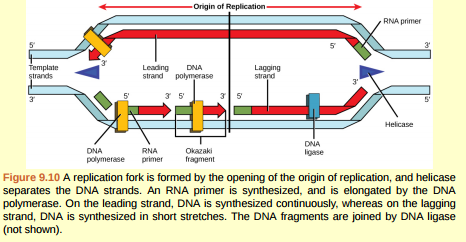

Question
Question
Question
Question
Question
Question
Question
Question
Question
Question
Question
Question
Question
Question
Question

Unlock Deck
Sign up to unlock the cards in this deck!
Unlock Deck
Unlock Deck
1/16

Play

Full screen (f)
Deck 9: Molecular Biology
1
Figure 9.10 You isolate a cell strain in which the joining together of Okazaki fragments is impaired and suspect that a mutation has occurred in an enzyme found at the replication fork. Which enzyme is most likely to be mutated?
The double helix structure of DNA (Deoxyribonucleic Acid) was proposed by Francis Crick and James Watson who said that DNA is composed of two strands which are twisted around each other and form a helix that is right-handed.
Replication of DNA is called the semi conservative method of replication as each strand of the double helix structure behaves as the template from which new DNA is made. Therefore, each new double strand or double helix consists of one new strand known as the daughter strand and one strand from the parent known as the parental strand.
The process of replication of DNA occurs in three main steps as follows:
i. DNA gets unwound at the origin of replication, forming a replication fork.
ii. DNA polymerase adds new bases to each of the parental strands which are complementary to one another. As DNA polymerase can only synthesize DNA in the 5' to 3' direction, therefore one strand is the leading strand where continuous DNA synthesis occurs while the other is the lagging strand where short pieces known as Okazaki fragments are formed in a discontinuous fashion.
iii. The Okazaki fragments use primers made of RNA to continue synthesis. The RNA primers are replaced with DNA nucleotides and gaps sealed by DNA ligase.
In a situation where the joining together of Okazaki fragments is impaired, a mutation in the enzyme DNA ligase is the most likely as this enzyme is responsible for the joining together of the Okazaki fragments in the lagging strand of DNA.
Replication of DNA is called the semi conservative method of replication as each strand of the double helix structure behaves as the template from which new DNA is made. Therefore, each new double strand or double helix consists of one new strand known as the daughter strand and one strand from the parent known as the parental strand.
The process of replication of DNA occurs in three main steps as follows:
i. DNA gets unwound at the origin of replication, forming a replication fork.
ii. DNA polymerase adds new bases to each of the parental strands which are complementary to one another. As DNA polymerase can only synthesize DNA in the 5' to 3' direction, therefore one strand is the leading strand where continuous DNA synthesis occurs while the other is the lagging strand where short pieces known as Okazaki fragments are formed in a discontinuous fashion.
iii. The Okazaki fragments use primers made of RNA to continue synthesis. The RNA primers are replaced with DNA nucleotides and gaps sealed by DNA ligase.
In a situation where the joining together of Okazaki fragments is impaired, a mutation in the enzyme DNA ligase is the most likely as this enzyme is responsible for the joining together of the Okazaki fragments in the lagging strand of DNA.
2
Which of the following does cytosine pair with?
A) guanine
B) thymine
C) adenine
D) a pyrimidine
A) guanine
B) thymine
C) adenine
D) a pyrimidine
The double helix structure of DNA (Deoxyribonucleic Acid) was proposed by Francis Crick and James Watson who said that DNA is composed of two strands which are twisted around each other and form a helix that is right-handed.
Adenine and guanine are purines which are double-ringed structures whereas cytosine and thymine are pyrimidines which are smaller and single-ringed structures. Base pairing occurs between purines and pyrimidines. Adenine pairs with thymine whereas guanine pairs with cytosine.
Cytosine being a pyrimidine cannot pair with thymine and a pyrimidine. Also, adenine and cytosine do not pair with each other due to Chargaff's Rule.
Hence, the options b., c. and d. are incorrect.
According to Chargaff's rule, in a molecule of DNA there is as much thymine as adenine and as much cytosine as guanine. Therefore, cytosine will pair with only guanine, according to this rule.
Hence, the correct answer is option
Adenine and guanine are purines which are double-ringed structures whereas cytosine and thymine are pyrimidines which are smaller and single-ringed structures. Base pairing occurs between purines and pyrimidines. Adenine pairs with thymine whereas guanine pairs with cytosine.
Cytosine being a pyrimidine cannot pair with thymine and a pyrimidine. Also, adenine and cytosine do not pair with each other due to Chargaff's Rule.
Hence, the options b., c. and d. are incorrect.
According to Chargaff's rule, in a molecule of DNA there is as much thymine as adenine and as much cytosine as guanine. Therefore, cytosine will pair with only guanine, according to this rule.
Hence, the correct answer is option
3
Prokaryotes contain a ________chromosome, and eukaryotes contain ________ chromosomes.
A) single-stranded circular; single-stranded linear
B) single-stranded linear; single-stranded circular
C) double-stranded circular; doublestranded linear
D) double-stranded linear; double-stranded circular
A) single-stranded circular; single-stranded linear
B) single-stranded linear; single-stranded circular
C) double-stranded circular; doublestranded linear
D) double-stranded linear; double-stranded circular
Chromosomes are organized and packaged structures which contain the DNA (Deoxyribonucleic Acid) of living organisms.
Prokaryotes have plasmids to store the DNA as they do not have a well-defined nucleus. These chromosomes are circular in shape and are double stranded.
Therefore, prokaryotes do not have single-stranded circular or linear and double stranded linear chromosomes.
Hence, the options a., b. and d. are incorrect.
Prokaryotes have their chromosome in a double-stranded and circular form which is found in the nucleoid which is an area of the cytoplasm. The chromosomes of eukaryotes on the other hand are double-stranded and linear which are wound around each other to form the DNA. The DNA of eukaryotes is wrapped around histones in order to form nucleosomes.
Hence, the correct answer is option
Prokaryotes have plasmids to store the DNA as they do not have a well-defined nucleus. These chromosomes are circular in shape and are double stranded.
Therefore, prokaryotes do not have single-stranded circular or linear and double stranded linear chromosomes.
Hence, the options a., b. and d. are incorrect.
Prokaryotes have their chromosome in a double-stranded and circular form which is found in the nucleoid which is an area of the cytoplasm. The chromosomes of eukaryotes on the other hand are double-stranded and linear which are wound around each other to form the DNA. The DNA of eukaryotes is wrapped around histones in order to form nucleosomes.
Hence, the correct answer is option
4
DNA replicates by which of the following models?
A) conservative
B) semiconservative
C) dispersive
D) none of the above
A) conservative
B) semiconservative
C) dispersive
D) none of the above
Unlock Deck
Unlock for access to all 16 flashcards in this deck.
Unlock Deck
k this deck
5
The initial mechanism for repairing nucleotide errors in DNA is ________.
A) mismatch repair
B) DNA polymerase proofreading
C) nucleotide excision repair
D) thymine dimers
A) mismatch repair
B) DNA polymerase proofreading
C) nucleotide excision repair
D) thymine dimers
Unlock Deck
Unlock for access to all 16 flashcards in this deck.
Unlock Deck
k this deck
6
A promoter is ________.
A) a specific sequence of DNA nucleotides
B) a specific sequence of RNA nucleotides
C) a protein that binds to DNA
D) an enzyme that synthesizes RNA
A) a specific sequence of DNA nucleotides
B) a specific sequence of RNA nucleotides
C) a protein that binds to DNA
D) an enzyme that synthesizes RNA
Unlock Deck
Unlock for access to all 16 flashcards in this deck.
Unlock Deck
k this deck
7
Portions of eukaryotic mRNA sequence that are removed during RNA processing are ________.
A) exons
B) caps
C) poly-A tails
D) introns
A) exons
B) caps
C) poly-A tails
D) introns
Unlock Deck
Unlock for access to all 16 flashcards in this deck.
Unlock Deck
k this deck
8
The RNA components of ribosomes are synthesized in the ________.
A) cytoplasm
B) nucleus
C) nucleolus
D) endoplasmic reticulum
A) cytoplasm
B) nucleus
C) nucleolus
D) endoplasmic reticulum
Unlock Deck
Unlock for access to all 16 flashcards in this deck.
Unlock Deck
k this deck
9
How long would the peptide be that is translated from this MRNA sequence: 5'- AUGGGCUACCGA-3'?
A) 0
B) 2
C) 3
D) 4
A) 0
B) 2
C) 3
D) 4
Unlock Deck
Unlock for access to all 16 flashcards in this deck.
Unlock Deck
k this deck
10
Control of gene expression in eukaryotic cells occurs at which level(s)?
A) only the transcriptional level
B) epigenetic and transcriptional levels
C) epigenetic, transcriptional, and translational levels
D) epigenetic, transcriptional, posttranscriptional, translational, and posttranslational levels
A) only the transcriptional level
B) epigenetic and transcriptional levels
C) epigenetic, transcriptional, and translational levels
D) epigenetic, transcriptional, posttranscriptional, translational, and posttranslational levels
Unlock Deck
Unlock for access to all 16 flashcards in this deck.
Unlock Deck
k this deck
11
Post-translational control refers to:
A) regulation of gene expression after transcription
B) regulation of gene expression after translation
C) control of epigenetic activation
D) period between transcription and translation
A) regulation of gene expression after transcription
B) regulation of gene expression after translation
C) control of epigenetic activation
D) period between transcription and translation
Unlock Deck
Unlock for access to all 16 flashcards in this deck.
Unlock Deck
k this deck
12
Describe the organization of the eukaryotic chromosome
Unlock Deck
Unlock for access to all 16 flashcards in this deck.
Unlock Deck
k this deck
13
Describe the structure and complementary base pairing of DNA.
Unlock Deck
Unlock for access to all 16 flashcards in this deck.
Unlock Deck
k this deck
14
How do the linear chromosomes in eukaryotes ensure that its ends are replicated completely?
Unlock Deck
Unlock for access to all 16 flashcards in this deck.
Unlock Deck
k this deck
15
Transcribe and translate the following DNA sequence (nontemplate strand): 5'- ATGGCCGGTTATTAAGCA-3'.
Unlock Deck
Unlock for access to all 16 flashcards in this deck.
Unlock Deck
k this deck
16
Describe how controlling gene expression will alter the overall protein levels in the cell.
Unlock Deck
Unlock for access to all 16 flashcards in this deck.
Unlock Deck
k this deck
Unlock Deck
Unlock for access to all 16 flashcards in this deck.







