





 Chat with AI

Deck 20: Recombinant Dna Technology
Full screen (f)

Question

Question
Question
Question
Question
Question
Question
Question
Question
Using DNA sequencing on a cloned DNA segment, you recover the nucleotide sequence shown below. Does this segment contain a palindromic recognition sequence for a restriction enzyme? If so, what is the double-stranded sequence of the palindrome, and what enzyme would cut at this sequence? (Consult Figure for a list of restriction sites.)CAGTATGGATCCCAT
Figure Common restriction enzymes, with their recognition sequence, DNA cutting patterns, and sources. Arrows indicate the location in the DNA cut by each enzyme.
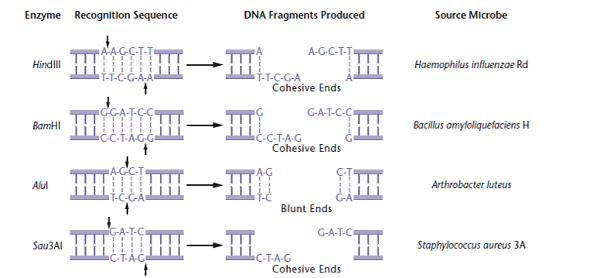
Figure Common restriction enzymes, with their recognition sequence, DNA cutting patterns, and sources. Arrows indicate the location in the DNA cut by each enzyme.
Question
Question
Question
Question
Question
Question
Question
Question
Question
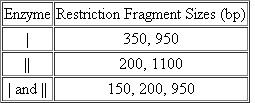
You have recovered a cloned DNA segment from a vector and determine that the insert is 1300 bp in length. To characterize this cloned segment, you isolate the insert and decide to construct a restriction map. Using enzyme I and enzyme II, followed by gel electrophoresis, you determine the number and size of the fragments produced by enzymes I and II alone and in combination, as recorded in the following table. Construct a restriction map from these data, showing the positions of the restriction-enzyme cutting sites relative to one another and the distance between them in units of base pairs.
Question
Question
Although the capture and trading of great apes has been banned in 112 countries since 1973, it is estimated that about 1000 chimpanzees are removed annually from Africa and smuggled into Europe, the United States, and Japan. This illegal trade is often disguised by simulating births in captivity. Until recently, genetic identity tests to uncover these illegal activities were not used because of the lack of highly polymorphic markers (markers that vary from one individual to the next) and the difficulties of obtaining chimpanzee blood samples. A study was reported in which DNA samples were extracted from freshly plucked chimpanzee hair roots and used as templates for PCR. The primers used in these studies flank highly polymorphic sites in human DNA that result from variable numbers of tandem nucleotide repeats. Several offspring and their putative parents were tested to determine whether the offspring were "legitimate" or the product of illegal trading. The data are shown in the following Southern blot.
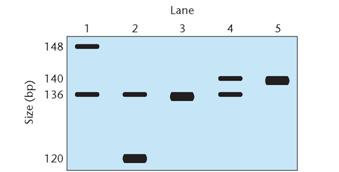
Lane 1: father chimpanzee
Lane 2: mother chimpanzee
Lanes 3-5: putative offspring A, B, C
Examine the data carefully and choose the best conclusion.
(a) None of the offspring is legitimate.
(b) Offspring B and C are not the products of these parents and were probably purchased on the illegal market. The data are consistent with offspring A being legitimate.
(c) Offspring A and B are products of the parents shown, but C is not and was therefore probably purchased on the illegal market.
(d) There are not enough data to draw any conclusions. Additional polymorphic sites should be examined.
(e) No conclusion can be drawn because "human" primers were used.
Lane 1: father chimpanzee
Lane 2: mother chimpanzee
Lanes 3-5: putative offspring A, B, C
Examine the data carefully and choose the best conclusion.
(a) None of the offspring is legitimate.
(b) Offspring B and C are not the products of these parents and were probably purchased on the illegal market. The data are consistent with offspring A being legitimate.
(c) Offspring A and B are products of the parents shown, but C is not and was therefore probably purchased on the illegal market.
(d) There are not enough data to draw any conclusions. Additional polymorphic sites should be examined.
(e) No conclusion can be drawn because "human" primers were used.
Question
Question
Question
Question
Question
Question
Question
Question
Question
Question
Question
Question
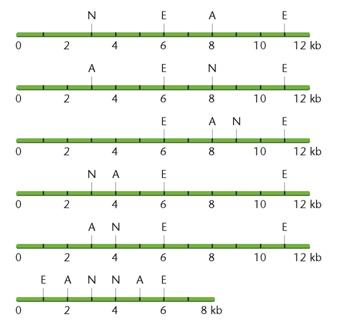
The gel presented here shows the pattern of bands of fragments produced with several restriction enzymes. The enzymes used are identified above and below the gel and six possible restriction maps are shown in the column to the right.
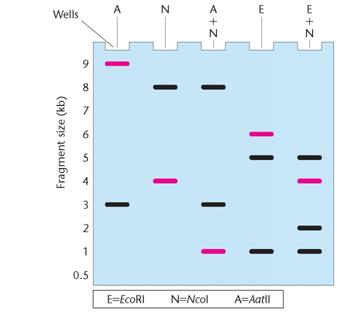
One of the six restriction maps shown is consistent with the pattern of bands shown in the gel.
(a) From your analysis of the pattern of bands on the gel, select the correct map and explain your reasoning.
(b) In a Southern blot prepared from this gel, the highlighted bands (pink) hybridized with the gene pep. Where is the pep gene located?
One of the six restriction maps shown is consistent with the pattern of bands shown in the gel.
(a) From your analysis of the pattern of bands on the gel, select the correct map and explain your reasoning.
(b) In a Southern blot prepared from this gel, the highlighted bands (pink) hybridized with the gene pep. Where is the pep gene located?
Question
A widely used method for calculating the annealing temperature for a primer used in PCR is 5 degrees below the T m (°C), which is computed by the equation 81.5 + 0.41 × (%GC) - (675/ N ), where %GC is the percentage of GC nucleotides in the oligonucleotide and N is the length of the oligonucleotide. Notice from the formula that both the GC content and the length of the oligonucleotide are variables. Assuming you have the following oligonucleotide as a primer, compute the annealing temperature for PCR. What is the relationship between T m (°C) and %GC? Why? ( Note : In reality, this computation provides only a starting point for empirical determination of the most useful annealing temperature.)5?-TTGAAAATATTTCCCATTGCC-3?
Question
Most of the techniques described in this chapter (blotting, cloning, PCR, etc.) are dependent on intermolecular attractions (annealing) between different populations of nucleic acids. Length of the strands, temperature, and percentage of GC nucleotides weigh considerably on intermolecular associations. Two other components commonly used in hybridization protocols are monovalent ions and formamide. A formula that takes monovalent ion (Na + ) and formamide concentrations into consideration to compute a T m (temperature of melting) is as follows:
▪m = 81.5 + 16.6(log M[Na + ]) + 0.41(%GC) - 0.72(%formamide)(a) For the following concentrations of Na + and formamide, calculate the T m. Assume 45% GC content.
![Most of the techniques described in this chapter (blotting, cloning, PCR, etc.) are dependent on intermolecular attractions (annealing) between different populations of nucleic acids. Length of the strands, temperature, and percentage of GC nucleotides weigh considerably on intermolecular associations. Two other components commonly used in hybridization protocols are monovalent ions and formamide. A formula that takes monovalent ion (Na + ) and formamide concentrations into consideration to compute a T m (temperature of melting) is as follows: ▪m = 81.5 + 16.6(log M[Na + ]) + 0.41(%GC) - 0.72(%formamide)(a) For the following concentrations of Na + and formamide, calculate the T m. Assume 45% GC content. (b) Given that formamide competes for hydrogen bond locations of nucleic acid bases and monovalent cations are attracted to the negative charges of nucleic acids, explain why the T m varies as described in part (a).<div style=padding-top: 35px>](https://d2lvgg3v3hfg70.cloudfront.net/SM1220/11eb563d_4e4d_b08e_a8c8_a34db556a8b2_SM1220_00.jpg) (b) Given that formamide competes for hydrogen bond locations of nucleic acid bases and monovalent cations are attracted to the negative charges of nucleic acids, explain why the T m varies as described in part (a).
(b) Given that formamide competes for hydrogen bond locations of nucleic acid bases and monovalent cations are attracted to the negative charges of nucleic acids, explain why the T m varies as described in part (a).
▪m = 81.5 + 16.6(log M[Na + ]) + 0.41(%GC) - 0.72(%formamide)(a) For the following concentrations of Na + and formamide, calculate the T m. Assume 45% GC content.
(b) Given that formamide competes for hydrogen bond locations of nucleic acid bases and monovalent cations are attracted to the negative charges of nucleic acids, explain why the T m varies as described in part (a). Question
Question
Question
There are a variety of circumstances under which rapid results using multiple markers in PCR amplifications are highly desired, such as in forensics, pathogen analysis, or detection of genetically modified organisms. In multiplex PCR, multiple sets of primers are used, often with less success than when applied to PCR as individual sets. Numerous studies have been conducted to optimize procedures, but each has described the process as time consuming and often unsuccessful. Considering the information given in Problem, why should multiplex PCR be any different than single primer set PCR in terms of dependability and ease of optimization?
Most of the techniques described in this chapter (blotting, cloning, PCR, etc.) are dependent on intermolecular attractions (annealing) between different populations of nucleic acids. Length of the strands, temperature, and percentage of GC nucleotides weigh considerably on intermolecular associations. Two other components commonly used in hybridization protocols are monovalent ions and formamide. A formula that takes monovalent ion (Na + ) and formamide concentrations into consideration to compute a T m (temperature of melting) is as follows:
▪m = 81.5 + 16.6(log M[Na + ]) + 0.41(%GC) - 0.72(%formamide)(a) For the following concentrations of Na + and formamide, calculate the T m. Assume 45% GC content.
![There are a variety of circumstances under which rapid results using multiple markers in PCR amplifications are highly desired, such as in forensics, pathogen analysis, or detection of genetically modified organisms. In multiplex PCR, multiple sets of primers are used, often with less success than when applied to PCR as individual sets. Numerous studies have been conducted to optimize procedures, but each has described the process as time consuming and often unsuccessful. Considering the information given in Problem, why should multiplex PCR be any different than single primer set PCR in terms of dependability and ease of optimization? Most of the techniques described in this chapter (blotting, cloning, PCR, etc.) are dependent on intermolecular attractions (annealing) between different populations of nucleic acids. Length of the strands, temperature, and percentage of GC nucleotides weigh considerably on intermolecular associations. Two other components commonly used in hybridization protocols are monovalent ions and formamide. A formula that takes monovalent ion (Na + ) and formamide concentrations into consideration to compute a T m (temperature of melting) is as follows: ▪m = 81.5 + 16.6(log M[Na + ]) + 0.41(%GC) - 0.72(%formamide)(a) For the following concentrations of Na + and formamide, calculate the T m. Assume 45% GC content. (b) Given that formamide competes for hydrogen bond locations of nucleic acid bases and monovalent cations are attracted to the negative charges of nucleic acids, explain why the T m varies as described in part (a).<div style=padding-top: 35px>](https://d2lvgg3v3hfg70.cloudfront.net/SM1220/11eb563d_4e4f_8555_a8c8_d99a8e64e285_SM1220_00.jpg) (b) Given that formamide competes for hydrogen bond locations of nucleic acid bases and monovalent cations are attracted to the negative charges of nucleic acids, explain why the T m varies as described in part (a).
(b) Given that formamide competes for hydrogen bond locations of nucleic acid bases and monovalent cations are attracted to the negative charges of nucleic acids, explain why the T m varies as described in part (a).
Most of the techniques described in this chapter (blotting, cloning, PCR, etc.) are dependent on intermolecular attractions (annealing) between different populations of nucleic acids. Length of the strands, temperature, and percentage of GC nucleotides weigh considerably on intermolecular associations. Two other components commonly used in hybridization protocols are monovalent ions and formamide. A formula that takes monovalent ion (Na + ) and formamide concentrations into consideration to compute a T m (temperature of melting) is as follows:
▪m = 81.5 + 16.6(log M[Na + ]) + 0.41(%GC) - 0.72(%formamide)(a) For the following concentrations of Na + and formamide, calculate the T m. Assume 45% GC content.
(b) Given that formamide competes for hydrogen bond locations of nucleic acid bases and monovalent cations are attracted to the negative charges of nucleic acids, explain why the T m varies as described in part (a).
Unlock Deck
Sign up to unlock the cards in this deck!
Unlock Deck
Unlock Deck
1/37

Play

Full screen (f)
Deck 20: Recombinant Dna Technology
1
Early in the 1970s, when recombinant DNA research was first developed, scientists realized that there may be unforeseen dangers, and after a self-imposed moratorium on all such research, they developed and implemented a detailed set of safety protocols for the construction, storage, and use of genetically modified organisms. These guidelines then formed the basis of regulations adopted by the federal government. Over time, safer methods were developed, and these stringent guidelines were gradually relaxed or, in many cases, eliminated altogether. Now, however, the specter of bioterrorism has refocused attention on the potential misuses of recombinant DNA technology. For example, individuals or small groups might use the information in genome databases coupled with recombinant DNA technology to construct or reconstruct agents of disease, such as the smallpox virus or the deadly influenza virus.
Do you think that the question of recombinant DNA research regulation by university and corporations should be revisited to monitor possible bioterrorist activity?
Do you think that the question of recombinant DNA research regulation by university and corporations should be revisited to monitor possible bioterrorist activity?
Since the atrocities of September 11 th , 2001, the question of recombinant deoxyribonucleic acid (DNA) research regulation and bioterrorist activity has been thrust back into the spotlight. It presents an interesting challenge because overregulation limits scientific advancement, while limited regulation increases the risk of bioterrorism.
The USA Patriot Act, passed in 2001, is a prime example of increased regulation of recombinant DNA research and access to harmful biological agents. This act increases law enforcement's capabilities to monitor and investigate potential abuse of biological agents. However, it also poses increased restrictions on recombinant DNA research at universities which could inhibit potential breakthroughs or vaccine development.
Publication of research results must also be carefully monitored. Research publications are vital to universities and corporations for spreading ideas and building partnerships to advance biomedical science. However, free publications in the wrong hands poses a national security risk.
Although recombinant DNA research regulation has been revisited since September 11 th , 2001, regulations should not be static, but constantly evolving to provide a balance between security and scientific advancement.
The USA Patriot Act, passed in 2001, is a prime example of increased regulation of recombinant DNA research and access to harmful biological agents. This act increases law enforcement's capabilities to monitor and investigate potential abuse of biological agents. However, it also poses increased restrictions on recombinant DNA research at universities which could inhibit potential breakthroughs or vaccine development.
Publication of research results must also be carefully monitored. Research publications are vital to universities and corporations for spreading ideas and building partnerships to advance biomedical science. However, free publications in the wrong hands poses a national security risk.
Although recombinant DNA research regulation has been revisited since September 11 th , 2001, regulations should not be static, but constantly evolving to provide a balance between security and scientific advancement.
2
In this chapter we focused on how specific DNA sequences can be copied, identified, characterized, and sequenced. At the same time, we found many opportunities to consider the methods and reasoning underlying these techniques. From the explanations given in the chapter, what answers would you propose to the following fundamental questions?
(a) In a recombinant DNA cloning experiment, how can we determine whether DNA fragments of interest have been incorporated into plasmids and, once host cells are transformed, which cells contain recombinant DNA?
(b) When using DNA libraries to clone genes, what combination of techniques are used to identify a particular gene of interest?
(c) What steps make PCR a chain reaction that can produce millions of copies of a specific DNA molecule in a matter of hours without using host cells?
(d) How has DNA sequencing technology evolved in response to the emerging needs of genome scientists?
(a) In a recombinant DNA cloning experiment, how can we determine whether DNA fragments of interest have been incorporated into plasmids and, once host cells are transformed, which cells contain recombinant DNA?
(b) When using DNA libraries to clone genes, what combination of techniques are used to identify a particular gene of interest?
(c) What steps make PCR a chain reaction that can produce millions of copies of a specific DNA molecule in a matter of hours without using host cells?
(d) How has DNA sequencing technology evolved in response to the emerging needs of genome scientists?
(a)Phenotypic changes can be used to reveal fragments of deoxyribonucleic acid (DNA) that have been inserted into plasmids. This is because normal gene function is altered due fragment insertion. For example, a tetracycline resistant gene may become tetracycline sensitive after inserting DNA fragments. Plating cells on a medium containing tetracycline would reveal plasmid insertion and cell transformation. Color indicators are also used, such as X-gal, so show phenotypic changes.
(b)
Several different approaches are used in library screening. Probes can identify specific genes. A probe is simply a DNA or ribonucleic acid (RNA) sequence complementary to the gene of interest in the library. It is labeled with a radioactive substance or color-changing molecules for identification.
With an appropriate primer, polymerase chain reaction (PCR) can also be used to screen libraries. Using primer sequences complementary to the gene of interest, genes can be identified and then quickly amplified using PCR to obtain many copies of DNA
(c)
Purified genomic DNA is denatured to single-stranded DNA. The single-stranded DNA is then annealed to primers sequences complementary to the gene of interest. DNA polymerase extends the primers and the number of DNA molecules is doubled after each cycle of PCR.
(d)Sanger sequencing, or dideoxynucleotide chain-termination sequencing, was first used in DNA sequencing. It utilized single reaction tubes and fluorescent labeling techniques to generate small DNA fragments of variable size. The fragments were separated by gel electrophoresis to determine the DNA sequence.
Newer and more advanced Sanger sequencing techniques attach beads to DNA fragments that are separated in a special gel and scanned by lasers to determine the DNA sequence.
This greatly improved the read and run capabilities of DNA sequencing but is not suitable for entire genome sequencing.
Next-generation sequencing (NSG) technologies utilize solid-phase methods such as pyrosequencing and the SOLiD (supported oligonucleotide ligation and detection) method. Even newer trends utilize nanotechnology for sequencing.
(b)
Several different approaches are used in library screening. Probes can identify specific genes. A probe is simply a DNA or ribonucleic acid (RNA) sequence complementary to the gene of interest in the library. It is labeled with a radioactive substance or color-changing molecules for identification.
With an appropriate primer, polymerase chain reaction (PCR) can also be used to screen libraries. Using primer sequences complementary to the gene of interest, genes can be identified and then quickly amplified using PCR to obtain many copies of DNA
(c)
Purified genomic DNA is denatured to single-stranded DNA. The single-stranded DNA is then annealed to primers sequences complementary to the gene of interest. DNA polymerase extends the primers and the number of DNA molecules is doubled after each cycle of PCR.
(d)Sanger sequencing, or dideoxynucleotide chain-termination sequencing, was first used in DNA sequencing. It utilized single reaction tubes and fluorescent labeling techniques to generate small DNA fragments of variable size. The fragments were separated by gel electrophoresis to determine the DNA sequence.
Newer and more advanced Sanger sequencing techniques attach beads to DNA fragments that are separated in a special gel and scanned by lasers to determine the DNA sequence.
This greatly improved the read and run capabilities of DNA sequencing but is not suitable for entire genome sequencing.
Next-generation sequencing (NSG) technologies utilize solid-phase methods such as pyrosequencing and the SOLiD (supported oligonucleotide ligation and detection) method. Even newer trends utilize nanotechnology for sequencing.
3
Early in the 1970s, when recombinant DNA research was first developed, scientists realized that there may be unforeseen dangers, and after a self-imposed moratorium on all such research, they developed and implemented a detailed set of safety protocols for the construction, storage, and use of genetically modified organisms. These guidelines then formed the basis of regulations adopted by the federal government. Over time, safer methods were developed, and these stringent guidelines were gradually relaxed or, in many cases, eliminated altogether. Now, however, the specter of bioterrorism has refocused attention on the potential misuses of recombinant DNA technology. For example, individuals or small groups might use the information in genome databases coupled with recombinant DNA technology to construct or reconstruct agents of disease, such as the smallpox virus or the deadly influenza virus.
Should freely available access to genetic databases, including genomes, and gene or protein sequences be continued, or should it be restricted to individuals who have been screened and approved for such access?
Should freely available access to genetic databases, including genomes, and gene or protein sequences be continued, or should it be restricted to individuals who have been screened and approved for such access?
Access to genetic databases should be restricted to screened and approved individuals. Screening is a fairly simple and effective tool to thwart access to potentially dangerous biological agents. Individuals committed to the safe use of genetic databases should have no problem with being screened, particularly because most genetic database-related research is performed through universities and corporations.
▪database of high-risk individuals should be established. Individuals requesting access to genetic databases would be screened against this database. Other restrictions, such as a criminal history or terrorist group affiliations, should be established to limit access by high-risk individuals.
▪database of high-risk individuals should be established. Individuals requesting access to genetic databases would be screened against this database. Other restrictions, such as a criminal history or terrorist group affiliations, should be established to limit access by high-risk individuals.
4
Review the Chapter Concepts list. All of these refer to recombinant DNA methods and applications. Write a short essay or sketch a diagram that provides an overview of how recombinant DNA techniques help geneticists study genes.
▪Recombinant DNA technology creates combinations of DNA sequences from different sources.
▪A common application of recombinant DNA technology is to clone a DNA segment of interest.
▪For some cloning applications, specific DNA segments are inserted into vectors to create recombinant DNA molecules that are transferred into eukaryotic or prokaryotic host cells, where the recombinant DNA replicates as the host cells divide.
▪DNA libraries are collections of cloned DNA and were historically used to isolate specific genes.
▪DNA segments can be quickly amplified and cloned millions of times using the polymerase chain reaction (PCR).
▪DNA, RNA, and proteins can be analyzed using a range of molecular techniques.
▪DNA sequencing reveals the nucleotide composition of cloned DNA, and major improvements in sequencing technologies have rapidly advanced many areas of modern genetics research, particularly genomics.
▪Gene knockout methods and transgenic animals have become invaluable for studying gene function in vivo.
▪Recombinant DNA technology creates combinations of DNA sequences from different sources.
▪A common application of recombinant DNA technology is to clone a DNA segment of interest.
▪For some cloning applications, specific DNA segments are inserted into vectors to create recombinant DNA molecules that are transferred into eukaryotic or prokaryotic host cells, where the recombinant DNA replicates as the host cells divide.
▪DNA libraries are collections of cloned DNA and were historically used to isolate specific genes.
▪DNA segments can be quickly amplified and cloned millions of times using the polymerase chain reaction (PCR).
▪DNA, RNA, and proteins can be analyzed using a range of molecular techniques.
▪DNA sequencing reveals the nucleotide composition of cloned DNA, and major improvements in sequencing technologies have rapidly advanced many areas of modern genetics research, particularly genomics.
▪Gene knockout methods and transgenic animals have become invaluable for studying gene function in vivo.
Unlock Deck
Unlock for access to all 37 flashcards in this deck.
Unlock Deck
k this deck
5
Early in the 1970s, when recombinant DNA research was first developed, scientists realized that there may be unforeseen dangers, and after a self-imposed moratorium on all such research, they developed and implemented a detailed set of safety protocols for the construction, storage, and use of genetically modified organisms. These guidelines then formed the basis of regulations adopted by the federal government. Over time, safer methods were developed, and these stringent guidelines were gradually relaxed or, in many cases, eliminated altogether. Now, however, the specter of bioterrorism has refocused attention on the potential misuses of recombinant DNA technology. For example, individuals or small groups might use the information in genome databases coupled with recombinant DNA technology to construct or reconstruct agents of disease, such as the smallpox virus or the deadly influenza virus.
Forty years after its development, the use of recombinant DNA technology is widespread and is found even in many middle school and high school biology courses. Are there some aspects of gene splicing that might be dangerous in the hands of an amateur?
Forty years after its development, the use of recombinant DNA technology is widespread and is found even in many middle school and high school biology courses. Are there some aspects of gene splicing that might be dangerous in the hands of an amateur?
Unlock Deck
Unlock for access to all 37 flashcards in this deck.
Unlock Deck
k this deck
6
What roles do restriction enzymes, vectors, and host cells play in recombinant DNA studies? What role does DNA ligase perform in a DNA cloning experiment? How does the action of DNA ligase differ from the function of restriction enzymes?
Unlock Deck
Unlock for access to all 37 flashcards in this deck.
Unlock Deck
k this deck
7
The human insulin gene contains a number of sequences that are removed in the processing of the mRNA transcript. In spite of the fact that bacterial cells cannot excise these sequences from mRNA transcripts, explain how a gene like this can be cloned into a bacterial cell and produce insulin.
Unlock Deck
Unlock for access to all 37 flashcards in this deck.
Unlock Deck
k this deck
8
Although many cloning applications involve introducing recombinant DNA into bacterial host cells, many other cell types are also used as hosts for recombinant DNA. Why?
Unlock Deck
Unlock for access to all 37 flashcards in this deck.
Unlock Deck
k this deck
9
Using DNA sequencing on a cloned DNA segment, you recover the nucleotide sequence shown below. Does this segment contain a palindromic recognition sequence for a restriction enzyme? If so, what is the double-stranded sequence of the palindrome, and what enzyme would cut at this sequence? (Consult Figure for a list of restriction sites.)CAGTATGGATCCCAT
Figure Common restriction enzymes, with their recognition sequence, DNA cutting patterns, and sources. Arrows indicate the location in the DNA cut by each enzyme.
Figure Common restriction enzymes, with their recognition sequence, DNA cutting patterns, and sources. Arrows indicate the location in the DNA cut by each enzyme.
Unlock Deck
Unlock for access to all 37 flashcards in this deck.
Unlock Deck
k this deck
10
Restriction sites are palindromic; that is, they read the same in the 5? to 3? direction on each strand of DNA. What is the advantage of having restriction sites organized in this way?
Unlock Deck
Unlock for access to all 37 flashcards in this deck.
Unlock Deck
k this deck
11
List the advantages and disadvantages of using plasmids as cloning vectors. What advantages do BACs and YACs provide over plasmids as cloning vectors?
Unlock Deck
Unlock for access to all 37 flashcards in this deck.
Unlock Deck
k this deck
12
What are the advantages of using a restriction enzyme whose recognition site is relatively rare? When would you use such enzymes?
Unlock Deck
Unlock for access to all 37 flashcards in this deck.
Unlock Deck
k this deck
13
The introduction of genes into plants is a common practice that has generated not only a host of genetically modified foodstuffs, but also significant worldwide controversy. Interestingly, a tumor-inducing plasmid is often used to produce genetically modified plants. Is the use of a tumor-inducing plasmid the source of such controversy?
Unlock Deck
Unlock for access to all 37 flashcards in this deck.
Unlock Deck
k this deck
14
In the context of recombinant DNA technology, of what use is a probe?
Unlock Deck
Unlock for access to all 37 flashcards in this deck.
Unlock Deck
k this deck
15
If you performed a PCR experiment starting with only one copy of double-stranded DNA, approximately how many DNA molecules would be present in the reaction tube after 15 cycles of amplification?
Unlock Deck
Unlock for access to all 37 flashcards in this deck.
Unlock Deck
k this deck
16
In a control experiment, a plasmid containing a Hind III recognition sequence within a kanamycin resistance gene is cut with Hind III, re-ligated, and used to transform E. coli K12 cells. Kanamycin-resistant colonies are selected, and plasmid DNA from these colonies is subjected to electrophoresis. Most of the colonies contain plasmids that produce single bands that migrate at the same rate as the original intact plasmid. A few colonies, however, produce two bands, one of original size and one that migrates much higher in the gel. Diagram the origin of this slow band as a product of ligation.
Unlock Deck
Unlock for access to all 37 flashcards in this deck.
Unlock Deck
k this deck
17
What advantages do cDNA libraries provide over genomic DNA libraries? Describe cloning applications where the use of a genomic library is necessary to provide information that a cDNA library cannot.
Unlock Deck
Unlock for access to all 37 flashcards in this deck.
Unlock Deck
k this deck
18
You have recovered a cloned DNA segment from a vector and determine that the insert is 1300 bp in length. To characterize this cloned segment, you isolate the insert and decide to construct a restriction map. Using enzyme I and enzyme II, followed by gel electrophoresis, you determine the number and size of the fragments produced by enzymes I and II alone and in combination, as recorded in the following table. Construct a restriction map from these data, showing the positions of the restriction-enzyme cutting sites relative to one another and the distance between them in units of base pairs.
Unlock Deck
Unlock for access to all 37 flashcards in this deck.
Unlock Deck
k this deck
19
To create a cDNA library, cDNA can be inserted into vectors and cloned. In the analysis of cDNA clones, it is often difficult to find clones that are full length-that is, many clones are shorter than the mature mRNA molecules from which they are derived. Why is this so?
Unlock Deck
Unlock for access to all 37 flashcards in this deck.
Unlock Deck
k this deck
20
Although the capture and trading of great apes has been banned in 112 countries since 1973, it is estimated that about 1000 chimpanzees are removed annually from Africa and smuggled into Europe, the United States, and Japan. This illegal trade is often disguised by simulating births in captivity. Until recently, genetic identity tests to uncover these illegal activities were not used because of the lack of highly polymorphic markers (markers that vary from one individual to the next) and the difficulties of obtaining chimpanzee blood samples. A study was reported in which DNA samples were extracted from freshly plucked chimpanzee hair roots and used as templates for PCR. The primers used in these studies flank highly polymorphic sites in human DNA that result from variable numbers of tandem nucleotide repeats. Several offspring and their putative parents were tested to determine whether the offspring were "legitimate" or the product of illegal trading. The data are shown in the following Southern blot.
Lane 1: father chimpanzee
Lane 2: mother chimpanzee
Lanes 3-5: putative offspring A, B, C
Examine the data carefully and choose the best conclusion.
(a) None of the offspring is legitimate.
(b) Offspring B and C are not the products of these parents and were probably purchased on the illegal market. The data are consistent with offspring A being legitimate.
(c) Offspring A and B are products of the parents shown, but C is not and was therefore probably purchased on the illegal market.
(d) There are not enough data to draw any conclusions. Additional polymorphic sites should be examined.
(e) No conclusion can be drawn because "human" primers were used.
Lane 1: father chimpanzee
Lane 2: mother chimpanzee
Lanes 3-5: putative offspring A, B, C
Examine the data carefully and choose the best conclusion.
(a) None of the offspring is legitimate.
(b) Offspring B and C are not the products of these parents and were probably purchased on the illegal market. The data are consistent with offspring A being legitimate.
(c) Offspring A and B are products of the parents shown, but C is not and was therefore probably purchased on the illegal market.
(d) There are not enough data to draw any conclusions. Additional polymorphic sites should be examined.
(e) No conclusion can be drawn because "human" primers were used.
Unlock Deck
Unlock for access to all 37 flashcards in this deck.
Unlock Deck
k this deck
21
List the steps involved in screening a genomic library. What must be known before starting such a procedure? What are the potential problems with such a procedure, and how can they be overcome or minimized?
Unlock Deck
Unlock for access to all 37 flashcards in this deck.
Unlock Deck
k this deck
22
To estimate the number of cleavage sites in a particular piece of DNA with a known size, you can apply the formula N /4 n where N is the number of base pairs in the target DNA and n is the number of bases in the recognition sequence of the restriction enzyme. If the recognition sequence for BamHI is GGATCC and the ? phage DNA contains approximately 48,500 bp, how many cleavage sites would you expect?
Unlock Deck
Unlock for access to all 37 flashcards in this deck.
Unlock Deck
k this deck
23
In a typical PCR reaction, describe what is happening in stages occurring at temperature ranges (a) 90-95°C, (b) 50-70°C, and (c) 70-75°C.
Unlock Deck
Unlock for access to all 37 flashcards in this deck.
Unlock Deck
k this deck
24
We usually think of enzymes as being most active at around 37°C, yet in PCR the DNA polymerase is subjected to multiple exposures of relatively high temperatures and seems to function appropriately at 70-75°C. What is special about the DNA polymerizing enzymes typically used in PCR?
Unlock Deck
Unlock for access to all 37 flashcards in this deck.
Unlock Deck
k this deck
25
How are dideoxynucleotides (ddNTPs) structurally different from deoxynucleotides (dNTPs), and how does this structural difference make ddNTPs valuable in chain-termination methods of DNA sequencing?
Unlock Deck
Unlock for access to all 37 flashcards in this deck.
Unlock Deck
k this deck
26
Assume you have conducted a DNA sequencing reaction using the chain-termination (Sanger) method. You performed all the steps correctly and electrophoresced the resulting DNA fragments correctly, but when you looked at the sequencing gel, many of the bands were duplicated (in terms of length) in other lanes. What might have happened?
Unlock Deck
Unlock for access to all 37 flashcards in this deck.
Unlock Deck
k this deck
27
How is fluorescent in situ hybridization (FISH) used to produce a spectral karyotype?
Unlock Deck
Unlock for access to all 37 flashcards in this deck.
Unlock Deck
k this deck
28
What is the difference between a knockout animal and a transgenic animal?
Unlock Deck
Unlock for access to all 37 flashcards in this deck.
Unlock Deck
k this deck
29
One complication of making a transgenic animal is that the transgene may integrate at random into the coding region, or the regulatory region, of an endogenous gene. What might be the consequences of such random integrations? How might this complicate genetic analysis of the transgene?
Unlock Deck
Unlock for access to all 37 flashcards in this deck.
Unlock Deck
k this deck
30
When disrupting a mouse gene by knockout, why is it desirable to breed mice until offspring homozygous (-/-) for the knockout target gene are obtained?
Unlock Deck
Unlock for access to all 37 flashcards in this deck.
Unlock Deck
k this deck
31
What techniques can scientists use to determine if a particular transgene has been integrated into the genome of an organism?
Unlock Deck
Unlock for access to all 37 flashcards in this deck.
Unlock Deck
k this deck
32
The gel presented here shows the pattern of bands of fragments produced with several restriction enzymes. The enzymes used are identified above and below the gel and six possible restriction maps are shown in the column to the right.
One of the six restriction maps shown is consistent with the pattern of bands shown in the gel.
(a) From your analysis of the pattern of bands on the gel, select the correct map and explain your reasoning.
(b) In a Southern blot prepared from this gel, the highlighted bands (pink) hybridized with the gene pep. Where is the pep gene located?
One of the six restriction maps shown is consistent with the pattern of bands shown in the gel.
(a) From your analysis of the pattern of bands on the gel, select the correct map and explain your reasoning.
(b) In a Southern blot prepared from this gel, the highlighted bands (pink) hybridized with the gene pep. Where is the pep gene located?
Unlock Deck
Unlock for access to all 37 flashcards in this deck.
Unlock Deck
k this deck
33
A widely used method for calculating the annealing temperature for a primer used in PCR is 5 degrees below the T m (°C), which is computed by the equation 81.5 + 0.41 × (%GC) - (675/ N ), where %GC is the percentage of GC nucleotides in the oligonucleotide and N is the length of the oligonucleotide. Notice from the formula that both the GC content and the length of the oligonucleotide are variables. Assuming you have the following oligonucleotide as a primer, compute the annealing temperature for PCR. What is the relationship between T m (°C) and %GC? Why? ( Note : In reality, this computation provides only a starting point for empirical determination of the most useful annealing temperature.)5?-TTGAAAATATTTCCCATTGCC-3?
Unlock Deck
Unlock for access to all 37 flashcards in this deck.
Unlock Deck
k this deck
34
Most of the techniques described in this chapter (blotting, cloning, PCR, etc.) are dependent on intermolecular attractions (annealing) between different populations of nucleic acids. Length of the strands, temperature, and percentage of GC nucleotides weigh considerably on intermolecular associations. Two other components commonly used in hybridization protocols are monovalent ions and formamide. A formula that takes monovalent ion (Na + ) and formamide concentrations into consideration to compute a T m (temperature of melting) is as follows:
▪m = 81.5 + 16.6(log M[Na + ]) + 0.41(%GC) - 0.72(%formamide)(a) For the following concentrations of Na + and formamide, calculate the T m. Assume 45% GC content.
(b) Given that formamide competes for hydrogen bond locations of nucleic acid bases and monovalent cations are attracted to the negative charges of nucleic acids, explain why the T m varies as described in part (a).
▪m = 81.5 + 16.6(log M[Na + ]) + 0.41(%GC) - 0.72(%formamide)(a) For the following concentrations of Na + and formamide, calculate the T m. Assume 45% GC content.
(b) Given that formamide competes for hydrogen bond locations of nucleic acid bases and monovalent cations are attracted to the negative charges of nucleic acids, explain why the T m varies as described in part (a). Unlock Deck
Unlock for access to all 37 flashcards in this deck.
Unlock Deck
k this deck
35
In humans, congenital heart disease is a common birth defect that affects approximately 1 out of 125 live births. Using reverse transcription PCR (RT-PCR), Zaidi et al. (2013) determined that approximately 10 percent of the cases resulted from point mutations, often involving histone function. To capture products of gene expression in developing hearts, they used oligo(dT) in their reverse transcription protocol.
(a) How would such a high %T in a primer influence annealing temperature?
(b) Compared with oligo(dT) primers, a pool of random sequence primers requires a trickier assessment of annealing temperature. Why?
(c) If one were interested in comparing the quantitative distribution of gene expression in say, the right and left side of a developing heart, how might one proceed using RT-PCR?
(a) How would such a high %T in a primer influence annealing temperature?
(b) Compared with oligo(dT) primers, a pool of random sequence primers requires a trickier assessment of annealing temperature. Why?
(c) If one were interested in comparing the quantitative distribution of gene expression in say, the right and left side of a developing heart, how might one proceed using RT-PCR?
Unlock Deck
Unlock for access to all 37 flashcards in this deck.
Unlock Deck
k this deck
36
The U.S. Department of Justice has established a database that catalogs PCR amplification products from short tandem repeats of the Y (Y-STRs) chromosome in humans. The database contains polymorphisms of five U.S. ethnic groups (African Americans, European Americans, Hispanics, Native Americans, and Asian Americans) as well as worldwide population.
(a) Given that STRs are repeats of varying lengths, for example (TCTG) 9-17 or (TAT) 6-14 , explain how PCR could reveal differences (polymorphisms) among individuals. How could the Department of Justice make use of those differences?
(b) Y-STRs from the nonrecombining region of the Y chromosome (NRY) have special relevance for forensic purposes. Why?
(c) What would be the value of knowing the ethnic population differences for Y-STR polymorphisms?
(d) For forensic applications, the probability of a "match" for a crime scene DNA sample and a suspect's DNA often culminates in a guilty or innocent verdict. How is a "match" determined, and what are the uses and limitations of such probabilities?
(a) Given that STRs are repeats of varying lengths, for example (TCTG) 9-17 or (TAT) 6-14 , explain how PCR could reveal differences (polymorphisms) among individuals. How could the Department of Justice make use of those differences?
(b) Y-STRs from the nonrecombining region of the Y chromosome (NRY) have special relevance for forensic purposes. Why?
(c) What would be the value of knowing the ethnic population differences for Y-STR polymorphisms?
(d) For forensic applications, the probability of a "match" for a crime scene DNA sample and a suspect's DNA often culminates in a guilty or innocent verdict. How is a "match" determined, and what are the uses and limitations of such probabilities?
Unlock Deck
Unlock for access to all 37 flashcards in this deck.
Unlock Deck
k this deck
37
There are a variety of circumstances under which rapid results using multiple markers in PCR amplifications are highly desired, such as in forensics, pathogen analysis, or detection of genetically modified organisms. In multiplex PCR, multiple sets of primers are used, often with less success than when applied to PCR as individual sets. Numerous studies have been conducted to optimize procedures, but each has described the process as time consuming and often unsuccessful. Considering the information given in Problem, why should multiplex PCR be any different than single primer set PCR in terms of dependability and ease of optimization?
Most of the techniques described in this chapter (blotting, cloning, PCR, etc.) are dependent on intermolecular attractions (annealing) between different populations of nucleic acids. Length of the strands, temperature, and percentage of GC nucleotides weigh considerably on intermolecular associations. Two other components commonly used in hybridization protocols are monovalent ions and formamide. A formula that takes monovalent ion (Na + ) and formamide concentrations into consideration to compute a T m (temperature of melting) is as follows:
▪m = 81.5 + 16.6(log M[Na + ]) + 0.41(%GC) - 0.72(%formamide)(a) For the following concentrations of Na + and formamide, calculate the T m. Assume 45% GC content.
(b) Given that formamide competes for hydrogen bond locations of nucleic acid bases and monovalent cations are attracted to the negative charges of nucleic acids, explain why the T m varies as described in part (a).
Most of the techniques described in this chapter (blotting, cloning, PCR, etc.) are dependent on intermolecular attractions (annealing) between different populations of nucleic acids. Length of the strands, temperature, and percentage of GC nucleotides weigh considerably on intermolecular associations. Two other components commonly used in hybridization protocols are monovalent ions and formamide. A formula that takes monovalent ion (Na + ) and formamide concentrations into consideration to compute a T m (temperature of melting) is as follows:
▪m = 81.5 + 16.6(log M[Na + ]) + 0.41(%GC) - 0.72(%formamide)(a) For the following concentrations of Na + and formamide, calculate the T m. Assume 45% GC content.
(b) Given that formamide competes for hydrogen bond locations of nucleic acid bases and monovalent cations are attracted to the negative charges of nucleic acids, explain why the T m varies as described in part (a). Unlock Deck
Unlock for access to all 37 flashcards in this deck.
Unlock Deck
k this deck
Unlock Deck
Unlock for access to all 37 flashcards in this deck.







