





 Chat with AI

Deck 22: Applications and Ethics of Genetic Engineering and Biotechnology
Full screen (f)

Question

Question
Question
Question
Question
Question
Question
Question
Question
One of the major causes of sickness, death, and economic loss in the cattle industry is Mannheimia haemolytica , which causes bovine pasteurellosis, or shipping fever. Noninvasive delivery of a vaccine using transgenic plants expressing immunogens would reduce labor costs and trauma to livestock. An early step toward developing an edible vaccine is to determine whether an injected version of an antigen (usually a derivative of the pathogen) is capable of stimulating the development of antibodies in a test organism. The following table assesses the ability of a transgenic portion of a toxin (Lkt) of M. haemolytica to stimulate development of specific antibodies in rabbits.
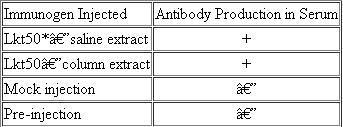 *Lkt50 is a smaller derivative ofLkt that lacks all hydrophobic regions. + indicates at least 50 percent neutralization of toxicity of Lkt; - indicates no neutralization activity.
Source: Modified from Lee et al. 2001. Infect. and Immunity 69: 5786-5793.
(a) What general conclusion can you draw from the data?
(b) With regards to development of a usable edible vaccine, what work remains to be done?
*Lkt50 is a smaller derivative ofLkt that lacks all hydrophobic regions. + indicates at least 50 percent neutralization of toxicity of Lkt; - indicates no neutralization activity.Source: Modified from Lee et al. 2001. Infect. and Immunity 69: 5786-5793.
(a) What general conclusion can you draw from the data?
(b) With regards to development of a usable edible vaccine, what work remains to be done?
Question
Question
Question
Question
Question
Question
Question
Question
Question
Question
Question
Question
Question
Question
Question
Question
Question
Question
Question
Question

Unlock Deck
Sign up to unlock the cards in this deck!
Unlock Deck
Unlock Deck
1/29

Play

Full screen (f)
Deck 22: Applications and Ethics of Genetic Engineering and Biotechnology
1
Ralph, a 57-year-old man, was diagnosed with colon cancer. His oncologist discussed the use of radiation and chemotherapy as treatments for this cancer and explained that each of these therapies kills actively dividing normal and cancer cells, causing debilitating side effects. Ralph decided to carefully review his options and went for a second opinion to a cancer clinic at a major teaching hospital. There he learned that researchers in a synthetic biology program were testing the use of genetically modified E. coli cells that selectively invade and kill cancer cells, with no effects on normal cells. Ralph decided to participate in this trial, and at an appointment to learn about the details, he was informed that he would be part of a Phase III trial, comparing the effects of the modified bacterial cells against conventional chemotherapy. As part of the trial, he would be randomly assigned to receive one or the other treatment. He was disappointed to learn this, because he assumed that he would receive the bacterial therapy.
What are Ralph's options at this point?
What are Ralph's options at this point?
Ralph's options when entering a Phase III clinical trial would be receive either the control treatment (conventional chemotherapy), or to receive the genetically modified E. coli treatment. While this would be disappointing for someone seeking alternative therapies, if the E. coli therapy were significantly more effective and less damaging than conventional chemotherapy, the option would eventually be allowed to all participants of the study.
2
In this chapter, we focused on a number of interesting applications of genetic engineering, genomics, and biotechnology. At the same time, we found many opportunities to consider the methods and reasoning by which much of this information was acquired. From the explanations given in the chapter, what answers would you propose to the following fundamental questions:
(a) What experimental evidence confirms that we have introduced a useful gene into a transgenic organism and that it performs as we anticipate?
(b) How can we use DNA analysis to determine that a human fetus has sickle-cell anemia?
(c) How can DNA microarray analysis be used to identify specific genes that are being expressed in a specific tissue?
(d) How are GWAS carried out, and what information do they provide?
(e) What are some of the technical reasons why gene therapy is difficult to carry out effectively?
(a) What experimental evidence confirms that we have introduced a useful gene into a transgenic organism and that it performs as we anticipate?
(b) How can we use DNA analysis to determine that a human fetus has sickle-cell anemia?
(c) How can DNA microarray analysis be used to identify specific genes that are being expressed in a specific tissue?
(d) How are GWAS carried out, and what information do they provide?
(e) What are some of the technical reasons why gene therapy is difficult to carry out effectively?
Sickle cell anemia is caused by a single amino acid substitution. This substitution eliminates a cutting site in the gene for a restriction enzyme, and therefore will alter the pattern of restriction fragments which would be seen on a Southern blot. These blots and the differences in in the results can help diagnose prenatal sickle cell anemia.
DNA microarray analysis can be used to identify specific genes being expressed in a specific tissue. These arrays analyze gene expression patterns because progression of tissue from healthy to diseased is accompanied by changes in expression of genes. mRNA expression is being detected and these arrays contain probes which select for a specific gene which is expressed differently in different cell types.
GWAS is carried out through the analysis of the genomes of thousands of unrelated individuals. These genomes are studied with respect to a particular disease through microarray analysis and then compared with individuals with genomes that lack the disease. This helps study the genetic variations which confer risk of the disease.
Gene therapy is difficult to carry out in practice. Many genes are interrelated and targeting a series of genes can lead to unwanted downstream effects. Also ensuring that the genetic modification is carried on through following generations is difficult to guarantee because the incorporation of the DNA may not always occur.
DNA microarray analysis can be used to identify specific genes being expressed in a specific tissue. These arrays analyze gene expression patterns because progression of tissue from healthy to diseased is accompanied by changes in expression of genes. mRNA expression is being detected and these arrays contain probes which select for a specific gene which is expressed differently in different cell types.
GWAS is carried out through the analysis of the genomes of thousands of unrelated individuals. These genomes are studied with respect to a particular disease through microarray analysis and then compared with individuals with genomes that lack the disease. This helps study the genetic variations which confer risk of the disease.
Gene therapy is difficult to carry out in practice. Many genes are interrelated and targeting a series of genes can lead to unwanted downstream effects. Also ensuring that the genetic modification is carried on through following generations is difficult to guarantee because the incorporation of the DNA may not always occur.
3
Ralph, a 57-year-old man, was diagnosed with colon cancer. His oncologist discussed the use of radiation and chemotherapy as treatments for this cancer and explained that each of these therapies kills actively dividing normal and cancer cells, causing debilitating side effects. Ralph decided to carefully review his options and went for a second opinion to a cancer clinic at a major teaching hospital. There he learned that researchers in a synthetic biology program were testing the use of genetically modified E. coli cells that selectively invade and kill cancer cells, with no effects on normal cells. Ralph decided to participate in this trial, and at an appointment to learn about the details, he was informed that he would be part of a Phase III trial, comparing the effects of the modified bacterial cells against conventional chemotherapy. As part of the trial, he would be randomly assigned to receive one or the other treatment. He was disappointed to learn this, because he assumed that he would receive the bacterial therapy.
Should he reconsider and try radiation and chemotherapy instead?
Should he reconsider and try radiation and chemotherapy instead?
Ralph can either reconsider and receive radiation/chemotherapy instead, or enter the clinical trial. At this point, his options are equivalent, worst case scenario in the clinical trial; he will receive the chemotherapy option (which he would receive should he reconsider). Best case scenario, he will receive the experimental therapy which he believes is better for the overall person. It would probably be in Ralph's best interests to continue with the clinical trial.
4
Review the Chapter Concepts list. Most of these center on applications of genetic technology that are becoming widespread. Write a short essay that summarizes the impacts that genomic applications are having on society and the ethical issues presented by these applications.
▪Recombinant DNA technology, genetic engineering, and biotechnology have revolutionized medicine and agriculture.
▪Genetically modified plants and animals can serve as bioreactors to produce therapeutic proteins and other valuable protein products.
▪Genetic modifications of plants have resulted in herbicide- and pest-resistant crops, and crops with improved nutritional value; similarly, transgenic animals are being created to produce therapeutic proteins and to protect animals from disease.
▪A synthetic genome has been assembled and transplanted into a donor bacterial strain, elevating interest in potential applications of synthetic biology.
▪Applications of recombinant DNA technology and genomics have become essential for diagnosing genetic disorders, determining genotypes, and scanning the human genome to detect diseases.
▪Genome-wide association studies (GWAS) scan for hundreds or thousands of genetic differences in an attempt to link genome variations to particular traits and diseases.
▪Medical clinics are adopting whole genome sequencing of an individual's DNA for disease diagnosis and treatment.
▪Computational services for predicting offspring based on a couple's genetics are being advertised to consumers.
▪Almost all applications of genetic engineering and biotechnology present unresolved ethical dilemmas that involve important moral, social, and legal issues.
▪Recombinant DNA technology, genetic engineering, and biotechnology have revolutionized medicine and agriculture.
▪Genetically modified plants and animals can serve as bioreactors to produce therapeutic proteins and other valuable protein products.
▪Genetic modifications of plants have resulted in herbicide- and pest-resistant crops, and crops with improved nutritional value; similarly, transgenic animals are being created to produce therapeutic proteins and to protect animals from disease.
▪A synthetic genome has been assembled and transplanted into a donor bacterial strain, elevating interest in potential applications of synthetic biology.
▪Applications of recombinant DNA technology and genomics have become essential for diagnosing genetic disorders, determining genotypes, and scanning the human genome to detect diseases.
▪Genome-wide association studies (GWAS) scan for hundreds or thousands of genetic differences in an attempt to link genome variations to particular traits and diseases.
▪Medical clinics are adopting whole genome sequencing of an individual's DNA for disease diagnosis and treatment.
▪Computational services for predicting offspring based on a couple's genetics are being advertised to consumers.
▪Almost all applications of genetic engineering and biotechnology present unresolved ethical dilemmas that involve important moral, social, and legal issues.
Unlock Deck
Unlock for access to all 29 flashcards in this deck.
Unlock Deck
k this deck
5
Ralph, a 57-year-old man, was diagnosed with colon cancer. His oncologist discussed the use of radiation and chemotherapy as treatments for this cancer and explained that each of these therapies kills actively dividing normal and cancer cells, causing debilitating side effects. Ralph decided to carefully review his options and went for a second opinion to a cancer clinic at a major teaching hospital. There he learned that researchers in a synthetic biology program were testing the use of genetically modified E. coli cells that selectively invade and kill cancer cells, with no effects on normal cells. Ralph decided to participate in this trial, and at an appointment to learn about the details, he was informed that he would be part of a Phase III trial, comparing the effects of the modified bacterial cells against conventional chemotherapy. As part of the trial, he would be randomly assigned to receive one or the other treatment. He was disappointed to learn this, because he assumed that he would receive the bacterial therapy.
Or should he enroll on the chance that he would receive therapy using the genetically modified bacteria and that it would be more effective than conventional therapy?
Or should he enroll on the chance that he would receive therapy using the genetically modified bacteria and that it would be more effective than conventional therapy?
Unlock Deck
Unlock for access to all 29 flashcards in this deck.
Unlock Deck
k this deck
6
One of the main safety issues associated with genetically modified crops is the potential for allergenicity caused by introducing an allergen or by changing the level of expression of a host allergen. Based on the observation that common allergenic proteins often contain identical stretches of a few (six or seven) amino acids, researchers developed a method for screening transgenic crops to evaluate potential allergenic properties (Kleter Peijnenburg, 2002. BMC Struct. Biol. 2: 8). How do you think they accomplished this?
Unlock Deck
Unlock for access to all 29 flashcards in this deck.
Unlock Deck
k this deck
7
Why are most recombinant human proteins produced in animal or plant hosts instead of bacterial host cells?
Unlock Deck
Unlock for access to all 29 flashcards in this deck.
Unlock Deck
k this deck
8
There are more than 1000 cloned farm animals in the United States. In the near future, milk from cloned cows and their offspring (born naturally) may be available in supermarkets. These cloned animals have not been transgenically modified, and they are no different than identical twins. Should milk from such animals and their natural-born offspring be labeled as coming from cloned cows or their descendants? Why?
Unlock Deck
Unlock for access to all 29 flashcards in this deck.
Unlock Deck
k this deck
9
One of the major causes of sickness, death, and economic loss in the cattle industry is Mannheimia haemolytica , which causes bovine pasteurellosis, or shipping fever. Noninvasive delivery of a vaccine using transgenic plants expressing immunogens would reduce labor costs and trauma to livestock. An early step toward developing an edible vaccine is to determine whether an injected version of an antigen (usually a derivative of the pathogen) is capable of stimulating the development of antibodies in a test organism. The following table assesses the ability of a transgenic portion of a toxin (Lkt) of M. haemolytica to stimulate development of specific antibodies in rabbits.
*Lkt50 is a smaller derivative ofLkt that lacks all hydrophobic regions. + indicates at least 50 percent neutralization of toxicity of Lkt; - indicates no neutralization activity.
Source: Modified from Lee et al. 2001. Infect. and Immunity 69: 5786-5793.
(a) What general conclusion can you draw from the data?
(b) With regards to development of a usable edible vaccine, what work remains to be done?
*Lkt50 is a smaller derivative ofLkt that lacks all hydrophobic regions. + indicates at least 50 percent neutralization of toxicity of Lkt; - indicates no neutralization activity.Source: Modified from Lee et al. 2001. Infect. and Immunity 69: 5786-5793.
(a) What general conclusion can you draw from the data?
(b) With regards to development of a usable edible vaccine, what work remains to be done?
Unlock Deck
Unlock for access to all 29 flashcards in this deck.
Unlock Deck
k this deck
10
Describe how the team from the J. Craig Venter Institute created a synthetic genome. How did they demonstrate that the genome converted the recipient strain of bacteria into a different strain?
Unlock Deck
Unlock for access to all 29 flashcards in this deck.
Unlock Deck
k this deck
11
Suppose you develop a screening method for cystic fibrosis that allows you to identify the predominant mutation ?508 and the next six most prevalent mutations. What must you consider before using this method to screen a population for this disorder?
Unlock Deck
Unlock for access to all 29 flashcards in this deck.
Unlock Deck
k this deck
12
Sequencing the human genome and the development of microarray technology promise to improve our understanding of normal and abnormal cell behavior. How are microarrays dramatically changing our understanding of complex diseases such as cancer?
Unlock Deck
Unlock for access to all 29 flashcards in this deck.
Unlock Deck
k this deck
13
A couple with European ancestry seeks genetic counseling before having children because of a history of cystic fibrosis (CF) in the husband's family. ASO testing for CF reveals that the husband is heterozygous for the ? 508 mutation and that the wife is heterozygous for the R117 mutation. You are the couple's genetic counselor. When consulting with you, they express their conviction that they are not at risk for having an affected child because they each carry different mutations and cannot have a child who is homozygous for either mutation. What would you say to them?
Unlock Deck
Unlock for access to all 29 flashcards in this deck.
Unlock Deck
k this deck
14
When genome scanning technologies become widespread, medical records will contain the results of such testing. Who should have access to this information? Should employers, potential employers, or insurance companies be allowed to have this information? Would you favor or oppose having the government establish and maintain a central database containing the results of individuals' genome scans?
Unlock Deck
Unlock for access to all 29 flashcards in this deck.
Unlock Deck
k this deck
15
What limits the use of differences in restriction enzyme sites as a way of detecting point mutations in human genes?
Unlock Deck
Unlock for access to all 29 flashcards in this deck.
Unlock Deck
k this deck
16
Might it make sense someday to sequence every newborn's genome at the time of birth? What are the potential advantages and concerns of this approach?
Unlock Deck
Unlock for access to all 29 flashcards in this deck.
Unlock Deck
k this deck
17
What is the main purpose of genome-wide association studies (GWAS)? How can information from GWAS be used to inform scientists and physicians about genetic diseases?
Unlock Deck
Unlock for access to all 29 flashcards in this deck.
Unlock Deck
k this deck
18
The family of a sixth-grade boy in Palo Alto, California, was informed by school administrators that he would have to transfer out of his middle school because they believed his mutation of the CFTR , which does not produce any symptoms associated with cystic fibrosis, posed a risk to other students at the school who have cystic fibrosis. After missing 11 days of school, a settlement was reached to have the boy return to school. Based on what you know about GINA, the Genetic Information Nondiscrimination Act, what ethical problems might you associate with this example?
Unlock Deck
Unlock for access to all 29 flashcards in this deck.
Unlock Deck
k this deck
19
Dominant mutations can be categorized according to whether they increase or decrease the overall activity of a gene or gene product. Although a loss-of-function mutation (a mutation that inactivates the gene product) is usually recessive, for some genes, one dose of the normal gene product, encoded by the normal allele, is not sufficient to produce a normal phenotype. In this case, a loss-of-function mutation in the gene will be dominant, and the gene is said to be haploinsufficient. A second category of dominant mutation is the gain-of-function mutation, which results in a new activity or increased activity or expression of a gene or gene product. The gene therapy technique currently used in clinical trials involves the "addition" to somatic cells of a normal copy of a gene. In other words, a normal copy of the gene is inserted into the genome of the mutant somatic cell, but the mutated copy of the gene is not removed or replaced. Will this strategy work for either of the two aforementioned types of dominant mutations?
Unlock Deck
Unlock for access to all 29 flashcards in this deck.
Unlock Deck
k this deck
20
In 2013 the actress Angelina Jolie elected to have prophylactic double-mastectomy surgery to prevent breast cancer based on a positive test for mutation of the BRCA1 gene. What are some potential positive and negative consequences of this high-profile example of acting on the results of a genetic test?
Unlock Deck
Unlock for access to all 29 flashcards in this deck.
Unlock Deck
k this deck
21
The Genetic Testing Registry is intended to provide better information to patients, but companies involved in genetic testing are not required to participate. Should company participation be mandatory? Why or why not? Explain your answers.
Unlock Deck
Unlock for access to all 29 flashcards in this deck.
Unlock Deck
k this deck
22
Should the FDA regulate direct-to-consumer genetic tests, or should these tests be available as a "buyer beware" product?
Unlock Deck
Unlock for access to all 29 flashcards in this deck.
Unlock Deck
k this deck
23
Would you have your genome sequenced, if the price was affordable? Why or why not? If you answered yes, would you make your genome sequence publicly available? How might such information be misused?
Unlock Deck
Unlock for access to all 29 flashcards in this deck.
Unlock Deck
k this deck
24
Following the tragic shooting of 20 children at a school in Newtown, Connecticut, in 2012, Connecticut's state medical examiner requested a full genetic analysis of the killer's genome. What do you think investigators might be looking for? What might they expect to find? Might this analysis lead to oversimplified analysis of the cause of the tragedy?
Unlock Deck
Unlock for access to all 29 flashcards in this deck.
Unlock Deck
k this deck
25
Private companies are now offering personal DNA sequencing along with interpretation. What services do they offer? Do you think that these services should be regulated, and if so, in what way? Investigate one such company, 23andMe, at http://www.23andMe.com.
Unlock Deck
Unlock for access to all 29 flashcards in this deck.
Unlock Deck
k this deck
26
Host transgenic mammals are often made by injecting transgenic DNA into a pronucleus, a process that is laborious, technically demanding, and typified by yields of less than 1 percent. Lately, the engineered lentivirus, a retrovirus, has been used to generate transgenic pigs, rats, mice, and cattle with greater than 10 percent efficiency (Whitelaw, 2004). Lentivectors have reverse transcriptase activity, can infect both dividing and nondividing cells, and are replication-defective. Present, in a labeled diagram, a strategy for producing a transgenic mammal carrying a pharmaceutically important gene using a lentivector.
Unlock Deck
Unlock for access to all 29 flashcards in this deck.
Unlock Deck
k this deck
27
Yeager, M., et al. ( Nature Genetics 39: 645-649, 2007) and Sladek, R. et al. ( Nature 445: 881-885, 2007) have used singlenucleotide polymorphisms (SNPs) in genome-wide association studies (GWAS) to identify novel risk loci for prostate cancer and Type 2 diabetes mellitus, respectively. Each study suggests that disease-risk genes can be identified that signify cantly contribute to the disease state. Given your understanding of such complex diseases, what would you consider as reasonable factors to consider when interpreting the results of GWAS studies?
Unlock Deck
Unlock for access to all 29 flashcards in this deck.
Unlock Deck
k this deck
28
In March, 2010 Judge R. Sweet ruled to invalidate Myriad Genetics' patents on the BRCA1 and BRCA2 genes. Sweet wrote that since the genes are part of the natural world, they are not patentable. Myriad Genetics also holds patents on the development of a direct-to-consumer test for the BRCA1 and BRCA2 genes.
(a) Would you agree with Judge Sweet's ruling to invalidate the patenting of the BRCA1 and BRCA2 genes? If you were asked to judge the patenting of the direct-to-consumer test for the BRCA1 and BRCA2 genes, how would you rule?
(b) J. Craig Venter has filed a patent application for his "first-ever human made life form." This patent is designed to cover the genome of M. genitalium. Would your ruling for Venter's "organism" be different from Judge Sweet's ruling on patenting of the BRCA1 and BRCA2 genes?
(a) Would you agree with Judge Sweet's ruling to invalidate the patenting of the BRCA1 and BRCA2 genes? If you were asked to judge the patenting of the direct-to-consumer test for the BRCA1 and BRCA2 genes, how would you rule?
(b) J. Craig Venter has filed a patent application for his "first-ever human made life form." This patent is designed to cover the genome of M. genitalium. Would your ruling for Venter's "organism" be different from Judge Sweet's ruling on patenting of the BRCA1 and BRCA2 genes?
Unlock Deck
Unlock for access to all 29 flashcards in this deck.
Unlock Deck
k this deck
29
A number of mouse models for human cystic fibrosis (CF) exist. Each of these mouse strains is transgenic and bears a different specific CFTR gene mutation. The mutations are the same as those seen in the varieties of human CF. These transgenic CF mice are being used to study the range of different phenotypes that characterize CF in humans. They are also used as models to test potential CF drugs. Unfortunately, most transgenic mouse CF strains do not show one of the most characteristic symptoms of human CF, that of lung congestion. Can you think of a reason why mouse CF strains do not display this symptom of human CF?
Unlock Deck
Unlock for access to all 29 flashcards in this deck.
Unlock Deck
k this deck
Unlock Deck
Unlock for access to all 29 flashcards in this deck.







