





 Chat with AI

Deck 21: Genomics, Bioinformatics, and Proteomics
Full screen (f)

Question

Question
Question
Question
Question
Question
Question
Question
Question
Question
Question
Question
Question
Question
Question
Question
Question
Question
Question
Question
Question
Question
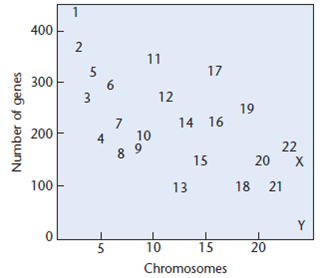
In a draft annotation and overview of the human genome sequence, F.A. Wright et al. (Genome Biol. 2001: 2(7): Research0025) presented a graph similar to the one shown here. The graph details the approximate number of genes from each chromosome that are expressed only in embryos. Review earlier information in the text on human chromosomal aneuploids and correlate that information with the graph. Does this graph provide insight as to why some aneuploids occur and others do not?
Question
Question
Question
Question
Question
Question
Question
Question
Question

Unlock Deck
Sign up to unlock the cards in this deck!
Unlock Deck
Unlock Deck
1/31

Play

Full screen (f)
Deck 21: Genomics, Bioinformatics, and Proteomics
1
A number of genes involved in susceptibility to inflammatory bowel disorders (IBDs), including Crohn disease and ulcerative colitis, have been identified. However, it is clear that other risk factors, both genetic and nongenetic, are important in triggering the onset of these diseases. Recent research has centered on understanding the role of the gut microbiome and its interactions with the host genome in IBD. It is known that the microbiome of those with IBD is different from that of those whose IBD is in remission, and it is also different from that of people who do not have IBD. These observations suggest that transfer of microbiota from unaffected individuals via fecal microbial transplantation (FMT) might be a successful treatment for IBD. This idea is supported by the use of FMT as an effective treatment in IBD individuals for a potentially life-threatening infection caused by the bacterium Clostridium difficile. Currently, four clinical trials are underway to evaluate the use of FMT as a treatment for IBD. If you had IBD, how would you react if your physician recommended that you enroll in one of these clinical studies to evaluate fecal transplants as a treatment?
Any individual with a history of inflammatory bowel disorder should consider the recommendation of enrollment in the clinical studies in the evaluation of fecal transplants. Much of the current research backs up the fact that the microbiome of an individual can impact their overall health. In gastrointestinal disorders specifically, the microbiological makeup of the intestine can influence the activity of the gut. This research is convincing enough to consider the option of fecal transplants.
2
In this chapter, we focused on the analysis of genomes, transcriptomes, and proteomes and considered important applications and findings from these endeavors. At the same time, we found many opportunities to consider the methods and reasoning by which much of this information was acquired. From the explanations given in the chapter, what answers would you propose to the following fundamental questions:
(a) How do we know which contigs are part of the same chromosome?
(b) How do we know if a genomic DNA sequence contains a protein-coding gene?
(c) What evidence supports the concept that humans share substantial sequence similarities and gene functional similarities with model organisms?
(d) How can proteomics identify differences between the number of protein-coding genes predicted for a genome and the number of proteins expressed by a genome?
(e) What evidence indicates that gene families result from gene duplication events?
(f) How have microarrays demonstrated that, although all cells of an organism have the same genome, some genes are expressed in almost all cells, whereas other genes show cell and tissue-specific expression?
(a) How do we know which contigs are part of the same chromosome?
(b) How do we know if a genomic DNA sequence contains a protein-coding gene?
(c) What evidence supports the concept that humans share substantial sequence similarities and gene functional similarities with model organisms?
(d) How can proteomics identify differences between the number of protein-coding genes predicted for a genome and the number of proteins expressed by a genome?
(e) What evidence indicates that gene families result from gene duplication events?
(f) How have microarrays demonstrated that, although all cells of an organism have the same genome, some genes are expressed in almost all cells, whereas other genes show cell and tissue-specific expression?
(a) Overlapping fragments that are adjoining segments that collectively form one continuous DNA molecule within a chromosome are called contigs. The DNA-sequence alignment identifies overlapping sequences and allows scientist to reconstruct their order in a chromosome.
(b) There are characteristics of protein-coding genes that are used in determining if the sequence contains a protein-coding gene. They contain one or more open reading frames that are triplets of three nucleotides that, after transcription and mRNA splicing, are translated into the amino acid sequence of a protein.
(c) Homologues genes are genes that are evolutionarily related. When the human genome was sequenced many open reading frames in it were identified as protein-coding genes based on their alignment with related genes of known function in other species. There are also orthologs. They are homologous genes in different species that are thought to have descended from a gene in a common ancestor.
(d) Proteomics is the complete identification, characterization, and quantitative analysis of the proteomes of a cell, tissue, or organism. It can be used to reconcile differences between the number of genes in a genome and the number of different proteins produced. There are techniques that can be used to determine the number of proteins produced. However, there is no single human proteome. Different tissues produce different sets of proteins. One technique used to identify the proteins expressed is the two-dimensional gel electrophoresis. It separates out the proteins based on their size.
(e) Comparative genomic has proven to be valuable for identifying member of multigene families. Multigene families are groups of genes that share similar but not identical DNA sequences through duplication and descent from a single ancestral gene. Their gene products often have similar functions, and that genes are often found at a single chromosomal locus. An example is paralogs and they are homologous gens that are present in the same single organism are believed to have evolved by gene duplication. Another example is the gene family evolution of globin gene superfamily. An ancestral gene encoding an oxygen transport protein was duplicated about 800 million years ago. This produced two sister genes and one evolved into the modern-day myoglobin gene.
(f) Microarrays are often constructed with antibodies that specifically recognize and bind to different proteins. They can show which cells express which proteins. This shows that all cells of an organism have the same genome; some genes are expressed in almost all cells. Whereas other genes show cell and tissue specific expression
(b) There are characteristics of protein-coding genes that are used in determining if the sequence contains a protein-coding gene. They contain one or more open reading frames that are triplets of three nucleotides that, after transcription and mRNA splicing, are translated into the amino acid sequence of a protein.
(c) Homologues genes are genes that are evolutionarily related. When the human genome was sequenced many open reading frames in it were identified as protein-coding genes based on their alignment with related genes of known function in other species. There are also orthologs. They are homologous genes in different species that are thought to have descended from a gene in a common ancestor.
(d) Proteomics is the complete identification, characterization, and quantitative analysis of the proteomes of a cell, tissue, or organism. It can be used to reconcile differences between the number of genes in a genome and the number of different proteins produced. There are techniques that can be used to determine the number of proteins produced. However, there is no single human proteome. Different tissues produce different sets of proteins. One technique used to identify the proteins expressed is the two-dimensional gel electrophoresis. It separates out the proteins based on their size.
(e) Comparative genomic has proven to be valuable for identifying member of multigene families. Multigene families are groups of genes that share similar but not identical DNA sequences through duplication and descent from a single ancestral gene. Their gene products often have similar functions, and that genes are often found at a single chromosomal locus. An example is paralogs and they are homologous gens that are present in the same single organism are believed to have evolved by gene duplication. Another example is the gene family evolution of globin gene superfamily. An ancestral gene encoding an oxygen transport protein was duplicated about 800 million years ago. This produced two sister genes and one evolved into the modern-day myoglobin gene.
(f) Microarrays are often constructed with antibodies that specifically recognize and bind to different proteins. They can show which cells express which proteins. This shows that all cells of an organism have the same genome; some genes are expressed in almost all cells. Whereas other genes show cell and tissue specific expression
3
A number of genes involved in susceptibility to inflammatory bowel disorders (IBDs), including Crohn disease and ulcerative colitis, have been identified. However, it is clear that other risk factors, both genetic and nongenetic, are important in triggering the onset of these diseases. Recent research has centered on understanding the role of the gut microbiome and its interactions with the host genome in IBD. It is known that the microbiome of those with IBD is different from that of those whose IBD is in remission, and it is also different from that of people who do not have IBD. These observations suggest that transfer of microbiota from unaffected individuals via fecal microbial transplantation (FMT) might be a successful treatment for IBD. This idea is supported by the use of FMT as an effective treatment in IBD individuals for a potentially life-threatening infection caused by the bacterium Clostridium difficile. Currently, four clinical trials are underway to evaluate the use of FMT as a treatment for IBD.
Current treatment of IBD involves the use of anti-inflammatory drugs, but these drugs achieve remission only in some cases. If genetic analysis reveals that you carry susceptibility alleles for IBD that respond to periodic FMT as a therapy, would you agree to try this method?
Current treatment of IBD involves the use of anti-inflammatory drugs, but these drugs achieve remission only in some cases. If genetic analysis reveals that you carry susceptibility alleles for IBD that respond to periodic FMT as a therapy, would you agree to try this method?
If genetic analysis revealed that an individual carries susceptibility alleles for IBD which would respond to fecal transplants as a therapy, it would not be essential to immediately try the method. If the disease is active, fecal transplants can induce treatment and remission, however if the disease is not active, there is no reason to force it into remission. Once an individual shows symptoms, it may be essential to aggressively manage the disease.
4
Review the Chapter Concepts list. All of these pertain to how genomics, bioinformatics, and proteomics approaches have changed how scientists study genes and proteins. Write a short essay that explains how recombinant DNA techniques were used to identify and study genes compared to how modern genomic techniques have revolutionized the cloning and analysis of genes.
▪Genomics applies recombinant DNA, DNA sequencing methods, and bioinformatics to sequence, assemble, and analyze genomes.
▪Disciplines in genomics encompass several areas of study, including structural and functional genomics, comparative genomics, and metagenomics, and have led to an "omics" revolution in modern biology.
▪Bioinformatics merges information technology with biology and mathematics to store, share, compare, and analyze nucleic acid and protein sequence data.
▪The Human Genome Project has greatly advanced our understanding of the organization, size, and function of the human genome.
▪Ten years after completion of the Human Genome Project, a new era of genomics studies is providing deeper insights into the human genome.
▪Comparative genomics analysis has revealed similarities and differences in genome size and organization.
▪Metagenomics is the study of genomes from environmental samples and is valuable for identifying microbial genomes.
▪Transcriptome analysis provides insight into patterns of gene expression and gene-regulatory activity of a genome.
▪Proteomics focuses on the protein content of cells and on the structures, functions, and interactions of proteins.
▪Systems biology approaches attempt to uncover complex interactions among genes, proteins, and other cellular components.
▪Genomics applies recombinant DNA, DNA sequencing methods, and bioinformatics to sequence, assemble, and analyze genomes.
▪Disciplines in genomics encompass several areas of study, including structural and functional genomics, comparative genomics, and metagenomics, and have led to an "omics" revolution in modern biology.
▪Bioinformatics merges information technology with biology and mathematics to store, share, compare, and analyze nucleic acid and protein sequence data.
▪The Human Genome Project has greatly advanced our understanding of the organization, size, and function of the human genome.
▪Ten years after completion of the Human Genome Project, a new era of genomics studies is providing deeper insights into the human genome.
▪Comparative genomics analysis has revealed similarities and differences in genome size and organization.
▪Metagenomics is the study of genomes from environmental samples and is valuable for identifying microbial genomes.
▪Transcriptome analysis provides insight into patterns of gene expression and gene-regulatory activity of a genome.
▪Proteomics focuses on the protein content of cells and on the structures, functions, and interactions of proteins.
▪Systems biology approaches attempt to uncover complex interactions among genes, proteins, and other cellular components.
Unlock Deck
Unlock for access to all 31 flashcards in this deck.
Unlock Deck
k this deck
5
A number of genes involved in susceptibility to inflammatory bowel disorders (IBDs), including Crohn disease and ulcerative colitis, have been identified. However, it is clear that other risk factors, both genetic and nongenetic, are important in triggering the onset of these diseases. Recent research has centered on understanding the role of the gut microbiome and its interactions with the host genome in IBD. It is known that the microbiome of those with IBD is different from that of those whose IBD is in remission, and it is also different from that of people who do not have IBD. These observations suggest that transfer of microbiota from unaffected individuals via fecal microbial transplantation (FMT) might be a successful treatment for IBD. This idea is supported by the use of FMT as an effective treatment in IBD individuals for a potentially life-threatening infection caused by the bacterium Clostridium difficile. Currently, four clinical trials are underway to evaluate the use of FMT as a treatment for IBD.
Before agreeing to FMT, what would you want to know about the microbiomes of individuals who do not have IBD?
Before agreeing to FMT, what would you want to know about the microbiomes of individuals who do not have IBD?
Unlock Deck
Unlock for access to all 31 flashcards in this deck.
Unlock Deck
k this deck
6
What is functional genomics? How does it differ from comparative genomics?
Unlock Deck
Unlock for access to all 31 flashcards in this deck.
Unlock Deck
k this deck
7
Compare and contrast whole-genome shotgun sequencing to a map-based cloning approach.
Unlock Deck
Unlock for access to all 31 flashcards in this deck.
Unlock Deck
k this deck
8
What is bioinformatics, and why is this discipline essential for studying genomes? Provide two examples of bioinformatics applications.
Unlock Deck
Unlock for access to all 31 flashcards in this deck.
Unlock Deck
k this deck
9
List and describe three major goals of the Human Genome Project.
Unlock Deck
Unlock for access to all 31 flashcards in this deck.
Unlock Deck
k this deck
10
How do high-throughput techniques such as computer-automated and next-generation sequencing and mass spectrometry facilitate research in genomics and proteomics? Explain.
Unlock Deck
Unlock for access to all 31 flashcards in this deck.
Unlock Deck
k this deck
11
BLAST searches and related applications are essential for analyzing gene and protein sequences. Define BLAST, describe basic features of this bioinformatics tool, and provide an example of information provided by a BLAST search.
Unlock Deck
Unlock for access to all 31 flashcards in this deck.
Unlock Deck
k this deck
12
What are pseudogenes, and how are they produced?
Unlock Deck
Unlock for access to all 31 flashcards in this deck.
Unlock Deck
k this deck
13
Describe the human genome in terms of genome size, the percentage of the genome that codes for proteins, how much is composed of repetitive sequences, and how many genes it contains. Describe two other features of the human genome.
Unlock Deck
Unlock for access to all 31 flashcards in this deck.
Unlock Deck
k this deck
14
What functional information about a genome can be determined through applications of chromatin immunoprecipitation (ChIP)?
Unlock Deck
Unlock for access to all 31 flashcards in this deck.
Unlock Deck
k this deck
15
The Human Genome Project has demonstrated that in humans of all races and nationalities approximately 99.9 percent of the sequence is the same, yet different individuals can be identified by DNA fingerprinting techniques. What is one primary variation in the human genome that can be used to distinguish different individuals? Briefly explain your answer.
Unlock Deck
Unlock for access to all 31 flashcards in this deck.
Unlock Deck
k this deck
16
Annotation involves identifying genes and gene-regulatory sequences in a genome. List and describe characteristics of a genome that are hallmarks for identifying genes in an unknown sequence. What characteristics would you look for in a prokaryotic genome? A eukaryotic genome?
Unlock Deck
Unlock for access to all 31 flashcards in this deck.
Unlock Deck
k this deck
17
Through the Human Genome Project (HGP), a relatively accurate human genome sequence was published in 2003 from combined samples from different individuals. It serves as a reference for a haploid genome. Recently, genomes of a number of individuals have been sequenced under the auspices of the Personal Genome Project (PGP). How do results from the PGP differ from those of the HGP?
Unlock Deck
Unlock for access to all 31 flashcards in this deck.
Unlock Deck
k this deck
18
Describe the significance of the Genome 10K plan.
Unlock Deck
Unlock for access to all 31 flashcards in this deck.
Unlock Deck
k this deck
19
It can be said that modern biology is experiencing an "omics" revolution. What does this mean? Explain your answer.
Unlock Deck
Unlock for access to all 31 flashcards in this deck.
Unlock Deck
k this deck
20
Metagenomics studies generate very large amounts of sequence data. Provide examples of genetic insight that can be learned from metagenomics.
Unlock Deck
Unlock for access to all 31 flashcards in this deck.
Unlock Deck
k this deck
21
What are gene microarrays? How are microarrays used?
Unlock Deck
Unlock for access to all 31 flashcards in this deck.
Unlock Deck
k this deck
22
In a draft annotation and overview of the human genome sequence, F.A. Wright et al. (Genome Biol. 2001: 2(7): Research0025) presented a graph similar to the one shown here. The graph details the approximate number of genes from each chromosome that are expressed only in embryos. Review earlier information in the text on human chromosomal aneuploids and correlate that information with the graph. Does this graph provide insight as to why some aneuploids occur and others do not?
Unlock Deck
Unlock for access to all 31 flashcards in this deck.
Unlock Deck
k this deck
23
Annotation of the human genome sequence reveals a discrepancy between the number of protein-coding genes and the number of predicted proteins actually expressed by the genome. Proteomic analysis indicates that human cells are capable of synthesizing more than 100,000 different proteins and perhaps three times this number. What is the discrepancy, and how can it be reconciled?
Unlock Deck
Unlock for access to all 31 flashcards in this deck.
Unlock Deck
k this deck
24
Genomic sequencing has opened the door to numerous studies that help us understand the evolutionary forces shaping the genetic makeup of organisms. Using databases containing the sequences of 25 genomes, scientists (Kreil, D.P. and Ouzounis, C.A., Nucl. Acids Res. 29: 1608-1615, 2001) examined the relationship between GC content and global amino acid composition. They found that it is possible to identify thermophilic species on the basis of their amino acid composition alone, which suggests that evolution in a hot environment selects for a certain whole organism amino acid composition. In what way might evolution in extreme environments influence genome and amino acid composition? How might evolution in extreme environments influence the interpretation of genome sequence data?
Unlock Deck
Unlock for access to all 31 flashcards in this deck.
Unlock Deck
k this deck
25
The ? -globin gene family consists of 60 kb of DNA, yet only 5 percent of the DNA encodes gene products. Account for as much of the remaining 95 percent of the DNA as you can.
Unlock Deck
Unlock for access to all 31 flashcards in this deck.
Unlock Deck
k this deck
26
Stoll and colleagues have compared candidate loci in humans and rats in search of loci in the human genome that are likely to contribute to the constellation of factors leading to hypertension. Through this research, they identified 26 chromosomal regions that they consider likely to contain hypertension genes. How can comparative genomics aid in the identification of genes responsible for such a complex human disease? The researchers state that comparisons of rat and human candidate loci to those in the mouse may help validate their studies. Why might this be so?
Unlock Deck
Unlock for access to all 31 flashcards in this deck.
Unlock Deck
k this deck
27
Homology can be defined as the presence of common structures because of shared ancestry. Homology can involve genes, proteins, or anatomical structures. As a result of "descent with modification," many homologous structures have adapted different purposes.
(a) List three anatomical structures in vertebrates that are homologous but have different functions.
(b) Is it likely that homologous proteins from different species have the same or similar functions? Explain.
(c) Under what circumstances might one expect proteins of similar function to not share homology? Would you expect such proteins to be homologous at the level of DNA sequences?
(a) List three anatomical structures in vertebrates that are homologous but have different functions.
(b) Is it likely that homologous proteins from different species have the same or similar functions? Explain.
(c) Under what circumstances might one expect proteins of similar function to not share homology? Would you expect such proteins to be homologous at the level of DNA sequences?
Unlock Deck
Unlock for access to all 31 flashcards in this deck.
Unlock Deck
k this deck
28
Comparisons between human and chimpanzee genomes indicate that a gene that may function as a wild type or normal gene in one primate may function as a disease-causing gene in another (The Chimpanzee Sequence and Analysis Consortium, Nature , 437: 69-87, 2005). For instance, the PPARG locus (regulator of adipocyte differentiation) is associated with type 2 diabetes in humans but functions as a wild-type gene in chimps. What factors might cause this apparent contradiction? Would you consider such apparent contradictions to be rare or common? What impact might such findings have on the use of comparative genomics to identify and design therapies for disease-causing genes in humans?
Unlock Deck
Unlock for access to all 31 flashcards in this deck.
Unlock Deck
k this deck
29
Traditionally, gene sequence homology implied functional similarity. Even though two proteins may contain over 60 percent sequence identity, only about 38 percent have identical functions (Roy et al., 2008). In some cases, closely related homologs may engender completely different classes of proteins (enzymes). Consider the 3D structure of two proteins with 60 percent homology with entirely different functions. Explain how different functions may evolve by discussing the position of the homologous amino acid track, its relation to nonhomologous tracks, and the role that chaperones may play in determining protein function.
Unlock Deck
Unlock for access to all 31 flashcards in this deck.
Unlock Deck
k this deck
30
The discovery that M. genitalium has a genome of 0.58 Mb and only 470 protein-coding genes has sparked interest in determining the minimum number of genes needed for a living cell. In the search for organisms with smaller and smaller genomes, a new species of Archaea, Nanoarchaeum equitans , was discovered in a high-temperature vent on the ocean floor. This prokaryote has one of the smallest cell sizes ever discovered, and its genome is only about 0.5 Mb. However, organisms such as M. genitalium, N. equitans , and other microbes with very small genomes are either parasites or symbionts. How does this affect the search for a minimum genome? Should the definition of the minimum genome size for a living cell be redefined?
Unlock Deck
Unlock for access to all 31 flashcards in this deck.
Unlock Deck
k this deck
31
Whole Exome Sequencing (WES) is becoming a procedure to help physicians identify the cause of a genetic condition that has defied diagnosis by traditional means. The implication here is that exons in the nuclear genome are sequenced in the hopes that, by comparison with the genomes of nonaffected individuals, a diagnosis might be revealed.
(a) What are the strengths and weaknesses of this approach?
(b) If you were ordering WES for a patient, would you also include an analysis of the patient's mitochondrial genome?
(a) What are the strengths and weaknesses of this approach?
(b) If you were ordering WES for a patient, would you also include an analysis of the patient's mitochondrial genome?
Unlock Deck
Unlock for access to all 31 flashcards in this deck.
Unlock Deck
k this deck
Unlock Deck
Unlock for access to all 31 flashcards in this deck.







