





 Chat with AI

Deck 16: Regulation of Gene Expression in Prokaryotes
Full screen (f)

Question

Question
Question
Question
Question
Question
Question
Question
Question
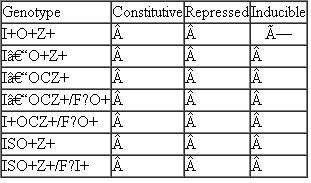
For the lac genotypes shown in the accompanying table, predict whether the structural genes (Z) are constitutive, permanently repressed, or inducible in the presence of lactose.
Question
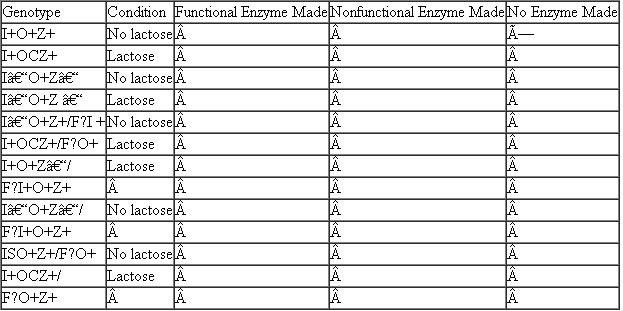
For the genotypes and conditions (lactose present or absent) shown in the following table, predict whether functional enzymes, nonfunctional enzymes, or no enzymes are made.
Question
Question
Question
Question
Question
Question
Question
Question
Question
Question
Question
Question
Question
Question
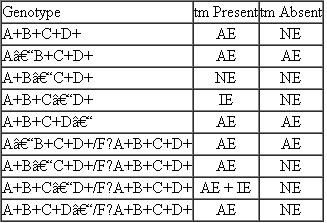
In a theoretical operon, genes A, B, C, and D represent the repressor gene, the promoter sequence, the operator gene, and the structural gene, but not necessarily in the order named. This operon is concerned with the metabolism of a theoretical molecule (tm). From the data provided in the accompanying table, first decide whether the operon is inducible or repressible. Then assign A , B , C , and D to the four parts of the operon. Explain your rationale. (AE = active enzyme; IE = inactive enzyme; NE = no enzyme)
Question
Question
A marine bacterium is isolated and shown to contain an inducible operon whose genetic products metabolize oil when it is encountered in the environment. Investigation demonstrates that the operon is under positive control and that there is a reg gene whose product interacts with an operator region ( o ) to regulate the structural genes, designated sg.
In an attempt to understand how the operon functions, a constitutive mutant strain and several partial diploid strains were isolated and tested with the results shown here:
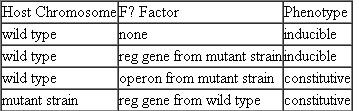 Draw all possible conclusions about the mutation as well as the nature of regulation of the operon. Is the constitutive mutation in the trans -acting reg element or in the cis -acting o operator element?
In an attempt to understand how the operon functions, a constitutive mutant strain and several partial diploid strains were isolated and tested with the results shown here:
Draw all possible conclusions about the mutation as well as the nature of regulation of the operon. Is the constitutive mutation in the trans -acting reg element or in the cis -acting o operator element? Question
The SOS repair genes in E. coli (discussed in Chapter 15) are negatively regulated by the lexA gene product, called the LexA repressor. When a cell sustains extensive damage to its DNA, the LexA repressor is inactivated by the recA gene product (RecA), and transcription of the SOS genes is increased dramatically.
One of the SOS genes is the uvrA gene. You are a student studying the function of the uvrA gene product in DNA repair. You isolate a mutant strain that shows constitutive expression of the UvrA protein. Naming this mutant strain uvrA C , you construct the following diagram showing the lexA and uvrA operons:

(a) Describe two different mutations that would result in a uvrA constitutive phenotype. Indicate the actual genotypes involved.
(b) Outline a series of genetic experiments that would use partial diploid strains to determine which of the two possible mutations you have isolated.
One of the SOS genes is the uvrA gene. You are a student studying the function of the uvrA gene product in DNA repair. You isolate a mutant strain that shows constitutive expression of the UvrA protein. Naming this mutant strain uvrA C , you construct the following diagram showing the lexA and uvrA operons:
(a) Describe two different mutations that would result in a uvrA constitutive phenotype. Indicate the actual genotypes involved.
(b) Outline a series of genetic experiments that would use partial diploid strains to determine which of the two possible mutations you have isolated.
Question
A fellow student considers the issues in Problem and argues that there is a more straightforward, nongenetic experiment that could differentiate between the two types of mutations. The experiment requires no fancy genetics and would allow you to easily assay the products of the other SOS genes. Propose such an experiment.
The SOS repair genes in E. coli (discussed in Chapter 15) are negatively regulated by the lexA gene product, called the LexA repressor. When a cell sustains extensive damage to its DNA, the LexA repressor is inactivated by the recA gene product (RecA), and transcription of the SOS genes is increased dramatically.
One of the SOS genes is the uvrA gene. You are a student studying the function of the uvrA gene product in DNA repair. You isolate a mutant strain that shows constitutive expression of the UvrA protein. Naming this mutant strain uvrA C , you construct the following diagram showing the lexA and uvrA operons:

(a) Describe two different mutations that would result in a uvrA constitutive phenotype. Indicate the actual genotypes involved.
(b) Outline a series of genetic experiments that would use partial diploid strains to determine which of the two possible mutations you have isolated.
The SOS repair genes in E. coli (discussed in Chapter 15) are negatively regulated by the lexA gene product, called the LexA repressor. When a cell sustains extensive damage to its DNA, the LexA repressor is inactivated by the recA gene product (RecA), and transcription of the SOS genes is increased dramatically.
One of the SOS genes is the uvrA gene. You are a student studying the function of the uvrA gene product in DNA repair. You isolate a mutant strain that shows constitutive expression of the UvrA protein. Naming this mutant strain uvrA C , you construct the following diagram showing the lexA and uvrA operons:
(a) Describe two different mutations that would result in a uvrA constitutive phenotype. Indicate the actual genotypes involved.
(b) Outline a series of genetic experiments that would use partial diploid strains to determine which of the two possible mutations you have isolated.
Question
Figure depicts numerous critical regions of the leader sequence of mRNA that play important roles during the process of attenuation in the trp operon. A closer view of the leader sequence, which begins at about position 30 downstream from the 5? end, is given at the bottom of the page, running across both columns.
Within this molecule are the sequences that cause the formation of the alternative hairpins. It also contains the successive triplets that encode tryptophan, where stalling during translation occurs. Take a large piece of paper (such as manila wrapping paper) and, along with several other students from your genetics class, work through the base sequence to identify the trp codons and the parts of the molecule representing the base-pairing regions that form the terminator and antiterminator hairpins shown in Figure.

(Leader sequence for the Problem)Figure
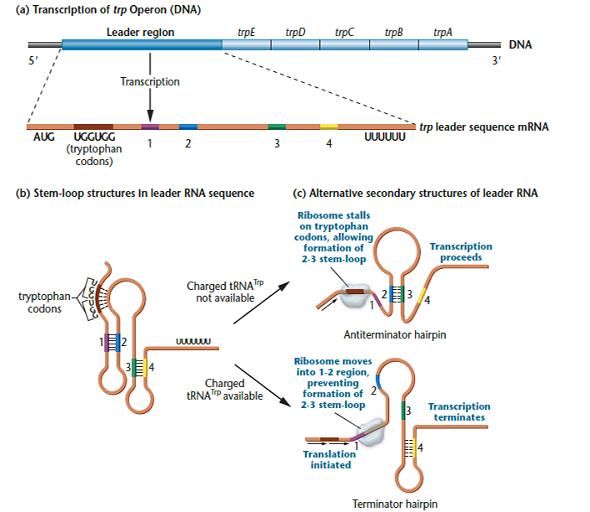
The attenuation model regulating the tryptophan operon.
Within this molecule are the sequences that cause the formation of the alternative hairpins. It also contains the successive triplets that encode tryptophan, where stalling during translation occurs. Take a large piece of paper (such as manila wrapping paper) and, along with several other students from your genetics class, work through the base sequence to identify the trp codons and the parts of the molecule representing the base-pairing regions that form the terminator and antiterminator hairpins shown in Figure.
(Leader sequence for the Problem)Figure
The attenuation model regulating the tryptophan operon.
Question
Question
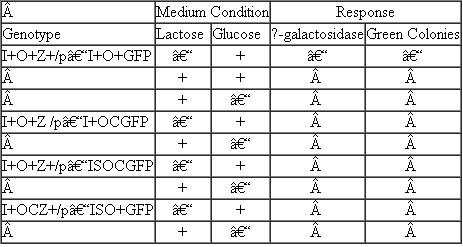
A reporter gene-that is, a gene whose activity is relatively easy to detect-is commonly used to study promoter activity under a variety of investigative circumstances. Recombinant DNA technology is used to attach such a reporter gene to the promoter of interest, after which the recombinant molecule is inserted by transformation or transfection into the cell or host organism of choice. Green fluorescent protein (GFP) from the jellyfish Aequorea victoria fluoresces green when exposed to blue light. Assume that you wished to study the regulatory apparatus of the lac operon and you developed a plasmid ( p ) that contained all the elements of the lac operon except that you replaced the lac structural genes with the GFP gene (your reporter gene). You used this plasmid to transform E. coli. Considering the following genotypes, under which of the following conditions would you expect ? -galactosidase production and/or green colonies when examined under blue light?

Unlock Deck
Sign up to unlock the cards in this deck!
Unlock Deck
Unlock Deck
1/31

Play

Full screen (f)
Deck 16: Regulation of Gene Expression in Prokaryotes
1
At a Midwestern university, several undergraduates reported to the health service with fever, muscle aches, and vomiting. Blood tests showed they had bacterial food poisoning, caused by Listeria monocytogenes. One student, a biology major, asked how the bacteria were able to get from the intestine into the bloodstream. The physician explained that Listeria cells that express a cell-surface protein, InIA, are able to use receptors on the surface of intestinal cells to gain entry and spread from there to the blood. Once in the blood, the bacteria reach the liver, where they use another cell-surface protein, InIB, to enter liver cells, which are the main sites of infection. She further explained that transcriptional levels of the inIA and inIB genes determine the infective ability of different Listeria strains.
Later, the student discussed this information with her genetics instructor, and together they pondered several questions about how bacteria are able to hijack the normal functions of receptors on human cells as part of their life cycle.
How can we tell if the inIA and inIB genes are expressed constitutively or are induced in the presence of the human receptors?
Later, the student discussed this information with her genetics instructor, and together they pondered several questions about how bacteria are able to hijack the normal functions of receptors on human cells as part of their life cycle.
How can we tell if the inIA and inIB genes are expressed constitutively or are induced in the presence of the human receptors?
An assay system could be designed to measure expression of inlA and inlB genes. Gene expression levels in the presence and absence of human receptors will indicate constitutive or inductive expression. If gene expression increases significantly when inlA and inlB genes are in the presence of human receptors, it signifies gene expression is induced by human receptors.
2
In this chapter, we focused on the regulation of gene expression in prokaryotes. Along the way, we found many opportunities to consider the methods and reasoning by which much of this information was acquired. From the explanations given in the chapter, what answers would you propose to the following fundamental questions?
(a) How do we know that bacteria regulate the expression of certain genes in response to the environment?
(b) What evidence established that lactose serves as the inducer of a gene whose product is related to lactose metabolism?
(c) What led researchers to conclude that a repressor molecule regulates the lac operon?
(d) How do we know that the lac repressor is a protein?
(e) How do we know that the trp operon is a repressible control system, in contrast to the lac operon, which is an inducible control system?
(a) How do we know that bacteria regulate the expression of certain genes in response to the environment?
(b) What evidence established that lactose serves as the inducer of a gene whose product is related to lactose metabolism?
(c) What led researchers to conclude that a repressor molecule regulates the lac operon?
(d) How do we know that the lac repressor is a protein?
(e) How do we know that the trp operon is a repressible control system, in contrast to the lac operon, which is an inducible control system?
(a)Experiments have long shown that bacteria induce gene expression based upon the metabolic needs of the cell. Experiments in which specific substrates were applied in the growth media resulted in expression of adaptive or inducible enzymes. In contrast, constitutive enzymes were shown to be expressed in any environment.
In addition, more recent experiments have shown that the presence of certain molecules or substrates inhibits gene expression. For example, in B. subtilis , abundant tryptophan in the cell inhibits expression of genes that produce the amino acid tryptophan.
(b)
Experiments in which lactose was added to the growth media of E. coli cells showed that lactose induced expression of lactose metabolism genes. Removal of lactose suppressed expression of genes involved in lactose metabolism.
(c)It was first suggested by Jacob and Monod from the identification of cis- acting O c mutations in E. coli cells. However, it was confirmed it was a repressor through isolation techniques with mutant E. coli that produced large quantities of the lac repressor. With the repressor isolated, experiments showed specific binding of the isolated molecule (the repressor) to the operator region of the lac operon.
(d)After isolation, the lac repressor was labeled with radioactive sulfur amino acids and subjected to sedimentation tests that showed it bound to both amino acids and deoxyribonucleic acid (DNA).
(e)
In the lac operon, addition of an inducer (lactose) to the medium stimulated expression of genes involved in lactose metabolism. In contrast, addition of tryptophan (repressor) to the growth medium of trp operon-containing cells resulted in repression of genes involved in tryptophan synthesis.
In addition, more recent experiments have shown that the presence of certain molecules or substrates inhibits gene expression. For example, in B. subtilis , abundant tryptophan in the cell inhibits expression of genes that produce the amino acid tryptophan.
(b)
Experiments in which lactose was added to the growth media of E. coli cells showed that lactose induced expression of lactose metabolism genes. Removal of lactose suppressed expression of genes involved in lactose metabolism.
(c)It was first suggested by Jacob and Monod from the identification of cis- acting O c mutations in E. coli cells. However, it was confirmed it was a repressor through isolation techniques with mutant E. coli that produced large quantities of the lac repressor. With the repressor isolated, experiments showed specific binding of the isolated molecule (the repressor) to the operator region of the lac operon.
(d)After isolation, the lac repressor was labeled with radioactive sulfur amino acids and subjected to sedimentation tests that showed it bound to both amino acids and deoxyribonucleic acid (DNA).
(e)
In the lac operon, addition of an inducer (lactose) to the medium stimulated expression of genes involved in lactose metabolism. In contrast, addition of tryptophan (repressor) to the growth medium of trp operon-containing cells resulted in repression of genes involved in tryptophan synthesis.
3
At a Midwestern university, several undergraduates reported to the health service with fever, muscle aches, and vomiting. Blood tests showed they had bacterial food poisoning, caused by Listeria monocytogenes. One student, a biology major, asked how the bacteria were able to get from the intestine into the bloodstream. The physician explained that Listeria cells that express a cell-surface protein, InIA, are able to use receptors on the surface of intestinal cells to gain entry and spread from there to the blood. Once in the blood, the bacteria reach the liver, where they use another cell-surface protein, InIB, to enter liver cells, which are the main sites of infection. She further explained that transcriptional levels of the inIA and inIB genes determine the infective ability of different Listeria strains.
Later, the student discussed this information with her genetics instructor, and together they pondered several questions about how bacteria are able to hijack the normal functions of receptors on human cells as part of their life cycle.
Might these genes be normally expressed at low levels, but undergo increased transcription once in contact with intestinal epithelial cells? How could this be determined?
Later, the student discussed this information with her genetics instructor, and together they pondered several questions about how bacteria are able to hijack the normal functions of receptors on human cells as part of their life cycle.
Might these genes be normally expressed at low levels, but undergo increased transcription once in contact with intestinal epithelial cells? How could this be determined?
Yes, it's possible these genes exhibit low levels of expression and increase transcription in the presence of intestinal epithelial cells. It's possible that intestinal epithelial cells bind enhancer elements of these genes to increase transcription. Microarray analysis of mRNA (messenger ribonucleic acid) levels in the presence and absence of epithelial cells would indicate if epithelial cells increase transcription rates and whether the genes are expressed at low levels.
4
Review the Chapter Concepts list on p. 396. These all relate to the regulation of gene expression in prokaryotes. Write a brief essay that discusses why you think regulatory systems evolved in bacteria (i.e., what advantages do regulatory systems provide to these organisms?), and, in the context of regulation, discuss why genes related to common functions are found together in operons.
▪In bacteria, regulation of gene expression is often linked to the metabolic needs of the cell.
▪Efficient expression of genetic information in bacteria is dependent on intricate regulatory mechanisms that exert control over transcription.
▪Mechanisms that regulate transcription are categorized as exerting either positive or negative control of gene expression.
▪Prokaryotic genes that encode proteins with related functions tend to be organized in clusters and are often under coordinated control. Such clusters, including their adjacent regulatory sequences, are called operons.
▪Transcription of genes within operons is either inducible or repressible.
▪Often, the metabolic end product of a biosynthetic pathway induces or represses gene expression in that pathway.
▪In bacteria, regulation of gene expression is often linked to the metabolic needs of the cell.
▪Efficient expression of genetic information in bacteria is dependent on intricate regulatory mechanisms that exert control over transcription.
▪Mechanisms that regulate transcription are categorized as exerting either positive or negative control of gene expression.
▪Prokaryotic genes that encode proteins with related functions tend to be organized in clusters and are often under coordinated control. Such clusters, including their adjacent regulatory sequences, are called operons.
▪Transcription of genes within operons is either inducible or repressible.
▪Often, the metabolic end product of a biosynthetic pathway induces or represses gene expression in that pathway.
Unlock Deck
Unlock for access to all 31 flashcards in this deck.
Unlock Deck
k this deck
5
At a Midwestern university, several undergraduates reported to the health service with fever, muscle aches, and vomiting. Blood tests showed they had bacterial food poisoning, caused by Listeria monocytogenes. One student, a biology major, asked how the bacteria were able to get from the intestine into the bloodstream. The physician explained that Listeria cells that express a cell-surface protein, InIA, are able to use receptors on the surface of intestinal cells to gain entry and spread from there to the blood. Once in the blood, the bacteria reach the liver, where they use another cell-surface protein, InIB, to enter liver cells, which are the main sites of infection. She further explained that transcriptional levels of the inIA and inIB genes determine the infective ability of different Listeria strains.
Later, the student discussed this information with her genetics instructor, and together they pondered several questions about how bacteria are able to hijack the normal functions of receptors on human cells as part of their life cycle.
Are the inIA and inIB genes part of an operon, or do they use a common promoter? What experiments might show this?
Later, the student discussed this information with her genetics instructor, and together they pondered several questions about how bacteria are able to hijack the normal functions of receptors on human cells as part of their life cycle.
Are the inIA and inIB genes part of an operon, or do they use a common promoter? What experiments might show this?
Unlock Deck
Unlock for access to all 31 flashcards in this deck.
Unlock Deck
k this deck
6
Contrast positive versus negative control of gene expression.
Unlock Deck
Unlock for access to all 31 flashcards in this deck.
Unlock Deck
k this deck
7
At a Midwestern university, several undergraduates reported to the health service with fever, muscle aches, and vomiting. Blood tests showed they had bacterial food poisoning, caused by Listeria monocytogenes. One student, a biology major, asked how the bacteria were able to get from the intestine into the bloodstream. The physician explained that Listeria cells that express a cell-surface protein, InIA, are able to use receptors on the surface of intestinal cells to gain entry and spread from there to the blood. Once in the blood, the bacteria reach the liver, where they use another cell-surface protein, InIB, to enter liver cells, which are the main sites of infection. She further explained that transcriptional levels of the inIA and inIB genes determine the infective ability of different Listeria strains.
Later, the student discussed this information with her genetics instructor, and together they pondered several questions about how bacteria are able to hijack the normal functions of receptors on human cells as part of their life cycle.
How might an understanding of the regulation of these bacterial genes be used to treat infections?
Later, the student discussed this information with her genetics instructor, and together they pondered several questions about how bacteria are able to hijack the normal functions of receptors on human cells as part of their life cycle.
How might an understanding of the regulation of these bacterial genes be used to treat infections?
Unlock Deck
Unlock for access to all 31 flashcards in this deck.
Unlock Deck
k this deck
8
Contrast the role of the repressor in an inducible system and in a repressible system.
Unlock Deck
Unlock for access to all 31 flashcards in this deck.
Unlock Deck
k this deck
9
For the lac genotypes shown in the accompanying table, predict whether the structural genes (Z) are constitutive, permanently repressed, or inducible in the presence of lactose.
Unlock Deck
Unlock for access to all 31 flashcards in this deck.
Unlock Deck
k this deck
10
For the genotypes and conditions (lactose present or absent) shown in the following table, predict whether functional enzymes, nonfunctional enzymes, or no enzymes are made.
Unlock Deck
Unlock for access to all 31 flashcards in this deck.
Unlock Deck
k this deck
11
The locations of numerous lacI - and lacI S mutations have been determined within the DNA sequence of the lacI gene. Among these, lacI - mutations were found to occur in the 5?-upstream region of the gene, while lacI S mutations were found to occur farther downstream in the gene. Are the locations of the two types of mutations within the gene consistent with what is known about the function of the repressor that is the product of the lacI gene?
Unlock Deck
Unlock for access to all 31 flashcards in this deck.
Unlock Deck
k this deck
12
Describe the experimental rationale that allowed the lac repressor to be isolated.
Unlock Deck
Unlock for access to all 31 flashcards in this deck.
Unlock Deck
k this deck
13
What properties demonstrate the lac repressor to be a protein? Describe the evidence that it indeed serves as a repressor within the operon system.
Unlock Deck
Unlock for access to all 31 flashcards in this deck.
Unlock Deck
k this deck
14
Predict the effect on the inducibility of the lac operon of a mutation that disrupts the function of (a) the crp gene, which encodes the CAP protein, and (b) the CAP-binding site within the promoter.
Unlock Deck
Unlock for access to all 31 flashcards in this deck.
Unlock Deck
k this deck
15
Erythritol, a natural sugar abundant in fruits and fermenting foods, is about 65 percent as sweet as table sugar and has about 95 percent fewer calories. It is "tooth friendly" and generally devoid of negative side effects as a human consumable product. Pathogenic Brucella strains that catabolize erythritol contain four closely spaced genes, all involved in erythritol metabolism. One of the four genes ( eryD ) encodes a product that represses the expression of the other three genes. Erythritol catabolism is stimulated by erythritol. Present a simple regulatory model to account for the regulation of erythritol catabolism in Brucella. Does this system appear to be under inducible or repressible control?
Unlock Deck
Unlock for access to all 31 flashcards in this deck.
Unlock Deck
k this deck
16
Describe the role of attenuation in the regulation of tryptophan biosynthesis.
Unlock Deck
Unlock for access to all 31 flashcards in this deck.
Unlock Deck
k this deck
17
Attenuation of the trp operon was viewed as a relatively inefficient way to achieve genetic regulation when it was first discovered in the 1970s. Since then, however, attenuation has been found to be a relatively common regulatory strategy. Assuming that attenuation is a relatively inefficient way to achieve genetic regulation, what might explain its widespread occurrence?
Unlock Deck
Unlock for access to all 31 flashcards in this deck.
Unlock Deck
k this deck
18
Neelaredoxin is a 15-kDa protein that is a gene product common in anaerobic prokaryotes. It has superoxide-scavenging activity, and it is constitutively expressed. In addition, its expression is not further induced during its exposure to O 2 or H 2 O 2 (Silva, G., et al. 2001. J. Bacteriol. 183: 4413-4420). What do the terms constitutively expressed and induced mean in terms of neelaredoxin synthesis?
Unlock Deck
Unlock for access to all 31 flashcards in this deck.
Unlock Deck
k this deck
19
Milk products such as cheeses and yogurts are dependent on the conversion by various anaerobic bacteria, including several Lactobacillus species, of lactose to glucose and galactose, ultimately producing lactic acid. These conversions are dependent on both permease and ? -galactosidase as part of the lac operon. After selection for rapid fermentation for the production of yogurt, one Lactobacillus subspecies lost its ability to regulate lac operon expression (Lapierre, L., et al. 2002. J. Bacteriol. 184: 928-935). Would you consider it likely that in this subspecies the lac operon is "on" or "off"? What genetic events would likely contribute to the loss of regulation as described above?
Unlock Deck
Unlock for access to all 31 flashcards in this deck.
Unlock Deck
k this deck
20
Assume that the structural genes of the lac operon have been fused, through recombinant DNA techniques, to the regulatory apparatus of the ara operon. If arabinose is provided in a minimal medium to E. coli carrying this gene fusion, would you expect ? -galactosidase to be produced at induced levels? Explain.
Unlock Deck
Unlock for access to all 31 flashcards in this deck.
Unlock Deck
k this deck
21
Both attenuation of the trp operon in E. coli and riboswitches in B. subtilis rely on changes in the secondary structure of the leader regions of mRNA to regulate gene expression. Compare and contrast the specific mechanisms in these two types of regulation.
Unlock Deck
Unlock for access to all 31 flashcards in this deck.
Unlock Deck
k this deck
22
Keeping in mind the life cycle of bacteriophages discussed earlier in the text (see Chapter 6), consider the following problem: During the reproductive cycle of a temperate bacteriophage, the viral DNA inserts into the bacterial chromosome where the resultant prophage behaves much like a Trojan horse. It can remain quiescent, or it can become lytic and initiate a burst of progeny viruses. Several operons maintain the prophage state by interacting with a repressor that keeps the lytic cycle in check. Insults (ultraviolet light, for example) to the bacterial cell lead to a partial breakdown of the repressor, which in turn causes the production of enzymes involved in the lytic cycle. As stated in this simple form, would you consider this system of regulation to be operating under positive or negative control?
Unlock Deck
Unlock for access to all 31 flashcards in this deck.
Unlock Deck
k this deck
23
Bacterial strategies to evade natural or human-imposed antibiotics are varied and include membrane-bound efflux pumps that export antibiotics from the cell. A review of efflux pumps (Grkovic, S., et al., 2002) states that, because energy is required to drive the pumps, activating them in the absence of the antibiotic has a selective disadvantage. The review also states that a given antibiotic may play a role in the regulation of efflux by interacting with either an activator protein or a repressor protein, depending on the system involved. How might such systems be categorized in terms of negative control ( inducible or repressible ) or positive control ( inducible or repressible )?
Unlock Deck
Unlock for access to all 31 flashcards in this deck.
Unlock Deck
k this deck
24
In a theoretical operon, genes A, B, C, and D represent the repressor gene, the promoter sequence, the operator gene, and the structural gene, but not necessarily in the order named. This operon is concerned with the metabolism of a theoretical molecule (tm). From the data provided in the accompanying table, first decide whether the operon is inducible or repressible. Then assign A , B , C , and D to the four parts of the operon. Explain your rationale. (AE = active enzyme; IE = inactive enzyme; NE = no enzyme)
Unlock Deck
Unlock for access to all 31 flashcards in this deck.
Unlock Deck
k this deck
25
A bacterial operon is responsible for the production of the biosynthetic enzymes needed to make the hypothetical amino acid tisophane (tis). The operon is regulated by a separate gene, R , deletion of which causes the loss of enzyme synthesis. In the wild-type condition, when tis is present, no enzymes are made; in the absence of tis, the enzymes are made. Mutations in the operator gene ( O - ) result in repression regardless of the presence of tis. Is the operon under positive or negative control? Propose a model for (a) repression of the genes in the presence of tis in wild-type cells and (b) the mutations.
Unlock Deck
Unlock for access to all 31 flashcards in this deck.
Unlock Deck
k this deck
26
A marine bacterium is isolated and shown to contain an inducible operon whose genetic products metabolize oil when it is encountered in the environment. Investigation demonstrates that the operon is under positive control and that there is a reg gene whose product interacts with an operator region ( o ) to regulate the structural genes, designated sg.
In an attempt to understand how the operon functions, a constitutive mutant strain and several partial diploid strains were isolated and tested with the results shown here:
Draw all possible conclusions about the mutation as well as the nature of regulation of the operon. Is the constitutive mutation in the trans -acting reg element or in the cis -acting o operator element?
In an attempt to understand how the operon functions, a constitutive mutant strain and several partial diploid strains were isolated and tested with the results shown here:
Draw all possible conclusions about the mutation as well as the nature of regulation of the operon. Is the constitutive mutation in the trans -acting reg element or in the cis -acting o operator element? Unlock Deck
Unlock for access to all 31 flashcards in this deck.
Unlock Deck
k this deck
27
The SOS repair genes in E. coli (discussed in Chapter 15) are negatively regulated by the lexA gene product, called the LexA repressor. When a cell sustains extensive damage to its DNA, the LexA repressor is inactivated by the recA gene product (RecA), and transcription of the SOS genes is increased dramatically.
One of the SOS genes is the uvrA gene. You are a student studying the function of the uvrA gene product in DNA repair. You isolate a mutant strain that shows constitutive expression of the UvrA protein. Naming this mutant strain uvrA C , you construct the following diagram showing the lexA and uvrA operons:
(a) Describe two different mutations that would result in a uvrA constitutive phenotype. Indicate the actual genotypes involved.
(b) Outline a series of genetic experiments that would use partial diploid strains to determine which of the two possible mutations you have isolated.
One of the SOS genes is the uvrA gene. You are a student studying the function of the uvrA gene product in DNA repair. You isolate a mutant strain that shows constitutive expression of the UvrA protein. Naming this mutant strain uvrA C , you construct the following diagram showing the lexA and uvrA operons:
(a) Describe two different mutations that would result in a uvrA constitutive phenotype. Indicate the actual genotypes involved.
(b) Outline a series of genetic experiments that would use partial diploid strains to determine which of the two possible mutations you have isolated.
Unlock Deck
Unlock for access to all 31 flashcards in this deck.
Unlock Deck
k this deck
28
A fellow student considers the issues in Problem and argues that there is a more straightforward, nongenetic experiment that could differentiate between the two types of mutations. The experiment requires no fancy genetics and would allow you to easily assay the products of the other SOS genes. Propose such an experiment.
The SOS repair genes in E. coli (discussed in Chapter 15) are negatively regulated by the lexA gene product, called the LexA repressor. When a cell sustains extensive damage to its DNA, the LexA repressor is inactivated by the recA gene product (RecA), and transcription of the SOS genes is increased dramatically.
One of the SOS genes is the uvrA gene. You are a student studying the function of the uvrA gene product in DNA repair. You isolate a mutant strain that shows constitutive expression of the UvrA protein. Naming this mutant strain uvrA C , you construct the following diagram showing the lexA and uvrA operons:
(a) Describe two different mutations that would result in a uvrA constitutive phenotype. Indicate the actual genotypes involved.
(b) Outline a series of genetic experiments that would use partial diploid strains to determine which of the two possible mutations you have isolated.
The SOS repair genes in E. coli (discussed in Chapter 15) are negatively regulated by the lexA gene product, called the LexA repressor. When a cell sustains extensive damage to its DNA, the LexA repressor is inactivated by the recA gene product (RecA), and transcription of the SOS genes is increased dramatically.
One of the SOS genes is the uvrA gene. You are a student studying the function of the uvrA gene product in DNA repair. You isolate a mutant strain that shows constitutive expression of the UvrA protein. Naming this mutant strain uvrA C , you construct the following diagram showing the lexA and uvrA operons:
(a) Describe two different mutations that would result in a uvrA constitutive phenotype. Indicate the actual genotypes involved.
(b) Outline a series of genetic experiments that would use partial diploid strains to determine which of the two possible mutations you have isolated.
Unlock Deck
Unlock for access to all 31 flashcards in this deck.
Unlock Deck
k this deck
29
Figure depicts numerous critical regions of the leader sequence of mRNA that play important roles during the process of attenuation in the trp operon. A closer view of the leader sequence, which begins at about position 30 downstream from the 5? end, is given at the bottom of the page, running across both columns.
Within this molecule are the sequences that cause the formation of the alternative hairpins. It also contains the successive triplets that encode tryptophan, where stalling during translation occurs. Take a large piece of paper (such as manila wrapping paper) and, along with several other students from your genetics class, work through the base sequence to identify the trp codons and the parts of the molecule representing the base-pairing regions that form the terminator and antiterminator hairpins shown in Figure.
(Leader sequence for the Problem)Figure
The attenuation model regulating the tryptophan operon.
Within this molecule are the sequences that cause the formation of the alternative hairpins. It also contains the successive triplets that encode tryptophan, where stalling during translation occurs. Take a large piece of paper (such as manila wrapping paper) and, along with several other students from your genetics class, work through the base sequence to identify the trp codons and the parts of the molecule representing the base-pairing regions that form the terminator and antiterminator hairpins shown in Figure.
(Leader sequence for the Problem)Figure
The attenuation model regulating the tryptophan operon.
Unlock Deck
Unlock for access to all 31 flashcards in this deck.
Unlock Deck
k this deck
30
One of the most prevalent sexually transmitted diseases is caused by the bacterium Chlamydia trachomatis and leads to blindness if left untreated. Upon infection, metabolically inert cells differentiate, through gene expression, to become metabolically active cells that divide by binary fission. It has been proposed that release from the inert state is dependent on heat-shock proteins that both activate the reproductive cycle and facilitate the binding of chlamydiae to host cells. Researchers made the following observations regarding the heat-shock regulatory system in Chlamydia trachomatis : (1) a regulator protein (call it R) binds to a cis -acting DNA element (call it D); (2) R and D function as a repressor-operator pair; (3) R functions as a negative regulator of transcription; (4) D is composed of an inverted-repeat sequence; (5) repression by R is dependent on D being supercoiled (Wilson Tan, 2002).
(a) Based on this information, devise a model to explain the heat-dependent regulation of metabolism in Chlamydia trachomatis.
(b) Some bacteria, like E. coli , use a heat-shock sigma factor to regulate heat-shock transcription. Are the above findings in Chlamydia compatible with use of a heat-sensitive sigma factor?
(a) Based on this information, devise a model to explain the heat-dependent regulation of metabolism in Chlamydia trachomatis.
(b) Some bacteria, like E. coli , use a heat-shock sigma factor to regulate heat-shock transcription. Are the above findings in Chlamydia compatible with use of a heat-sensitive sigma factor?
Unlock Deck
Unlock for access to all 31 flashcards in this deck.
Unlock Deck
k this deck
31
A reporter gene-that is, a gene whose activity is relatively easy to detect-is commonly used to study promoter activity under a variety of investigative circumstances. Recombinant DNA technology is used to attach such a reporter gene to the promoter of interest, after which the recombinant molecule is inserted by transformation or transfection into the cell or host organism of choice. Green fluorescent protein (GFP) from the jellyfish Aequorea victoria fluoresces green when exposed to blue light. Assume that you wished to study the regulatory apparatus of the lac operon and you developed a plasmid ( p ) that contained all the elements of the lac operon except that you replaced the lac structural genes with the GFP gene (your reporter gene). You used this plasmid to transform E. coli. Considering the following genotypes, under which of the following conditions would you expect ? -galactosidase production and/or green colonies when examined under blue light?
Unlock Deck
Unlock for access to all 31 flashcards in this deck.
Unlock Deck
k this deck
Unlock Deck
Unlock for access to all 31 flashcards in this deck.







