





 Chat with AI

Deck 15: Gene Mutation, Dna Repair, and
Full screen (f)

Question

Question
Question
Question
Question
Question
Question
Question
Question
Question
Question
Question
Question
Question
Question
Question
Question
Question
Question
Question
Question
Question
Question
Question
Question
Question
Question
In a bacterial culture in which all cells are unable to synthesize leucine ( leu - ), a potent mutagen is added, and the cells are allowed to undergo one round of replication. At that point, samples are taken, a series of dilutions is made, and the cells are plated on either minimal medium or minimal medium containing leucine. The first culture condition (minimal medium) allows the growth of only leu + cells, while the second culture condition (minimal medium with leucine added) allows growth of all cells. The results of the experiment are as follows:
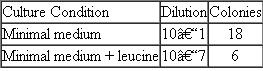 What is the rate of mutation at the locus associated with leucine biosynthesis?
What is the rate of mutation at the locus associated with leucine biosynthesis? Question
Presented here are hypothetical findings from studies of heterokaryons formed from seven human xeroderma pigmentosum cell strains:
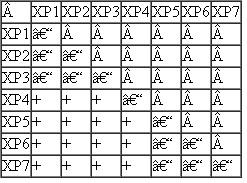 Note: + = complementation; - = no complementation
These data are measurements of the occurrence or nonoccurrence of unscheduled DNA synthesis in the fused heterokaryon. None of the strains alone shows any unscheduled DNA synthesis. Which strains fall into the same complementation groups? How many different groups are revealed based on these data? What can we conclude about the genetic basis of XP from these data?
Note: + = complementation; - = no complementationThese data are measurements of the occurrence or nonoccurrence of unscheduled DNA synthesis in the fused heterokaryon. None of the strains alone shows any unscheduled DNA synthesis. Which strains fall into the same complementation groups? How many different groups are revealed based on these data? What can we conclude about the genetic basis of XP from these data?
Question
Question
Question
Question
Among Betazoids in the world of Star Trek ® , the ability to read minds is under the control of a gene called mindreader (abbreviated mr ). Most Betazoids can read minds, but rare recessive mutations in the mr gene result in two alternative phenotypes: delayed-receivers and insensitives. Delayed-receivers have some mind-reading ability but perform the task much more slowly than normal Betazoids. Insensitives cannot read minds at all. Betazoid genes do not have introns, so the gene only contains coding DNA. It is 3332 nucleotides in length, and Betazoids use a four-letter genetic code.
The following table shows some data from five unrelated mr mutations.
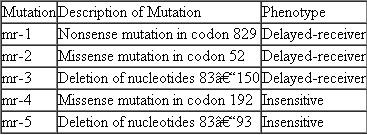 For each mutation, provide a plausible explanation for why it gives rise to its associated phenotype and not to the other phenotype. For example, hypothesize why the mr-1 nonsense mutation in codon 829 gives rise to the milder delayed-receiver phenotype rather than the more severe insensitive phenotype. Then repeat this type of analysis for the other mutations. (More than one explanation is possible, so be creative within plausible bounds!)
The following table shows some data from five unrelated mr mutations.
For each mutation, provide a plausible explanation for why it gives rise to its associated phenotype and not to the other phenotype. For example, hypothesize why the mr-1 nonsense mutation in codon 829 gives rise to the milder delayed-receiver phenotype rather than the more severe insensitive phenotype. Then repeat this type of analysis for the other mutations. (More than one explanation is possible, so be creative within plausible bounds!) Question
Skin cancer carries a lifetime risk nearly equal to that of all other cancers combined. Following is a graph (modified from Kraemer, 1997. Proc. Natl. Acad. Sci. (USA) 94: 11-14) depicting the age of onset of skin cancers in patients with or without XP, where the cumulative percentage of skin cancer is plotted against age. The non-XP curve is based on 29,757 cancers surveyed by the National Cancer Institute, and the curve representing those with XP is based on 63 skin cancers from the Xeroderma Pigmentosum Registry.
(a) Provide an overview of the information contained in the graph.
(b) Explain why individuals with XP show such an early age of onset.
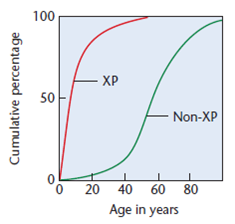
(a) Provide an overview of the information contained in the graph.
(b) Explain why individuals with XP show such an early age of onset.
Question
Question
Question
Question
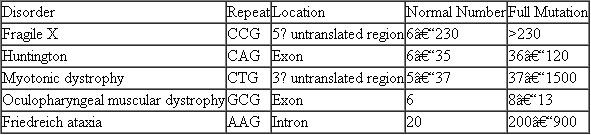
A variety of neural and muscular disorders are associated with expansions of trinucleotide repeat sequences. The table below lists several disorders, the repeat motifs, their locations, the normal number of repeats, and the number of repeats in the full mutations.
(a) Most disorders attributable to trinucleotide repeats result from expansion of the repeats. Two mechanisms are often proposed to explain repeat expansion: (1) unequal synapsis and crossing over and (2) errors in DNA replication where single-stranded, base-paired loops are formed that conflict with linear replication. Present a simple sketch of each mechanism.
(b) Notice that some of the repeats occur in areas of the gene that are not translated. How can a mutation occur if the alteration is not reflected in an altered amino acid sequence?
(c) In the two cases where the repeat expansions occur in exons, the extent of expansion is considerably less than when the expansion occurs outside exons. Present an explanation for this observation.
(a) Most disorders attributable to trinucleotide repeats result from expansion of the repeats. Two mechanisms are often proposed to explain repeat expansion: (1) unequal synapsis and crossing over and (2) errors in DNA replication where single-stranded, base-paired loops are formed that conflict with linear replication. Present a simple sketch of each mechanism.
(b) Notice that some of the repeats occur in areas of the gene that are not translated. How can a mutation occur if the alteration is not reflected in an altered amino acid sequence?
(c) In the two cases where the repeat expansions occur in exons, the extent of expansion is considerably less than when the expansion occurs outside exons. Present an explanation for this observation.

Unlock Deck
Sign up to unlock the cards in this deck!
Unlock Deck
Unlock Deck
1/37

Play

Full screen (f)
Deck 15: Gene Mutation, Dna Repair, and
1
Seven months pregnant, an expectant mother was undergoing a routine ultrasound. While prior tests had been normal, this one showed that the limbs of the fetus were unusually short. The doctor suspected that the baby might have a genetic form of dwarfism called achondroplasia. He told her that the disorder was due to an autosomal dominant mutation and occurred with a frequency of about 1 in 25,000 births. The expectant mother had studied genetics in college and immediately raised several questions. How would you answer them?
How could her baby have a dominantly inherited disorder if there was no history of this condition on either side of the family?
How could her baby have a dominantly inherited disorder if there was no history of this condition on either side of the family?
Only one copy of a gene needs to be mutated to express the mutant phenotype in an autosomal dominant mutation. However, autosomal dominant mutations can exhibit incomplete penetrance. Penetrance is the proportion of individuals with a particular mutation that express the mutant phenotype. Therefore, carriers of the mutant allele in the family did not express the mutant phenotype (i.e. achondroplasia).
Also, both parents could be heterozygous for the dominant allele (Aa) and the child homozygous (AA). Whereas the parents showed incomplete dominance from the one mutant allele, the child received both mutant alleles and expressed the mutant phenotype.
Lastly, a mutation in the FGFR3 gene, which is a cause of achondroplasia, could have arisen spontaneously in the child to produce the disease.
Also, both parents could be heterozygous for the dominant allele (Aa) and the child homozygous (AA). Whereas the parents showed incomplete dominance from the one mutant allele, the child received both mutant alleles and expressed the mutant phenotype.
Lastly, a mutation in the FGFR3 gene, which is a cause of achondroplasia, could have arisen spontaneously in the child to produce the disease.
2
In this chapter, we focused on how gene mutations arise and how cells repair DNA damage. At the same time, we found opportunities to consider the methods and reasoning by which much of this information was acquired. From the explanations given in the chapter,
(a) How do we know that mutations occur spontaneously?
(b) How do we know that certain chemicals and wavelengths of radiation induce mutations in DNA?
(c) How do we know that DNA repair mechanisms detect and correct the majority of spontaneous and induced mutations?
(a) How do we know that mutations occur spontaneously?
(b) How do we know that certain chemicals and wavelengths of radiation induce mutations in DNA?
(c) How do we know that DNA repair mechanisms detect and correct the majority of spontaneous and induced mutations?
(a)Many experiments and natural observations show that mutations can be induced by a variety of agents. However, many other mutations arise from unknown causes and are unable to be traced to inherited mutations in families. From this knowledge, it can be concluded that mutations arise spontaneously. Experiments have proved mutations arise spontaneously and our increased knowledge of molecular biology (particularly deoxyribonucleic acid (DNA) replication and repair) has further confirmed these observations.
(b)
Experimental studies are crucial in confirming that certain agents can induce mutations in DNA. If an agent is suspected to be mutagenic, the Ames test is an effective method to determine this hypothesis. In the Ames test, bacterial cells are exposed to a mutagen and will only grow in a selective media if mutations have occurred.
However, many mutagens are identified by the unfortunate observation of tumor development in individuals exposed to seemingly innocuous chemicals or radiation. Epidemiological studies that follow certain populations exposed to a particular chemical, such as benzene exposure in industrial workers, are useful in identifying mutagens.
(c)
Molecular studies have identified a host of proofreading and repair mechanisms that correct mutations in DNA. Repair mechanisms have been conserved throughout evolution and without them, survival of a species would be greatly diminished. In addition, with errors in DNA synthesis and replication and the presence of environmental mutagens, it would be expected that organisms would develop a variety of mechanisms to combat DNA damage.
(b)
Experimental studies are crucial in confirming that certain agents can induce mutations in DNA. If an agent is suspected to be mutagenic, the Ames test is an effective method to determine this hypothesis. In the Ames test, bacterial cells are exposed to a mutagen and will only grow in a selective media if mutations have occurred.
However, many mutagens are identified by the unfortunate observation of tumor development in individuals exposed to seemingly innocuous chemicals or radiation. Epidemiological studies that follow certain populations exposed to a particular chemical, such as benzene exposure in industrial workers, are useful in identifying mutagens.
(c)
Molecular studies have identified a host of proofreading and repair mechanisms that correct mutations in DNA. Repair mechanisms have been conserved throughout evolution and without them, survival of a species would be greatly diminished. In addition, with errors in DNA synthesis and replication and the presence of environmental mutagens, it would be expected that organisms would develop a variety of mechanisms to combat DNA damage.
3
Seven months pregnant, an expectant mother was undergoing a routine ultrasound. While prior tests had been normal, this one showed that the limbs of the fetus were unusually short. The doctor suspected that the baby might have a genetic form of dwarfism called achondroplasia. He told her that the disorder was due to an autosomal dominant mutation and occurred with a frequency of about 1 in 25,000 births. The expectant mother had studied genetics in college and immediately raised several questions. How would you answer them?
Is the mutation more likely to have come from the mother or the father?
Is the mutation more likely to have come from the mother or the father?
Across populations for an autosomal dominant mutation, the proportion of affected males is equal to affected females. Inheritance patterns of autosomal mutations are not influenced by sex, that is, they are not tied to sex chromosomes like X-linked mutations. Therefore, there is an equal chance that the child received the diseased allele from the mother or father.
It's also possible that both parents passed the disease allele to the child. Both parents could have been heterozygous for the dominant allele and exhibited incomplete dominance. The child may have received both mutant alleles (homozygous) from each parent, resulting in expression of the mutant phenotype.
It's also possible that both parents passed the disease allele to the child. Both parents could have been heterozygous for the dominant allele and exhibited incomplete dominance. The child may have received both mutant alleles (homozygous) from each parent, resulting in expression of the mutant phenotype.
4
Review the Chapter Concepts list. These concepts relate to how gene mutations occur, their phenotypic effects, and how mutations can be repaired. The first four concepts focus on the effects of gene mutations in diploid organisms. Write a short essay describing how these concepts would apply, or not apply, to a haploid organism such as E. coli.
Chapter Concepts
▪Mutations comprise any change in the base-pair sequence of DNA.
▪Mutations are a source of genetic variation and provide the raw material for natural selection. They are also the source of genetic damage that contributes to cell death, genetic diseases, and cancer.
▪Mutations have a wide range of effects on organisms depending on the type of base-pair alteration, the location of the mutation within the chromosome, and the function of the affected gene product.
▪Mutations can occur spontaneously as a result of natural biological and chemical processes, or they can be induced by external factors, such as chemicals or radiation.
▪Single-gene mutations cause a wide variety of human diseases.
▪Organisms rely on a number of DNA repair mechanisms to counteract mutations. These mechanisms range from proofreading and correction of replication errors to base excision and homologous recombination repair.
▪Mutations in genes whose products control DNA repair lead to genome hypermutability, human DNA repair diseases, and cancers.
▪Transposable elements may move into and out of chromosomes, causing chromosome breaks and inducing mutations both within coding regions and in gene-regulatory regions.
Chapter Concepts
▪Mutations comprise any change in the base-pair sequence of DNA.
▪Mutations are a source of genetic variation and provide the raw material for natural selection. They are also the source of genetic damage that contributes to cell death, genetic diseases, and cancer.
▪Mutations have a wide range of effects on organisms depending on the type of base-pair alteration, the location of the mutation within the chromosome, and the function of the affected gene product.
▪Mutations can occur spontaneously as a result of natural biological and chemical processes, or they can be induced by external factors, such as chemicals or radiation.
▪Single-gene mutations cause a wide variety of human diseases.
▪Organisms rely on a number of DNA repair mechanisms to counteract mutations. These mechanisms range from proofreading and correction of replication errors to base excision and homologous recombination repair.
▪Mutations in genes whose products control DNA repair lead to genome hypermutability, human DNA repair diseases, and cancers.
▪Transposable elements may move into and out of chromosomes, causing chromosome breaks and inducing mutations both within coding regions and in gene-regulatory regions.
Unlock Deck
Unlock for access to all 37 flashcards in this deck.
Unlock Deck
k this deck
5
Seven months pregnant, an expectant mother was undergoing a routine ultrasound. While prior tests had been normal, this one showed that the limbs of the fetus were unusually short. The doctor suspected that the baby might have a genetic form of dwarfism called achondroplasia. He told her that the disorder was due to an autosomal dominant mutation and occurred with a frequency of about 1 in 25,000 births. The expectant mother had studied genetics in college and immediately raised several questions. How would you answer them?
If this child has achondroplasia, is there an increased chance that their next child would also have this disorder?
If this child has achondroplasia, is there an increased chance that their next child would also have this disorder?
Unlock Deck
Unlock for access to all 37 flashcards in this deck.
Unlock Deck
k this deck
6
What is a spontaneous mutation, and why are spontaneous mutations rare?
Unlock Deck
Unlock for access to all 37 flashcards in this deck.
Unlock Deck
k this deck
7
Seven months pregnant, an expectant mother was undergoing a routine ultrasound. While prior tests had been normal, this one showed that the limbs of the fetus were unusually short. The doctor suspected that the baby might have a genetic form of dwarfism called achondroplasia. He told her that the disorder was due to an autosomal dominant mutation and occurred with a frequency of about 1 in 25,000 births. The expectant mother had studied genetics in college and immediately raised several questions. How would you answer them?
Could this disorder have been caused by X rays or ultrasounds she had earlier in pregnancy?
Could this disorder have been caused by X rays or ultrasounds she had earlier in pregnancy?
Unlock Deck
Unlock for access to all 37 flashcards in this deck.
Unlock Deck
k this deck
8
Why would a mutation in a somatic cell of a multicellular organism escape detection?
Unlock Deck
Unlock for access to all 37 flashcards in this deck.
Unlock Deck
k this deck
9
Most mutations are thought to be deleterious. Why, then, is it reasonable to state that mutations are essential to the evolutionary process?
Unlock Deck
Unlock for access to all 37 flashcards in this deck.
Unlock Deck
k this deck
10
Why is a random mutation more likely to be deleterious than beneficial?
Unlock Deck
Unlock for access to all 37 flashcards in this deck.
Unlock Deck
k this deck
11
Most mutations in a diploid organism are recessive. Why?
Unlock Deck
Unlock for access to all 37 flashcards in this deck.
Unlock Deck
k this deck
12
What is meant by a conditional mutation?
Unlock Deck
Unlock for access to all 37 flashcards in this deck.
Unlock Deck
k this deck
13
Describe a tautomeric shift and how it may lead to a mutation.
Unlock Deck
Unlock for access to all 37 flashcards in this deck.
Unlock Deck
k this deck
14
Contrast and compare the mutagenic effects of deaminating agents, alkylating agents, and base analogs.
Unlock Deck
Unlock for access to all 37 flashcards in this deck.
Unlock Deck
k this deck
15
Acridine dyes induce frameshift mutations. Why are frame-shift mutations likely to be more detrimental than point mutations, in which a single pyrimidine or purine has been substituted?
Unlock Deck
Unlock for access to all 37 flashcards in this deck.
Unlock Deck
k this deck
16
Why are X rays more potent mutagens than UV radiation?
Unlock Deck
Unlock for access to all 37 flashcards in this deck.
Unlock Deck
k this deck
17
DNA damage brought on by a variety of natural and artificial agents elicits a wide variety of cellular responses involving numerous signaling pathways. In addition to the activation of DNA repair mechanisms, there can be activation of pathways leading to apoptosis (programmed cell death) and cell-cycle arrest. Why would apoptosis and cell-cycle arrest often be part of a cellular response to DNA damage?
Unlock Deck
Unlock for access to all 37 flashcards in this deck.
Unlock Deck
k this deck
18
Contrast the various types of DNA repair mechanisms known to counteract the effects of UV radiation. What is the role of visible light in repairing UV-induced mutations?
Unlock Deck
Unlock for access to all 37 flashcards in this deck.
Unlock Deck
k this deck
19
Mammography is an accurate screening technique for the early detection of breast cancer in humans. Because this technique uses X rays diagnostically, it has been highly controversial. Can you explain why? What reasons justify the use of X rays for such a medical screening technique?
Unlock Deck
Unlock for access to all 37 flashcards in this deck.
Unlock Deck
k this deck
20
A significant number of mutations in the HBB gene that cause human ? -thalassemia occur within introns or in upstream noncoding sequences. Explain why mutations in these regions often lead to severe disease, although they may not directly alter the coding regions of the gene.
Unlock Deck
Unlock for access to all 37 flashcards in this deck.
Unlock Deck
k this deck
21
Describe how the Ames test screens for potential environmental mutagens. Why is it thought that a compound that tests positively in the Ames test may also be carcinogenic?
Unlock Deck
Unlock for access to all 37 flashcards in this deck.
Unlock Deck
k this deck
22
What genetic defects result in the disorder xeroderma pigmentosum (XP) in humans? How do these defects create the phenotypes associated with the disorder?
Unlock Deck
Unlock for access to all 37 flashcards in this deck.
Unlock Deck
k this deck
23
Compare several transposable elements in bacteria, maize, Drosophila , and humans. What properties do they share?
Unlock Deck
Unlock for access to all 37 flashcards in this deck.
Unlock Deck
k this deck
24
Speculate on how improved living conditions and medical care in the developed nations might affect human mutation rates, both neutral and deleterious.
Unlock Deck
Unlock for access to all 37 flashcards in this deck.
Unlock Deck
k this deck
25
In maize, a Ds or Ac transposon can cause mutations in genes at or near the site of transposon insertion. It is possible for these elements to transpose away from their original site, causing a reversion of the mutant phenotype. In some cases, however, even more severe phenotypes appear, due to events at or near the mutant allele. What might be happening to the transposon or the nearby gene to create more severe mutations?
Unlock Deck
Unlock for access to all 37 flashcards in this deck.
Unlock Deck
k this deck
26
It is estimated that about 0.2 percent of human mutations are due to transposon insertions, and a much higher degree of mutational damage is known to occur in some other organisms. In what way might transposons contribute positively to evolution?
Unlock Deck
Unlock for access to all 37 flashcards in this deck.
Unlock Deck
k this deck
27
In a bacterial culture in which all cells are unable to synthesize leucine ( leu - ), a potent mutagen is added, and the cells are allowed to undergo one round of replication. At that point, samples are taken, a series of dilutions is made, and the cells are plated on either minimal medium or minimal medium containing leucine. The first culture condition (minimal medium) allows the growth of only leu + cells, while the second culture condition (minimal medium with leucine added) allows growth of all cells. The results of the experiment are as follows:
What is the rate of mutation at the locus associated with leucine biosynthesis?
What is the rate of mutation at the locus associated with leucine biosynthesis? Unlock Deck
Unlock for access to all 37 flashcards in this deck.
Unlock Deck
k this deck
28
Presented here are hypothetical findings from studies of heterokaryons formed from seven human xeroderma pigmentosum cell strains:
Note: + = complementation; - = no complementation
These data are measurements of the occurrence or nonoccurrence of unscheduled DNA synthesis in the fused heterokaryon. None of the strains alone shows any unscheduled DNA synthesis. Which strains fall into the same complementation groups? How many different groups are revealed based on these data? What can we conclude about the genetic basis of XP from these data?
Note: + = complementation; - = no complementationThese data are measurements of the occurrence or nonoccurrence of unscheduled DNA synthesis in the fused heterokaryon. None of the strains alone shows any unscheduled DNA synthesis. Which strains fall into the same complementation groups? How many different groups are revealed based on these data? What can we conclude about the genetic basis of XP from these data?
Unlock Deck
Unlock for access to all 37 flashcards in this deck.
Unlock Deck
k this deck
29
Imagine yourself as one of the team of geneticists who launches a study of the genetic effects of high-energy radiation on the surviving Japanese population immediately following the atom bomb attacks at Hiroshima and Nagasaki in 1945. Demonstrate your insights into both chromosomal and gene mutation by outlining a short-term and long-term study that addresses these radiation effects. Be sure to include strategies for considering the effects on both somatic and germ-line tissues.
Unlock Deck
Unlock for access to all 37 flashcards in this deck.
Unlock Deck
k this deck
30
With the knowledge that radiation causes mutations, many assume that human-made forms of radiation are the major contributors to the mutational load in humans. What evidence suggests otherwise?
Unlock Deck
Unlock for access to all 37 flashcards in this deck.
Unlock Deck
k this deck
31
Human equivalents of bacterial DNA mismatch repair proteins are subject to mutational damage just as are other proteins. What evidence indicates that mutations in human DNA mismatch repair genes are related to certain forms of cancer?
Unlock Deck
Unlock for access to all 37 flashcards in this deck.
Unlock Deck
k this deck
32
Among Betazoids in the world of Star Trek ® , the ability to read minds is under the control of a gene called mindreader (abbreviated mr ). Most Betazoids can read minds, but rare recessive mutations in the mr gene result in two alternative phenotypes: delayed-receivers and insensitives. Delayed-receivers have some mind-reading ability but perform the task much more slowly than normal Betazoids. Insensitives cannot read minds at all. Betazoid genes do not have introns, so the gene only contains coding DNA. It is 3332 nucleotides in length, and Betazoids use a four-letter genetic code.
The following table shows some data from five unrelated mr mutations.
For each mutation, provide a plausible explanation for why it gives rise to its associated phenotype and not to the other phenotype. For example, hypothesize why the mr-1 nonsense mutation in codon 829 gives rise to the milder delayed-receiver phenotype rather than the more severe insensitive phenotype. Then repeat this type of analysis for the other mutations. (More than one explanation is possible, so be creative within plausible bounds!)
The following table shows some data from five unrelated mr mutations.
For each mutation, provide a plausible explanation for why it gives rise to its associated phenotype and not to the other phenotype. For example, hypothesize why the mr-1 nonsense mutation in codon 829 gives rise to the milder delayed-receiver phenotype rather than the more severe insensitive phenotype. Then repeat this type of analysis for the other mutations. (More than one explanation is possible, so be creative within plausible bounds!) Unlock Deck
Unlock for access to all 37 flashcards in this deck.
Unlock Deck
k this deck
33
Skin cancer carries a lifetime risk nearly equal to that of all other cancers combined. Following is a graph (modified from Kraemer, 1997. Proc. Natl. Acad. Sci. (USA) 94: 11-14) depicting the age of onset of skin cancers in patients with or without XP, where the cumulative percentage of skin cancer is plotted against age. The non-XP curve is based on 29,757 cancers surveyed by the National Cancer Institute, and the curve representing those with XP is based on 63 skin cancers from the Xeroderma Pigmentosum Registry.
(a) Provide an overview of the information contained in the graph.
(b) Explain why individuals with XP show such an early age of onset.
(a) Provide an overview of the information contained in the graph.
(b) Explain why individuals with XP show such an early age of onset.
Unlock Deck
Unlock for access to all 37 flashcards in this deck.
Unlock Deck
k this deck
34
The initial discovery of IS elements in bacteria revealed the presence of an element upstream (5?) of three genes controlling galactose metabolism. All three genes were affected simultaneously, although there was only one IS insertion. Offer an explanation as to why this might occur.
Unlock Deck
Unlock for access to all 37 flashcards in this deck.
Unlock Deck
k this deck
35
It has been noted that most transposons in humans and other organisms are located in noncoding regions of the genome-regions such as introns, pseudogenes, and stretches of particular types of repetitive DNA. There are several ways to interpret this observation. Describe two possible interpretations. Which interpretation do you favor? Why?
Unlock Deck
Unlock for access to all 37 flashcards in this deck.
Unlock Deck
k this deck
36
Mutations in the IL2RG gene cause approximately 30 percent of severe combined immunodeficiency disorder (SCID) cases. These mutations result in alterations to a protein component of cytokine receptors that are essential for proper development of the immune system. The IL2RG gene is composed of eight exons and contains upstream and downstream sequences that are necessary for proper transcription and translation. Below are some of the mutations observed. For each, explain its likely influence on the IL2RG gene product (assume its length to be 375 amino acids).
(a) Nonsense mutation in coding regions
(b) Insertion in Exon 1, causing frameshift
(c) Insertion in Exon 7, causing frameshift
(d) Missense mutation
(e) Deletion in Exon 2, causing frameshift
(f) Deletion in Exon 2, in frame
(g) Large deletion covering Exons 2 and 3
(a) Nonsense mutation in coding regions
(b) Insertion in Exon 1, causing frameshift
(c) Insertion in Exon 7, causing frameshift
(d) Missense mutation
(e) Deletion in Exon 2, causing frameshift
(f) Deletion in Exon 2, in frame
(g) Large deletion covering Exons 2 and 3
Unlock Deck
Unlock for access to all 37 flashcards in this deck.
Unlock Deck
k this deck
37
A variety of neural and muscular disorders are associated with expansions of trinucleotide repeat sequences. The table below lists several disorders, the repeat motifs, their locations, the normal number of repeats, and the number of repeats in the full mutations.
(a) Most disorders attributable to trinucleotide repeats result from expansion of the repeats. Two mechanisms are often proposed to explain repeat expansion: (1) unequal synapsis and crossing over and (2) errors in DNA replication where single-stranded, base-paired loops are formed that conflict with linear replication. Present a simple sketch of each mechanism.
(b) Notice that some of the repeats occur in areas of the gene that are not translated. How can a mutation occur if the alteration is not reflected in an altered amino acid sequence?
(c) In the two cases where the repeat expansions occur in exons, the extent of expansion is considerably less than when the expansion occurs outside exons. Present an explanation for this observation.
(a) Most disorders attributable to trinucleotide repeats result from expansion of the repeats. Two mechanisms are often proposed to explain repeat expansion: (1) unequal synapsis and crossing over and (2) errors in DNA replication where single-stranded, base-paired loops are formed that conflict with linear replication. Present a simple sketch of each mechanism.
(b) Notice that some of the repeats occur in areas of the gene that are not translated. How can a mutation occur if the alteration is not reflected in an altered amino acid sequence?
(c) In the two cases where the repeat expansions occur in exons, the extent of expansion is considerably less than when the expansion occurs outside exons. Present an explanation for this observation.
Unlock Deck
Unlock for access to all 37 flashcards in this deck.
Unlock Deck
k this deck
Unlock Deck
Unlock for access to all 37 flashcards in this deck.







